periodical issue
Freedom First
By Bertram D. Wolfe, Purshottam Tricumdas, Polemicus, Ernest S. Pisko, K. K. Menon, P.A.P., J. D'Souza, S.J., M. P. T. Acharya
Printed & Published by Narie Oliaji at the Kanada Press, Podar Chambers, 109, Parsi Bazaar St., Fort, Bombay. Issued by the Indian Committee for Cultural Freedom, Maneckjee Wadia Building, 127, Mahatma Gandhi Road, Bombay 1. · Bombay · 1952
12 pages
Freedom First
Summary
This is the October 1952 issue (No. 5) of Freedom First, organ of the Indian Committee for Cultural Freedom, edited from Bombay. In the rendered pages the issue leads with an extended article by the American historian Bertram D. Wolfe, “Soviet Technique of Historiography,” which dissects how Stalinist historiography retroactively rewrites the past — purging figures (Trotsky, Bukharin, Pokrovsky), rewriting textbooks, inflating the Stalin cult, and using history as a political weapon; the piece is marked “To be continued” and is incomplete in this rendered chunk. Also included are an unsigned “Notes” column commenting on the Fischer-Radhakrishnan controversy over free speech for foreign visitors, an obituary of Gandhian thinker K. G. Mashruwala, a note on General Naguib’s Egypt, and an expose of the Communist-front “International Student Relief” organisation; a first-hand report by Purshottam Tricumdas on the International Congress of Jurists held in Berlin (25-31 July 1952), which investigated rule-of-law violations in East Germany and debated “The Right to Resist” totalitarianism; a book review section covering Walter Kolarz’s Russia and Her Colonies, Louis Fischer’s The Life and Death of Stalin, a Socialist Union pamphlet on the principles of socialism, and Aneurin Bevan’s In Place of Fear; a reader’s letter praising Jayaprakash Narayan’s essay “Incentives for Goodness”; a compilation of press clippings titled “With Many Voices”; and a short note, “Stalin’s Annual Income,” by M. P. T. Acharya. The volume’s argumentative center, in the rendered pages, is anti-totalitarian and anti-Communist: exposing Soviet propaganda techniques, defending civil liberties and free expression, and cataloguing Communist front organisations and Eastern Bloc repression.
Key points
-
Bertram D. Wolfe’s “Soviet Technique Of Historiography” (part one) argues that Soviet history-writing serves as a political weapon, purging disfavoured figures such as Trotsky, Bukharin and the historian M. N. Pokrovsky into “unpersons.”
-
The “Notes” section defends Louis Fischer’s right to criticise Vice-President Radhakrishnan, eulogises Gandhian thinker K. G. Mashruwala, praises General Naguib’s Egyptian land reform, and exposes “International Student Relief” as a Communist front rivalling the genuine World University Service.
-
Purshottam Tricumdas reports on the International Congress of Jurists in Berlin, which documented East German rule-of-law violations including the abduction of lawyer Dr. Linse, and describes his unsuccessful push to broaden the Congress’s condemnation to South Africa, Tunisia and Algeria.
-
A review section covers Walter Kolarz’s “Russia and Her Colonies” on Soviet suppression of non-Russian nationalities, Louis Fischer’s “The Life and Death of Stalin,” a Socialist Union pamphlet regrounding British socialism in ethical values, and Aneurin Bevan’s “In Place of Fear,” praised for its critique of laissez-faire capitalism but faulted for naivety about Soviet intentions.
-
A reader’s letter from J. D’Souza, S.J. praises Jayaprakash Narayan’s “Incentives for Goodness” as a welcome return to the spiritual foundations of Indian culture.
-
M. P. T. Acharya’s short note, “Stalin’s Annual Income,” itemises Stalin’s stated official earnings at roughly one million roubles a year.
Essays
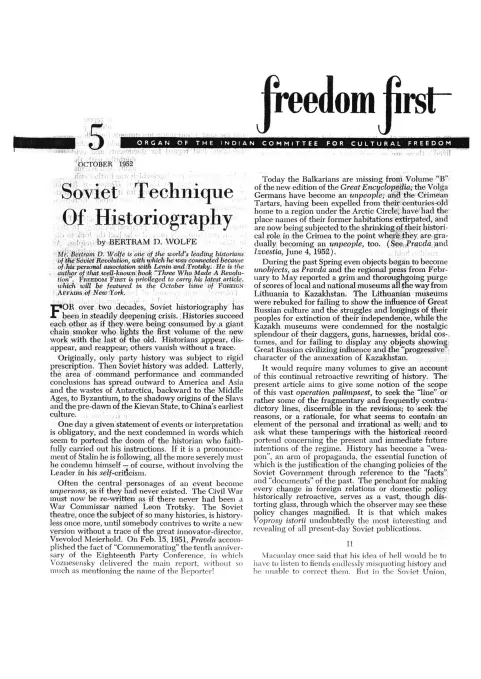
Soviet Technique Of Historiography
By Bertram D. Wolfe
Bertram D. Wolfe’s “Soviet Technique of Historiography” argues that Soviet history-writing has become an instrument of political control rather than a scholarly discipline. Wolfe traces the process by which historians, texts, and even museum exhibits are continually revised to match the Communist Party’s shifting political line, with disfavoured figures (Trotsky, Bukharin, and the historian M. N. Pokrovsky among them) turned into “unpersons” and erased from the record. He shows how Stalin personally directed this rewriting from the 1920s onward, backdating his relationship with Lenin, eliminating Trotsky from accounts of the Revolution and Civil War, and eventually dictating the falsified History of the Communist Party: Short Course. The piece (marked “To be continued” at the end of the rendered pages) frames Soviet historiography as a form of Orwellian control over the present through control of the past.
- Soviet historiography is described as being in continual crisis, with histories and historians alternately promoted and purged to match the Party line.
- Whole nationalities (Volga Germans, Crimean Tartars) are said to be turned into ‘unpeoples’ in the new Great Encyclopedia and in museum displays.
- The historian M. N. Pokrovsky is presented as a case study: dominant in the 1920s, praised by Lenin, then posthumously purged in 1934 for ‘anti-national’ and ‘anti-Marxist’ deviations.
- Stalin is shown personally revising the historical record of his relationship to Lenin, backdating claims to leadership and inserting fabricated ‘prophecies’ into his own collected works.
- The duality-unity ‘Lenin-Trotsky’ is described as forcibly replaced by ‘Lenin-Stalin’ in the historical record, with associated books and documents destroyed or ‘corrected’.
- Wolfe frames history as a ‘weapon’ of Soviet propaganda whose function is to retroactively justify current policy changes.
- The article quotes Orwell’s formula (‘Who controls the present, controls the past’) as summing up Stalin’s attitude toward history.
Notes (Fischer & Radhakrishnan; K. G. Mashruwala; Egypt; Trojan Horse)
An unsigned ‘Notes’ column covers four short items: it defends Louis Fischer’s right as a foreign visitor to criticise Indian Vice-President Radhakrishnan’s remarks, arguing that free comment by visiting publicists should not be treated as a ‘witch hunt’ while similar criticism of foreign governments by Indians goes unremarked; it mourns the death of Gandhian thinker K. G. Mashruwala, editor of Harijan and a leading interpreter of Gandhi’s thought; it comments favourably on General Naguib’s reformist coup government in Egypt, particularly a land reform bill; and it exposes ‘International Student Relief’ as a Communist front organisation, a rival to the genuine World University Service, run by the Communist-controlled International Union of Students from Prague.
- Defends Louis Fischer’s right to criticise Vice-President Radhakrishnan’s remarks as a matter of free expression for foreign visitors.
- Accuses certain Indian commentators of applying a double standard on criticism of foreign vs domestic governments.
- Eulogises K. G. Mashruwala as a philosopher of Gandhism and successor to Gandhi as editor of Harijan.
- Praises General Naguib’s Egyptian government for land reform limiting holdings to about 200 acres.
- Identifies ‘International Student Relief’ (I.S.R.) as a Communist front set up by the Communist-controlled International Union of Students (I.U.S.) to rival the genuine World University Service.
International Congress Of Jurists—Berlin, 25th July–31st July 1952
By Purshottam Tricumdas
Purshottam Tricumdas reports on the International Congress of Jurists held in Berlin, 25-31 July 1952, convened by an Investigating Committee of West German lawyers under Dr. Friedenau and sponsored by the Federal Minister of Justice and Berlin’s Mayor Dr. Reuter. The Congress, attended by about 150 delegates from 45 countries, documented flagrant violations of law and torture in East Germany, including the kidnapping of lawyer Dr. Linse by East German agents. Tricumdas describes his own push to broaden the Congress’s scope to condemn human-rights violations everywhere (South Africa, Tunisia, Algeria) rather than only in the Iron Curtain countries, an effort that was diluted by the Congress’s decision to limit itself to a factual report. The piece (continued from page 5 to page 12 in this chunk) concludes with an account of a session on ‘The Right to Resist’ totalitarianism, in which Tricumdas argued civil disobedience might be a viable mode of resistance even against ruthless regimes, and closes with tribute to Dr. Friedenau, Dr. Linse, and other German lawyers facing the totalitarian threat.
- The Congress was convened by West German lawyers investigating rule-of-law violations in East Germany, including torture and the abduction of lawyer Dr. Linse by East German agents.
- About 150 delegates from 45 countries attended, including judges from Japan, Canada, and several Asian and South American nations.
- Tricumdas pushed unsuccessfully for the Congress to unequivocally condemn human rights violations everywhere, including South Africa, Tunisia, and Algeria, not just in Iron Curtain states.
- The Congress ultimately limited itself to a factual report on East Germany rather than asserting general human-rights principles.
- A session on ‘The Right to Resist’ debated whether civil disobedience could be effective against a ruthless totalitarian police state.
- Tricumdas closes with tribute to Dr. Friedenau and Dr. Linse for their courage against the East German regime.
Review: Russia and her Colonies (by Walter Kolarz)
By Polemicus
The ‘Review’ section carries four signed book notices. ‘Polemicus’ reviews Walter Kolarz’s Russia and Her Colonies, praising its documentation (drawn almost exclusively from Soviet sources) of how Soviet nationalities policy has suppressed genuine national aspirations under a facade of solving the nationalities problem, driven by Russian chauvinism under Stalin. Ernest S. Pisko (reprinted from the Christian Science Monitor) reviews Louis Fischer’s The Life and Death of Stalin as a brilliant, readable psychological and historical portrait of Stalin. K. K. Menon reviews the Socialist Union pamphlet Socialism: A New Statement of Principles, a British Labour Party group’s rethinking of socialist ideals around ethical values rather than pure economic determinism. ‘P.A.P.’ reviews Aneurin Bevan’s In Place of Fear, praising its attack on laissez-faire capitalism but faulting Bevan’s naive faith in Soviet intentions in foreign policy.
- Kolarz’s book is said to explode the myth that the USSR has solved its nationalities problem, showing Stalin-era Russification and suppression of non-Russian cultures.
- Fischer’s Stalin biography is praised for combining biography with a broader analysis of Soviet history from 1917 onward.
- The Socialist Union pamphlet is described as re-grounding British socialism in ethical values rather than mechanical economic determinism, in reaction to the failures of Soviet collectivism.
- Bevan’s In Place of Fear is praised for its critique of laissez-faire capitalism as unscientific and immoral, but criticised for a naive view of Soviet intentions in international affairs.
Review: The Life and Death of Stalin (by Louis Fischer)
By Ernest S. Pisko
A letter to the editors from J. D’Souza, S.J., Director of the Indian Institute of Social Order, Poona, praises Jayaprakash Narayan’s September article “Incentives for Goodness,” which argued that materialism cannot provide an incentive for individual and social goodness. D’Souza reads Narayan’s essay as a welcome return to the spiritual foundations of Indian culture and a critique of the determinism underlying both Marxism and secular humanism.
- D’Souza congratulates the editors on publishing Jayaprakash Narayan’s September article ‘Incentives for Goodness.’
- He reads Narayan’s essay as arguing that individual and social good cannot be secured on a materialist creed.
- D’Souza frames Narayan’s position as a revolt against materialism on moral grounds, rooted in the spiritual foundations of Indian culture.
- He expresses hope that Narayan’s philosophical quest will continue along these lines, invoking the maxim ‘Know Thyself.‘
Review: Socialism: A New Statement of Principles
By K. K. Menon
“With Many Voices” is a compilation of short press clippings from various publications (Hindustan Times, United Nations World, Times of India, Bharat Jyoti), prefaced by a Tennyson epigraph, covering items such as a new Soviet propaganda song about Stalin, V. K. Krishna Menon’s dismissal of India’s birth-rate as a concern, an East Berlin art exhibition praising Soviet industrial paintings previously shown under Hitler, a UN World prediction (borne out by Pravda) that Moscow would frame Eisenhower’s candidacy as a Democratic ruse, the Geneva Universal Copyright Convention signed by 35 nations including India, Eisenhower’s pledge to appoint a Black cabinet member if elected, and Henry Wallace’s admission that he was wrong about Soviet intentions regarding the Cold War.
- Reports a new Soviet propaganda song, ‘The great Stalin is leading us to Communism,’ tied to the new five-year plan.
- Quotes V. K. Krishna Menon dismissing concern about India’s birth-rate as ‘utter nonsense.’
- Notes a Soviet-zone art exhibition praising a painting that had earlier been shown under a Hitler-patronised exhibition with a different title.
- Highlights a Universal Copyright Convention signed at Geneva by 35 nations including India.
- Quotes Eisenhower’s pledge to appoint a Black cabinet member if elected president.
- Quotes Henry Wallace admitting ‘I was wrong’ about Soviet Communist intentions regarding the Cold War.
Review: In Place of Fear (by Aneurin Bevan)
By P.A.P.
A brief note by M. P. T. Acharya, “Stalin’s Annual Income,” itemises Stalin’s stated official earnings (60,000 roubles as Prime Minister, 60,000 as General Secretary of the Communist Party, 600,000 in book royalties, and 100,000 in expenses for villas and cars provided by the state), plus subsidised goods purchases, totalling roughly one million roubles a year.
- Lists Stalin’s stated income sources: 60,000 roubles as Prime Minister, 60,000 as General Secretary, 600,000 from book royalties, and 100,000 in state-provided expenses.
- Notes Stalin is also given subsidised ‘buying tickets’ allowing him to purchase goods at 80 per cent below price.
- Totals Stalin’s annual income at about one million roubles.
Generated by the v1.5 extraction pipeline. Awaiting editorial review.
Metadata and summary are AI-extracted from the source PDF and reviewed for editorial accuracy. The original work is available via the Read PDF tab above (where present); paragraph-level citation inside the PDF is deferred to a future engagement.