periodical issue
Freedom First
Edited by Zafar Futehally
Printed & Published by Narie Oliaji at the Kanada Press, Podar Chambers, 109, Parsi Bazaar St., Fort, Bombay · Bombay · 1952
12 pages
Freedom First
Summary
This is issue No. 7 of Freedom First (December 1952), the monthly bulletin of the Indian Committee for Cultural Freedom, edited under the banner “Organ of the Indian Committee for Cultural Freedom.” The issue centers on a running debate about whether political parties need an ideology, opened by Philip Spratt’s essay “Priorities” and continued by S. R. Mohan Das’s “Principles And Incidentals,” both responding to prior contributions by Asoka Mehta, Acharya Kripalani, and Rohit Dave. A second debate, “Freedom FIRST?”, stages a direct exchange between Prof. M. L. Dantwala (arguing that hungry populations in under-developed countries are made vulnerable to Communism by material want, not by any deficit of ideals) and M. R. Masani (defending his view that non-material values and human dignity take priority over bread, while insisting both must be pursued together). The issue also carries obituary notes on Benedetto Croce and Chaim Weismann, a note on staged Communist “organised attendance” at rallies (based on a leaked Bulgarian document), commentary on All India Radio’s film-song policy, a review of Woodrow Wyatt’s Southwards from China, a review of a Soviet play (“Sins of the Commissars”) satirizing Communist elite hypocrisy, a piece defending Moral Re-Armament (MRA) against critics from both Communist and traditionalist Indian camps, and reprinted vignettes and quotations from the world press under “With Many Voices” and standalone pieces (“Ferry to Nowhere,” “Bull In A China Shop”) illustrating Cold War themes of totalitarianism, propaganda, and the West’s ideological contest with Communism.
Key points
-
Philip Spratt’s “Priorities” surveys Liberalism, Marxism and Gandhism as ideologies combining an ethical ideal with a self-interested economic theory, and recommends an Indian party stress the ethical ideal over elaborate economic theory.
-
S. R. Mohan Das’s “Principles And Incidentals” dissects what ideology means for a political party, warning that implementing methods can wrongly ossify into first principles themselves.
-
A running “Freedom FIRST?” debate pits Prof. M. L. Dantwala, who argues hunger rather than any deficit of ideals makes India’s poor vulnerable to Communism, against M. R. Masani, who defends the priority of non-material values and dignity while insisting both must be pursued together.
-
An unsigned piece reports on a scandalous Soviet play, “Sins of the Commissars,” which exposed sexual and moral corruption among Communist Party elites despite official denunciation by Pravda and Bolshevik.
-
“M.R.A.” defends the Moral Re-Armament movement’s Bombay visit against both Communist and traditionalist Indian criticism, crediting its meetings with dissolving class distinctions into shared moral equality.
-
“Ferry to Nowhere” and “Bull In A China Shop,” both reprinted from the New York Times, use the plight of a stateless traveller and a bookshop encounter with Soviet delegate Jacob Malik as symbols of Cold War tyranny and censorship.
-
An unsigned review of Woodrow Wyatt’s “Southwards from China” credits Wyatt’s on-the-ground access but faults his neglect of Gandhi’s role in containing Communism on the subcontinent.
Essays
Priorities
By Philip Spratt
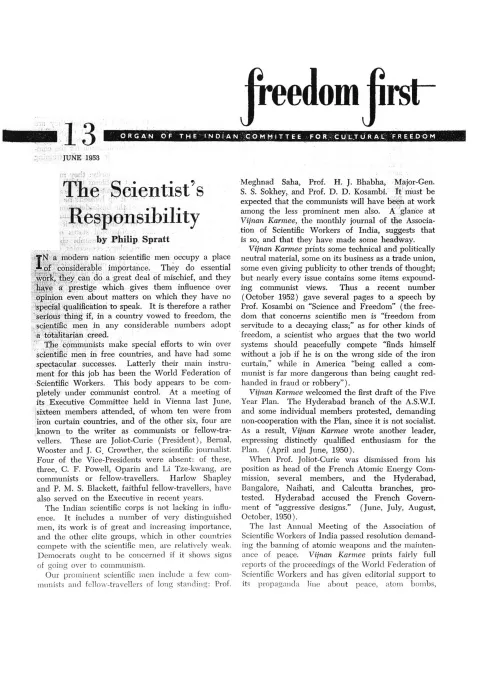
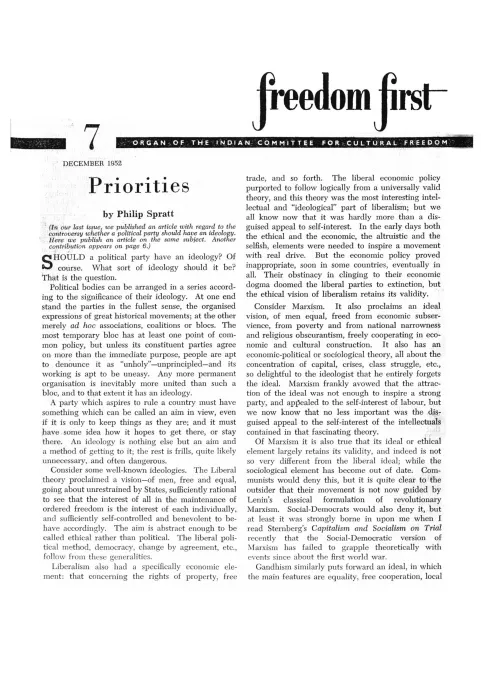
Philip Spratt’s “Priorities” asks whether a political party needs an ideology, and argues that historically parties combine an ethical/utopian ideal with an economic-sociological theory that mostly serves to disguise appeals to self-interest. He surveys Liberalism, Marxism, and Gandhism as case studies, arguing that each movement’s ideal element retains validity even after its economic or sociological theory becomes outdated or is exposed as a rationalized appeal to sectional interest. He concludes that an Indian party seeking success should prioritize a worthy ethical ideal over elaborate economic theory, and should rely on demonstrated truth, hard work, and honest administration rather than sectional appeals.
- Frames ideology as combining an ethical/utopian ideal with an economic or sociological theory.
- Argues Liberalism’s economic theory (property rights, free trade) was largely a disguised appeal to self-interest, though its ethical vision of equality and freedom retains validity.
- Applies the same critique to Marxism, citing Machajski’s fifty-year-old charge that Marxist theory disguises the self-interest of intellectuals.
- Discusses Gandhism as an ideology whose political method (truth and non-violence) is less theoretical than Marxism’s, and whose appeal to national sentiment caused its decline after Independence.
- Recommends that an Indian party stress the abstract ethical ideal, give theory a secondary place, and rely on hard work, honest administration, and the Indian public’s indulgence for lapses.
Notes (Benedetto Croce / Chaim Weismann / Organised Attendance / A. I. R. and Film Songs)
No summary was extracted for this article. Listed for completeness.
Freedom FIRST? — NO, says Prof. M. L. Dantwala
By Prof. M. L. Dantwala
Prof. M. L. Dantwala’s contribution to the “Freedom FIRST?” debate rebuts M. R. Masani’s earlier claim that even impoverished Indian workers would rank freedom above bread. Dantwala argues that in under-developed countries with starving populations, the hungry stomach, not the empty mind, is what makes people vulnerable to Communism — a situation basically different from pre-Communist Czechoslovakia or the present-day United States. He insists this is not an argument against non-material values but a caution against generalizing from a well-fed worker’s stated incentive priorities to the situation of India’s poor, and closes by affirming that man does not live by bread alone but dies without it, and that non-material values should never be made a precondition, especially not one tied to US military or economic aid.
- Directly rebuts Masani’s Freedom First claim that freedom ‘takes priority’ over bread even among India’s poor.
- Distinguishes India’s situation (mass hunger) from Czechoslovakia pre-1948 and the contemporary United States.
- Warns against a ‘simple statistical error’ of projecting the preferences of the well-fed onto the starving.
- Argues American aid should be accepted as an ally against poverty, not as a quid pro quo tied to ideological allegiance.
- Concludes the fight against hunger must proceed without demanding non-material values as a precondition, trusting good means will produce good ends.
Freedom FIRST? — YES, says M. R. Masani
By M. R. Masani
M. R. Masani’s reply to Dantwala clarifies that he never claimed freedom takes strict priority over bread for India’s poor, but rather that non-material values (traditional ways of life, religion, family, self-respect, dignity) take priority over left-wing intellectuals’ obsession with Soviet-style Five-Year Plans and ‘giantism.’ He reveals his original remarks were a condensation of a Convocation Address delivered at Mount Holyoke College aimed at an American audience, arguing the US should continue giving unconditional material aid to India while seeking a meeting of hearts and minds with Asian peoples, without demanding India abandon neutralism as a condition of aid. He restates that Freedom First’s title reflects Lord Acton’s dictum that liberty is the supreme good, given priority in importance rather than in time, and voices hope that Dantwala will come to share the ideological emphasis Masani places today.
- Denies claiming freedom ‘takes priority’ over bread for India’s poor; clarifies the claim concerned non-material versus ‘giantism’-obsessed intellectual priorities.
- Reveals the original remarks were a condensed Convocation Address given at Mount Holyoke College, addressed to an American audience, not Indian readers.
- Argues the US should keep giving unconditional aid to India without demanding ideological allegiance as quid pro quo.
- Invokes Lord Acton to explain the title ‘Freedom First’ as priority in importance, not chronology.
- Criticizes R.H.S. Crossman’s ‘condescending and offensive attitude’ toward Asian and African peoples and cites his own 1944 book Socialism Reconsidered.
Principles And Incidentals
By S. R. Mohan Das
S. R. Mohan Das’s “Principles And Incidentals” is a philosophical dissection of what ‘ideology’ means for a political party, responding to prior remarks by Asoka Mehta, Acharya Kripalani, and Rohit Dave. He argues that ideology is a continual synthesis of experience, requiring both a fixed base of ‘first principles’ and an evolving, revisable set of implementing methods (‘instruments of engineering’ such as socialization or decentralization). He warns that means can wrongly ossify into ends, using Gandhism’s absolutist rejection of industrialisation and the Indian Socialists’ partial convergence with Gandhian decentralisation (for very different philosophical reasons) as illustrations. He closes by arguing that the merger of the KMPP and the Socialist Party shows agreement on method more than on philosophy, and that a party’s identity ultimately lies in its distinctive instruments for implementing first principles, not in the principles alone.
- Defines ideology as demanding ‘ceaseless investigation’ rather than rigid conclusions, structured around a fixed base of first principles plus evolving implementing methods.
- Distinguishes the Gandhian route to decentralisation (religious/mystic, anti-material) from the ultra-secular Socialists’ route (materialist, secular) despite surface agreement.
- Uses the KMPP-Socialist Party merger as a case study: agreement on ‘means’/methods without necessarily any philosophical convergence.
- Warns that means (‘socialization,’ ‘decentralization’) risk becoming mistaken for first principles themselves through a feedback/vested-interest dynamic.
- Concludes a party’s identity lies in its distinctive instruments for implementing shared first principles, which must remain elastic and open to revision.
Reviews: Southwards from China (by Woodrow Wyatt)
An unsigned review (a ‘Sunday Times Correspondent’) of Woodrow Wyatt’s Southwards from China (Hodder & Stoughton, London, 1952), an Englishman’s survey of South East Asia since 1945. The review praises Wyatt’s first-hand knowledge from his time as a member of the Parliamentary Delegation to India, personal assistant to Sir Stafford Cripps, and a 1949 tour of Burma, Malaya, Siam, and Indonesia, but criticizes his pro-British-Labour bias for downplaying the role of popular nationalist movements and Gandhi’s influence in defeating Communism in the Indo-Pakistan subcontinent. The reviewer highlights Wyatt’s warnings about Chinese imperialism, his call for UN-backed collective resistance to Communist aggression modeled on Korea, and his emphasis on economic aid via the Colombo Plan, while insisting that the deeper battle against Communism in South East Asia is a ‘trial and test of ideas and ideologies’ that technical assistance alone cannot win.
- Wyatt’s book is framed as the ‘Englishman’s’ counterpart to Michener’s American survey of South East Asia (reviewed in a previous issue).
- The reviewer credits Wyatt’s on-the-ground access (Parliamentary Delegation to India, Assistant to Stafford Cripps, 1949 Asia tour) but faults his neglect of Gandhi and popular nationalist movements in explaining the containment of Communism in India/Pakistan.
- Summarizes Wyatt’s view that French mishandling of Indo-China nationalism has driven nationalists toward Communism.
- Highlights Wyatt’s proposal that UN treat Communist Chinese aggression in South East Asia the same as the Korea invasion, and his call for the US to fund the Colombo Plan alongside Britain.
- The review closes on its own editorial claim that the fight against Communism in the region is a contest of ideologies, not solvable by technical assistance alone.
Plays: Sins Of The Commissars
By a Sunday Times Correspondent
“Sins of the Commissars,” by a Sunday Times Correspondent, reports on a scandalous Soviet play, When We Are Beautiful, by October magazine editor Panfyorov, that depicts sexual and moral corruption among Communist Party elites in Moscow. The piece treats the play, though artistically poor, as sociologically revealing: its plot of adultery and infidelity among party secretaries, trade union officials, and artists exposes the hypocrisy of a supposedly puritanical Soviet elite. It notes the play was denounced by official Party organs Bolshevik and Pravda for giving ‘a wholly misleading impression of life in the U.S.S.R. as a whole,’ and connects this literary scandal to a genuine internal Party crackdown on corruption, embezzlement, and nepotism ahead of the October 5 Party Congress in Moscow.
- Describes Panfyorov’s play When We Are Beautiful as exposing ‘the looseness of sexual morals among the privileged few in modern Russia.’
- Notes official Party organs Bolshevik and Pravda denounced the play for artificially isolating and exaggerating negative aspects of Soviet life.
- Frames the play as sociologically revealing despite being artistically weak.
- Links the literary scandal to a real anti-corruption ‘minor purge’ underway in preparation for the Party Congress convening October 5 in Moscow.
- Highlights the irony that Soviet elites accused of hypocrisy behave, in the reviewer’s telling, ‘like heroes in a cheap semi-pornographic novel.‘
M. R. A.
By Mona
An unsigned piece titled “M.R.A.” (signed MONA) defends the Moral Re-Armament movement’s Bombay visit against cynicism from two camps: Communists and fellow-travellers who attack MRA’s founder Dr. Buchman over an alleged pro-Hitler remark (while ignoring the Soviet-Nazi pact), and cultural snobs who resent a Western movement echoing Gandhian moral ideas. The author credits MRA’s team with genuine sincerity and effective dramatic technique, observes that its meetings dissolve class distinctions between society ladies, businessmen, and the poor into a shared sense of moral and spiritual equality, and argues that if MRA can durably instill the moral revolution Gandhiji embodied, it would be a major contribution to India’s democratic uplift, even if it is ‘old wine in new bottles.’
- Identifies two sources of cynicism toward MRA’s Bombay visit: Communists invoking Buchman’s alleged ‘Thank God for Hitler’ remark, and cultural snobs resenting Western moral instruction echoing Gandhian ideas.
- Notes MRA’s ten days of activity in Bombay drew enthusiasm even from ‘sober and sophisticated men’ and militant trade unionists.
- Observes that MRA meetings at the Taj Ballroom dissolve the ‘ultra-sensitive consciousness of material inequality’ among a socially mixed crowd into a sense of moral and spiritual equality.
- Frames MRA as potentially reinforcing ‘the moral revolution which Gandhiji so effectively lived for.’
- Closes with the metaphor that MRA may be ‘old wine in new bottles’ but the wine’s content (honesty, purity, unselfishness, love) matters more than the bottle.
Ferry to Nowhere
By New York Times (reprint)
“Ferry to Nowhere,” reprinted from the New York Times, recounts the plight of M. P. O’Brien, a stateless Hungarian-American man shuttling for two weeks on a ferry between Macao and Hong Kong because neither Portuguese Macao, British Hong Kong, nor the American consul will admit him. The piece uses his oscillation as a symbol for humanity caught between opposing tyrannies — of the Left and the Right — and for civilization’s fluctuation between peace and war, hope and despair, closing with a wish that he, and by extension all such symbolic ‘passengers,’ find safe harbor.
- Recounts the real predicament of stateless traveller M. P. O’Brien, shuttling between Macao and Hong Kong for two weeks without valid papers.
- No jurisdiction — American, Portuguese, or British — will admit him.
- Uses his situation as an extended metaphor for humanity’s oscillation between the ‘tyranny of the Left and the tyranny of the Right.’
- Draws on Stanley Rich’s Associated Press dispatch as a direct source for O’Brien’s story.
- Closes hoping ‘all ferries come to their slips at last and all the passengers happily disembark.‘
Bull In A China Shop
By David Anderson in New York Times
“Bull In A China Shop,” by David Anderson in the New York Times, narrates a real chance encounter at a Manhattan bookstore between Jacob A. Malik, the retiring Soviet permanent delegate to the United Nations, and Mikhail Koriakov, a Russian-émigré professor of Russian Literature at Fordham University and author of I’ll Never Go Back. Koriakov needles Malik with pointed questions about why Moscow has no bookshop offering international literature the way New York’s Four Continent Book Corporation does, and about Soviet censorship, until an irritated Malik ends the exchange by refusing to talk further, while Koriakov walks away ‘beaming with contentment.’
- Describes an unplanned real encounter between Soviet UN delegate Jacob A. Malik and émigré Professor Mikhail Koriakov at a New York bookstore.
- Koriakov, without revealing his identity as the author of I’ll Never Go Back, presses Malik on the absence of a Moscow bookshop selling foreign literature freely.
- The exchange escalates to censorship and Communist author Maurice Thorez’s book Le Fils du Peuple as the sole French title once available in the Moscow store.
- Malik ends the conversation abruptly, refusing further discussion.
- The piece is framed as a small symbolic victory of open intellectual exchange over Soviet evasiveness.
With Many Voices
“With Many Voices” is a miscellany of short, dated press excerpts and quotations from around the world illustrating Cold War themes: Dr. Frank Buchman comparing walking with Gandhiji to walking with Aristotle; a Singapore ship-captain’s protest over a misreported flag-decoration gesture; East and West Berlin’s rival teenage newspapers both titled ‘The Young World’; John Foster Dulles declaring the colonial system obsolete; commentary on the Peking Peace Conference’s muted references to the Soviet Union; Indian press claims that Communists will never gain power in India due to cultural heritage; C. D. Deshmukh’s remark that Russia contributes nothing to UN assistance programmes; and a London Times editorial on Chinese POWs refusing repatriation.
- Opens with Tennyson’s ‘With Many Voices’ epigraph framing the miscellany.
- Includes Dr. Frank Buchman’s comparison of Gandhiji to Aristotle, and his claim that ‘600 million people who lived in Asia were a deciding factor at the crossroads of the world.’
- Reports on East/West Berlin’s rival ‘Young World’ newspapers and the Western version’s use of rockets to distribute anti-Communist copies behind the Iron Curtain.
- Cites John Foster Dulles calling the colonial system obsolete.
- Quotes C. D. Deshmukh, India’s Finance Minister, stating Russia contributes nothing to UN assistance programmes, and a London Times editorial on Chinese ‘volunteers’ refusing repatriation.
Generated by the v1.5 extraction pipeline. Awaiting editorial review.
Metadata and summary are AI-extracted from the source PDF and reviewed for editorial accuracy. The original work is available via the Read PDF tab above (where present); paragraph-level citation inside the PDF is deferred to a future engagement.