periodical issue
Freedom First
By Aamir Ali, Prof. A. V. Hill, P.A.P., Laeeq Futehally, Keshav Gore
The Indian Committee for Cultural Freedom, 127, Mahatma Gandhi Road, Bombay 1. Printed & published by Nariman Oliaji at Kanada Press, 109 Parsi Bazaar Street, Bombay 1. · Bombay · 1953
12 pages
Freedom First
Summary
This is issue No. 8 (January 1953) of Freedom First, the monthly bulletin of the Indian Committee for Cultural Freedom, affiliated with the Congress for Cultural Freedom and its World Movement for Cultural Freedom. In the rendered pages, the issue opens with an unsigned editorial reproducing the Congress for Cultural Freedom’s appeal to the UN Secretary-General demanding an investigation into the Prague show trial of eleven Communist leaders, framing the trial’s use of antisemitic Zionist accusations as a revival of Nazi-style racial incitement. A ‘Notes’ section covers three items: a tribute to Sane Guruji’s Antar-Bharati movement for inter-cultural exchange, a sharp critique of V. K. Krishna Menon’s Korea peace resolution as appeasement rather than neutrality, and a report (‘Injured Innocence’) on a cleared privilege complaint involving Dr. Satyanarain Sinha and A. K. Gopalan over Communist-line criticism, drawing a parallel to the Owen Lattimore perjury case in the U.S. The issue carries two signed feature essays: Aamir Ali’s ‘Siddhartha Gautama, The Buddha,’ presenting the Buddha as a pragmatic ethical teacher opposed to esoteric metaphysics and defending reason, tolerance and equality across caste; and excerpts from Prof. A. V. Hill’s British Association presidential address, ‘The Ethical Dilemma of Science,’ which uses India’s First Five-Year Plan population data to probe whether relieving disease without parallel population control creates a net ethical harm. The issue closes with book reviews (Hemingway’s The Old Man and the Sea, UNESCO’s What Is Race?, and Michel Padev’s Dimitrov Wastes No Bullets on the Petkov trial), a lively ‘To the Editors’ letters page debating M. R. Masani, Moral Re-Armament, and All India Radio’s music policy, a report on Francois Bondy’s (Congress for Cultural Freedom) visit to Bombay and Madras, and a closing press-digest column, ‘With Many Voices,’ of quotations from contemporary Indian and international newspapers on Cold War and domestic political themes.
Key points
-
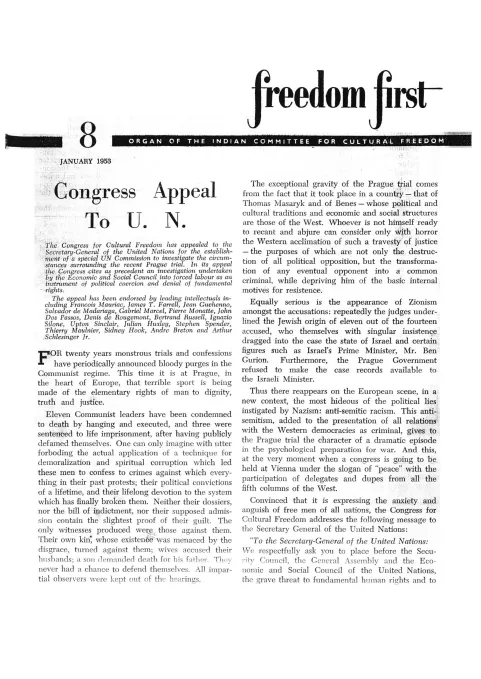
An unsigned editorial reproduces the Congress for Cultural Freedom’s appeal to the UN Secretary-General demanding investigation of the Prague show trial, condemning its use of “Zionism” as an accusation against mostly Jewish defendants as a revival of Nazi-style incitement.
-
The “Notes” section eulogises Sane Guruji’s Antar-Bharati inter-cultural movement, criticises Krishna Menon’s Korea peace resolution as appeasement after rejection by the USSR, China and Korea itself, and reports Dr. Satyanarain Sinha’s clearance of A. K. Gopalan’s forgery charge.
-
Aamir Ali’s “Siddhartha Gautama, The Buddha” presents the Buddha as a pragmatic ethical teacher who refused metaphysical speculation and asserted the equality of all castes.
-
Prof. A. V. Hill’s presidential address, excerpted as “Is this Neutrality?,” uses India’s First Five-Year Plan population data to probe whether medical relief from disease without parallel education and development creates a net ethical harm.
-
Book reviews cover Hemingway’s “The Old Man and the Sea,” UNESCO’s “What Is Race?,” praised as a scientific rebuttal of racial prejudice, and Michel Padev’s “Dimitrov Wastes No Bullets” on the Petkov trial.
-
Letters to the editor include Shankar Raj’s critique of Moral Re-Armament as substituting vague talk of “absolutes” for genuine ethical rigor, and J. B. H. Wadia’s complaint about All India Radio’s film-music policy.
-
A report covers Francois Bondy’s visit to the Committee’s Bombay and Madras chapters, and the closing press digest notes Vinoba Bhave’s remark on leaders who cannot control their own minds.
Essays
Congress Appeal To U.N.
An unsigned editorial reproduces the Congress for Cultural Freedom’s formal appeal to the UN Secretary-General for a special UN Commission to investigate the Prague trial, in which eleven Communist leaders were condemned to death and three to life imprisonment after confessing to fantastical charges. The piece argues the confessions were extracted through psychological coercion, condemns the introduction of ‘Zionism’ as an accusation against the mostly Jewish defendants as an echo of Nazi racial incitement, and reproduces the five-point appeal citing the UN Charter and the Universal Declaration of Human Rights.
- Eleven Communist leaders were condemned to death and three to life imprisonment in the Prague trial after publicly confessing.
- The appeal argues confessions were produced through a deliberate technique of demoralization and spiritual corruption, with no genuine evidence of guilt.
- Zionism was introduced as an accusation, with eleven of fourteen accused noted for Jewish origin, which the piece calls a revival of Nazi-style antisemitic incitement.
- The Congress for Cultural Freedom formally petitioned the UN Secretary-General to place the matter before the Security Council, General Assembly, and Economic and Social Council.
- The appeal invokes precedent from an earlier UN Economic and Social Council investigation into forced labour as an instrument of political coercion.
- The appeal was endorsed by prominent intellectuals including Francois Mauriac, Bertrand Russell, Julian Huxley, Sidney Hook, and Andre Breton.
Notes: Antar-Bharati
The ‘Notes’ section gathers three short items. The first eulogizes Sane Guruji and his Antar-Bharati ideal of inter-lingual, inter-cultural centres to bind India’s diverse regions together, noting the idea’s practical realization at Poona but its general neglect after his death, and welcoming the Government of India’s new Academy of National Literature as fulfilling a similar function. The second, ‘Vital Distinction,’ criticizes Krishna Menon’s Korea peace resolution at the UN as appeasement rather than true neutrality, detailing its rejection by the Soviet Union (Vyshinsky), China (Chou En-lai), and even Korea itself, and citing Times of India columnist ‘Vivek’ on the naivety of Nehru and Menon’s diplomacy. The third, ‘Injured Innocence,’ reports that a Privileges Committee cleared Dr. Satyanarain Sinha of A. K. Gopalan’s charge of using forged documents to criticize Communist legislators, noting the Indian press’s relative silence on the vindication compared to its earlier outcry, and draws a parallel to Owen Lattimore’s indictment on perjury charges in the United States.
- Sane Guruji’s Antar-Bharati idea sought inter-lingual, inter-cultural centres to counter India’s centrifugal linguistic and communal tensions after Partition.
- The Government of India’s planned Academy of National Literature is seen as advancing similar aims through cross-language translation.
- Krishna Menon’s Korea resolution was rejected in turn by the USSR, China, and Korea itself, and Menon repeatedly amended his position after each rebuff.
- The piece argues India’s ‘neutral’ diplomacy on Korea in practice tilted toward appeasement of Communist positions.
- Dr. Satyanarain Sinha was cleared by a Privileges Committee of A. K. Gopalan’s charge of using forged documents against Communist legislators.
- The case is likened to Owen Lattimore’s indictment for perjury in the U.S. Senate hearings, as an example of press double standards toward accused anti-Communists.
Vital Distinction
Aamir Ali’s essay presents the Buddha as a figure whose essential humanity has been obscured by scholarly esotericism and Pali erudition, arguing for a more accessible, layman’s understanding of his teachings. It stresses that the Buddha refused metaphysical speculation about the afterlife in favor of a practical, ethical Eightfold Path (right thinking, intention, speech, action, livelihood, effort, mindfulness, concentration), illustrating this with parables including the poisoned-arrow analogy, the leaves-in-the-hand parable on the limits of revealed knowledge, and the story of Kisa Gotami and the mustard seed teaching that death and mourning are universal. The essay closes by describing the Buddha’s tolerance toward critics and his teaching of caste equality, likening the merging of castes under his teaching to rivers losing their separate identities in the ocean.
- The essay argues excessive scholarly esotericism and Pali philology has obscured the Buddha’s essential, accessible humanity.
- The Buddha refused metaphysical speculation about life after death, holding it irrelevant to living a good life.
- The poisoned-arrow parable illustrates the folly of demanding full metaphysical explanation before acting practically.
- The story of Kisa Gotami and the mustard seed teaches that death and mourning are universal, not exceptional, human experiences.
- The Buddha’s tolerance stemmed from his willingness to hear all views and extract what was valid, even from hostile critics.
- The essay frames the Buddha’s teaching as attacking caste barriers and asserting the equality of all people.
Is this Neutrality?
Extracted from Prof. A. V. Hill’s presidential address to the British Association for the Advancement of Science, this piece frames the central ethical dilemma of modern science: medical and public-health advances have dramatically increased population and lifespan even in poor countries, but without parallel investment in education (especially of women) and material development, that same relief from disease intensifies pressure on food and natural resources. Hill uses India’s 1951 First Five-Year Plan report as his central case study, citing a population growth of roughly 5 million a year in a population of 360 million, and a struggle merely to restore pre-war (already miserable) standards of food and clothing. He argues there is no simple answer to whether alleviating suffering can be ethically wrong when its unintended consequences may be worse, but concludes that scientific integrity of thought must be paired with humane, courageous moral judgment by the wider community, since abandoning the pursuit of knowledge is neither possible nor desirable.
- Hill’s address, delivered at the British Association’s annual meeting, discusses whether relieving human suffering through medical science can create graver problems via population increase.
- India’s First Five-Year Plan (1951) is cited as showing a nearly 1.5% annual population growth rate, adding about 5 million people yearly to a population of 360 million.
- Even the full effort of the Five-Year Plan may only restore pre-war standards of food and clothing, themselves described as miserably poor.
- Hill rejects both extremes: that suffering should be left unrelieved, and that science and its applications alone can guarantee prosperity.
- He argues education, especially of women, is necessary for effective family planning but requires resources as great as those spent on medicine and hygiene.
- Hill concludes there is no special ethical dilemma unique to scientists; moral judgment on the use of scientific discovery falls on the whole community, and integrity of thought remains the scientist’s absolute duty.
Injured Innocence
Three signed book reviews appear on page 9. P.A.P. reviews Hemingway’s The Old Man and the Sea, admiring its craftsmanship but questioning the American critical enthusiasm and any claim that it functions as a grand political symbol. Laeeq Futehally reviews UNESCO’s What Is Race?, praising it as a scientifically grounded rebuttal of racial prejudice and urging its inclusion in university curricula. Keshav Gore reviews Michel Padev’s Dimitrov Wastes No Bullets, an account of the trial and execution of Bulgarian Agrarian leader Nikola Petkov, framing it as an indictment of Western fellow-travellers rather than only of Communist prosecutors.
- P.A.P.’s review of The Old Man and the Sea questions whether the novella carries the grand symbolic weight some American critics claimed for it.
- Laeeq Futehally’s review of What Is Race? calls it the most accurate and weighty answer yet to questions about the biological basis of race, crediting UNESCO’s scientists and Julian Huxley’s prose.
- Futehally recommends the book be included in university syllabi given its potential contribution to keeping world peace.
- Keshav Gore’s review of Dimitrov Wastes No Bullets recounts the trial and execution of Bulgarian Agrarian party leader Nikola Petkov.
- Gore argues the book’s real target is Western ‘fellow-travellers’ who enabled Communist consolidation, not just the Bulgarian regime itself.
Siddhartha Gautama, The Buddha
By Aamir Ali
The letters section carries four contributions. Lucy Beach of California responds warmly to M. R. Masani’s earlier Freedom First article on Indian spirituality and materialism, describing her own gesture of sending a plough to India through CARE with a note emphasizing spiritual over material giving. Sailesh K. Roy critiques Prof. Dantwala’s piece on Bread versus Freedom, arguing that in under-developed countries hunger, not ideology, makes people vulnerable to Communism, and faulting Masani for prioritizing ideological refutation of Crossman over addressing material need. Shankar Raj writes an extended critique of Moral Re-Armament (M.R.A.), arguing it demands no intellectual effort and offers only vague talk of ‘absolutes’ rather than rigorous ethical thought, concluding M.R.A. leaves its followers self-centred and unchanged. J. B. H. Wadia writes sarcastically about All India Radio’s crackdown on film music in favor of classical music, questioning the fairness of the sarcasm used against a female playback singer and suggesting the journal itself be renamed ‘Fetters First.’
- Lucy Beach’s letter responds to M. R. Masani’s article on Indian spirituality, recounting her gesture of sending a plough to India via CARE with a spiritual message attached.
- Sailesh K. Roy argues hunger, not ideological confusion, is what makes populations in under-developed countries vulnerable to Communism.
- Shankar Raj’s letter is a sustained critique of Moral Re-Armament, arguing it substitutes vague talk of moral ‘absolutes’ for genuine intellectual and ethical rigor.
- J. B. H. Wadia’s letter criticizes an earlier note’s sarcastic treatment of a female playback singer amid a debate over All India Radio’s film-versus-classical-music policy, proposing the journal be renamed ‘Fetters First.‘
The Ethical Dilemma of Science
By Prof. A. V. Hill
This short news item reports on the visit of Francois Bondy, Secretary of the Congress for Cultural Freedom and editor of Preuves, to the Indian Committee for Cultural Freedom’s Bombay and Madras chapters. Bondy addressed press conferences, university and civic audiences, and social gatherings in both cities, speaking on ‘The Struggle for Cultural Freedom’ in Madras and ‘New Trends in European Literature and the Arts’ under the P.E.N. All-India Centre in Bombay, and was received by civic and academic dignitaries including the Mayor of Bombay and the Vice-Chancellor of Bombay University.
- Francois Bondy, Secretary of the Congress for Cultural Freedom and editor of Preuves, visited Bombay and Madras chapters of the Indian Committee for Cultural Freedom.
- In Madras, Bondy addressed a public meeting on ‘The Struggle for Cultural Freedom’ and met scientists at Madras University.
- In Bombay, Bondy addressed students of Wilson College, was received by the Mayor and Bombay University’s Vice-Chancellor, and spoke to the P.E.N. All-India Centre on European literature and the arts.
- The Indian Committee for Cultural Freedom arranged a launch trip to the Elephanta Caves for Bondy.
International Congress of Scientists
The closing ‘With Many Voices’ column, prefaced by a Tennyson epigraph, compiles brief quotations from contemporary newspapers and public figures on political events of late 1952, including a London quip about Bevan, Strachey, Attlee and Morrison, Nehru’s remarks to schoolchildren and his temper in the House of the People, Acharya Vinoba Bhave’s comment on leaders who cannot control their own minds, Taya Zinkin’s assessment of Yugoslavia as a police state edging toward liberty, a joint statement by the Socialist Parties of India, Indonesia and Burma rejecting Cominform Communism, and reports on anti-Communist tattooing among Korean POWs and Srangadhar Das’s warning about Stalinism as a form of imperialism.
- The column compiles short newspaper quotations on Cold War and Indian political topics from December 1952.
- The Socialist Parties of India, Indonesia and Burma jointly rejected Cominform Communism as denying the dignity and equality of man.
- Acharya Vinoba Bhave is quoted criticizing leaders who claim to control their people without controlling their own minds.
- Taya Zinkin’s Times of India piece describes Yugoslavia as still a police state but one beginning to move toward liberty.
- Reports describe Communist Korean POWs tattooing themselves with anti-Communist slogans to avoid forcible repatriation.
Generated by the v1.5 extraction pipeline. Awaiting editorial review.
Metadata and summary are AI-extracted from the source PDF and reviewed for editorial accuracy. The original work is available via the Read PDF tab above (where present); paragraph-level citation inside the PDF is deferred to a future engagement.