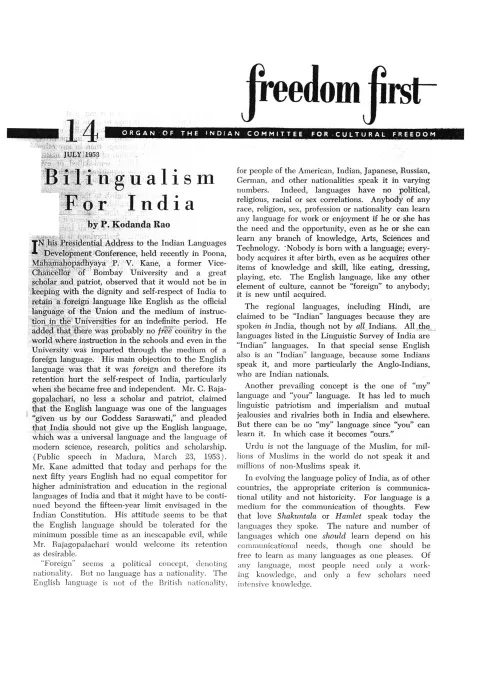
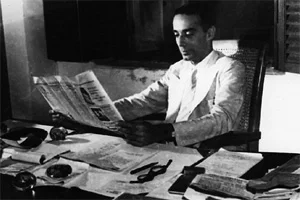
periodical issue
Freedom First
By Michael Polanyi, Bertram D. Wolfe, J. C. Daruvala, Polemicus, R. H., Rationalist
Edited by Aziz Madni; printed & published by Narie Oliaji at Kanoda Press, 109 Parsi Bazaar Street, Bombay 1. · Bombay · 1953
12 pages
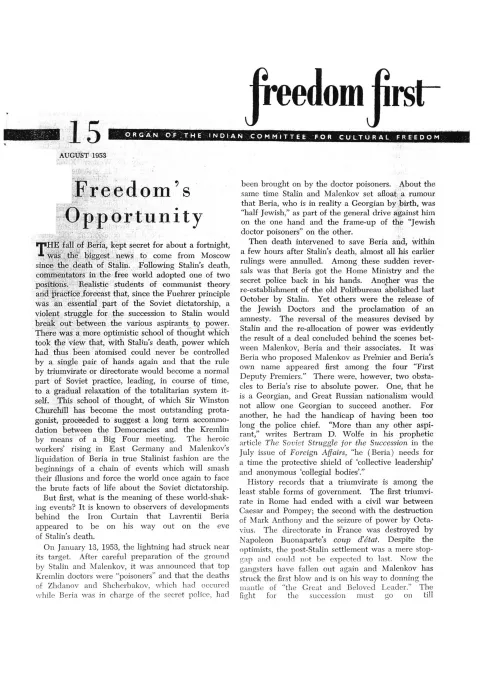
Freedom First
Summary
Freedom First No. 15 (August 1953), organ of the Indian Committee for Cultural Freedom, is a Cold War-era liberal-anticommunist monthly bulletin edited by Aziz Madni. The issue opens with the unsigned editorial ‘Freedom’s Opportunity’, analyzing Lavrentii Beria’s fall from power following Stalin’s death and arguing that the Soviet succession crisis is an opportunity for the free world to support captive peoples rather than pursue Big Four appeasement. A ‘Notes’ section covers the silencing of the columnist Vivek, a UN/ILO report on forced labour in the USSR and South Africa, U.S. and Asian reactions to President Syngman Rhee’s release of Korean POWs, China’s ban on contraceptive imports, and a correction regarding Dr. Ralph Bunche’s remarks on Indian universities. An editorial titled ‘The Essence Of Democracy’ rebuts Jayaprakash Narayan’s criticism of party-based parliamentary opposition, invoking E.F.M. Durbin’s The Politics of Democratic Socialism to defend organized opposition as essential to democracy. Michael Polanyi contributes ‘Protests And Problems’, previewing the Hamburg ‘Science and Freedom’ conference and arguing that opposing totalitarian control of scholarship requires clearer principles of intellectual liberty than exist even in the West. Bertram D. Wolfe’s ‘Meherally, Gandhi & The C.S.P.’ recounts, largely through recollected dialogue with Yusuf Meherally, how the Congress Socialist Party detected and expelled Communist Party infiltrators in the 1930s, and describes Wolfe’s own political conversion from suspicion to admiration of Gandhi. A CCF message, ‘Hands Across The Iron Curtain’, greets scientists in communist countries. The unsigned piece ‘The Need To Identify’ defends the bulletin’s practice of naming suspected communists and fellow-travellers, distinguishing this from McCarthyism on grounds of disinterestedness and the different (more lenient) climate for accused persons in India, and reports the dismissal of P. Padhye from Navashakti for attending a discussion on ‘The World after Stalin’. A review section covers Arthur Koestler’s autobiography Arrow in the Blue and Hector Hawton’s The Feast of Unreason on Existentialism. Letters to the editor debate Einstein’s remarks on refusing to testify before congressional committees, and J. C. Daruvala of the ICCF protests the cancellation of D. F. Karaka’s passport as a violation of freedom of travel. The issue closes with notice of the ICCF’s September 1953 Annual Conference in Madras and a ‘With Many Voices’ column of contemporary press quotations on communism, Korea, and the Cold War, followed by a membership form and the printing colophon.
Key points
-
The unsigned editorial “Freedom’s Opportunity” analyses Beria’s fall after Stalin’s death as an opportunity for the free world to support captive peoples rather than pursue Big Four appeasement.
-
Michael Polanyi’s “Protests And Problems” previews the Hamburg “Science and Freedom” conference, arguing that denouncing totalitarian control of scholarship requires clearer principles of intellectual liberty than presently exist, and criticises the Soviet imposition of Lysenko’s biology on the Academy.
-
An editorial, “The Essence Of Democracy,” rebuts Jayaprakash Narayan’s criticism of party-based parliamentary opposition, invoking E.F.M. Durbin’s “The Politics of Democratic Socialism” to defend organised opposition as essential to democracy.
-
Bertram D. Wolfe’s “Meherally, Gandhi & The C.S.P.” recounts how the Congress Socialist Party detected and expelled Communist infiltrators in the 1930s, crediting Gandhi’s moral influence for the party’s relative immunity to corruption, and narrates Wolfe’s own conversion to admiration of Gandhi.
-
“The Need To Identify” defends the bulletin’s practice of naming suspected Communists and fellow-travellers as distinct from McCarthyism, and reports the dismissal of Prabhakar Padhye from Navashakti for attending a discussion on “The World after Stalin.”
-
A review section covers Arthur Koestler’s autobiography “Arrow in the Blue” and Hector Hawton’s “The Feast of Unreason” on Existentialism.
-
Letters to the editor debate Einstein’s refusal to testify before congressional committees, and J. C. Daruvala protests the cancellation of D. F. Karaka’s passport as a violation of freedom of travel.
Essays
Freedom’s Opportunity
In ‘Protests And Problems’, Michael Polanyi previews the International Conference on ‘Science and Freedom’, organised in Hamburg by the University of Hamburg and the Congress for Cultural Freedom (23-26 July). He argues that denouncing totalitarian control of scholarship is ineffectual without much clearer principles of intellectual liberty than currently exist, tracing how pacifism, Munich, and Yalta shaped Western attitudes toward liberty, and how state funding and the ‘19th-century’ decline of academic tradition have weakened universities’ sense of independent purpose. He contends that the West, too, operates under an intertwined political-scholarly authority that determines what counts as legitimate science (citing the Soviet imposition of Michurin and Lysenko’s biology on the Academy as the extreme case), and closes by questioning whether the old Royal Society ideal of ‘Nullius in verba’ (‘we recognise no authority’) can still safely guide the pursuit of liberty today.
- Frames the Hamburg ‘Science and Freedom’ conference (July 23-26, 1953) as a response to the treatment of scholars under totalitarianism.
- Argues totalitarian obscurantism cannot be effectively denounced without clearer principles of intellectual liberty.
- Traces the West’s loss of faith in pacifism through Munich and Yalta to a new passion for liberty.
- Criticizes the Soviet Communist Party’s 1948 imposition of Michurin/Lysenko biology on the Academy, overriding Mendelian genetics.
- Argues the West too has an authority — prevailing scholarly opinion — that frames what academic freedom protects, and that this authority, not its absence, safeguards academic freedom.
- Ends by questioning whether ‘Nullius in verba’, the Royal Society’s anti-authority motto, can still guide the ideal of liberty.
Notes (A Light Snuffed Out; Malan and Malenkov; Reactionary China; Dr. Ralph Bunche; Justice For Korea)
In ‘Meherally, Gandhi & The C.S.P.’, Bertram D. Wolfe recounts, largely as reported dialogue with Yusuf Meherally, how the Congress Socialist Party in India admitted Communist Party members in the 1930s under the Comintern’s ‘popular front’ strategy, only to discover the communists were secretly working to capture the CSP and discredit Gandhi. Minoo Masani is credited as the lone early voice warning against admitting communists, resigning when unheeded; the party later expelled all known communists and sympathizers within a set deadline, suffering negligible losses — which Wolfe attributes to Gandhi’s moral influence immunizing the CSP against the corruption seen in other countries’ socialist movements. The essay closes with Wolfe’s personal account of his own shift from suspicion of Gandhi (during the 1922 non-cooperation suspension) to conviction that Gandhi was ‘the greatest man of the first half of our century,’ prompted by long observation of Gandhi’s strategic and symbolic leadership of the independence movement.
- Describes the Comintern’s mid-1930s ‘popular front’ pivot and its effect of infiltrating socialist and Congress ranks in India via the Congress Socialist Party (CSP).
- Minoo Masani is named as the only Indian socialist who warned early that communists were not morally fit for CSP or Congress membership, and who resigned over the issue.
- Yusuf Meherally, quoted at length, describes accusing Communist Party faction leaders of ‘moral duplicity’ after obtaining a secret circular instructing them to sabotage CSP candidates.
- The CSP set a one-week ultimatum for communists to withdraw or be expelled, and reports ‘no serious losses’ as a result, unlike socialist parties elsewhere.
- Wolfe attributes the CSP’s relative immunity to communist corruption to Gandhi’s moral influence on the party.
- Wolfe narrates his own political conversion, from believing (during the 1922 suspension of non-cooperation) that Gandhi had become ‘a British puppet or a traitor,’ to concluding Gandhi was one of the great men of the century.
Generated by the v1.5 extraction pipeline. Awaiting editorial review.
Metadata and summary are AI-extracted from the source PDF and reviewed for editorial accuracy. The original work is available via the Read PDF tab above (where present); paragraph-level citation inside the PDF is deferred to a future engagement.