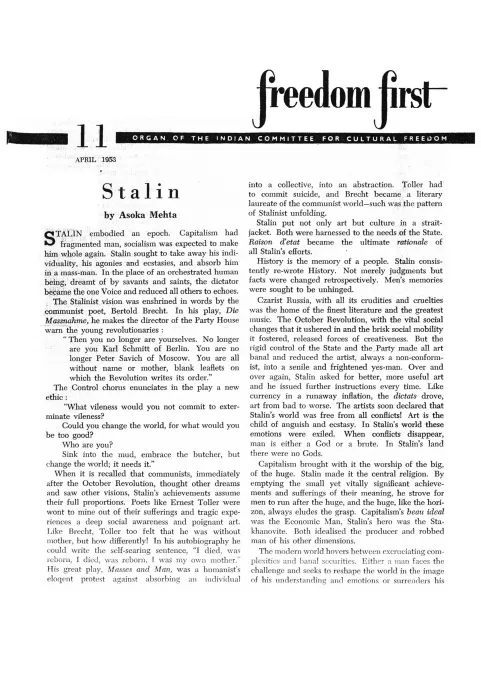
periodical issue
Freedom First
By Francois Bondy, R. H. S. Crossman, M.P., M. R. Masani, R.H.
Edited by Aziz Madni; printed & published by Narie Oliaji at Kanada Press, 109 Parsi Bazaar Street, Bombay 1. · Bombay · 1953
12 pages
Freedom First
Summary
This is the September 1953 issue (No. 16) of Freedom First, the monthly bulletin of the Indian Committee for Cultural Freedom (ICCF), affiliated to the Congress for Cultural Freedom. The issue opens with an editorial, “Another Landmark,” previewing the Committee’s second Annual General Meeting to be held in Madras that September, inaugurated by C. Rajagopalachari. A “Notes” section comments on Indian radio policy (arguing for an autonomous BBC-style broadcasting corporation and cautiously weighing commercial broadcasting), on the fall of Mossadegh in Iran as a defeat for Soviet expansionism, on the restoration of D. F. Karaka’s passport, on Communist-organised “citizens’ meetings” as anti-democratic fronts, on a polio outbreak overshadowing a Communist youth festival in Bucharest, and on “British Defeatism”—criticising Labour figures like Morgan Phillips and Clement Attlee for a double standard that admits Communist China’s legitimacy while condemning Franco’s Spain. Francois Bondy, Publications Director of the Congress for Cultural Freedom, reports at length on the Hamburg Congress on Science and Freedom (July 1953), surveying debates among scientists (Sydney Hook, James Franck, Michael Polanyi, Friedrich Hayek and others) on the responsibilities of scientists under totalitarianism, the corruption of Soviet science by Lyssenkoism, and the need for an international scientific solidarity. The issue reprints a notable exchange, “The Universality of Human Values,” between the British Labour MP R. H. S. Crossman and M. R. Masani, debating whether Communism remains a “liberative force” in Asia and Africa and whether parliamentary democracy is suited to post-colonial societies; a brief unsigned review (by “R.H.”) of Sartre’s play Lucifer and the Lord follows. The bulk of the back half is the ICCF’s own Annual Report (“A Year of Achievement,” May 1952–August 1953), detailing the Committee’s founding meeting, office-bearers, the launch of Freedom First itself, its programme of talks and receptions (including one for Adlai Stevenson), its Paris Exposition delegation, its press and literature-distribution activities, and current membership figures (495 members). The issue closes with a “With Many Voices” column of press quotations on current affairs and a membership solicitation ad listing the Committee’s contributors.
Key points
-
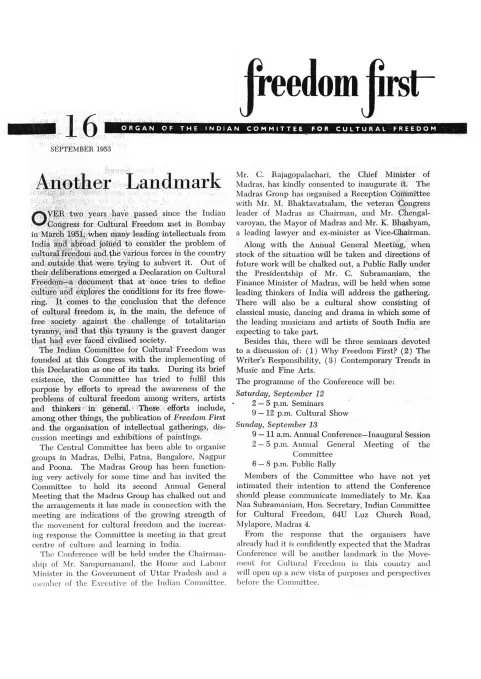
An editorial, “Another Landmark,” previews the Committee’s second Annual General Meeting in Madras, inaugurated by C. Rajagopalachari, recapping the 1951 Bombay Congress and the resulting Declaration on Cultural Freedom.
-
The “Notes” section argues for a BBC-style autonomous broadcasting corporation for All India Radio, frames Mossadegh’s fall in Iran as a defeat for Soviet expansion, and criticises British Labour figures for a double standard admitting Communist China’s legitimacy while condemning Franco’s Spain.
-
Francois Bondy reports at length on the Hamburg Congress on Science and Freedom, where Sydney Hook argued scientific freedom is inseparable from citizenship, geneticists documented Lysenkoism’s damage, and Friedrich Hayek grounded scientific freedom in the “omnipresence of ignorance.”
-
A reprinted exchange, “The Universality Of Human Values,” pits R. H. S. Crossman, who argues Communism can still be a “liberative force” outside Europe, against M. R. Masani, who rebuts him by citing Jayaprakash Narayan, Lohia and Asoka Mehta as Asians pursuing change while resisting Soviet and Chinese imperialism.
-
The Indian Committee for Cultural Freedom’s Annual Report, “A Year of Achievement,” records the founding of Freedom First, international representation on the Congress’s Executive Committee, and total membership of 495 as of August 1953.
-
R.H. reviews Sartre’s play “Lucifer and the Lord,” judging it “rambling and ill-constructed” and questioning Sartre’s assumed causal link between atheism and social revolution.
Essays
Essay 1
No summary was extracted for this article. Listed for completeness.
Another Landmark
An unsigned editorial announcing the second Annual General Meeting of the Indian Committee for Cultural Freedom, to be held in Madras in September 1953. It recaps the founding of the Committee at the 1951 Indian Congress for Cultural Freedom in Bombay, the resulting Declaration on Cultural Freedom, and the Committee’s activities since (publishing Freedom First, organising regional groups in Madras, Delhi, Patna, Bangalore, Nagpur and Poona). It details the Madras conference programme: seminars on “Why Freedom First?”, “The Writer’s Responsibility,” and “Contemporary Trends in Music and Fine Arts”; a cultural show; and a public rally presided over by C. Subramaniam with C. Rajagopalachari inaugurating.
- Announces the ICCF’s second Annual General Meeting, Madras, September 12-13, 1953
- C. Rajagopalachari (Chief Minister of Madras) to inaugurate the conference
- Recaps the 1951 Bombay Congress for Cultural Freedom and the resulting Declaration on Cultural Freedom
- Lists existing regional groups: Madras, Delhi, Patna, Bangalore, Nagpur, Poona
- Details conference programme: seminars, cultural show, public rally
Notes (Autonomy For Radio; Commercial Broadcasts?; Iran Saved; The Right to Travel; Citizens’ Meetings; Polio in Bucharest; British Defeatism)
A set of unsigned short editorial notes on current affairs. “Autonomy For Radio” argues for a BBC-style autonomous broadcasting corporation for All India Radio, criticising nepotism, government propaganda and dull programming, and cautiously weighing the case for commercial/sponsored broadcasting on the U.S. model. “Iran Saved” celebrates the fall of Mohammad Mossadegh as a popular repudiation of Soviet-orbit drift, and criticises sections of the Indian press for having lionised him. “The Right to Travel” welcomes the restoration of journalist D. F. Karaka’s passport. “Citizens’ Meetings” warns that Communist-organised “peace” meetings after the Korean armistice are astroturfed fronts. “Polio in Bucharest” reports a polio epidemic concealed during a Communist youth festival. “British Defeatism” criticises British Labour figures (Morgan Phillips, Clement Attlee) for a double standard admitting Communist China to legitimacy while opposing Franco’s Spain, framing this as the same neutralism that runs through the Crossman-Masani exchange reprinted later in the issue.
- Advocates an autonomous, BBC-style broadcasting corporation to replace All India Radio’s current governance
- Weighs the pros and cons of commercial/sponsored radio broadcasting
- Frames the fall of Mossadegh in Iran as a victory against Soviet influence and criticises Indian press coverage that had favoured him
- Welcomes restoration of D. F. Karaka’s passport as vindication of civil liberty
- Describes Communist ‘citizens’ meetings’ as astroturfed anti-democratic fronts following the Korean armistice
- Reports a polio epidemic in Bucharest during a Communist-sponsored youth festival
- Criticises British Labour figures for a double standard between Communist and fascist dictatorships
Science And Freedom
By Francois Bondy
Francois Bondy, Publications Director of the Congress for Cultural Freedom, reports on the Conference on Science and Freedom held in Hamburg (July 23-26, 1953) under the auspices of the Congress and Hamburg University. One hundred and twenty scientists from nineteen countries — including Lisa Meitner, James Franck, Arthur Compton, Max von Laue, Alexander Weissberg-Cybulski, and the geneticist Dobzhansky — debated the rights, responsibilities and freedoms of scientists under totalitarianism. Sydney Hook argued scientific freedom is a positive value entailing the freedom of the scientist as citizen. German scientists (Jores, Kuhn) gave harrowing accounts of Nazi-era complicity and human experimentation, framing the conference’s central tension between scientific ‘neutrality’ and civic responsibility. Geneticists including Dobzhansky and Nachtsheim documented the damage done to Soviet science by Lysenkoism. The report closes on debates about whether scientists are especially susceptible to totalitarian ideology (Theodor Litt, Helmut Plessner, Raymond Aron), Friedrich Hayek’s argument that scientific freedom rests on the ‘omnipresence of ignorance’ rather than a search for final truth, and Michael Polanyi’s comparison of scientific freedom to the free market, concluding with a proposal by Nicolas Nabokov for a permanent International Secretariat of scientists.
- Reports on the Hamburg Congress on Science and Freedom, July 23-26, 1953, organised by the Congress for Cultural Freedom and Hamburg University
- 120 scientists from 19 countries attended, including several who had suffered directly under Nazi or Soviet rule
- Sydney Hook argued scientific freedom is inseparable from the scientist’s freedom as a citizen: ‘Liberty is contagious and revolutionary’
- German scientists gave first-hand accounts of Nazi-era complicity in human experimentation, raising the question of scientists’ civic responsibility versus claimed ‘neutrality’
- Geneticists documented how Lysenkoism and Mitschurinism devastated Soviet genetics and agricultural science
- Friedrich Hayek argued the best case for scientific freedom lies in the ‘omnipresence of ignorance,’ not the search for final truth
- Michael Polanyi compared scientific freedom to the free market as an autonomous social institution
- Nicolas Nabokov proposed a permanent International Secretariat of scientists to continue the Congress’s work
The Universality Of Human Values
By R. H. S. Crossman, M.P. / M. R. Masani
R. H. S. Crossman’s contribution to a reprinted exchange (originally in Socialist Commentary) responding to M. R. Masani’s Freedom First article “The Universality of Human Values” (November 1952). Crossman defends his view that communism can still be a “liberative force” outside Europe where the democratic revolution — land redistribution, the break-up of feudal power — has not yet occurred, arguing that parliamentary democracy, suited to societies where political and social freedom is already established, may be inadequate or even an obstacle to rapid social change in places like the Arab world or parts of Asia. He maintains that American policy should not prop up colonial or client regimes (Bao Dai, Chiang Kai-shek, Syngman Rhee) to fill a ‘political vacuum’ left by decolonisation, and that the U.S. and France would be wiser to recognise Ho Chi Minh’s government than continue the war in Indo-China.
- Defends the claim that communism can be a ‘liberative force’ outside Europe and North America, where the democratic revolution has not yet taken place
- Argues parliamentary institutions are suited only to societies where political, civil and social freedom are already established
- Cites Britain’s Irish troubles (1910-14) and Henry VIII’s break with the Church as examples where parliamentary process would have stalled necessary change
- Opposes American support for Bao Dai, Chiang Kai-shek and Syngman Rhee as propping up a ‘political vacuum’ left by decolonisation
- Argues the U.S. and France should recognise Ho Chi Minh’s regime rather than continue the Indo-China war
M. R. Masani’s reply to Crossman in the same reprinted exchange, rebutting Crossman’s five points. Masani argues that no free Asian country is more reactionary by Crossman’s own test than the Soviet or Chinese dictatorships, accuses Crossman of unknowingly reproducing the Leninist ‘dictatorship of the proletariat’ argument, and rejects the caricature of the ‘young Arab’ who must choose between a corrupt social order and Marxism-Leninism, citing Jayaprakash Narayan, Ram Manohar Lohia and Asoka Mehta as examples of Asians pursuing social change while resisting Soviet and Chinese imperialism. He criticises Crossman’s proposal to recognise Ho Chi Minh’s Indo-Chinese regime as legitimising a Soviet-trained agent, and closes by tracing what he sees as Crossman’s confusion to the ‘basic fallacy of neutralism.’
- Argues no free Asian democracy is, by Crossman’s own test, more reactionary than the Soviet or Chinese dictatorships
- Accuses Crossman of unwittingly endorsing the Leninist concept of the ‘dictatorship of the proletariat’
- Cites Jayaprakash Narayan, Ram Manohar Lohia and Asoka Mehta as Asians who pursue social change while resisting Soviet/Chinese imperialism, rejecting Crossman’s caricature of a ‘young Arab’ with only two choices
- Criticises Ho Chi Minh as a Soviet-trained agent whose recognition would not constitute liberation
- Attributes Crossman’s position to the ‘basic fallacy of neutralism’, contrasting it with Crossman’s earlier editorship of The God That Failed
Review: Lucifer And The Lord (by Jean-Paul Sartre)
By R.H.
An unsigned review, initialled “R.H.,” of Jean-Paul Sartre’s play Lucifer and the Lord (Hamish Hamilton, 1952). The reviewer summarises Sartre’s own account of the play’s premise — that if God exists, Good and Evil are the same, since the protagonist Goetz achieves identical destructive results whether he acts evilly or benevolently — and judges the play ‘rambling and ill-constructed,’ with Goetz’s character ‘totally incoherent’ after the first act. The review argues Sartre ‘wants to have it both ways’ regarding Goetz’s belief in God, producing ‘sheer chaos,’ and questions why Goetz’s rejection of God should lead him to throw in his lot with the peasants’ revolutionary army, concluding that Sartre’s assumed causal link between atheism and social revolution is not as ironclad as the play wants to suggest.
- Reviews Sartre’s play Lucifer and the Lord, set during the 16th-century German peasants’ uprising
- Summarises Sartre’s stated premise: if God exists, Good and Evil produce identical results in the world
- Judges the play ‘rambling and ill-constructed’ with an incoherent central character
- Argues Sartre inconsistently wants Goetz to both believe and not believe in God
- Questions the assumed causal connection in the play between atheism and social revolution
A Year of Achievement,
By The Indian Committee for Cultural Freedom
The Indian Committee for Cultural Freedom’s Annual Report, ‘A Year of Achievement,’ covering May 1952 to August 1953. It records the first Annual General Meeting (Bombay, April 1952, chaired by Jayaprakash Narayan), the election of the Executive Committee (M. R. Masani, Asoka Mehta, Ram Singh, Jaipal Singh, Sampurnanand, Raja Rao, P. Kodanda Rao and others), the founding of Freedom First (first issue June 1, 1952; Aziz Madni appointed editor in January 1953), and a list of the bulletin’s significant articles and book reviews over fifteen issues. It details international representation (M. R. Masani on the International Executive Committee; a Far East/South-East Asia tour by Masani and Francois Bondy), the Committee’s delegation to the 1952 Paris Exposition of Arts, an extensive list of talks and meetings hosted in Bombay and Madras (with visiting speakers including Herbert Passin, Kenzo Takayanagi, and Francois Bondy), receptions including one for Adlai Stevenson at the Taj Mahal Hotel in May 1953, anniversary commemorations for Sri Aurobindo, Ananda Coomaraswamy and Raja Ram Mohan Roy, press and literature distribution activities (including 1,000 copies of Edward Hunter’s Brain Washing in Red China), and current administrative details including total membership of 495 as of August 25, 1953, broken down by city.
- Covers ICCF activity from May 1952 to August 1953, styled as the Committee’s annual report
- Records founding of Freedom First (first issue June 1, 1952) and its editorial board and staff changes
- Lists international representation: M. R. Masani on the International Executive Committee; a Masani/Bondy tour of the Far East and South-East Asia
- Details the Committee’s delegation to the 1952 Paris Exposition of Arts (‘The Masterpieces of the Twentieth Century’)
- Lists numerous talks, receptions and anniversary meetings hosted by the Committee in Bombay and Madras, including a reception for Adlai Stevenson
- Reports total membership of 495 as of August 25, 1953, with a city-by-city breakdown (Bombay 204, Madras 102, etc.)
- Describes press and literature distribution work, including distribution of Edward Hunter’s Brain Washing in Red China
With Many Voices
The ‘With Many Voices’ column collects short press quotations on current affairs from Indian and international newspapers of August 1953, epigraphed with lines from Tennyson. Quotations touch on American policy in Kashmir, V. K. Krishna Menon’s anti-communist remarks, Syngman Rhee’s stance on Korean prisoners, an Indian municipality’s protest over Beria’s fate, and Adlai Stevenson’s remark on Belgrade’s reaction to Stalin’s death, among others. The page also carries a membership recruitment advertisement for the Indian Committee for Cultural Freedom, listing its contributors (including Sydney Hook, Jayaprakash Narayan, Michael Polanyi, Philip Spratt, Sampurnanand, M. R. Masani and Asoka Mehta) and an enrolment form.
- Column of short press quotations on current affairs from August 1953, framed by an epigraph from Tennyson
- Includes quotations touching Kashmir, Korea, Beria’s downfall, and Stalin’s death
- Followed by a membership recruitment advertisement for the Indian Committee for Cultural Freedom listing its roster of contributors
- Issue colophon: edited by Aziz Madni; printed and published by Narie Oliaji at Kanada Press, Bombay
Generated by the v1.5 extraction pipeline. Awaiting editorial review.
Essay 8
No summary was extracted for this article. Listed for completeness.
Metadata and summary are AI-extracted from the source PDF and reviewed for editorial accuracy. The original work is available via the Read PDF tab above (where present); paragraph-level citation inside the PDF is deferred to a future engagement.