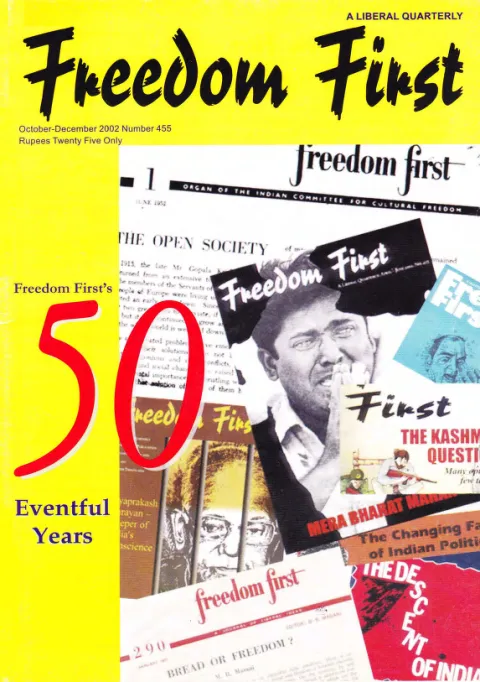
periodical issue
Freedom First
printed & published by Narie Oliaji at Kanada Press, 109 Parsi Bazaar Street, Bombay 1 · Bombay · 1953
12 pages
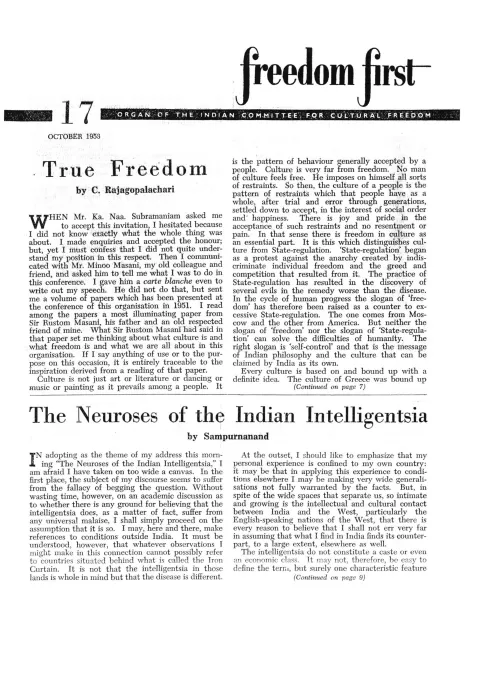
Freedom First
Summary
This is issue No. 17 (October 1953) of Freedom First, the monthly bulletin of the Indian Committee for Cultural Freedom (ICCF), affiliated to the World Movement for Cultural Freedom. The issue centers on the ICCF’s Second Annual Conference held in Madras on 12-13 September 1953, publishing the two keynote addresses in full: C. Rajagopalachari’s inaugural address “True Freedom,” which argues that Indian culture is built on self-control rather than freedom-as-licence or state-regulation, drawing on the Isa Vasya Upanishad and the Bhagavad Gita; and Dr. Sampurnanand’s presidential address “The Neuroses of the Indian Intelligentsia,” a diagnosis of the Indian intellectual’s condition as one of uncertainty, faith-lessness, and rootlessness produced by the collision of communism, democracy, economic hardship, and a cultural leadership cut off from the masses. The issue also carries the Annual General Meeting’s seven resolutions (on Bhoodan, forced labour, the Asian communist threat, solidarity with victims of totalitarian tyranny, cultural freedom for Adivasis, the Committee’s stand, and greetings to the World Movement), a report on the conference proceedings and its seminars, a review of D. F. Karaka’s biography of Nehru, a “Notes” column commenting on Cold War propaganda and Indira Gandhi’s remarks on the USSR, and a short report on ICCF activities including a reception for Dr. Harry Gideonse.
Key points
-
C. Rajagopalachari’s inaugural address “True Freedom” argues Indian culture rests on self-control rather than freedom-as-licence or state-regulation, drawing on the Isa Vasya Upanishad and Bhagavad Gita, and rejects relativism about truth as common to both Hitlerism and Communism.
-
Dr. Sampurnanand’s presidential address “The Neuroses of the Indian Intelligentsia” diagnoses a pervasive uncertainty and rootlessness among Indian intellectuals, contrasting India unfavourably with Russia’s cultural continuity through revolution, and calls for a Vedanta-rooted universalist culture to fill the spiritual vacuum.
-
The Annual General Meeting adopted seven resolutions spanning Bhoodan, forced labour, the Asian communist threat, solidarity with victims of totalitarian tyranny, and cultural freedom for Adivasis.
-
The issue also carries a review of D. F. Karaka’s biography of Nehru and a “Notes” column commenting on Cold War propaganda and Indira Gandhi’s remarks on the USSR.
-
A short report covers ICCF activities including a reception for Dr. Harry Gideonse.
Essays
True Freedom
By C. Rajagopalachari
Rajagopalachari’s inaugural address to the ICCF’s Second Annual Conference argues that culture, properly understood, is not synonymous with freedom but with a pattern of self-imposed restraint that a people settle into through trial and error. He contrasts the Western polarity between the Soviet slogan of ‘state-regulation’ and the American slogan of ‘freedom,’ proposing instead that the true Indian answer to both is ‘self-control’ (drawn from the Upanishads and the Gita, and given modern force by Gandhi). He works through the opening verses of the Isa Vasya Upanishad and passages of the Gita to argue that action performed with detachment and dedicated to the divine is the only way to escape the contamination inherent in all activity, and that a culture based on recognition of the soul is what distinguishes Indian civilisation from a modern civilisation that has learned to control nature and the minds of others but not itself. He closes by rejecting relativism about truth (linking it to Hitlerism and Communism, both of which he says dethrone truth to dethrone God) and reaffirms that self-control, not freedom or regulation, should be the ICCF’s watchword.
- Culture is the pattern of restraints a people accept through trial and error, not the absence of restraint.
- The ‘freedom’ slogan and the ‘state-regulation’ slogan are both partial answers to human difficulties; the truer Indian answer is self-control.
- Rajagopalachari draws on the Isa Vasya Upanishad and Bhagavad Gita verses to argue for action performed with detachment and dedication to God.
- Modern civilisation has mastered control over nature but not over the self, and has extended this failure into psychological control over other minds (Hitlerism, Communism).
- Truth and moral values must be treated as inviolable; relativism about truth is what he most dislikes in Communism.
- He proposes ‘self-control’ rather than ‘freedom’ as the ICCF’s battle-standard.
The Neuroses of the Indian Intelligentsia
By Sampurnanand
Dr. Sampurnanand’s presidential address diagnoses a pervasive neurosis in the Indian intelligentsia (and, by extension, intelligentsias elsewhere outside the communist bloc), arising from acute uncertainty and instability. He traces this to India’s independence coinciding with an age of ideological war between communism and democracy; to economic stagnation, unemployment, and the breakdown of old social bonds like the joint family; and to a leadership and intellectual class that has borrowed Western ideas wholesale without reworking them into anything indigenous. He contrasts India unfavourably with Russia, which he says preserved a cultural continuity even through revolution because Marxist philosophy filled the ideological void and Lenin and Gorky had genuine affinity with the people, whereas India’s post-independence leadership lacks that intimate connection with the masses. Universities, he argues, have failed to create a genuinely Indian, integrative culture, teaching Indian civilisation as a dead subject rather than a living one. He criticises the Constitution and the ‘Secular State’ and ‘Welfare State’ concepts as spiritually inert ideals incapable of commanding sacrifice, and closes by calling for leadership to actively shape a cultural life rooted in Vedantic universalism (illustrated with Sanskrit verses) rather than borrowed Western abstractions.
- The Indian intelligentsia suffers from a neurosis rooted in uncertainty, instability, and lack of faith, distinct from (though related to) similar disorders elsewhere.
- Political independence arrived amid a global ideological war between communism and democracy, leaving young Indians pulled between the two.
- Economic stagnation, unemployment, and social change (e.g. breakdown of the joint family) compound the intelligentsia’s disorientation.
- Russia, unlike India, preserved cultural continuity through revolution because Marxism filled the ideological vacuum and its leaders had genuine ties to the people; India’s leadership lacks this intimacy with the masses.
- Indian universities have failed to build an integrative national culture, teaching Indian civilisation as an inert academic subject.
- The Constitution, the Secular State, and the Welfare State are criticized as spiritually thin concepts unable to inspire sacrifice or faith.
- He calls for a renewed, Vedanta-rooted universalist culture (‘the Absolute Existence is one, the wise call it by many names’) to fill the spiritual vacuum, cautioning against both religious mumbo-jumbo dismissal and Hindu communalism.
Generated by the v1.5 extraction pipeline. Awaiting editorial review.
Metadata and summary are AI-extracted from the source PDF and reviewed for editorial accuracy. The original work is available via the Read PDF tab above (where present); paragraph-level citation inside the PDF is deferred to a future engagement.