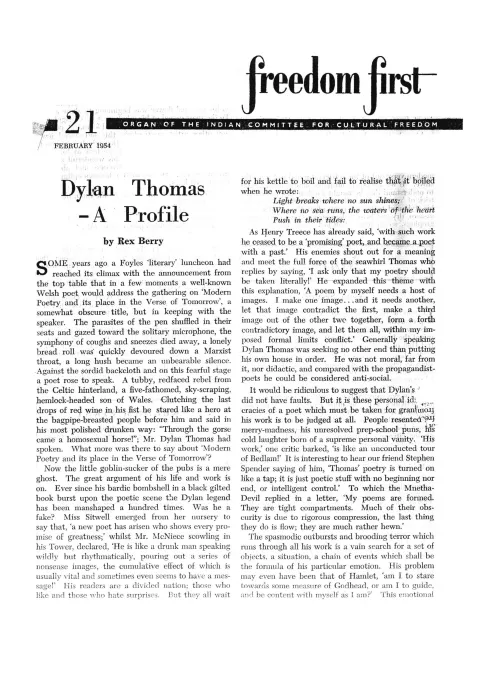
periodical issue
Freedom First
By Narie Oliaji, From A Contributor, Bruno Shaw, J. B. H. Wadia, Faiz Noorani, F. R. Bharucha, R. H., N. D. O.
Printed & Published by Narie Oliaji at The Kanada Press, 109, Parsi Bazaar Street, Bombay [1] · Bombay · 1953
12 pages
Freedom First
Summary
This is the complete December 1953 issue (No. 19) of Freedom First, the monthly bulletin of the Indian Committee for Cultural Freedom, edited by Faiz Noorani and printed in Bombay. The issue mixes cultural commentary, anti-communist polemic, and domestic political commentary. Narie Oliaji opens with an essay on whether art has a purpose, rejecting Proudhon’s utilitarian view of art in favour of Zola’s idea that art transforms rather than merely serves. An unsigned Notes section comments on the Assam tribal incident, Ramon Magsaysay’s election as President of the Philippines, film censorship and state prizes for art, a U.S. Army War Crimes Division report on Korean War atrocities, Justice P. B. Mukharji’s inquiry into a Calcutta press-police clash, and a sardonic item on Cheddi Jagan and Forbes Burnham’s calypso-themed anti-imperialist tour. An anonymous contributor’s ‘The Limits Of A United Front’ criticises the Praja Socialist Party’s Travancore-Cochin electoral arrangement with the Communist Party as a dangerous first step toward a full alliance. Bruno Shaw’s ‘The Saga Of Wang Ti-chiu’ (reprinted from The New Leader) narrates the story of a Chinese POW from the Korean War who rejected repatriation to Communist China. J. B. H. Wadia’s ‘The New Humanism: A Plea’ criticises the ICCF’s own second conference for retreating into praise of restraint and religious tradition (citing Rajaji and Sampurnanandji’s speeches) and argues instead for M. N. Roy’s philosophy of Radical/New Humanism as the basis of cultural freedom. Faiz Noorani’s ‘Nothing Left For Communists To Destroy?’ rebuts a despairing correspondent’s threat to vote Communist out of frustration with the ruling regime, defending India’s young democracy as slow but self-correcting. A Review section covers four books/journals: a symposium on Soviet Science, Carsun Chang’s The Third Force in China, Karl Jaspers’ Tragedy Is Not Enough, and the Pacific Spectator’s Summer 1953 issue. A C.C.F. News section reports on Raymond Aron’s November tour of Indian cities and the publication of the Madras ICCF conference proceedings. The issue closes with ‘With Many Voices,’ a column of quoted press clippings and quips on Cold War and Indian political topics, a subscription/enrolment form for the Indian Committee for Cultural Freedom, and the continuation of Noorani’s essay.
Key points
-
Narie Oliaji’s “Has Art A Purpose?” rejects Proudhon’s utilitarian view that art must serve humanity’s uplift, preferring Zola’s definition of art as transformation rather than imitation, and praises Shakespeare for never taking political sides.
-
The “Notes” section urges sympathetic treatment of Assam’s Dafla tribesmen, welcomes Ramon Magsaysay’s election in the Philippines, and reports the US Army’s tally of 29,815 victims of Communist Korean War atrocities.
-
An anonymous contributor’s “The Limits Of A United Front” condemns the Praja Socialist Party’s Travancore-Cochin seat-sharing arrangement with Communists as the “thin end of the wedge” toward blurring democratic-communist moral distinctions.
-
Bruno Shaw’s “The Saga Of Wang Ti-chiu” narrates a young Chinese POW’s defection from Communist indoctrination, framing the roughly 16,000 Chinese and 6,300 Korean POWs who refused repatriation as proof Communism could not hold its soldiers’ loyalty.
-
J. B. H. Wadia’s “The New Humanism: A Plea” criticises the ICCF’s own conference speeches for urging acceptance of traditional restraints, proposing M. N. Roy’s Radical Humanism, centred on the sanctity of the individual, as cultural freedom’s proper programme.
-
Faiz Noorani’s “Nothing Left For Communists To Destroy?” argues democracy’s key advantage over dictatorship is that it can be voted out, urging patience over a protest vote for Communism.
-
A review section covers a Soviet Science symposium showing politically distorted genetics research, Carsun Chang’s “The Third Force in China,” and Karl Jaspers’s “Tragedy Is Not Enough.”
Essays
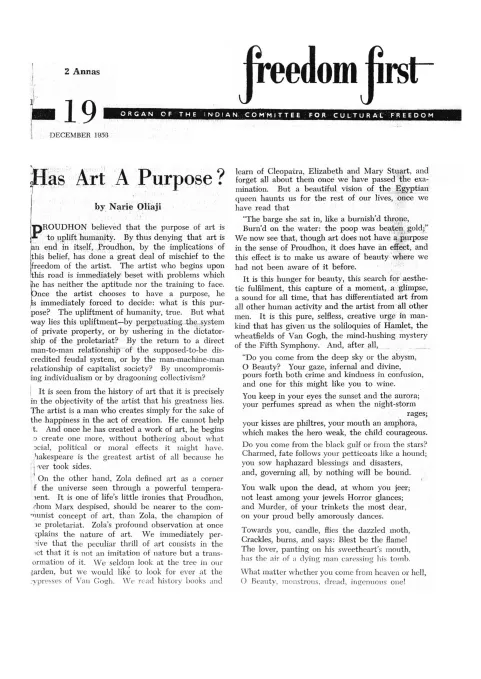
Has Art A Purpose?
By Narie Oliaji
Narie Oliaji argues against Proudhon’s claim that art must serve a purpose (the uplift of humanity), holding that this doctrine forces artists into political binds and constrains their freedom. Zola’s definition of art as nature seen through a temperament is preferred: art transforms rather than merely imitates, and its value lies in awakening a hunger for beauty rather than serving any social, political or moral end. Shakespeare is praised as the greatest artist precisely because he never took sides. The essay closes by quoting a Baudelaire poem on Beauty at length.
- Proudhon’s view that art’s purpose is to uplift humanity is rejected as constraining the artist’s freedom.
- Zola’s definition of art as ‘a corner of the universe seen through a powerful temperament’ is endorsed as explaining art’s true nature.
- Art’s distinguishing feature is that it transforms rather than imitates nature.
- Shakespeare is held up as the greatest artist because he never took political or moral sides.
- The essay closes with an extended verbatim quotation from a Baudelaire poem on Beauty.
Notes (The Assam Incident / Philippines Election / Bread And Circuses / War Crimes / Liberty Of The Press / Their Song For Us)
An unsigned Notes column covering five items: the Assam Rifles/Dafla tribesmen incident, urging sympathetic and non-punitive handling of tribal peoples; the election of Ramon Magsaysay as President of the Philippines, praised for his anti-communist and anti-corruption record as Defence Minister; a critique of the Bombay government’s practice of awarding state prizes for plays and films, arguing art needs no state patronage; a report on the U.S. Army’s War Crimes Division findings on Korean War atrocities by Chinese/North Korean forces; a summary and endorsement of Justice P. B. Mukharji’s finding that the Calcutta press had misconceived ‘liberty of the press’ as license to defy police in a Section 144 case; and a sardonic item on Cheddi Jagan and Forbes Burnham’s calypso-style anti-imperialist speaking tour outside British Guiana.
- The Assam Rifles/Dafla tribesmen clash is used to reaffirm the ICCF Madras resolution calling for a sympathetic, non-punitive approach to tribal peoples.
- Ramon Magsaysay’s election as Philippines President is welcomed as an anti-communist milestone comparable to Adenauer’s in Germany.
- State prizes for films and plays are criticised: art needs no state patronage and is its own justification.
- The U.S. Army War Crimes Division report tallies 29,815 victims of Communist Korean War atrocities, including the Taejon massacre.
- Justice Mukharji’s inquiry into a Calcutta press-police clash concluded the press had wrongly claimed a right to defy a Section 144 order.
- A satirical note treats Cheddi Jagan and Forbes Burnham’s overseas anti-imperialist tour as an unconvincing ‘calypso’ performance.
The Limits Of A United Front
By From A Contributor
An anonymous contributor criticises the Praja Socialist Party’s National Executive decision to permit its Travancore-Cochin branch an electoral seat-sharing arrangement with the Communist Party, arguing this crosses the line from legitimate inter-party competition into collaboration with a totalitarian force. The essay traces the socialists’ longstanding policy of non-cooperation with communists back to Jayaprakash Narayan’s ‘Never again’ pledge after his obituary for Communist-Socialist cooperation in the 1930s, and warns that even a limited seat-sharing arrangement is ‘the thin end of the wedge’ that blurs the moral distinction between democrats and communists, ultimately aiding communist subversion of democratic institutions.
- The PSP Executive’s decision to let its Travancore-Cochin unit share seats with communists is condemned as stepping beyond legitimate democratic party competition.
- Historical precedent is invoked: Jayaprakash Narayan’s 1930s obituary for Communist-Socialist cooperation and his ‘Never again’ pledge.
- The essay argues that blurring moral distinctions between democratic and communist parties favours communist subversion of democracy.
- Two-cornered contests are endorsed only when both contestants are committed to democratic principles; alliances with totalitarian parties are condemned regardless of scale.
- The essay expresses hope the forthcoming PSP Convention will reject any such alliance.
The Saga Of Wang Ti-chiu
By Bruno Shaw
Bruno Shaw’s article, reprinted from The New Leader, narrates the story of Wang Ti-chiu, a 24-year-old Chinese peasant soldier from Honan who fought in the Korean War, grew disillusioned with Communist indoctrination and wartime hardship after reading a UN safe-conduct leaflet, and eventually defected with a small group of comrades to the enemy side, finding the leaflet’s promises true. The piece situates Wang as one of roughly 16,000 Chinese and 6,300 Korean POWs who elected to reject repatriation to Communist territory under the Neutral Nations Repatriation Commission, framing their choice as evidence of communism’s failure to hold the loyalty of its own soldiers.
- Wang Ti-chiu is a 24-year-old Chinese peasant soldier from Honan whose family suffered land confiscation and indoctrination under Communist rule.
- He was taught obedience to ‘Father Mao’ and ‘Brother Stalin’ and to report even his parents’ ‘unpatriotic acts.’
- Battle hardship and a UN safe-conduct leaflet led him and a small group to defect to UN forces rather than remain with Communist Chinese forces.
- He is presented as one of about 16,000 Chinese and 6,300 Korean POWs who refused repatriation under the Neutral Nations Repatriation Commission.
- The article frames mass non-repatriation as proof that Communism could not command the loyalty of its own soldiers.
The New Humanism: A Plea
By J. B. H. Wadia
J. B. H. Wadia, a sponsor of the first ICCF conference, expresses disappointment that the speeches of Rajaji (C. Rajagopalachari) and Sampurnanandji at the second conference urged acceptance of restraints and traditional Indian religious/philosophical frameworks (including Varnashrama Dharma) as remedies for India’s social malaise, which he sees as a betrayal of cultural freedom’s spirit. He challenges the selective use of scriptural quotation to defend restraint, invoking the materialist/atheist schools of Indian philosophy (Charvaka, Kapila, Lokayatta) as equally ‘Indian’ as Vedanta. He proposes M. N. Roy’s philosophy of New (Radical) Humanism — grounded in the sanctity of the individual and freedom from restraints — as the true programmatic answer to cultural freedom’s challenge, and closes urging the ICCF to remain firmly anti-communist without lapsing into religious or traditionalist reaction.
- Wadia criticises Rajaji and Sampurnanandji’s second-conference speeches for urging ‘joy and pride’ in restraints and traditional religious frameworks.
- He objects specifically to invoking Varnashrama Dharma, associating it with the caste system and untouchability.
- He argues selective scriptural quotation is an unfruitful method, citing the materialist Charvaka and Lokayatta schools as counter-examples within the Indian tradition.
- He proposes M. N. Roy’s philosophy of New Humanism, centred on the sanctity of the individual, as cultural freedom’s proper programme.
- He warns that anti-communism must not curdle into religious or traditionalist reaction, since ICCF members are ‘anti-totalitarian’ on all fronts.
Nothing Left For Communists To Destroy?
By Faiz Noorani
Faiz Noorani responds to a despairing correspondent who wrote that he would vote Communist purely to punish the current government, arguing that such a vote would strengthen a foreign-controlled conspiracy and that democracy, while slow and imperfect, retains the crucial advantage of being reversible through free elections, unlike Communist dictatorship. Noorani surveys the achievements of independent India (a democratic constitution, guaranteed rights, industrial and production gains) alongside its shortcomings (illiteracy, inexperience, lack of informed public opinion), drawing on an Oxford University survey of the 1950 British general election to argue that democratic maturity takes time even in established democracies. He closes by warning that revolution and violence lead to outcomes worse than what they replace, and that India’s citizens must exercise patience and their existing right to change government through elections rather than gamble on communism.
- Noorani responds to a reader’s threat to vote Communist purely out of frustration with the current government.
- He argues democracy’s key advantage over dictatorship is that it can be voted out, while a communist takeover would be irrevocable.
- He lists national independence, rule of law, free press, and an electorate conscious of its rights and responsibilities as democracy’s essential elements.
- He cites an Oxford University survey of the 1950 British general election to argue that democratic maturity takes time even in advanced democracies.
- He warns that revolution and violence typically produce outcomes worse than the conditions they sought to replace.
Review: Soviet Science
By F. R. Bharucha
A Review section presents four short unsigned or initialed reviews. F. R. Bharucha reviews Soviet Science (a 1951 AAAS Philadelphia symposium, published 1952), noting that Soviet research, especially in genetics, is politically directed and that even the U.S. shows troubling parallels in its screening of atomic scientists, though it otherwise preserves greater scientific freedom. F.S.N. reviews Carsun Chang’s The Third Force in China, praising its scholarly, unbiased account of the failed Chinese ‘third force’ between the Kuomintang and the communists, and its critique of Sardar Panikkar’s and Sir Benegal Rau’s views on India-China relations. R.H. reviews Karl Jaspers’ Tragedy Is Not Enough, situating Jaspers among Existentialist thinkers second only to Heidegger and examining his account of tragedy through Oedipus and Hamlet. N.D.O. reviews the Pacific Spectator’s Summer 1953 issue, noting its three India-related items (an article on Tamil life and letters and two short stories) alongside pieces by Henry R. Luce and an essay on Gogol’s centenary.
- Soviet Science (AAAS symposium) is reviewed as showing Soviet research, especially genetics, distorted by state political control.
- The reviewer notes the U.S. screening of atomic scientists shows some parallel constraint, though American science otherwise remains freer.
- Carsun Chang’s The Third Force in China is praised as a scholarly, unbiased chronicle of China’s failed democratic middle path between Kuomintang and communists.
- Karl Jaspers’ Tragedy Is Not Enough is reviewed as a translated excerpt of his larger work Von der Wahrheit, ranking him just below Heidegger among Existentialists.
- The Pacific Spectator’s Summer 1953 issue is noted for featuring three India-related items among ten total, including work on Tamil life and letters.
Review: The Third Force in China
By F. S. N.
The C.C.F. News column reports two items: a note on Raymond Aron’s November visit to India as a representative of the Congress for Cultural Freedom’s International Executive, touring Calcutta, Nagpur, Madras, Bangalore, Bombay and Delhi and addressing meetings on topics from French literature to Marxism; and an announcement that the Proceedings of the Indian Committee for Cultural Freedom’s Annual Conference held in Madras, including addresses by C. Rajagopalachari, Sampurnanand, and M. Bhaktavatsalam, have been published in book form and are available for Rs. 2/8.
- Raymond Aron, of the Congress for Cultural Freedom’s International Executive, toured Calcutta, Nagpur, Madras, Bangalore, Bombay and Delhi in November 1953.
- Aron addressed meetings on subjects ranging from ‘Contemporary Trends in French Literature’ to ‘Marxism from Marx to Malenkov.’
- The Madras ICCF Annual Conference Proceedings, including addresses by Rajagopalachari, Sampurnanand and M. Bhaktavatsalam, have been published and are available for purchase.
Review: Tragedy Is Not Enough
By R. H.
The closing ‘With Many Voices’ column collects a series of press clippings and quotations on Cold War and Indian political topics, including an exchange between a Briton and Winston Churchill on foreign aid, Prof. George Catlin on American isolationism, Sir John Kotelawala on hartals and revolution, Ramon Magsaysay on collective security against communism, M. Ananthasayanam Ayyengar’s remark that ‘every quarelling Congressman is an unpaid agent of the Communist Party,’ a Pan Mun Jon dispatch on Korean War POW repatriation refusal statistics, an arrest of a student for satyagraha at a Mahatma Gandhi college in Trivandrum, Lord Swinton on Britain’s recognition of Nehru, and a quip equating communism with pregnancy (‘there is no such thing as partly’). The page also carries an Indian Committee for Cultural Freedom membership enrolment form and the continuation of Noorani’s essay from page 9.
- The column collects short quoted press items from Times of India, New Leader, Indian Express, Bombay Chronicle, Evening News of India, Free Press Bulletin, and the London Times/Statesman.
- Items span Cold War rhetoric, Korean War POW repatriation statistics, and Indian political commentary.
- M. Ananthasayanam Ayyengar is quoted calling every quarrelling Congressman ‘an unpaid agent of the Communist Party.’
- A Pan Mun Jon dispatch reports that only 59 of 1,872 prisoners hearing Communist explanations had accepted repatriation as of November 4.
- The page also carries an ICCF membership enrolment form and the continuation of Noorani’s ‘Nothing Left For Communists To Destroy?’ essay.
Generated by the v1.5 extraction pipeline. Awaiting editorial review.
Metadata and summary are AI-extracted from the source PDF and reviewed for editorial accuracy. The original work is available via the Read PDF tab above (where present); paragraph-level citation inside the PDF is deferred to a future engagement.