periodical issue
Freedom First
Indian Committee for Cultural Freedom, 127 Mahatma Gandhi Road, Bombay 1; printed & published by Prabhakar Padhye at The Kanada Press, 109 Parsi Bazaar Street, Bombay 1 · Bombay · 1954
12 pages
Freedom First
Summary
This is the January 1954 issue (No. 20) of Freedom First, the monthly bulletin of the Indian Committee for Cultural Freedom, published from Bombay. The issue opens with a lead essay by C. Rajagopalachari, “Hindu Philosophy In A Modern State,” arguing that Vedanta and the Bhagavad Gita’s doctrine of Karma-Yoga (disinterested, detached work) supply a spiritual foundation uniquely suited to a modern regulated economy, and defending Hindu philosophy’s compatibility with science, catholicity of worship, and true (non-fatalistic) renunciation. A substantial “Notes” section covers current affairs: India’s abstention on the UN Committee on Forced Labour’s report on Soviet practices, student indiscipline and educational decline, a tribute to W. Somerset Maugham’s 80th birthday, the plight of 400,000 unrepatriated prisoners of war held by the USSR, the Bermuda-to-Berlin diplomatic sequence with the Soviet bloc, and a satirical piece on self-styled Bombay theatre producers. Two further signed pieces address the arts: an unsigned “Postscript On Eugene O’Neill” surveying his dramatic career and stylistic restlessness, and T. V. Subba Rao’s “Freedom Of Self-Expression,” which uses the Carnatic composer Tyagaraja and the concept of the raga to argue that true artistic freedom operates within, not against, inherited tradition. The issue closes with book reviews (of ‘Vivek’s’ India Without Illusions and Raja Hutheesing’s Window on China), brief notices of new books, a note on the founding of the Ceylon Committee for Cultural Freedom, and a “With Many Voices” page of press quotations on Cold War politics, ending with a membership form for the Indian Committee for Cultural Freedom.
Key points
-
C. Rajagopalachari’s “Hindu Philosophy In A Modern State” reads the Gita’s doctrine of Karma-Yoga as the spiritual basis for a regulated, non-competitive modern economy, and distinguishes Karma from fatalism as “the truest charter of freedom and initiative.”
-
The “Notes” section criticises India’s UN abstention on the Committee on Forced Labour’s report on Soviet practices, links student indiscipline to Communist exploitation of unrest, and highlights roughly 400,000 West German, Japanese and Italian nationals still held in Soviet territory.
-
An unsigned appreciation, “A Postscript On Eugene O’Neill,” surveys O’Neill’s restless movement between dramatic styles, judging “Mourning Becomes Electra” his closest approach to true tragic purpose.
-
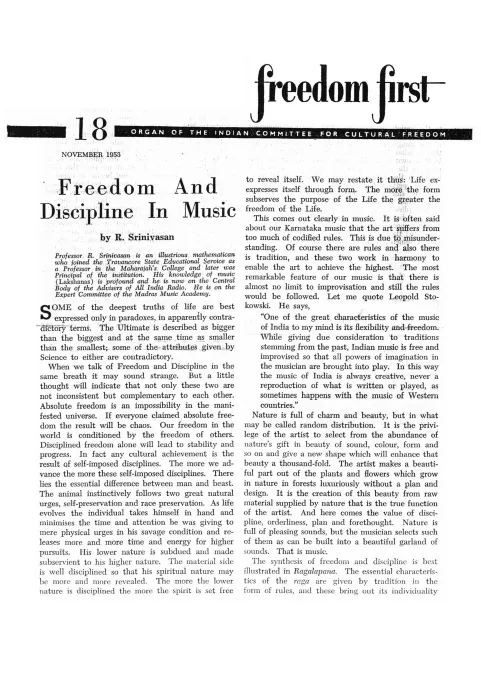
T. V. Subba Rao’s “Freedom Of Self-Expression” uses the Carnatic composer Tyagaraja to argue that true artistic freedom operates within, not against, inherited tradition.
-
Faiz Noorani reviews ‘Vivek’s’ “India Without Illusions,” praising its forthright realism about India’s professed neutrality, while Aziz Madni reviews Raja Hutheesing’s “Window on China” as a detached, non-propagandistic account of two visits to Mao’s China.
-
The issue notes the founding of the Ceylon Committee for Cultural Freedom, inaugurated in Colombo on 17 November 1953.
Essays
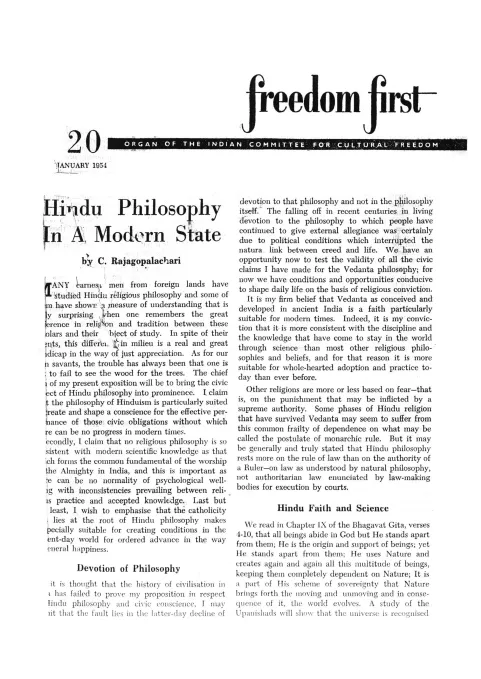
Hindu Philosophy In A Modern State
By C. Rajagopalachari
Rajagopalachari argues that Hindu philosophy, properly understood, is exceptionally well suited to shaping the civic conscience of a modern state. He claims Vedanta anticipated modern scientific ideas (evolution, the conservation of energy) and rests on the rule of law rather than fear of an arbitrary God. The essay’s central move is to read the Bhagavad Gita’s doctrine of Karma-Yoga — work performed as duty and offering, without attachment to its fruits or to profit — as the spiritual basis needed for a ‘regulated’, non-competitive economy that has replaced the profit motive across the modern world. He warns that movements which sought economic revolution by discarding religion as an ‘opiate’ committed a suicidal error, since only a spiritual faith, not state compulsion, can sustain genuinely unselfish conduct. He then defends Hindu catholicity (tolerance of all forms of worship as valid paths to God) as the doctrine’s most valuable inheritance, and devotes a long section to rebutting the charge that Hinduism preaches fatalism: he distinguishes Karma (the moral law of cause and effect, compatible with free will and effort) from Fatalism, and argues that Grace and Karma are not contradictory, since penitence itself is an effortful, rewarded act. The essay ends by linking Karma-doctrine to Gandhi’s example, addressing the objection that a self identifying with future rebirths lacks memory-based motivation (answered via the intrinsic ‘joy of right conduct’), and closing with a vision of ever-widening circles of cooperation — from village to patriotism to Vedanta — as the basis for a better, self-regulating world order that does not need to rely on the coercive power of the state.
- Argues Hindu/Vedantic philosophy anticipated modern scientific concepts (evolution, conservation of energy) and rests on natural law rather than fear of an authoritarian deity
- Reads the Gita’s Karma-Yoga (detached, dutiful work, not for profit) as the spiritual basis needed to sustain a regulated, non-competitive modern economy
- Warns that revolutionary movements which discarded religion as an ‘opiate’ to enable economic upheaval committed a suicidal, ultimately unsustainable error
- Defends Hindu catholicity — tolerance of all forms of worship as valid paths to one God — as compatible with, not opposed to, modern pluralist civic life
- Distinguishes Karma (the moral law of cause and effect, compatible with free will and effort) from Fatalism, arguing Karma is ‘the truest charter of freedom and initiative’
- Reconciles the doctrines of Grace and Karma, arguing penitence is itself an effortful act rewarded within the law of Karma
- Cites Gandhi’s life as evidence that this philosophy inspires real-world civic resolve and fearlessness
- Closes with an image of concentric cooperation — village, patriotism, Vedanta — producing a better world without relying on state compulsion
Notes (India and Forced Labour; Students and Discipline; W. Somerset Maugham; Mislaid: 400,000 Souls; Bermuda to Berlin; Art for Who’s Sake?)
A miscellany of unsigned editorial notes on current affairs. Items include a sharp criticism of India’s abstention (rather than condemnation) in the UN vote on the Committee on Forced Labour’s report documenting Soviet forced-labour practices, contrasted with India’s readiness to criticize Western colonial powers; a piece on student indiscipline in Indian universities linking it to declining educational standards and Communist exploitation of student unrest (quoting Congress politician Sampurnanand approvingly); a birthday tribute to W. Somerset Maugham on turning eighty; a note titled ‘Mislaid: 400,000 Souls’ on West German, Japanese, and Italian citizens still held in Soviet territory; a review of the Bermuda conference communique and the prospects for the upcoming Berlin conference with the Soviets, expressing skepticism that compromise will be possible except on Soviet terms; and a satirical sketch, ‘Art for Who’s Sake?’, mocking self-promoting Bombay theatre producers.
- Criticizes India’s abstention in the UN vote on the Committee on Forced Labour’s report on Soviet forced-labour practices as inconsistent with India’s readiness to criticize Western colonial powers
- Links recent student indiscipline in Indian universities to a broader decline in educational standards and to Communist exploitation of student unrest
- Marks W. Somerset Maugham’s 80th birthday with praise for his apolitical, unpolemical fiction
- Highlights the unresolved issue of roughly 400,000 West German, Japanese, Italian, and Austrian nationals still held in Soviet territory since WWII
- Assesses the Bermuda ‘Big Three’ communique and expresses skepticism about the prospects for the planned Berlin conference with the USSR
- Satirizes self-promoting amateur theatre producers in contemporary Bombay
A Postscript On Eugene O’Neill
An unsigned appreciation of Eugene O’Neill’s dramatic career, arguing that O’Neill lacked the ‘perfect adjustment’ between desire and stagecraft achieved by Sophocles, Aeschylus, and Shakespeare, and instead moved restlessly between styles (realism, expressionism, masks, marathon-length plays, a nine-play cycle) out of an unconscious recognition of his limits as a literary stylist. The piece traces his development from Beyond the Horizon and The Emperor Jones through The Hairy Ape and All God’s Chillun Got Wings to the two late trilogies, Strange Interlude and Mourning Becomes Electra, judging the latter his closest approach to true tragic purpose, before closing on his late, disease-hampered career (The Iceman Cometh, A Moon for the Misbegotten) and an overall verdict that O’Neill had genius but lacked the ‘final element of power and balance out of which greatness is born.’
- Argues O’Neill, unlike Sophocles, Aeschylus, or Shakespeare, never achieved a perfect fit between his dramatic ambition and the stage, and restlessly tried nearly every theatrical style
- Traces his stylistic evolution from Beyond the Horizon and The Emperor Jones through expressionist works (The Hairy Ape, All God’s Chillun Got Wings) to the trilogies
- Judges Mourning Becomes Electra his closest approach to true tragic purpose, more successful than the Freudian-inflected Strange Interlude
- Criticizes O’Neill’s reliance on exclamation marks and ‘sharp cries, broken phrases’ rather than language of real beauty
- Notes his late career was hampered by a palsy-like illness, yielding The Iceman Cometh and the then-unstaged A Moon for the Misbegotten
- Concludes O’Neill had genuine dramatic stature and genius but lacked the final quality from which greatness is born
Freedom Of Self-Expression
By T. V. Subba Rao
T. V. Subba Rao argues that freedom is meaningful only in tension with restraint, and illustrates this through the life and work of the Carnatic composer Tyagaraja, whom he presents as the supreme embodiment of creative self-expression reconciled with tradition. Tyagaraja’s genius lay in transforming the Kirtana into a vehicle flexible enough to contain every other compositional form, and in inventing the improvisatory Manodharma Sangita, yet his devotion, his reverence for elders and the Purvacharyas, and his refusal to depart from traditional scales and rhythms show that his freedom operated within inherited constraint rather than against it. The essay extends this argument to the raga and the alap as Indian music’s purest expression of creative freedom-within-form, and closes with a broader claim that censorship, when exercised by people of taste, is a legitimate restraint, while the greater danger to freedom is not restraint itself but the absence of it, which degenerates into licentiousness and chaos.
- Frames freedom and restraint as forces that must be harmonized; unqualified freedom is ‘unthinkable in practical life’
- Presents Tyagaraja as the supreme reconciliation of creative liberty and traditional restraint in Carnatic music
- Credits Tyagaraja with transforming the Kirtana into an elastic form capable of embodying all other compositional types, and with inventing Manodharma Sangita (improvisatory music)
- Argues Tyagaraja’s reverence for tradition and for the Purvacharyas (predecessor teachers) shows freedom flourishing through, not against, inherited form
- Holds up the raga and the alap as the purest embodiment of freedom-within-form in Indian art
- Concludes that the worst enemy of freedom is the lack of wholesome restraint, which causes it to degenerate into licentiousness and chaos
Review: India Without Illusions (by ‘Vivek’)
By Faiz Noorani
A review section covering two books. Faiz Noorani reviews ‘Vivek’s’ India Without Illusions (New Book Co., 1953), a collection of the pseudonymous columnist’s Times of India articles, praising its ‘forthright and serious’ realism about India’s foreign policy of neutrality (including a cited Mao Tse-tung line that ‘a third way does not exist’) and its treatment of domestic problems from over-population to corruption and prohibition, while noting disagreement with the author’s assessment of Sardar Patel and of economic planning. Aziz Madni reviews Raja Hutheesing’s Window on China (Casement Publications, 1953), an account of the author’s two visits to Mao’s China as part of the India-China Friendship Association delegation, praising its detached, unsentimental honesty about both the promises and the brutal costs of Communist rule, and closing on the observation that no Communist dictatorship, once clamped down, has ever been broken up from within. A shorter ‘Books in Brief’ column (by R.H.) surveys new titles including a Sartre excerpt on existential psychoanalysis, Andre Malraux’s The Voices of Silence, Maria Bellonci’s Lucrezia Borgia, and works by Walter de la Mare and E. H. Ramsden.
- Faiz Noorani praises ‘Vivek’s’ India Without Illusions for forthright realism about India’s foreign policy of professed neutrality amid Cold War pressures
- The review cites Mao Tse-tung’s line that ‘Neutrality is a facade and a third way does not exist’ as central to Vivek’s argument
- Noorani disagrees with Vivek’s estimate of Sardar Patel and of economic planning but calls the book’s broader argument forceful
- Aziz Madni reviews Raja Hutheesing’s Window on China as a detached, non-propagandistic firsthand account from two visits (1951 and a later visit) as part of an India-China Friendship Association delegation
- Madni notes the book’s three parts cover the delegation’s Peking visit, Chinese economy under land reform, and ‘Chinese Democracy’, with a closing observation that no Communist dictatorship has been broken from within except by war or comparable upheaval
- Books in Brief column surveys new releases including a Sartre excerpt, Malraux’s The Voices of Silence, and Maria Bellonci’s Lucrezia Borgia
Review: Window on China (by Raja Hutheesing)
By Aziz Madni
The issue’s closing page, ‘With Many Voices,’ is a compilation of short press quotations on Cold War and international politics from November-December 1953 — covering Soviet diplomatic posture, Korean POW disputes, Asian solidarity, and Communist Party statements in India and Ceylon — framed by an epigraph from Tennyson. The page is followed by a note that the Ceylon Committee for Cultural Freedom was inaugurated in Colombo on November 17, 1953, and a membership enrollment form for the Indian Committee for Cultural Freedom.
- Compiles press quotations from November-December 1953 on Soviet diplomatic posture, Korean POW negotiations, and Communist statements in India and Ceylon
- Includes a quotation from Sir John Kotelawala, Prime Minister of Ceylon, on tolerating all opposition parties except the Communist Party
- Notes the Ceylon Committee for Cultural Freedom was inaugurated in Colombo on November 17, 1953 by J. R. Jayawardene
- Closes the issue with a membership enrollment form for the Indian Committee for Cultural Freedom
Generated by the v1.5 extraction pipeline. Awaiting editorial review.
Metadata and summary are AI-extracted from the source PDF and reviewed for editorial accuracy. The original work is available via the Read PDF tab above (where present); paragraph-level citation inside the PDF is deferred to a future engagement.