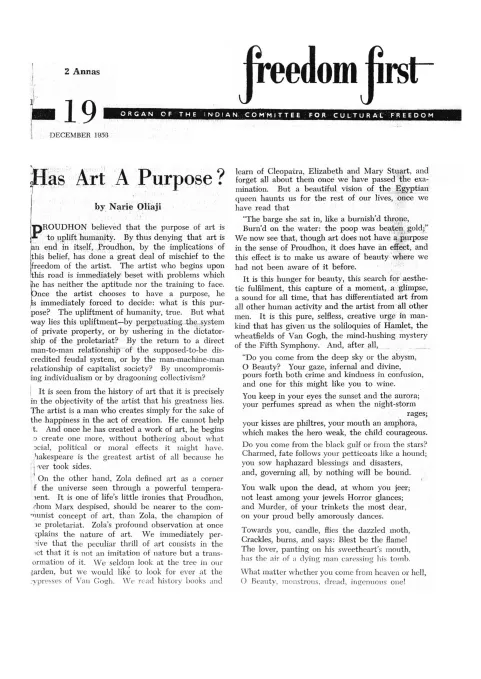
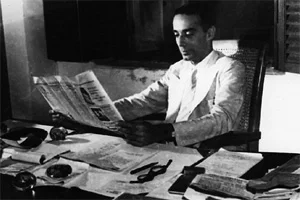
periodical issue
Freedom First
Organ of the Indian Committee for Cultural Freedom
By Rex Berry, John S. Connor, S. M. Shakoor, B. A., N.D.O., F. S. N., R. H.
printed & published by Prabhakar Padhye at The Kanada Press, 109 Parsi Bazaar Street, Bombay 1 · Bombay · 1954
12 pages
Freedom First
Summary
This is the complete February 1954 issue (No. 21) of Freedom First, the monthly bulletin of the Indian Committee for Cultural Freedom, published from Bombay and affiliated to the World Movement for Cultural Freedom. The issue mixes literary criticism, anti-communist political commentary, and arts reviews. Rex Berry profiles the poet Dylan Thomas, who had died in November 1953; John S. Connor surveys the historical rise of Liberalism from the Middle Ages through the 19th century as a prelude to critiquing contemporary ‘New Humanism’ and ‘Radical Humanism’ as disguised revivals of a discredited philosophy; and S. M. Shakoor, a Guianese trade unionist, gives a detailed insider account of the 1953 British Guiana constitutional crisis, arguing that Cheddi Jagan’s communist-led People’s Progressive Party subverted democratic trade unions and provoked the British government into suspending the colony’s constitution. An unsigned front-of-book ‘Notes’ section and the unsigned article ‘Embrace of Death’ cover Asian regional security, a Bombay Government order restricting English-medium school admissions, the repatriation of anti-communist Chinese/Korean POWs, an international legal conference in Delhi, warnings against politicised history textbooks, the treatment of Yugoslav dissident Milovan Djilas, and leaked correspondence exposing Communist Party of India tactics toward United Front partners ahead of the Travancore-Cochin elections. A ‘Review’ section covers a Soviet cultural delegation’s ballet and variety performance in Bombay, an exhibition of painter Shiavax Chavda’s work, and three book notices (Korean Tales, The Oliviers, and a ‘Books in Brief’ roundup covering Baudelaire, Yeats, Churchill’s war memoirs, Simenon, and G. S. Fraser). The issue closes with ‘With Many Voices,’ a column of pointed quotations from the contemporary press on Indian foreign policy, communism, and world affairs, followed by an ICCF membership form and colophon.
Key points
-
Rex Berry’s profile of Dylan Thomas, who had recently died, defends his poetic obscurity as a product of rigorous compression rather than lack of control.
-
John S. Connor’s essay on the new humanism traces Western Liberalism’s rise and its blind spots, arguing Marx synthesised Hegel, Feuerbach and Ricardo into Communism as Liberalism’s chief challenger, and frames “New Humanism” as an attempt to revive a philosophically bankrupt pragmatic liberalism.
-
S. M. Shakoor’s “The British Guiana Crisis” gives an insider account of Cheddi Jagan’s communist-led People’s Progressive Party capturing the colony’s trade unions and Assembly, prompting the British government to suspend the constitution.
-
The “Notes” section endorses Ceylon PM Kotelawala’s call for an Asian collective-security pact, condemns Bombay’s restriction of English-medium school admissions as unconstitutional “educational apartheid,” and reports leaked CPI correspondence exposing the “United Democratic Front” as a Leninist tactic to destroy, not ally with, socialist parties.
-
A review section covers a Soviet Cultural Delegation’s disappointing ballet performance in Bombay, painter Shiavax Chavda’s exhibition, and Melvin Voorhees’s “Korean Tales,” criticised for crude generalisations about “Oriental” peoples.
-
“Books in Brief” notes new titles on Baudelaire, unpublished Yeats correspondence, and the final volume of Churchill’s Second World War memoirs.
Essays
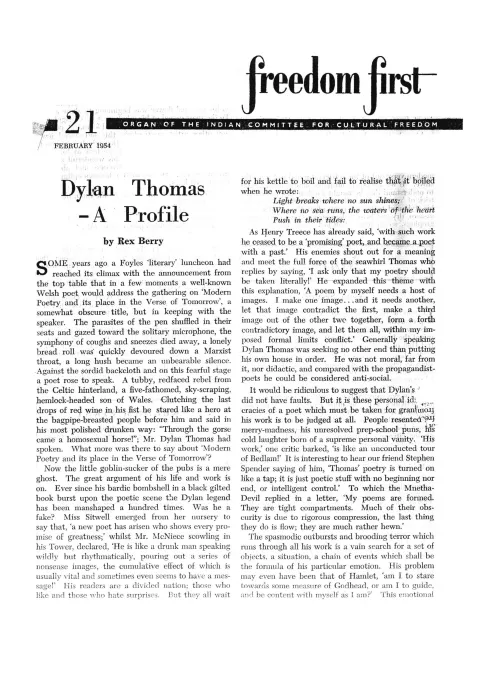
Dylan Thomas – A Profile
By Rex Berry
Rex Berry’s profile sketches Dylan Thomas as a poet who cultivated a public persona of bardic excess while producing dense, self-consciously ‘hewn’ verse that critics found either brilliant or incoherent. Berry surveys the range of contemporary critical reaction — from Edith Sitwell’s praise to Louis MacNeice’s ambivalence and Stephen Spender’s charge that the poetry lacked ‘beginning nor end, or intelligent control’ — and argues that Thomas’s obscurity was less a pose than the product of rigorous compression rather than free-flowing effusion. The piece closes by reporting Thomas’s recent death in a New York hospital and quoting several of his own lines as a fitting self-written epitaph.
- Opens with an anecdote of Thomas’s provocative behaviour at a Foyles literary luncheon
- Surveys divided contemporary critical opinion (Sitwell, MacNeice, Spender, Henry Treece)
- Argues Thomas sought no didactic or moral end, only to ‘put his own house in order’
- Defends Thomas’s obscurity as a product of compression, not lack of control, quoting a Thomas letter reply to Spender
- Reports Thomas’s death in a New York hospital and closes with his own verse as epitaph
The New Humanism—A Critique
By John S. Connor
An unsigned front-of-book ‘Notes’ section covering several current-affairs items. It welcomes the Ceylonese Prime Minister’s call for an Asian regional security pact against communist infiltration; criticises a Bombay Government order restricting English-medium school admission to Anglo-Indians and non-Asians as a violation of the Universal Declaration of Human Rights and the Indian Constitution, quoting Frank Anthony’s description of it as ‘educational apartheid’; welcomes the release of anti-communist Chinese and Korean prisoners of war despite communist propaganda efforts to prevent it; assesses a Delhi international legal conference as valuable mainly for its discussion of the UN Charter; warns against politicised, doctrinaire history teaching following an address by Dr. P. V. Kane; and expresses regret over the treatment of Yugoslav dissident Milovan Djilas, questioning the durability of Yugoslavia’s break from Stalinism. A closing item criticises the Praja Socialist Party’s flirtation with a United Front with communists in Travancore-Cochin as historically shortsighted.
- Endorses Ceylon PM Kotelawala’s call for an Asian collective-security pact against communism
- Condemns the Bombay Government’s restriction of English-school admissions as unconstitutional ‘educational apartheid’
- Welcomes release of anti-communist Chinese/Korean POWs as a propaganda defeat for communists
- Faults an international legal conference in Delhi for weak agenda focus but credits its UN Charter debate
- Warns against rewriting history for political ends, referencing Dr. P. V. Kane’s History Congress address
- Criticises Yugoslavia’s persecution of Milovan Djilas as a relapse toward Soviet-style repression
- Warns the Praja Socialist Party against repeating 1930s-style United Front collaboration with communists in Travancore-Cochin
The British Guiana Crisis
By S. M. Shakoor
This unsigned article reports a leaked correspondence, disclosed by the Democratic Research Service on the eve of Travancore-Cochin’s general elections, between Dr. N. M. Jaisoorya, M.P., and Mr. G. M. Shroff of the Hyderabad P.D.F. and the Central Committee of the Communist Party of India. The article argues the correspondence exposes the CPI’s ‘United Democratic Front’ strategy as a Leninist tactic to destroy, not ally with, socialist and other democratic parties, quoting Lenin’s own boast of giving ‘the embrace that killed’ to allied parties. It presents Jaisoorya and Shroff’s letter of complaint that CPI ‘working class leadership’ really means unaccountable CPI dominance enforced through ‘undemocratic methods and intrigues,’ and the CPI Central Committee’s dismissive, threatening reply accusing them of ‘anti-communist slanders’ and of being tools of ‘imperialists and feudal landlords.’
- Reports disclosure of secret CPI correspondence with Dr. N. M. Jaisoorya and G. M. Shroff ahead of Travancore-Cochin elections
- Frames the CPI’s ‘United Democratic Front’ proposal as a tactic to destroy allied socialist parties, not unite with them
- Quotes Lenin on Bolshevik alliance tactics with ‘bourgeois liberalism’ and British socialists
- Quotes Jaisoorya/Shroff’s letter alleging CPI leadership means unaccountable, undemocratic CPI dominance over the Front
- Quotes the CPI Central Committee’s reply accusing the pair of repeating ‘anti-communist slanders’ and serving ‘imperialists and feudal landlords’
Review (Ballet-Hoo; The Art of Chavda; Korean Tales; The Oliviers; Books in Brief)
By B.A. / N.D.O. / F.S.N. / R.H.
John S. Connor traces the historical development of Western Liberalism from a revolt against medieval religious and spiritual authority, through the consolidation of a materialist, property-centred legal and economic order by the close of the 17th century, to its ‘triumphant epoch’ in the 19th century when freedom of contract and laissez-faire were elevated into unassailable doctrine. Connor argues that this classical Liberalism, for all its achievements, left the propertyless masses without real liberation and produced the conditions — via Marx’s synthesis of Hegel, Feuerbach, and Ricardo — that gave rise to Communism as a reaction. The essay (whose second half, not covered by the essay’s own title discussion here, argues against ‘New Humanism’ as a naive attempt to revive discredited Liberal humanist assumptions) closes by warning that the same intellectual carelessness that let Communism arise now threatens to give the ‘New Humanism’ undeserved credibility.
- Traces Liberalism’s origin to a revolt against religious/spiritual authority in the early modern period
- Describes the emergence by the 17th century of a materialist, self-sufficient, property-focused legal-political order
- Argues 19th-century Liberalism’s freedom of contract doctrine left the propertyless working masses effectively unliberated
- Credits (critically) Marx with synthesising Hegel’s dialectics, Feuerbach’s materialism, Proudhon’s sociology and Ricardo’s economics into Communism as Liberalism’s chief challenger
- Frames ‘New Humanism’ and ‘Radical Humanism’ as attempts to revive a philosophically bankrupt pragmatic liberalism under new names
Embrace Of Death (unsigned editorial)
S. M. Shakoor, described as a prominent Guianese trade unionist, gives an inside account of the 1953 British Guiana constitutional crisis following Dr. Cheddi Jagan’s tour of India. He traces the history of trade unionism in the colony from Hubert Critchlow’s founding of the British Guiana Labour Union through the 1940s rise of the Man-Power Citizens’ Association, and describes how Dr. J. P. Lachhmansingh’s rival Guiana Industrial Workers’ Union, backed by Cheddi and Janet Jagan and Forbes Burnham (both said to have absorbed communist doctrine), gained ground through wildcat strikes and eventually captured 18 of 24 Assembly seats via the communist-dominated People’s Progressive Party. Shakoor recounts the PPP government’s controversial legislative agenda — including a resolution on the Rosenbergs, repeal of a ban on communist literature, a compulsory land-cultivation bill, and the contentious Labour Relations Bill — culminating in the British Government’s dispatch of troops and warships and the Governor’s suspension of the five-month-old constitution. He frames the episode as a warning about communist subversion of trade unions and calls on international trade unionists to help the free unions rebuild.
- Introduces context: Cheddi Jagan’s recent tour of India prompted this explanatory account by a fellow Guianese trade unionist
- Traces the colony’s trade union history from Hubert Critchlow’s B.G. Labour Union through the Man-Power Citizens’ Association’s sugar-industry gains
- Describes Dr. J. P. Lachhmansingh’s rival Guiana Industrial Workers’ Union and its communist backers, including Cheddi and Janet Jagan and Forbes Burnham
- Details the PPP government’s 18-of-24-seat Assembly majority and its controversial legislative programme
- Covers the 25-day sugar strike, the Labour Relations Bill controversy, and the Speaker’s refusal to suspend standing rules
- Recounts the British Government’s dispatch of troops/warships and the Governor’s suspension of the constitution
- Closes with a call for outside trade union help to rebuild free unions in British Guiana
Notes (Asian Security; Freedom in Education; At Last; International Legal Conference; On Re-Writing History; Relapse?)
A miscellany ‘Review’ section with four items. B.A. reviews a Soviet Cultural Delegation’s ballet and variety performance at Bombay’s Excelsior Theatre, finding the eclectic mixed programme disappointing overall, criticising ballerina Maya Plietskaya’s technique and mocking the audience’s enthusiastic reception of a mangled rendition of Iqbal’s national song. N.D.O. profiles painter Shiavax Chavda’s eleventh one-man exhibition in Bombay, praising his independence from political and artistic cliques and his documentation of Hindu temples in Indonesia. F.S.N. pans Melvin B. Voorhees’s Korean Tales for its sweeping, condescending generalisations about ‘Oriental’ peoples. R.H. reviews Felix Barker’s The Oliviers as a well-researched but quotation-heavy double biography, and contributes a ‘Books in Brief’ roundup covering new books on Baudelaire, an unpublished Yeats correspondence, the final volume of Churchill’s Second World War memoirs, a new Simenon novel, and G. S. Fraser’s The Modern Writer and His World.
- B.A. criticises a Soviet Cultural Delegation ballet/variety show in Bombay as an uneven, disappointing hotch-potch
- N.D.O. praises painter Shiavax Chavda’s independence from political cliques and his Indonesian temple documentation
- F.S.N. criticises Melvin Voorhees’s Korean Tales for crude generalisations about ‘Oriental’ peoples and militaries
- R.H. reviews Felix Barker’s The Oliviers as detailed but overly reliant on quoted criticism
- ‘Books in Brief’ notes new titles on Baudelaire, Yeats’s correspondence, Churchill’s war memoirs, Simenon, and G. S. Fraser
I.C.C.F. News / Ceylon C.C.F.
The issue’s back page, ‘With Many Voices,’ is an unsigned column of pointed excerpts from the contemporary Indian and international press on foreign policy, communism, and world affairs — including remarks from the Hindustan Times, Daily Telegraph, Newsweek on Nixon’s India trip, Asoka Mehta on the failure of India’s foreign policy, and Malcolm Muggeridge’s quip on Marxism and Christianity. The page also carries an ICCF membership enrolment form and the issue’s printing colophon (edited by Faiz S. Noorani; printed and published by Prabhakar Padhye at The Kanada Press, Bombay).
- Unsigned quotations column excerpting Indian and international press commentary on foreign policy and communism
- Includes Newsweek’s report that Nixon saw Nehru’s neutralism as rooted in belief India could dominate a weak, unarmed non-communist Asia
- Includes Asoka Mehta’s assessment that India’s foreign policy had failed
- Includes Malcolm Muggeridge’s aphorism on Marxism becoming a ‘Christian heresy’ turned persecutor
- Carries the issue’s ICCF membership form and print colophon (Faiz S. Noorani, editor; Prabhakar Padhye, printer/publisher)
Generated by the v1.5 extraction pipeline. Awaiting editorial review.
Metadata and summary are AI-extracted from the source PDF and reviewed for editorial accuracy. The original work is available via the Read PDF tab above (where present); paragraph-level citation inside the PDF is deferred to a future engagement.