periodical issue
Freedom First
Organ of the Indian Committee for Cultural Freedom
By V. B. Karnik, R. B. Joshi, Prabhakar Padhye, Professor Dr. Theodor Litt, Yatim Ghaznavi, R.H.
Edited by Faiz S. Noorani; printed & published by Prabhakar Padhye at The Kanada Press, 109 Parsi Bazaar Street, Bombay 1. · Bombay · 1954
12 pages
Freedom First
Summary
This is issue No. 25 (June 1954) of Freedom First, the monthly bulletin of the Indian Committee for Cultural Freedom, affiliated to the Congress for Cultural Freedom. The issue is anchored by V. B. Karnik’s lead essay “Two Crusades Or One?”, which rebuts Jawaharlal Nehru’s characterisation of the Cold War as a symmetrical clash of two equally fanatical ideological crusades, arguing instead that the free nations share no common economic system but are united by a commitment to liberty, and that the real struggle is between liberty and tyranny rather than between two rival economic dogmas. An unsigned “Notes” section comments on the Colombo Conference of Prime Ministers, U Nu and the Pan-Buddhist Conference in Rangoon, Soviet “neo-imperialism,” the India-China treaty over Tibet (“The Tibetan Sell Out”), the removal of communists from government service, Sheikh Abdullah’s continued detention in Kashmir, the U.S. Supreme Court’s school desegregation ruling, and the election of Asoka Mehta to the House of the People. R. B. Joshi reports critically on the P.E.N. Third All-India Writers’ Conference at Chidambaram, and Prabhakar Padhye contributes a second instalment on “The Committee And The Arts,” defending the autonomy of aesthetic experience against totalitarian instrumentalization of art. Professor Theodor Litt’s paper “Science And Moral Responsibility” (delivered at the Hamburg Conference on Science and Freedom) argues against the notion of scientific objectivity as morally neutral. Yatim Ghaznavi reviews Jean-Paul Sartre’s scenario “In The Mesh,” and an unsigned “Review” column covers the news magazine Jana, several books in brief, C.C.F. news (music prize winners, the Arthur Miller passport controversy), and I.C.C.F. news. The issue closes with “With Many Voices,” a compilation of press quotations on Cold War and Colombo Conference themes, and a membership enrolment form for the Indian Committee for Cultural Freedom. The volume is edited by Faiz S. Noorani and printed and published by Prabhakar Padhye.
Key points
-
V. B. Karnik’s “Two Crusades Or One?” rebuts Nehru’s characterisation of the Cold War as a symmetrical clash of two fanatical crusades, arguing free nations share no common economic system but are united only by commitment to liberty against totalitarianism.
-
The “Notes” section credits U Nu of Burma as the Colombo Conference’s quiet anti-communist hero, condemns the India-China Tibet treaty as “The Tibetan Sell Out,” and welcomes the US Supreme Court’s school desegregation ruling.
-
R. B. Joshi’s report on the P.E.N. Third All-India Writers’ Conference at Chidambaram criticises its crowded format and challenges Nehru’s call for “one literature” as contrary to creative writing’s rootedness in particular experience.
-
Prabhakar Padhye’s “The Committee And The Arts” defends the autonomy of aesthetic experience against totalitarian instrumentalisation of art, citing writer Krishna Chandra as an artist hollowed out by ideological service.
-
Professor Theodor Litt’s “Science And Moral Responsibility,” delivered at the Hamburg Conference, argues scientific objectivity is not morally neutral, since social inquiry inevitably shapes the society it studies.
-
Yatim Ghaznavi reviews Sartre’s scenario “In The Mesh,” summarising Sartre’s view that submitting one’s will to party, religion or law denies one’s freedom, while arguing Sartre conflates freedom with unmitigated licence.
-
The issue also records news of the Hamburg music prize winners and the American Committee’s protest against the denial of a passport to playwright Arthur Miller.
Essays
Two Crusades Or One?
By V. B. Karnik
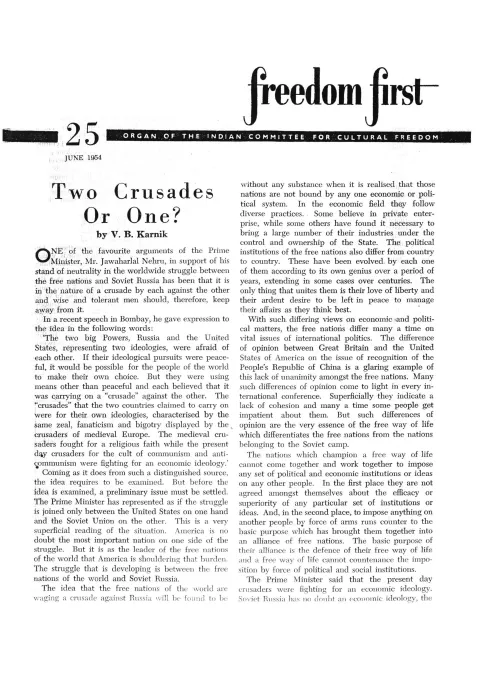
V. B. Karnik challenges Nehru’s claim that the Cold War is a clash of two equally fanatical “crusades” waged by the United States and Soviet Russia for rival economic ideologies. Karnik argues this framing is superficial: the free nations are not bound by any single economic system (ranging from private enterprise to full socialism), and their unity rests solely on a shared commitment to liberty and self-government, not on any common economic dogma they seek to impose. He contrasts this with communism, which he presents as a totalising creed that must, by its own logic, seek to establish one economic and political order across the whole world, making the communist camp the true bearer of a crusading zeal. The essay (continued from page 2 to page 11) closes by insisting that the real axis of the struggle is liberty versus tyranny, not one ideology versus another, and that Nehru does the anti-communist cause an injustice by placing communism and anti-communism on the same moral plane.
- Rebuts Nehru’s Bombay speech describing the US-USSR conflict as a crusade of one ideology against another
- Argues free nations have no single shared economic system (from private enterprise to full socialism, citing Tito’s Yugoslavia)
- Contends the only bond among free nations is love of liberty and the desire for self-government
- Distinguishes the free-nations alliance (defensive, non-imposing) from communism’s inherently totalising, globally expansionist logic
- Frames the true struggle as one between liberty and tyranny, not between two economic ideologies
- Criticizes Nehru for equating communism and anti-communism as morally equivalent ‘crusades’
- Argues the anti-communist fighter deserves support even if imperfect, since he defends liberty against the graver threat
Notes (Colombo—A Balance Sheet; The Pan-Buddhist Conference; Neo-Imperialism of Soviet Russia; The Tibetan Sell Out; Communists in Government Service; Shaikh Abdulla’s Detention; A Great Decision; Asoka Mehta)
An unsigned editorial ‘Notes’ section covering several current events of May-June 1954. It offers a ‘balance sheet’ on the Colombo Conference of Prime Ministers, crediting Sir John Kotelawala’s chairmanship and praising Burmese Prime Minister U Nu as the conference’s quiet hero for his firm anti-communist stance, while criticizing V. K. Krishna Menon’s attempts to misuse the occasion, and noting the conference’s incompleteness given the exclusion of anti-communist Philippines and Thailand. A further note on the Pan-Buddhist Conference in Rangoon discusses U Nu’s hopes to build an ideological Buddhist bulwark against communism, while warning that communist-aligned monks may attempt to turn the conference into a communist front. A note titled ‘Neo-Imperialism of Soviet Russia’ commends U Kyaw Nyein’s warning about Soviet-style colonialism. ‘The Tibetan Sell Out’ condemns the India-China treaty over Tibet as a betrayal of Tibetan self-determination, praising Acharya Kripalani and P. D. Tandon for opposing it in Parliament. ‘Communists in Government Service’ reports on the removal of communists from Indian and American government posts, citing Home Minister Dr. Katju’s parliamentary reply, and applauds provincial leaders such as Pandit Govind Vallabh Pant and Ujjal Singh for condemning communism, while criticizing some Congressmen for disregarding the AICC directive against communist-sponsored peace bodies. ‘Shaikh Abdulla’s Detention’ supports Jayaprakash Narayan’s demand for the Kashmir leader’s release or trial, criticizing Bakshi Ghulam Mahomed’s response. ‘A Great Decision’ praises the US Supreme Court’s school desegregation ruling, invoking Ralph Bunche and Lincoln. A final note congratulates Asoka Mehta on his election to the House of the People.
- Praises Sir John Kotelawala’s chairing of the Colombo Conference and singles out U Nu of Burma as its real hero for insisting on resisting external communist interference
- Criticizes V. K. Krishna Menon for attempting to misuse the Colombo Conference for ideological ends
- Discusses the Pan-Buddhist Conference in Rangoon and the risk of communist infiltration of the Buddhist front
- Condemns the India-China Tibet treaty as a betrayal of Tibetan self-determination (‘The Tibetan Sell Out’), praising Kripalani and Tandon’s parliamentary dissent
- Reports Home Minister Katju’s parliamentary disclosure that 85 government employees were investigated for subversive activity in 1953-54
- Praises provincial leaders (Pant, Ujjal Singh) for condemning communism and criticizes AICC members who ignore anti-communist directives
- Supports Jayaprakash Narayan’s call for the release or trial of Sheikh Abdullah, criticizing Bakshi Ghulam Mahomed
- Welcomes the US Supreme Court’s school desegregation ruling as an historic step for American democracy
- Congratulates Asoka Mehta, a member of the Committee’s Executive, on his election to Parliament
The P.E.N. Conference At Chidambaram
By R. B. Joshi
R. B. Joshi reports on the P.E.N. Third All-India Writers’ Conference held at Chidambaram, arguing the event squandered an opportunity for writers from different regions of India to genuinely get to know each other’s literatures. Joshi criticizes the conference’s crowded format — three symposia and two discussions on topics including the influence of the Ramayana on regional literature and the progress of regional literatures from 1948-53 — for allotting speakers only ten minutes each, producing hasty and confused speeches with no real discussion. He also critiques the session on ‘The Role of English in Free India’ for failing to address the practical question of how much English Indian graduates should be expected to know, and takes issue with points from Nehru’s inaugural address, particularly Nehru’s calls for ‘one literature’ and for writers to ‘think in terms of the nation,’ which Joshi argues runs counter to the nature of creative writing rooted in particular, concrete experience. He closes by urging the P.E.N. All-India Centre to organise regional centres and conferences to better connect with writers across India.
- Argues the Chidambaram P.E.N. conference failed to let writers from different Indian regions get to know each other’s literatures
- Criticizes the crowded symposia format (ten minutes per speaker) for producing confused, undiscussed speeches
- Notes serious but undiscussed views on whether Independence helped or hurt the inspirational force behind regional literatures
- Critiques the session on the role of English in India for failing to address practical questions of adequacy and standard
- Challenges Nehru’s inaugural remarks urging ‘one literature’ and writers ‘thinking in terms of the nation’ as contrary to the particular, concrete nature of creative writing
- Recommends the P.E.N. All-India Centre organise regional centres and periodical conferences
The Committee And The Arts
By Prabhakar Padhye
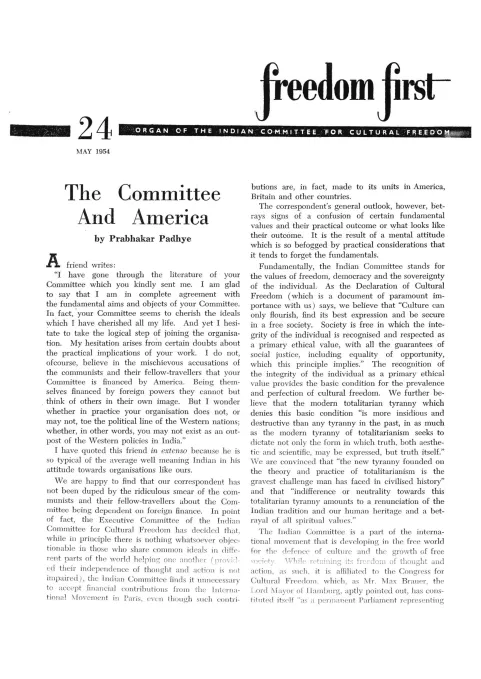
Prabhakar Padhye continues his series on the Congress for Cultural Freedom’s engagement with the arts, examining how the creative spirit is threatened by totalitarian instrumentalization of art in the name of ‘progressive literature.’ He argues that artistic truth is distinct from scientific or practical truth, and that all art is unique both because it is intensely individual and because it belongs to the aesthetic rather than logical or practical realm. Padhye, citing the critic C. Day Lewis, defends the reality of a distinct ‘aesthetic emotion,’ and argues that imposing practical, collective purposes on art destroys its uniqueness. He contends that so-called progressive art not only deprives ordinary people of genuine artistic enjoyment (rebutting the notion that ‘the people’ need simplified didactic art) but actually destroys the artist, citing the case of Krishna Chandra as an example of an artist whose work has been hollowed out by propagandist service. The essay closes by describing the Indian Committee’s position: the Committee will not require the artist to be anti-totalitarian or anti-communist (itself a propagandist trick) but simply free.
- Argues aesthetic truth is a distinct mode of truth, separate from scientific and practical truth
- Defends the existence of a distinct ‘aesthetic emotion,’ citing C. Day Lewis’s The Poetic Image
- Contends imposing practical or collective purposes on art destroys its individualistic uniqueness
- Rebuts the ‘progressive literature’ premise that ordinary people need didactic, practically-purposed art, citing folk-art and folk-literature as counter-evidence
- Cites the Indian writer Krishna Chandra as an example of an artist whose work was hollowed out by ideological service
- States the Committee’s position: ask the artist to be free, not anti-totalitarian or anti-communist, since demanding the latter is itself a propagandist trick
- Invokes J. W. N. Sullivan’s idea that consciousness-widening art has been a significant factor in humanity’s evolution from amoeba to man
Science And Moral Responsibility
By Professor Dr. Theodor Litt
Professor Theodor Litt’s paper, presented at the Hamburg Conference on ‘Science and Freedom,’ argues against the widespread view that scientific objectivity is morally neutral. Litt contends that the very act of pursuing knowledge transforms the investigator and is itself a moral activity, since adherence to truth is a moral quality that grows more important as forces seeking to falsify reality intensify. He argues that while natural science can maintain something close to ‘objectivity’ because its objects are unaffected by human inquiry, the study of human society is different: the investigator belongs to the same species as the object studied, so any failure of veracity damages not only the investigator’s conscience but the society being studied, since human reality is shaped by the very ideas directed at it. Litt concludes that the moral responsibility of science becomes dominant when science acts as an enlightening and advisory force in society, especially given contemporary efforts to conscript scientists into propagating lies.
- Challenges the view that scientific objectivity is morally neutral or free of moral assumptions
- Argues the pursuit of knowledge itself transforms the investigator and is a vital part of human development
- Holds that adherence to truth is itself a moral quality whose value rises as forces against truth intensify
- Distinguishes natural science (where objects are unaffected by inquiry) from social/human inquiry, where the investigator belongs to the same species as the object studied
- Argues human reality is shaped by ideas directed at it, so falsity in social theory damages both investigator and society
- Concludes moral responsibility becomes paramount when science functions as an enlightening, advisory force in society
In The Sartrian Mesh
By Yatim Ghaznavi
Yatim Ghaznavi reviews Jean-Paul Sartre’s scenario ‘In The Mesh’ (translated by Mervyn Savill, Andrew Dakers, 1954), using it as an occasion to examine Sartre’s existentialist philosophy of freedom. Ghaznavi frames Sartre’s work through Gabriel Marcel’s question of why Sartre finds existence ‘nauseating rather than glorious,’ and situates Sartre within a tradition of self-analysis extending from Pascal’s discomfort with the self to Zola’s dictum that the novelist ‘must kill the hero.’ The review examines the play’s central figure, dictator Jean Aguerra, whose exercise and eventual resistance to the loss of freedom exemplifies Sartre’s view that men are free but do not know it, and that submitting one’s will to party, religion, or law is itself an act of denying one’s freedom. Ghaznavi credits the play with keeping alive ‘an uneasy conscience,’ as Sartre believes literature should, but concludes that Sartre conflates his abstract concept of freedom with the unmitigated licence exercised by a figure like Aguerra, arguing a line must be drawn between freedom and licence even in existentialist terms.
- Reviews Sartre’s scenario ‘In The Mesh’ (Savill translation, Andrew Dakers, 1954, 128pp, 9 shillings)
- Opens with Gabriel Marcel’s question about Sartre finding existence nauseating rather than glorious
- Situates Sartre in a lineage of self-analytical writers including Pascal and Zola
- Analyzes dictator Jean Aguerra as a ‘freedom caught in a trap,’ resisting others who would reduce his capacity to resist
- Quotes Sartre’s L’Etre et le Neant on character existing only as an object of others’ knowledge
- Summarizes Sartre’s core belief that men are free but unaware of it, and that submission to party, religion or law denies one’s freedom
- Concludes Sartre conflates freedom with ‘unmitigated licence’ and argues a line must be drawn between the two even in existentialist terms
Review (Jana; Books in Brief)
By R.H.
An unsigned Review section (closing with the initials ‘R.H.’) covers the first issue of Jana, a new independent news magazine of ‘resurgent Asia and Africa’ published from Colombo, describing its coverage of the Colombo Prime Ministers’ Conference. A ‘Books in Brief’ subsection notes Robert Gittings’s John Keats: The Living Year, Jacques Maritain’s Creative Intuition in Art and Poetry, Conrad Bonifazi’s Christendom Attacked, and the second volume of Robert Musil’s The Man Without Qualities, along with a comparison of Kierkegaard’s and Nietzsche’s shared contempt for mediocrity despite opposite aims regarding Christianity. A ‘C.C.F. News’ item reports winners of the Congress for Cultural Freedom’s ‘XXth Century Masterpiece Festival’ international composers’ contest (Lou Harrison, Jean-Louis Martinet, Mario Peragallo, Vladimir Vogel, Giselher Klebe), judged by a jury including Aaron Copland, and notes the American Committee for Cultural Freedom’s protest against the denial of a passport to playwright Arthur Miller. An ‘I.C.C.F. News’ item records that Prof. R. B. Joshi addressed a May 10th meeting on the All-India Writers’ Conference at Chidambaram.
- Reviews the first issue of Jana, an independent Colombo-published news magazine of ‘resurgent Asia and Africa’
- Books in Brief notes new works by Robert Gittings (on Keats), Jacques Maritain (Creative Intuition in Art and Poetry), Conrad Bonifazi, and Robert Musil (The Man Without Qualities, vol. 2)
- Compares Kierkegaard and Nietzsche as both hostile to mediocrity but opposed in their aims toward Christianity
- Reports winners of the Congress for Cultural Freedom’s XXth Century Masterpiece Festival composers’ contest, judged by a jury including Aaron Copland
- Notes the American Committee for Cultural Freedom’s protest of the US State Department’s denial of a passport to Arthur Miller
- Records Prof. R. B. Joshi’s May 10th address on the Chidambaram P.E.N. conference under ICCF auspices
C.C.F. News
‘With Many Voices’ is a compilation of press quotations, framed by an epigraph from Tennyson, gathering statements from May 1954 on Cold War and Colombo Conference themes. Quoted figures and outlets include A. D. Gorwala in the Statesman, U.S. Secretary of State John Foster Dulles writing in Nations’ Business, the Archbishop of York in the Sunday Times, the Eastern Economist on the Colombo Conference and Dien Bien Phu, Pakistani Prime Minister Mahommed Ali on reciprocal restrictions on Soviet diplomats, Nehru’s reply to Shri Valiula in the Council of States, the Hindu on Tass Agency personnel, Frank Moraes in the Times of India and the Hindustan Times on V. K. Krishna Menon’s role at Colombo, and Acharya Kripalani’s remarks in a Foreign Affairs debate reported in the Hindustan Times. The page also carries a membership enrolment form for the Indian Committee for Cultural Freedom and the publication’s imprint: edited by Faiz S. Noorani, printed and published by Prabhakar Padhye at The Kanada Press, Bombay.
- Compiles press quotations on Cold War and Colombo Conference themes from May 1954
- Quotes A. D. Gorwala, John Foster Dulles, the Archbishop of York, and the Eastern Economist
- Includes Pakistani PM Mahommed Ali’s statement on reciprocal restrictions on Soviet diplomats and Nehru’s contrasting reply on the same issue
- Multiple quotations concern V. K. Krishna Menon’s controversial role and perceived pro-communist leanings at the Colombo Conference
- Closes with the Indian Committee for Cultural Freedom’s membership enrolment form and the issue’s imprint (editor Faiz S. Noorani, printer/publisher Prabhakar Padhye)
Generated by the v1.5 extraction pipeline. Awaiting editorial review.
Metadata and summary are AI-extracted from the source PDF and reviewed for editorial accuracy. The original work is available via the Read PDF tab above (where present); paragraph-level citation inside the PDF is deferred to a future engagement.