periodical issue
Freedom First
By V. B. Karnik, Daphne Whittam, Upton Sinclair, Ruben D. Villatoro, X.Y.Z., M. R. M., Z. F., M.B.S., R. H.
Edited by V. B. Karnik; printed & published by Prabhakar Padhye at The Kanada Press, 109 Parsi Bazaar Street, Bombay 1. Issued by the Indian Committee for Cultural Freedom, 127 Mahatma Gandhi Road, Bombay 1. · Bombay · 1954
12 pages
Freedom First
Summary
This is issue No. 27 (August 1954) of Freedom First, the monthly bulletin of the Indian Committee for Cultural Freedom (affiliated to the Congress for Cultural Freedom / World Movement for Cultural Freedom), edited by V. B. Karnik and printed and published by Prabhakar Padhye at The Kanada Press, Bombay. The issue is dominated by anti-communist Cold War commentary from an Indian liberal-anticommunist standpoint: Karnik’s lead essay surveys threats to freedom both from communism and from illiberal tendencies within the free world (colonialism, McCarthyism); a Guatemalan trade unionist recounts communist capture of the labour movement under the Arbenz government; Upton Sinclair defends civil liberties while warning against communist infiltration of liberal organisations; and a review essay assesses Robert C. North’s study of Sino-Soviet communism. The issue also carries lighter and miscellaneous content: an essay on Burmese Prime Minister U Nu’s anti-communist propaganda film ‘The People Win Through’ (reprinted from Encounter), a reader’s rejoinder on the Committee’s relationship to “Western” versus “international” values, several book reviews (on isms, on U.S. racial desegregation, on Spanish culture, Cervantes, Edmund Wilson), a page of miscellaneous editorial notes, a page of quoted press excerpts (‘With Many Voices’) on Chou En-lai’s India visit and communist affairs, and notices of C.C.F. activities in Paris. The overall centre of gravity is anti-communist cultural-freedom advocacy, inflected with concern about the erosion of civil liberties in the name of anti-communism, and a running argument about non-alignment/neutralism among Indian intellectuals.
Key points
-
V. B. Karnik’s “Threats To Freedom In The Free World” argues colonialism, especially French rule in Indo-China and British action in Kenya, and McCarthyism both weaken the free world’s anti-communist cause by handing propaganda advantages to Communists.
-
Daphne Whittam’s “A Prime Minister Makes A Movie” recounts Burmese PM U Nu’s anti-communist propaganda film “The People Win Through,” noting it portrays its central Communist character sympathetically as a sincere, misguided idealist.
-
Upton Sinclair’s “Democrats With A Small ‘d’” recounts his decades of civil-liberties activism and warns that American Communists now pose as small-”d” democrats infiltrating genuine civil liberties organisations.
-
Ruben D. Villatoro’s “Red Dictatorship In Guatemala” describes how Communists built a “veritable communist trade union dictatorship” under President Arbenz, and recounts his own torture and forced deportation after challenging its Soviet funding.
-
A reader signing as X.Y.Z. argues Indian “moral neutrality” toward the Cold War reflects a deep-seated collectivist habit of mind rather than mere strategic calculation, conceding the ICCF’s values are foreign imports worth spreading nonetheless.
-
A review of Robert C. North’s “Moscow and the Chinese Communists” traces Lenin’s 1920 programme to co-opt Asian nationalist movements, and quotes Mao Zedong rejecting any “third way” or neutrality between Soviet and “imperialist” camps.
Essays
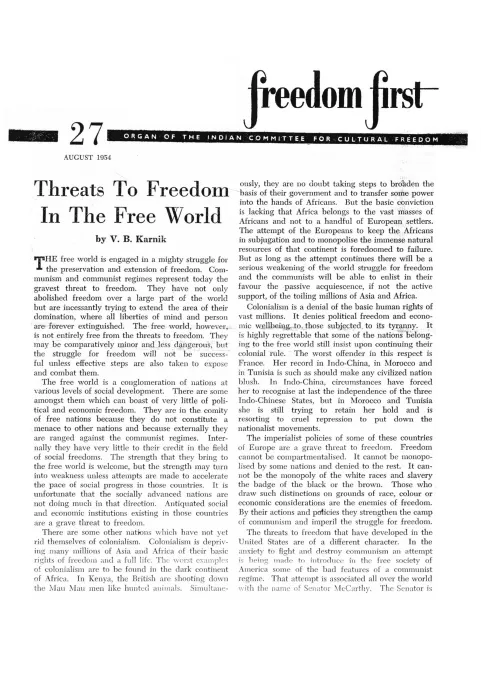
Threats To Freedom In The Free World
By V. B. Karnik
V. B. Karnik surveys the state of the ‘free world’s’ struggle against communism, arguing that while communism is the gravest threat to freedom, the free world itself harbours dangers that weaken its cause. He criticises the persistence of colonialism (singling out France’s record in Indo-China, Morocco and Tunisia, and British suppression of the Mau Mau in Kenya) as a moral and strategic liability that hands communists a propaganda advantage among Asian and African peoples. He then turns to the United States, characterising McCarthyism as a tendency (not merely one senator) that, in the name of anti-communism, has infringed the civil liberties of American citizens through visa denials, dismissals on suspicion, and character assassination. Karnik warns that a ‘pyrrhic victory’ over communism achieved by abandoning liberal freedoms would itself be a defeat, and closes by affirming that in a free society, unlike a totalitarian one, threats to freedom can be openly identified, contested, and defeated by an alert citizenry.
- The free world is not uniformly free; some allied nations offer little internally in the way of political or social freedom.
- Colonialism (especially French rule in Indo-China, Morocco, Tunisia, and British action against the Mau Mau in Kenya) denies basic rights and hands communists a propaganda weapon.
- McCarthyism represents a serious domestic threat to freedom in the U.S. because it is a tendency, not an isolated individual, and has led to persecution of innocent persons.
- Fear of communism can itself produce suppression of non-conformist and dissenting views, undermining the free society it purports to defend.
- A free society is distinguished from a totalitarian one by its capacity to recognise and defeat internal threats to freedom rather than deny they exist.
Notes (How Not To Travel; New Palace For Lamas; Communist Criteria; Abolition Of Death Penalty)
Daphne Whittam, in a piece reprinted from Encounter, describes how Burmese Prime Minister U Nu, a playwright before entering politics, wrote the play ‘The People Win Through’ and its subsequent film adaptation as a dramatisation of the futility of seizing power by armed revolt, aimed at the 1948 Communist insurrection in Burma. The essay traces U Nu’s literary and political biography, summarises the play/film’s plot (the disillusionment and death of a young Communist intellectual, Aung Min, torn between Party loyalty and his friend Aye Maung’s anti-revolt arguments), and assesses its reception: popular with the ‘common man’ for whom it was intended but received coolly by the intelligentsia due to its artistic simplifications, though it gained topical resonance because Burmese audiences recognised its events as lived history rather than propaganda.
- U Nu was already a playwright before becoming Burma’s Prime Minister, and wrote ‘The People Win Through’ to dramatise the futility of armed revolt as a path to power.
- The play/film centres on Aung Min, a Communist Party member who becomes disillusioned after witnessing the brutality of a unit commander and dies a ‘hero’ after abandoning the Party.
- The film softened and restructured the original stage play’s disjointed political harangues into a more dramatically coherent, popularly appealing narrative.
- Despite being unambiguously anti-communist, the film portrays its central Communist character sympathetically as a sincere, misguided idealist rather than a villain.
- The film was popular with ordinary audiences but viewed with some derision by Burmese intelligentsia, reflecting a broader gulf between intellectuals and the post-independence government.
A Prime Minister Makes A Movie
By Daphne Whittam
Upton Sinclair recounts his decades of civil-liberties activism, beginning with his arrest during the 1924 Los Angeles longshoremen’s strike while attempting to read the Bill of Rights, an episode that led to the founding of the Southern California branch of the American Civil Liberties Union. He then pivots to the present, describing communism as a ‘new enemy’ more dangerous than the strike-era authorities he once opposed, defending himself against Soviet and fellow-traveller accusations of being a ‘Red-baiter,’ and warning that American communists now disguise themselves as small-‘d’ democrats infiltrating and subverting genuine civil liberties organisations from within.
- Sinclair recounts his 1920s arrest in Los Angeles for attempting to read the Bill of Rights during a longshoremen’s strike, which led to the founding of the ACLU’s Southern California branch.
- He argues communism is now a more brutal and dangerous adversary of civil liberties than the authorities he once fought.
- He rejects Soviet and fellow-traveller accusations that he has become a ‘Red-baiter’ and ‘Wall Street lackey.’
- He describes Soviet suppression of information and disappearance of dissenters based on testimony from former fellow-travellers.
- He warns that American communists now pose as ‘democrats with a small d’ and infiltrate civil liberties organisations to redirect their policies from within.
Democrats With A Small “d”
By Upton Sinclair
Ruben D. Villatoro, president of Guatemala’s National Union of Free Workers, describes the post-1944 revolution rise of two rival labour federations: an independent Trade Union Federation and a communist-oriented Confederation of Workers of Guatemala (GGT), subsidised by Russian agents and affiliated with communist-controlled international bodies. He recounts how, under President Jacobo Arbenz’s government, communists manoeuvred experienced labour leaders out and built a ‘veritable communist trade union dictatorship,’ and describes the harassment, arrest, torture and eventual forced deportation of himself and his colleagues after their independent union publicly challenged CGTG’s communist funding and practices. An editorial note explains the piece was written before the Armas revolt that overthrew Arbenz.
- The 1944 Guatemalan revolution enabled a genuine, independent trade union movement (SAMF, Teachers’ Union, and others) based on freedom and independence from parties and government.
- A rival, communist-oriented federation (GGT) was organised by teachers and political refugees, subsidised by Russian agents and affiliated to communist-controlled international labour bodies.
- Under Arbenz, communists secured 70% of key positions in a merged General Confederation of Workers of Guatemala (CGTG) and forced out experienced, independent leaders.
- Villatoro’s independent National Union of Free Workers (UNTL) publicly challenged the CGTG’s receipt of a $10,000 monthly subsidy and its sabotage of independent unions.
- In January 1954 armed communists attacked the UNTL’s headquarters, tortured its leaders (including Villatoro) to extract false confessions, and the government subsequently deported them to Mexico and Honduras.
Red Dictatorship In Guatemala
By Ruben D. Villatoro
A reader writing under the initials X.Y.Z. responds to an earlier article by Mr. Padhye (in the May issue) on the Committee’s relationship to Western/international values and America. The correspondent broadly agrees with the case for anti-communism but offers a personal reflection on Indian neutralism, arguing that India’s ‘moral neutrality’ toward the Cold War stems from a deep-seated, ideologically-rooted habit of mind rather than mere strategic calculation, and that Indians’ instinctive collectivism and suspicion of individual achievement make full acceptance of Western liberal values (‘sovereignty of the individual’) unlikely. The writer admits the Committee’s values, though genuinely worth spreading, are foreign imports whose ‘alienness’ obstructs their acceptance, and wishes the Committee luck in what he calls a near-herculean task of converting Indians to these ideals.
- The correspondent agrees with the anti-communist case made by the referenced Padhye article but wants to explain Indian ‘moral neutralism’ toward the Cold War.
- India’s neutralism is described as ideological and rooted in habits of mind (‘Hindu, oriental, Asiatic, primitive’), not merely a response to security concerns.
- The writer argues Indian culture harbours an ‘ancient communism’ — a collectivist ethic suspicious of individual achievement and property — that predisposes it against Western individualist liberal values.
- He concedes the charge that the I.C.C.F. is ‘an outpost of the West in India’ is true insofar as its values are foreign imports, even though he judges them worth spreading.
- Figures like Nehru are described as symbolic totems for Indians rather than individuals to be placed on either side of the Cold War binary.
The Committee And America (letter responding to Mr. Padhye’s May article)
By X.Y.Z.
A review (signed M.R.M.) of Robert C. North’s ‘Moscow and the Chinese Communists’ (Stanford University Press), which the reviewer calls the first full-length authentic account of the communist conquest of China based on primary party documents. The review traces North’s argument that Soviet and Chinese communism have functioned as a coordinated programme since Lenin’s 1920 proposal to the Second Congress of the Communist International to capture nationalist revolutions in Asia, noting instances where Chinese leaders (not Russian ones) bore the cost when Moscow-directed policy failed. The reviewer highlights North’s use of communist leaders’ own words to show the state is conceived as ‘an instrument of class warfare,’ criticises North for assuming party rhetoric will be read literally by Western readers as it was intended for internal audiences, and closes by urging a cheaper edition for Asian readers given the book’s importance for the region.
- North’s book is presented as the first full-length, documented account of the communist conquest of China, based directly on party documents.
- Lenin’s 1920 programme for the Second Congress of the Communist International aimed to co-opt nationalist movements in Asia (including China and India) while infiltrating and eventually capturing their labour and military forces.
- Despite occasional Sino-Soviet friction, Chinese leaders (e.g., Li Li-san) — not Russian ones — were made to answer for failures of Moscow-directed policy, while Stalin’s authority remained largely unchallenged.
- The reviewer criticises North for taking communist leaders’ public statements at face value without noting they were addressed to internal party audiences, not the West.
- Mao Zedong is quoted as viewing the world as divided into only two camps (Soviet and ‘imperialist’/democratic), rejecting any ‘third way’ or neutrality.
- The reviewer connects the book’s thesis to Burmese socialist leader U Kyaw Nyein’s judgement that Soviet imperialism is more degrading and dangerous than other forms because it is more systematic.
Generated by the v1.5 extraction pipeline. Awaiting editorial review.
Metadata and summary are AI-extracted from the source PDF and reviewed for editorial accuracy. The original work is available via the Read PDF tab above (where present); paragraph-level citation inside the PDF is deferred to a future engagement.