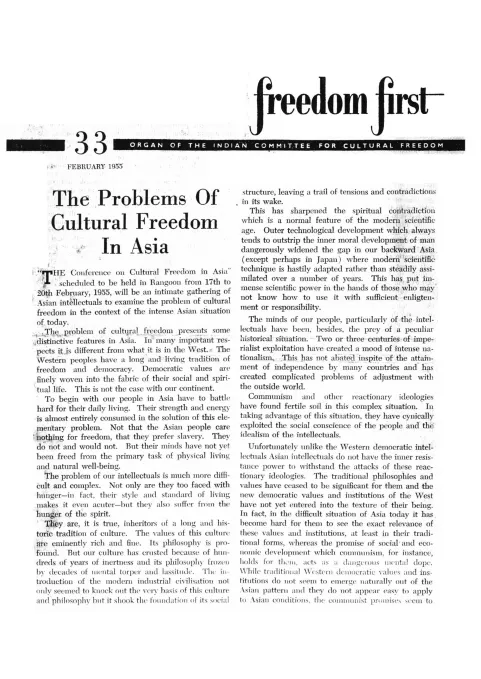
periodical issue
Freedom First
By Malcolm Muggeridge, Philip Spratt, Croebos, Denis De Rougemont, Gopal Krishna
Printed & published by Prabhakar Padhye at The Kanada Press, 109 Parsi Bazaar Street, Bombay 1. · Bombay · 1954
12 pages
Freedom First
Summary
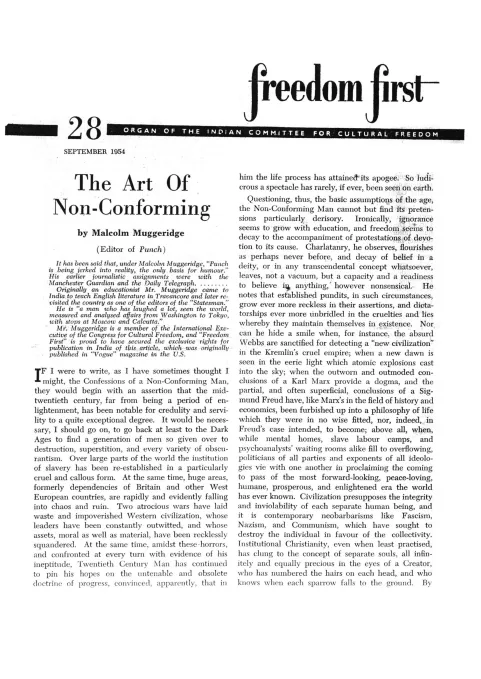
This is the September 1954 issue (No. 28) of Freedom First, the monthly bulletin of the Indian Committee for Cultural Freedom, edited by V. B. Karnik and published in Bombay. The issue is anti-communist and anti-totalitarian in orientation, built around the Cold War theme of intellectual and political non-conformity as a bulwark against both Soviet and Chinese communism and against fascism. Its centerpiece essays are Malcolm Muggeridge’s “The Art Of Non-Conforming,” which argues that mid-twentieth-century civilization is marked by credulity and conformism and that resistance requires individual non-conformity; Philip Spratt’s autobiographical “The Dream He Lost,” recounting his journey from British Communist Party membership and the Meerut Conspiracy Case to disillusionment and rejection of Marxism; and Denis de Rougemont’s “The Anxiety Of Modern Man,” a psychological account of why uprooted individuals in mass society flee freedom for totalitarian discipline. The issue also carries a page of unsigned “Notes” commenting on Chinese Communist diplomacy toward Nepal and Thailand, Dr. Lin Yutang’s appointment in Singapore, the restoration of trade unionism in Guatemala, Chinese communist propaganda against Aneurin Bevan, the revival of the Indian Honours List, and Indian delegates’ conduct at communist-organised conferences; a satirical piece by “Croebos” on Soviet sports diplomacy (“Malenkov Invites You To Attend…”); an obituary note on the French novelist Colette; a book review by Gopal Krishna of Arthur Koestler’s autobiography The Invisible Writing; a “Books In Brief” review column; a comic strip on the Indo-China settlement; a satirical verse (“Chouing Things Over”) on the Chou En-lai/Attlee meeting; ICCF organisational news; and a closing “With Many Voices” page of topical quotations on communism and the Cold War from figures including B. R. Ambedkar, Carl Rowan, The Economist, James Burnham, Trygve Lie, and others.
Key points
-
Malcolm Muggeridge’s “The Art Of Non-Conforming” argues the mid-twentieth century is marked by credulity and re-enslavement rather than enlightenment, holding that Fascism, Nazism and Communism alike attack the individual’s integrity, and that non-conformity is the root of humour.
-
Philip Spratt’s autobiographical “The Dream He Lost” recounts his journey from British Communist Party organiser and Meerut Conspiracy Case defendant to disillusionment, concluding the Soviet refusal to sustain the wartime alliance was “the biggest crime” even the Soviet government committed.
-
Denis de Rougemont’s “The Anxiety Of Modern Man” argues that the collapse of inherited moral codes leaves individuals susceptible to totalitarian movements offering relief from the burden of choice, citing Koestler’s correspondents who joined the Communist Party for its discipline.
-
The “Notes” section criticises China’s Chou En-lai for backing Nepalese rebel Dr. K. I. Singh despite pledges of non-intervention, and reports academician N. R. Phatak’s account of Indian delegates’ poor conduct at Communist-sponsored conferences.
-
Gopal Krishna reviews Arthur Koestler’s “The Invisible Writing,” praising its psychological explanation for the false confessions at the Moscow Trials and framing the book as illuminating civilisation’s struggle against totalitarian barbarism.
-
“Croebos” satirises Soviet sports diplomacy, and a brief item reports Carl Rowan’s Bombay address on “A Free Press In A Free Society.”
Essays
The Art Of Non-Conforming
By Malcolm Muggeridge
Malcolm Muggeridge, identified as Editor of Punch, argues that the mid-twentieth century, far from an age of enlightenment, has been marked by exceptional credulity, servility, and re-enslavement across large parts of the world. He contends that mass ideologies (Fascism, Nazism, Communism) attack the integrity of the individual, and that the impulse to non-conform is a vital form of resistance, though it carries risks of eccentricity or madness, as illustrated through Jonathan Swift and Don Quixote. He closes (in the page-11 continuation) by praising figures like Paulinus who kept faith amid civilizational collapse, and argues non-conformity is the root of humour, indispensable to a free society.
- Argues the mid-20th century is marked by credulity, servility, and re-enslavement rather than enlightenment.
- Criticizes uncritical faith in ‘progress’ despite mental homes, slave labour camps, and psychoanalysts’ waiting rooms filling to overflowing.
- Frames Marxism and Freudianism as partial, superficial doctrines wrongly elevated into full philosophies of life.
- Holds that Fascism, Nazism, and Communism alike attack the separateness and inviolability of the individual.
- Uses Jonathan Swift’s epitaph and Don Quixote’s fate to show both the value and the psychological danger of non-conformity.
- Cites Paulinus tending a shrine amid Rome’s collapse as the model of non-conforming at its sanest.
- Argues non-conformity is the root of humour and that a wholly conformist society cannot laugh.
The Dream He Lost
By Philip Spratt
An unsigned page of editorial ‘Notes’ covering several short items: Chinese Communist hypocrisy toward Nepal over the fugitive Dr. K. I. Singh despite pledges of non-intervention; a Hanoi mayor’s appeal for aid to Vietnamese fleeing communist-controlled Tonkin; Dr. Lin Yutang’s appointment as Chancellor-designate of Nanyang University, Singapore; the restoration of a democratic trade union committee in Guatemala under Ruben Villatoro; a Chinese communist encyclopaedia entry mocking Aneurin Bevan as a ‘foreign reactionary’; the Indian government’s revival of the Honours List and its possible unconstitutionality under Article 18; and an account by academician N. R. Phatak, writing in the Marathi weekly Vividhvritta, of the poor conduct of Indian delegates at communist-sponsored international conferences.
- Criticizes China’s Chou En-lai for violating the ‘five principles of peaceful co-existence’ by backing Nepalese rebel Dr. K. I. Singh.
- Reports the Mayor of Hanoi’s appeal to free-world cities for aid to Vietnamese refugees from the Viet Minh regime.
- Notes Dr. Lin Yutang’s new post as Chancellor-designate of Nanyang University in Singapore.
- Reports restoration of democratic trade unionism in Guatemala after the fall of the communist-dominated regime.
- Cites a Chinese communist encyclopaedia listing Aneurin Bevan as a ‘Foreign Reactionary’ alongside Churchill and Eden.
- Discusses the revival of India’s Honours List and questions its constitutionality under Article 18.
- Relays Prof. N. R. Phatak’s account (via Vividhvritta) of undisciplined, embarrassing behaviour by Indian delegates at communist conferences in Prague, Berlin, and Moscow.
Malenkov Invites You To Attend…
By “Croebos”
A short unsigned obituary notice on the French novelist Colette (Sidonie Gabrielle Claudine Colette), who died on 3 August 1954 at age 81. It recounts her election as the first woman president of the Goncourt Academy, her prolific output of novels and stories popular across social classes, and her frank, passionate treatment of love and sexuality in her writing.
- Colette died 3 August 1954 in her Paris apartment at the Palais Royal, aged 81.
- She was the first woman elected president of the Goncourt Academy.
- Her fifty-odd novels and short stories were popular across social classes.
- Her writing centered on women’s problems of love, treated with notable sexual frankness.
The Anxiety Of Modern Man
By Denis De Rougemont
Philip Spratt, a former British Communist Party organiser in India and principal accused in the Meerut Conspiracy Case, gives an autobiographical account of why he joined and later left the Communist Party. He describes the bleak post-World-War-I atmosphere in Britain that drew him to communism in 1924, his active organising work in India including strikes and the Meerut trial and imprisonment, and his growing disillusionment with communist intrigue, factionalism, and dialectical reasoning. He describes rejecting Marxist philosophy as incoherent, the shock of the Soviet purges and the ‘physical liquidation’ of a British Party acquaintance, and his final break driven by the Nazi-Soviet Pact and the Soviet failure to work with the West after 1941, which he calls one of the biggest crimes committed even by the Soviet government.
- Spratt joined the Communist Party in 1924, drawn by the bleak, class-bound atmosphere of post-WWI Britain.
- He organised strikes in India and was the most prominent defendant in the Meerut Conspiracy Case.
- He grew uncomfortable with communist intrigue, faction-fighting, and the gap between rhetoric and practice.
- He wrote a book-length critique of Marxist dialectic, concluding it lacked validity outside a rough biological/psychological theory.
- The Soviet purges, the disappearance of an acquaintance, and Eugene Lyons’ Assignment in Utopia deepened his disillusionment.
- The Nazi-Soviet Pact and the invasion of Finland pushed him to publicly criticise Soviet policy.
- He concludes the Soviet Union’s refusal to maintain the East-West wartime alliance was ‘the biggest crime’ even the Soviet government committed, ranging himself among its ‘open enemies.‘
Review: The Invisible Writing: An Autobiography by Arthur Koestler
By Gopal Krishna
Writing under the pseudonym ‘Croebos,’ the author satirises Soviet and communist-bloc use of sport as propaganda, describing invitations extended to unqualified Indian athletes (such as table-tennis player Ranbir Bhandari, invited to Moscow despite protest from the Table-Tennis Federation of India) and government reluctance to fund a stronger Indian contingent to genuine events like the World University Summer Games in Budapest. The piece argues Western democracies neglect organised sport as a tool of goodwill and cultural diplomacy while the Iron Curtain countries exploit it as propaganda, and calls for greater government control over who accepts such invitations and more Western investment in countering this form of Communist activity.
- Argues Iron Curtain countries use organised sport, tied to youth movements, as propaganda rather than for its own sake.
- Cites the case of Ranbir Bhandari, invited to Moscow by Soviet sports authorities despite being far from India’s top table-tennis player.
- Notes India could only send four athletes to the Empire Games for lack of funds, while Iron Curtain-linked invitations to Budapest came with generous funding.
- Calls for greater Indian government control over acceptance of foreign sporting invitations.
- Urges Western democracies, especially the United States, to invest more in countering this Communist propaganda tactic.
Notes (Profession And Practice; A Mayor’s Appeal; Dr. Lin Comes Back; T.U.s Restored In Gautemala; Bevan Through Chinese Eyes; Titles Again; Indians In The Communist Circus)
Denis de Rougemont examines why modern man fears freedom, describing a young European confronted by too many undefined choices in a world where traditional codes of custom, religion, and bourgeois morality have collapsed. He argues that this anxiety and rootlessness make individuals susceptible to totalitarian movements (Fascism, Nazism, Communism) which offer a reassuring, if illusory, sense of order and discipline in place of the burdens of individual choice. He cites Arthur Koestler’s account of readers who, moved by The Yogi and the Commissar, nonetheless joined the Communist Party seeking the discipline it promised. De Rougemont warns that Western democracies cannot answer the totalitarian temptation with mere polemic unless they address the underlying material insecurity that drives people to seek refuge from freedom.
- Frames modern man’s fear of freedom as rooted in the collapse of inherited codes: bourgeois morality, custom, and religious faith.
- Argues nationalism and political passions filled the vacuum left by weakened local patriotism and tradition after WWI.
- Contends dictatorships (Duce, Fuehrer, Caudillo) succeeded by offering to relieve individuals of the burden of choice and moral guilt.
- Cites Arthur Koestler’s correspondents who joined the Communist Party precisely because of the discipline it promised, despite agreeing with anti-Stalinist critique.
- Insists that Western democracies’ anti-dictatorship rhetoric will fail unless they address the material insecurity underlying the flight from freedom.
- Distinguishes the psychological need for discipline (to escape choice, risk, and guilt) from any innate love of slavery.
Colette
A short satirical verse, reprinted from Gene Sosin’s piece in the New Leader, mocking the Attlee-Bevan Labour delegation’s cordial banquet with Chou En-lai in China, warning readers not to be taken in by Chinese communist hospitality.
- Satirises the Attlee-Bevan Labour delegation’s banquet with Chou En-lai, reported under the headline ‘Chou En-lai Fetes Attlee Group.’
- Warns against being taken in (‘swallowed whole’) by Chinese communist hospitality and diplomacy.
- Reprinted from Gene Sosin’s piece in the New Leader.
Chouing Things Over (verse)
By Gene Sosin in the New Leader (reprinted)
A brief news item reporting Indian Committee for Cultural Freedom (ICCF) activities: a Bombay Committee public meeting on 30 August addressed by American journalist Carl Rowan on ‘A Free Press In A Free Society,’ presided over by R. V. Moorty; and the election of V. B. Karnik to the ICCF Executive Committee and as an Honorary Secretary.
- Carl Rowan, described as a noted Negro journalist from the United States, addressed an ICCF Bombay Committee meeting on 30 August 1954 on ‘A Free Press In A Free Society.’
- R. V. Moorty presided over the meeting.
- V. B. Karnik was elected to the ICCF Executive Committee and as an Honorary Secretary.
I.C.C.F. News
Gopal Krishna reviews Arthur Koestler’s autobiography The Invisible Writing (Collins with Hamish Hamilton, 1954), covering the period 1931-1953 with emphasis on 1931-1940. The review calls it a ‘political autobiography’ and a ‘typical case-history’ of the educated European middle class of Koestler’s generation, tracing his membership in the German Communist Party, his visit to the Soviet Union, his work with Comintern-linked agencies in Paris, his imprisonment and death sentence during the Spanish Civil War, and his eventual spiritual break with communism. Krishna praises Koestler’s psychological insight, especially his explanation (echoing Darkness at Noon) of why Bolshevik defendants at the Moscow Trials made false confessions, and closes by framing Koestler’s book as a warning about civilisation’s struggle against totalitarian barbarism.
- The Invisible Writing covers 1931-1953, with the bulk on 1931-1940, from Koestler’s German Communist Party membership to his flight to England.
- Koestler resigned from the German Communist Party in spring 1938 after his death-cell experience in the Spanish Civil War (Cell No. 40, Seville).
- Krishna highlights Koestler’s explanation for the false confessions at the Moscow Trials as driven by belief that confession served socialism’s interests.
- The review notes Koestler continued believing in Soviet ‘foundations’ even after leaving the Party, until the 1939 Stalin-Hitler Pact ‘rudely destroyed this pious hope.’
- Krishna frames the book as illuminating civilisation’s central conflict with totalitarian barbarism.
Books In Brief
By R. H.
An unsigned ‘Books In Brief’ column of short notices: Ignazio Silone’s A Handful Of Blackberries; Arthur Colby Sprague’s Shakespearian Players And Performances; T. S. Eliot’s play The Confidential Clerk; a new English translation of the Mongol-dynasty Chinese play The Story Of The Circle Of Chalk by Hui-Lan-Ki; Cuba’s award to Ernest Hemingway on his fifty-fifth birthday; and the launch of the quarterly East And West on Soviet and Baltic problems.
- Reviews Ignazio Silone’s A Handful Of Blackberries as a disappointing record of disillusionment following a false dawn.
- Notes Arthur Colby Sprague’s Shakespearian Players And Performances as a satisfying scholarly exercise.
- Finds T. S. Eliot’s The Confidential Clerk falls short of expectations set by The Cocktail Party.
- Notes the first direct-from-Chinese English translation of the 13th-century Mongol-dynasty play The Story Of The Circle Of Chalk.
- Reports Cuba’s award of the Order of Carlos Manuel de Cespedes gold medal to Ernest Hemingway on his 55th birthday.
- Announces the new quarterly East And West, devoted to Soviet and Baltic problems.
With Many Voices
The issue’s closing page, ‘With Many Voices,’ collects short topical quotations on communism, the Cold War, and international diplomacy from a range of contemporary figures and publications, framed by an epigraph from Tennyson. Quoted sources include Dr. B. R. Ambedkar warning against appeasement in the Council of States, Carl Rowan on Senator McCarthy, The Economist and James Burnham on co-existence with the Soviet bloc, the New Leader on Chinese Communism and the succession struggle around Mao Tse-tung, U Nu’s preface to Burma Under the Japanese, Salvador de Madariaga on the Cold War and Soviet arming rhetoric, and News Chronicle on Chinese Communist ambitions toward Formosa. The page closes with the ICCF’s Bombay address and a membership enrolment form, and the colophon naming V. B. Karnik as editor and Prabhakar Padhye as printer/publisher at The Kanada Press, Bombay.
- Dr. B. R. Ambedkar, quoted from the Council of States (26 August 1954), warns that appeasement-style peace only feeds a giant that may later consume the appeaser.
- Carl Rowan (Hindustan Times, 15 July 1954) states Senator McCarthy was hated by the American public as a demagogue riding Cold War fear.
- The Economist (13 July 1954) likens the Geneva settlement to Dunkirk rather than a diplomatic victory, and argues peaceful co-existence must rest on strength and unity.
- The New Leader (26 July / 2 August 1954) frames Chinese Communism as counter-revolutionary and reports on the succession struggle amid Mao Tse-tung’s declining health.
- Salvador de Madariaga (New Leader, 9 August 1954) argues the real issue is winning the Cold War, and relays a Soviet diplomat’s remark on arms and revolution.
- News Chronicle (16 August 1954) warns that communists ‘only make peace in one place in order to make war in another,’ citing Chinese rhetoric on ‘liberating’ Formosa.
- The page includes an ICCF membership enrolment form (Rs. 3/- annual fee) and publication colophon naming editor V. B. Karnik and printer/publisher Prabhakar Padhye of The Kanada Press, Bombay.
Generated by the v1.5 extraction pipeline. Awaiting editorial review.
Metadata and summary are AI-extracted from the source PDF and reviewed for editorial accuracy. The original work is available via the Read PDF tab above (where present); paragraph-level citation inside the PDF is deferred to a future engagement.