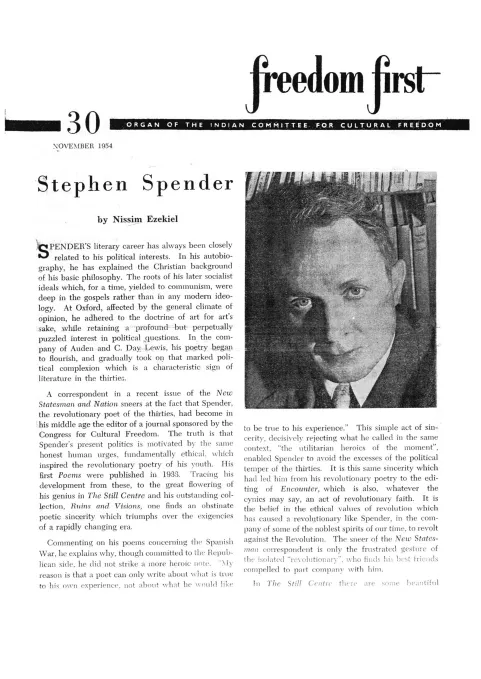
periodical issue
Freedom First
By Stephen Spender, Nissim Ezekiel, Ashad, Principal G. R. Dalvi, Laeeq Futehally, Faiz Noorani
Edited by V. B. Karnik; printed & published by Prabhakar Padhye at The Kanada Press, 109 Persi Bazaar Street, Bombay 1 · Bombay · 1954
12 pages
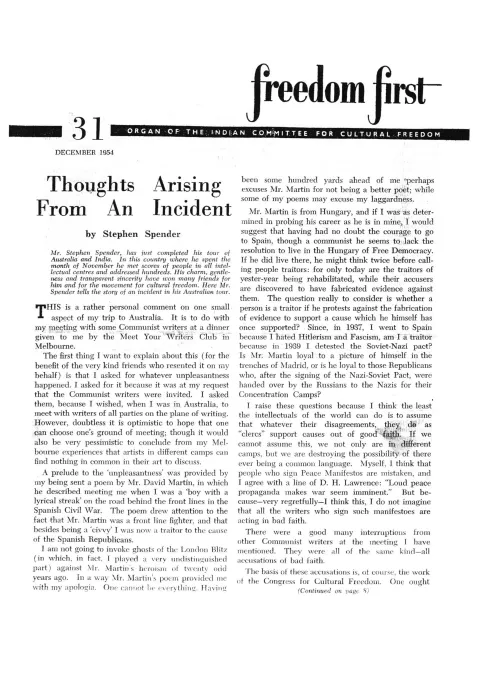
Freedom First
Summary
This is the December 1954 issue (No. 31) of Freedom First, the monthly organ of the Indian Committee for Cultural Freedom (I.C.C.F.), edited by V. B. Karnik. The issue is anchored by Stephen Spender’s essay reflecting on a hostile encounter with Communist writers during his Australian tour, followed by a news report chronicling his extensive lecture tour of India in October-November 1954. The unsigned ‘Notes’ section comments on Rajendra Prasad’s warnings against executive overreach in the welfare state, the Rashtriya Seva Dal’s voluntary-labour rally near Poona, India’s diplomatic softness toward Communist China, the attack on Asoka Mehta in Kashmir, and Calcutta police’s employment scheme for ‘amateur’ rowdies. Nissim Ezekiel contributes a sustained polemical dissection of ‘Adib’ (the pen name of Times of India columnist Sham Lal) for his hostile review of Salvador de Madariaga. ‘Ashad’ analyses Ilya Ehrenburg’s essay on the poverty of contemporary Soviet literature and the condemnation of writers like Vera Panova. Principal G. R. Dalvi reviews M. R. Masani’s history of the Communist Party of India, arguing that anti-communist opposition needs a constructive humanist philosophy, not merely appeals to religion or nationalism. Further reviews cover Frank Rounds Jr.’s account of daily life in Moscow and Aubrey Mennen’s satirical ‘Rama Retold’. An unsigned obituary for Soviet prosecutor Andrei Vyshinsky recounts his role in the Stalinist purges, accompanied by a David Low cartoon on Nehru’s Peking visit. The issue closes with ‘With Many Voices,’ a compilation of press quotations on Communism, coexistence, and Indian foreign policy from figures including Indira Gandhi, Jawaharlal Nehru, B. R. Shenoy, and Herbert Morrison.
Key points
-
Stephen Spender’s “Thoughts Arising From An Incident” reflects on being accused of betraying the Spanish Republican cause for criticising Communist fabrication of evidence, arguing intellectuals should assume good faith across political camps and defending the Congress for Cultural Freedom’s positive cultural programming.
-
The “Notes” section records President Rajendra Prasad’s warnings against executive overreach into judicial functions, and reports the attack on socialist leader Asoka Mehta in Kashmir under National Conference one-party rule.
-
Nissim Ezekiel’s “The Case Of Comrade Adib” exposes Times of India columnist Sham Lal’s pseudonymous “Adib” column as selectively quoting and misrepresenting anti-Communist writers including Salvador de Madariaga, Hemingway and Bertrand Russell.
-
Writing as “Ashad,” an essay on Ilya Ehrenburg’s “The Writer and His Craft” argues Ehrenburg cannot acknowledge that political control of literature, not merely excessive industrial themes, is the root cause of Soviet writing’s decline.
-
Principal G. R. Dalvi reviews M. R. Masani’s “The Communist Party of India — A Short History,” arguing that opposition to Communism must be grounded in a scientific, humanist social philosophy rather than religion or nationalism alone.
-
An unsigned obituary for Soviet prosecutor Andrei Vyshinsky traces his role in the Moscow show trials following Kirov’s murder, which sent many of Lenin’s former colleagues to death or exile.
-
Laeeq Futehally reviews Frank Rounds Jr.’s “A Window on Red Square” on everyday Moscow life under constant surveillance, and Faiz Noorani reviews Aubrey Mennen’s “Rama Retold” as an unsuccessful burlesque of the Ramayana.
Essays
Thoughts Arising From An Incident
By Stephen Spender
Stephen Spender recounts a ‘personal comment’ on an unpleasant encounter with Communist writers at a dinner in Melbourne during his Australian tour, provoked by a poem from David Martin accusing him of being a ‘traitor’ to the Spanish Republican cause for having criticized Soviet-era fabrications. Spender argues that consistent opposition to totalitarian fabrication of evidence does not make one disloyal to causes once supported, and that intellectuals should assume good faith across political camps even amid disagreement. He closes (in the continuation on page 8) by defending the Congress for Cultural Freedom against the charge that it is a one-note anti-Communist front, noting its broad executive committee (Raymond Aron, David Rousset, Ignazio Silone) and its positive cultural programming (the Festival of Twentieth Century Masterpieces, Encounter magazine), framing intellectual freedom as something to be built, not merely defended.
- Spender was accused by fellow poet David Martin of being a ‘traitor’ to the Spanish Republican cause because of his criticism of Communist fabrication of evidence.
- Spender questions whether loyalty to a cause requires ignoring crimes committed in its name, citing the Nazi-Soviet Pact and the handover of Spanish Republicans to Nazi camps.
- He argues intellectuals across political camps should assume mutual good faith (‘clercs’ supporting causes sincerely) rather than accusing each other of bad faith.
- He disagrees with peace manifestos on strategic grounds but does not think signatories act in bad faith.
- In the continuation, he defends the Congress for Cultural Freedom against the charge that it exists solely for anti-Communist propaganda, citing its diverse international executive.
- He frames the Congress’s positive project as sustaining vital intellectual and artistic freedom through publications like Encounter and cultural festivals, not merely opposing McCarthyism or Communism defensively.
Stephen Spender In India
An unsigned news report details Stephen Spender’s month-long tour of India (28 October to 28 November 1954) under I.C.C.F. auspices, listing his stops in Madras, Ernakulam, Trivandrum, Bangalore, Bombay, Poona, Calcutta, Banaras, Lucknow, and Delhi, the lectures and receptions he gave, and notable audiences including S. S. Vasan of Gemini Studios and the Left Book Club in Calcutta.
- Spender arrived in India on 28 October 1954 and departed for Karachi on 28 November.
- He addressed public meetings in Madras, Ernakulam, Trivandrum, Bangalore, Bombay, Poona, Calcutta, Banaras, Lucknow and Delhi under I.C.C.F. and university auspices.
- Madras University instituted an annual ‘Spender Prize’ of Rs. 500 for the best student of the year.
- In Bombay, M. R. Masani chaired a public meeting in place of an ill Governor G. S. Bajpai.
- Spender met Tamil writers, Kanarese writers and poets, and members of the Left Book Club in Calcutta.
Notes (The Welfare State and its Limitations; The R.S.D. Rally at Hadapsar; Who Rules Kashmir?; Student Sagacity; First Fruits; Selective Service)
The unsigned ‘Notes’ section covers six short items: President Rajendra Prasad’s warnings against executive and legislative overreach into judicial functions and against the state monopolising welfare; praise for the Rashtriya Seva Dal’s voluntary-labour rally near Poona under Jayaprakash Narayan’s guidance; India’s diplomatic concessions to Communist China, including the expulsion of a Chinese-community newspaper editor and the cold-shouldering of exiled Hungarian leader Ferencz Nagy; the attack on socialist leader Asoka Mehta in Kashmir and the one-party rule of the National Conference; testimony from Indian student delegates who visited Soviet universities describing rigid Party control of education; and a satirical item on the Calcutta police’s employment scheme for reformed ‘amateur’ rowdies.
- President Rajendra Prasad warned against the executive/legislature usurping judicial functions and against the state monopolising the welfare field.
- The Rashtra Seva Dal’s 3,000-volunteer rally near Poona, under Jayaprakash Narayan’s guidance, built a bund for a co-operative farm as part of a ‘reconstruction of society through self-help.’
- China expelled Dr. C. S. Liu, editor of the Chinese Journal of India, for publishing pro-Nationalist speeches; India also snubbed exiled Hungarian leader Ferencz Nagy at Peking’s implicit pressure.
- Socialist leader Asoka Mehta was attacked in Srinagar while organizing a Kashmir branch of the Praja Socialist Party; Acharya J. B. Kripalani called National Conference rule ‘a reign of terror.’
- Indian student delegates Satya Dev Sharma and D. N. Panigrahi, returning from a Moscow University-hosted trip, reported that dialectical materialism governed all education and student unions were tightly Party-controlled.
- A satirical note describes Calcutta police’s scheme to offer ‘amateur’ rowdies jobs to stop them throwing stones and burning tramcars.
The Case Of Comrade Adib
By Nissim Ezekiel
Nissim Ezekiel mounts a detailed polemical takedown of ‘Adib,’ the pen name of Sham Lal, an assistant editor of the Times of India whose ‘Life and Letters’ column Ezekiel accuses of being a vehicle for Communist propaganda dressed as literary criticism. Ezekiel analyses Adib’s hostile review of Salvador de Madariaga’s Essays With a Purpose in detail, showing how Adib selectively quotes, strips context, and constructs a fictional ‘sophisticated lady’ interlocutor to mock and discredit anti-Communist writers (Madariaga, Hemingway, Bertrand Russell, John Masters) while treating Communist and fellow-travelling authors with deference. Ezekiel concludes that beneath the sneering rhetorical technique, Adib’s own ideas are thin and derivative, reducible to a handful of trite, self-congratulatory aphorisms.
- ‘Adib’ is revealed to be the pen name of Sham Lal, an assistant editor of the Times of India writing the ‘Life and Letters’ column.
- Ezekiel documents Adib’s habitual technique: quoting selectively, removing qualifying punctuation, and using a fictional ‘sophisticated lady’ reader to mock ideas he opposes.
- Adib’s review of Madariaga’s Essays With a Purpose ignores most of the book’s content (essays on Spain, on writing) to focus solely on discrediting Madariaga’s politics.
- Ezekiel notes Adib has made six or seven attacks on Encounter articles since its inception, and that the magazine’s editor declined to publish Ezekiel’s own protest letter.
- After ‘demolishing’ Madariaga, Adib also attacks Hemingway, Bertrand Russell and John Masters, inventing dialogue that Ezekiel says makes them ‘talk like idiots.’
- Ezekiel argues Adib maintains a double standard: harsh scrutiny for anti-Communist writers, deference for Communist or fellow-travelling authors.
Ilya Ehrenburg And Soviet Literature
By “Ashad”
Writing under the pseudonym ‘Ashad,’ this essay examines Ilya Ehrenburg’s article ‘The Writer and His Craft,’ which had been celebrated by Bombay ‘Russophiles’ as an epoch-making analysis of Soviet literature’s decline. Ashad shows that Ehrenburg, despite conceding that Soviet writing suffers from too much emphasis on public/industrial life and too little on personal, intimate experience, is unable to acknowledge that the root cause is political control of literature itself. The essay contrasts the freedom of the ‘bourgeois capitalist’ author to criticize his own society against the Soviet writer’s obligation to affirm the party line, and cites the recent condemnation of authors (Vera Panova, Konstantin Sivonov’s own denunciations) as evidence that Soviet literary criticism functions as political condemnation.
- Ehrenburg’s article responds to a young Leningrad engineer’s complaint that contemporary Russian literature is ‘paler than life’ compared to Tsarist-era writing.
- Ehrenburg attributes the weakness to excessive focus on public/industrial themes (tractors, dams, factories) and insufficient attention to personal and intimate life.
- Vera Panova’s novel ‘The Seasons of the Year,’ which depicted ongoing conflicts in Soviet society, was condemned despite having been publishable in the post-Stalin thaw.
- Konstantine Sivonov, who himself had called for more literary realism in 1953, is the same critic who later condemned Ehrenburg’s ‘gloomy’ story ‘The Thaw.’
- The author argues Soviet writers cannot truly criticize their society or its leaders in the way authors in the ‘bourgeois capitalist world’ can.
- The essay is skeptical that Ehrenburg’s optimistic claim — that Soviet writers can now give a ‘faithful and profound reflection’ of Soviet society — is credible, given ongoing condemnations.
The Past and Future of Indian Communism (review of M. R. Masani’s “The Communist Party of India — A Short History”)
By Principal G. R. Dalvi
Principal G. R. Dalvi reviews M. R. Masani’s ‘The Communist Party of India — A Short History,’ praising its factual, well-documented narration of the Party’s history through the 1951 General Elections and its Third Congress at Madurai (December 1953), with an introduction by Guy Wint. Dalvi argues that while Masani’s factual chapters (I-VIII) are valuable, the analytical chapters (IX, describing Communist infiltration of cultural/labour/welfare organisations, and XI, on outlook) are inadequate to help readers understand and counter the danger, especially given the risk that impressionable young readers might instead be drawn toward Communism. Dalvi contends that opposition to Communism cannot rely on religion, Gandhism, or nationalism alone, and must instead be grounded in a scientific, humanist social philosophy capable of matching Communism’s own ideological appeal.
- Masani’s book covers the Communist Party of India’s history since World War I through the 1951 General Elections (chapters I-VIII), with chapter X on the 1953 Madurai Third Congress.
- Dalvi values the book’s freedom from ‘untruthful methodology’ since it is written by a non-Communist, contra typical Communist or fellow-traveller historiography.
- Dalvi criticizes chapters IX and XI as inadequate for helping readers understand or counter Communism’s dangers, warning the book could risk making impressionable readers sympathetic to Communism.
- Masani (via M. N. Roy) argues the decisive factors favoring Communism are psychological and emotional, not merely economic or illiteracy, and can be counteracted by ‘inspiring and dynamic leadership.’
- Dalvi lists the forces Masani identifies as opposed to Communism — religion, socialists, the Five Year Plan, Gandhism, Bhoodan Yagna — and argues these are inadequate or even counterproductive as anti-Communist strategies.
- Dalvi calls for non-Communists to develop a ‘superior social philosophy’ grounded in humanism and modern scientific knowledge to defeat Communism in the realm of ideas.
Review — A Window on Red Square (review of Frank Rounds, Jr.)
By Laeeq Futehally
Laeeq Futehally reviews Frank Rounds Jr.’s ‘A Window on Red Square,’ an account of everyday life in Moscow based on the author’s 18 months as an attache at the American Embassy, praising it as a rare, reasonably objective account of ordinary Russian life — housing, clothing, shops — even though it lacks diplomatic secrets. The review notes that the most unpleasant aspect the book conveys is the sensation of being under constant surveillance, and the constant exposure of Soviet citizens to state propaganda.
- Frank Rounds Jr. spent 18 months in Moscow as an attache in the American Embassy.
- The book’s value lies in giving an objective, non-secret account of everyday Soviet life — housing, clothing, and daily routines.
- The reviewer finds the depiction unflattering, particularly the sense of being continuously watched and the near-constant exposure to Soviet propaganda.
Review — Rama Retold (review of Aubrey Mennen)
By Faiz Noorani
Faiz Noorani reviews Aubrey Mennen’s ‘Rama Retold,’ criticizing it as a ‘burlesque’ version of the Ramayana interspersed with aphoristic ‘Tales of Valmiki’ and a concluding note on Indian thought, arguing the effort fails as serious literature and reflects Mennen’s uneasy relationship with his own Indo-Irish heritage.
- Mennen’s book presents a ‘burlesque’ retelling of the Ramayana alongside ‘morsels of wisdom’ called Tales of Valmiki.
- The book’s morals suggest power matters more than right and wrong, and that virtue is ‘comic.’
- The reviewer characterizes Mennen (born Menon, of Indo-Irish extraction) as uncomfortable with his Indian heritage.
- The review judges the book’s twelve-page attempt to encapsulate Indian thought from pre-history to Gandhi as unsuccessful.
In Memoriam (Andrei Yanourievitch Vyshinsky)
An unsigned obituary for Andrei Vyshinsky, the Soviet prosecutor who died at his desk after more than 30 years of loyal service to the Bolshevik regime. It traces his path from a Menshevik lawyer who joined the Communist Party only after the Bolshevik coup, his instrumental role as prosecutor in the show trials of the Old Bolsheviks following Kirov’s murder, and his later career as a diplomat and ambassador to the U.N., concluding that his memory will remain linked to the purges of the mid-1930s that killed millions. The page includes a David Low cartoon depicting Nehru’s visit to Peking.
- Vyshinsky, of Polish descent, studied law at St. Petersburg and initially belonged to the Menshevik faction before joining the Bolsheviks after their 1917 coup.
- He helped the Cheka locate and ‘liquidate’ or exile former Menshevik colleagues, leading Maxim Gorky to privately call him the regime’s ‘most wicked police sniper.’
- He became infamous in the mid-1930s as prosecutor in the show trials following Kirov’s murder, sending many of Lenin’s former colleagues to death or exile.
- Despite his services, Stalin never admitted Vyshinsky to the inner Politburo sanctum.
- He later served as a diplomat and ambassador to the U.N. Assembly, known for prolific oratory and frequent use of the veto and ‘nyet.’
- A David Low cartoon on the same page satirizes Nehru’s visit to Peking, captioned ‘Indians … Chinese … All the same you see?‘
With Many Voices
The closing feature ‘With Many Voices’ compiles brief press quotations from October-November 1954 on themes of Communism, coexistence, and Indian foreign policy, drawn from sources including Indira Gandhi in the Times of India, Nehru in the Free Press Journal, B. R. Shenoy in the Times of India, Herbert Morrison in the New Leader, and George Meany in the New Leader, among others, framed by an epigraph from Tennyson.
- Indira Gandhi is quoted (Times of India, 21 Nov 1954) contrasting India’s democratic elections with the guided elections of Russia and China.
- Nehru is quoted (Free Press Journal, 1 Nov 1954) noting Chinese assurances against interference in Burma, Thailand, and Indonesia, with skepticism about the future.
- B. R. Shenoy is quoted (Times of India, 6 Nov 1954) calling deficit financing for the Five-Year Plan ‘the best subsidy to Communism.’
- Herbert Morrison (New Leader) argues Communism is not a movement of the Left but a reactionary force worse than Tsarist autocracy.
- The feature also quotes Principal F. Correia-Afonso on Portuguese claims in Goa, Dr. Katju on suspicion of cheap-book offers, and Governor Dewey on politics as public duty.
Generated by the v1.5 extraction pipeline. Awaiting editorial review.
Metadata and summary are AI-extracted from the source PDF and reviewed for editorial accuracy. The original work is available via the Read PDF tab above (where present); paragraph-level citation inside the PDF is deferred to a future engagement.