periodical issue
Freedom First
No. 34, March 1955
By U Ba Nyunt, S. S. Vasan, Yatin Gaznavi
Printed & published by Prabhakar Padhye at The Kamala Press, 199 Parsi Bazaar Street, Bombay 1, for the Indian Committee for Cultural Freedom, 127 Mahatma Gandhi Road, Bombay 1 · Bombay · 1955
12 pages
Freedom First
Summary
This is issue No. 34 (March 1955) of Freedom First, the monthly bulletin of the Indian Committee for Cultural Freedom, affiliated with the (Congress for) Cultural Freedom movement. The issue is dominated by coverage of the Conference on Cultural Freedom in Asia, held in Rangoon from 17-20 February 1955 and jointly organised by the Congress for Cultural Freedom and Burma’s Society for the Extension of Democratic Ideals — reproducing the Mayor of Rangoon’s inaugural address, an unsigned report on the proceedings, and a set of messages sent to the conference by figures such as Lin Yutang, Sir Arthur Wijeyewardhene, Kotaro Tanaka, Han Suyin and Bertrand Russell. Alongside this, the issue carries an editorial ‘Notes’ section on Cold War and domestic Indian politics, a speech by film producer S. S. Vasan on the problems of the Indian cinema industry, an essay-review by Yatin Gaznavi engaging Jacques Maritain’s Man and the State, three book/exhibition reviews, an I.C.C.F. News column on committee activities, and a closing page of press-quotation squibs (‘With Many Voices’) satirising Cold War commentary. The volume’s centre of gravity is anti-communist cultural-freedom advocacy: the case that intellectual liberty, tolerance and the right of opposition are indivisible conditions of democratic life, counterposed against both Soviet-style totalitarianism and complacent ‘co-existence’ framing.
Key points
-
U Ba Nyunt, Mayor of Rangoon, opens the Conference on Cultural Freedom in Asia with an inaugural address, “Culture And Freedom,” arguing culture cannot flourish without freedom and warning the Welfare State’s expansion of planning risks becoming ‘a new form of imperialism.’
-
An unsigned report on the Rangoon conference lists thirty-five delegates from twelve countries and records M. R. Masani’s argument that co-existence may be possible between states but not between the cultures of democracy and communism, alongside Jayaprakash Narayan’s keynote on Bhoodan as voluntary social action.
-
Messages of support to the conference from Lin Yutang, Sir Arthur Wijeyewardhene, Kotaro Tanaka, Han Suyin and Bertrand Russell are reproduced, urging the Congress for Cultural Freedom to remain free of party affiliation and stressing Asia’s spiritual traditions.
-
A ‘Notes’ column reads Malenkov’s fall and Bulganin’s rise as evidence Khrushchev has had to placate army interests, praises a 150-signatory Telugu writers’ declaration for parliamentary democracy, and satirises a new ‘United Marxist Party’ in Bombay for claiming independence from Moscow while remaining pro-Soviet.
-
S. S. Vasan, President of the Film Federation of India, argues in a reproduced speech, “Problems Of The Indian Cinema,” that Indian cinema’s slow artistic progress owes to low economic standards and mass tastes, and proposes reforms including reduced admission tax and liberalised censorship.
-
Yatin Gaznavi’s essay-review of Jacques Maritain’s Man and the State argues political conflict lies less in competing lists of rights than in the hierarchy of values by which they are ordered, while explicitly dissenting from Maritain’s claim that only the Church can handle ‘matters of intelligence.’
-
Three reviews cover R. P. Masani’s Education for World Understanding (Adam Adil), Tadeusz Wittlin’s Reluctant Traveller in Russia on two years in Soviet forced-labour camps (Laeeq Futehally), and a Czechoslovak Industries Exhibition in Bombay.
-
I.C.C.F. News reports a Calcutta send-off tea party for delegates departing to Rangoon and a Poona Group lecture series on Maharashtra’s nineteenth-century reform trends, covering Agarkar, Shinde and Phuley.
-
‘With Many Voices’ closes with press quotations including Clement Attlee comparing Russian foreign policy to Tsarist imperialism and Sir John Kotelawala crediting America’s atom bomb with keeping ‘free Asia’ free of war.
Essays
set pattern
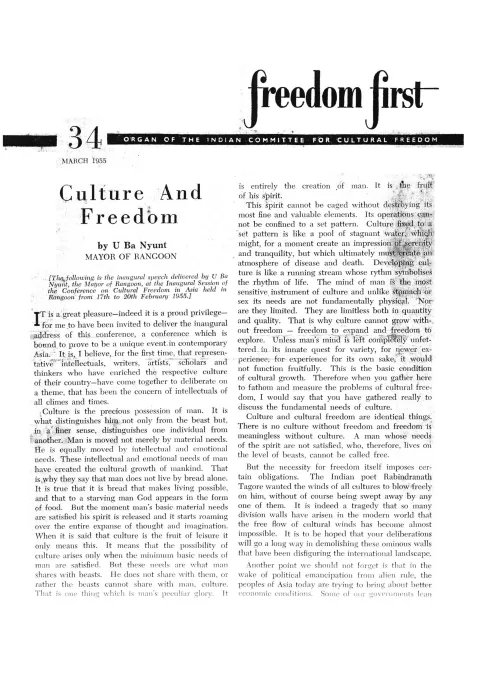
This is the inaugural address delivered by U Ba Nyunt, Mayor of Rangoon, at the opening session of the Conference on Cultural Freedom in Asia (17-20 February 1955). U Ba Nyunt argues that culture is inseparable from freedom: culture is the fruit of the human spirit, and a spirit that is caged or forced into a ‘set pattern’ stagnates and dies. He warns that the modern Welfare State, in the name of planning and progress, risks concentrating all authority in the hands of the State or a few individuals, producing ‘a new form of imperialism’ more dangerous than old colonial imperialism because it is more systematic and morally self-justifying. He calls on Asian nations, having won political freedom, to resist this drift, and to hold to indigenous democratic-cultural traditions — Burmese Pyedawtha, Indian Gandhism and Bhoodan, Indonesian Pantjasila — as bulwarks against totalitarian encroachment. He closes by welcoming delegates to Burma as an appropriate first venue for the movement, framing the choice of democracy over dictatorship as a deliberate, considered one.
- Culture is defined as the fruit of the human spirit and cannot grow without freedom to explore and experiment.
- The Welfare State’s expansion of planning risks concentrating power and suppressing opposition, becoming ‘even more degrading and more dangerous’ than old-time imperialism.
- Asian nations are urged to resist totalitarianism by holding to their own cultural-democratic traditions (Pyedawtha in Burma, Gandhism/Bhoodan in India, Pantjasila in Indonesia).
- Burma’s choice of democracy over dictatorship is presented as a deliberate, non-accidental national decision guided by PM U Nu.
- The address frames the Rangoon conference as the first gathering of its kind to bring Asian intellectuals together against totalitarian threats to culture.
Culture And Freedom
By U Ba Nyunt, Mayor of Rangoon
An unsigned ‘Notes’ column of short editorial comments on current affairs. The lead item analyses the ousting of Malenkov and installation of Bulganin as Soviet premier, reading it as evidence that Khruschev, though now dominant within the party, has had to concede ground to army interests (hence Bulganin’s appointment and Zhukov’s elevation to Defence Minister), and warns Asian democracies against being lulled by a ‘friendlier’ Soviet posture toward India, Burma and Indonesia, citing Czechoslovakia’s Benes as a cautionary precedent. A second item praises a declaration by more than 150 Telugu writers and artists affirming ‘unshakeable faith’ in parliamentary-democratic Welfare State ideals and rejecting totalitarianism of both left and right, and notes a similar manifesto by a new Union of Indian Artists and Writers formed in Bangalore. A third item (‘Pure Simons’) satirises the formation of the doctrinally fractious ‘United Marxist Party’ in Bombay, mocking its claimed independence from Communist orthodoxy while it remains ‘most friendly’ toward the Soviet Union and Communist China. A closing item (‘Bray, New World’) is a satirical squib on a Madras Livestock Board scheme to address a shortage of donkeys through state planning, mocking bureaucratic ‘planned progress’.
- Malenkov’s fall and Bulganin’s installation are read as signs Khruschev has had to placate army interests rather than as evidence of a stable new order.
- Asian democracies are warned not to be taken in by a Soviet ‘friendly’ posture toward India, Burma and Indonesia, with Czechoslovakia’s fate cited as a warning.
- A Telugu writers’ declaration affirming Welfare-State/parliamentary democracy and opposing totalitarianism of left and right is praised as an encouraging sign.
- A new Bombay ‘United Marxist Party’ is satirised for claiming independence from Communist orthodoxy while remaining pro-Soviet and pro-Communist-China.
- A satirical item on state-planned donkey-breeding in Madras mocks bureaucratic overreach into ‘planned progress’.
Notes (The Fall of Malenkov; Telagu Writers’ Statement)
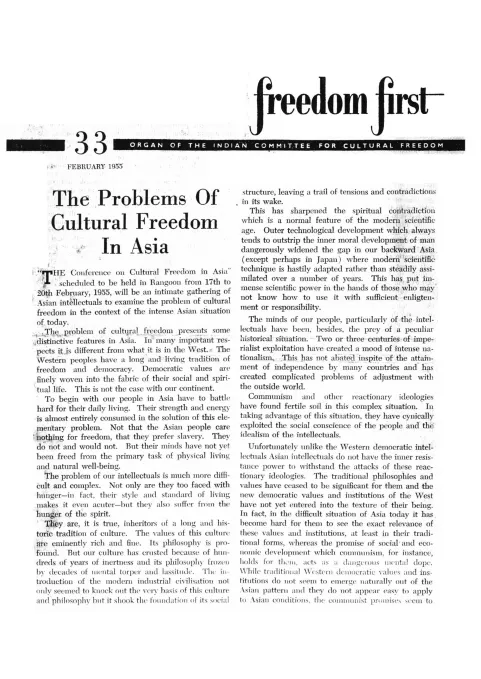
An unsigned report on the Conference on Cultural Freedom in Asia held in Rangoon, 17-20 February 1955, jointly organised by the Congress for Cultural Freedom and Burma’s Society for the Extension of Democratic Ideals. The report lists the thirty-five delegates from twelve countries (including Jayaprakash Narayan, M. R. Masani, Eric da’Costa, Tarkateerth Laxmanshastri Joshi, A. K. Mukerji and V. B. Karnik from India), describes the conference’s Honorary Chairmen (a roster of prominent Asian intellectuals and officials), and summarises the proceedings across three topics: the condition of cultural freedom in Asia, the legacy of colonialism, the tension between economic planning and cultural freedom, and threats posed by international communism and Chinese totalitarianism to Overseas Chinese intellectuals. M. R. Masani’s address to the conference argued that ‘humanity cannot be half slave and half free’ and that while co-existence between states might be possible, there can be no co-existence between the culture of democracy and the culture of communism. Jayaprakash Narayan’s keynote stressed that man alone creates culture, that culture requires recognition of individual supremacy, and highlighted India’s Bhoodan movement as a voluntary, non-state approach to social and economic problems. The conference concluded with resolutions to establish national Committees for Cultural Freedom and coordinate a regional movement, and closes by quoting London Observer correspondent Philip Deane’s admiring account of the delegates as unembittered idealists willing to ‘swim against the stream’.
- Thirty-five delegates from twelve Asian countries attended, including a six-member Indian delegation led by Jayaprakash Narayan and M. R. Masani.
- M. R. Masani’s address held that co-existence may be possible between states with differing ideologies, but not between the culture of democracy and the culture of communism.
- Jayaprakash Narayan’s keynote emphasised man’s creation of culture through recognising individual supremacy, and pointed to the Bhoodan movement as solving social problems through voluntary action rather than state legislation.
- Discussion topics included the legacy of colonialism, the tension between state economic planning and cultural freedom, and threats from international communism to cultural minorities including Overseas Chinese.
- The conference resolved to establish national Committees for Cultural Freedom in participating countries and to coordinate the emerging movement across Asia, with Mr Padhye tasked as regional coordinator.
- Observer correspondent Philip Deane is quoted describing the delegates as ‘not embittered second-raters’ who could easily climb onto more popular bandwagons but chose instead to ‘swim against the stream’.
Conference On Cultural Freedom In Asia
A compilation of extracts from messages of greeting and support sent to the Rangoon Conference on Cultural Freedom in Asia by prominent international figures, continued from page 7 onto page 11. Contributors include Dr Lin Yutang (urging that the Congress for Cultural Freedom stay free of party affiliations), Sir Arthur Wijeyewardhene (framing the conference as a step toward peace in Asia), Dr Kotaro Tanaka (arguing Asia’s spiritual roots must be re-emphasised against overly material Western influence), Dr Han Suyin (a meditation on freedom’s degraded and ‘derisive’ meaning amid Cold War propaganda, expressing regret at being unable to attend), and Bertrand Russell (expressing ‘whole-hearted sympathy’ with the conference’s objects and hope for its success).
- Lin Yutang urges that the Congress for Cultural Freedom keep itself free of party affiliations to function properly.
- Sir Arthur Wijeyewardhene frames the conference as a step in a larger movement for peace in Asia and the world.
- Kotaro Tanaka argues Asia must more clearly emphasise its spiritual and moral traditions against a purely material import of Western civilisation.
- Han Suyin offers an extended reflection on how words like ‘freedom’ and ‘peace’ have been debased by propaganda and ‘otiose fanaticism’, while expressing hope the conference offers ‘a way out of this swampy jungle’.
- Bertrand Russell, Honorary President of the Congress for Cultural Freedom, sends wholehearted sympathy and hopes for the conference’s success given cultural freedom’s importance to the well-being of mankind.
Problems Of The Indian Cinema
By S. S. Vasan
Extracts from a speech by S. S. Vasan, President of the Film Federation of India, delivered at a Film Seminar organised by the All India Sangeet Natak Akademi in New Delhi. Vasan argues that the Indian cinema, though young and often accused of neglecting artistic standards, has become an inescapable feature of national life, reaching millions daily and shaping their ideals and emotions. He attributes slow artistic progress to India’s low economic standards and mass audience tastes favouring melodrama, and criticises public intellectuals and ‘genteel’ society for a snobbish, under-examined prejudice against the film industry. He surveys the varied legitimate uses of cinema (education, propaganda, advertisement, fine art, cultural diplomacy) and insists producers must remain entertainers first, quoting Rajaji’s dictum that wholesome entertainment is itself a patriotic service. He closes with five concrete policy proposals to help the industry grow: unrestricted licensing of new cinemas, substantially reduced or abolished admission tax, liberalised censorship, subsidy for educational and artistic films, and government assistance in domestic manufacture of raw film stock and equipment.
- Vasan argues cinema’s growth is inevitable given its reach into millions of lives daily, regardless of doubts about its artistic stability.
- He attributes the industry’s slow artistic development chiefly to India’s low economic standards and mass audiences’ preference for melodrama.
- He criticises ‘genteel’ public opinion and public men/philosophers for a closed-minded, class-based prejudice against the film industry and its performers.
- Cinema’s legitimate uses are surveyed as ranging from education and propaganda to fine art and cultural diplomacy, each requiring different sponsoring agencies.
- He proposes five reforms: unrestricted cinema licensing, reduced/abolished admission tax, liberalised censorship, subsidy for artistic/educational films, and state help manufacturing raw film stock domestically.
Man And The State
By Yatin Gaznavi
An essay by Yatin Gaznavi reviewing/engaging Jacques Maritain’s Man and the State (O’Sullivan, Hollis and Carter, 1954), continued from page 9 to page 11. Gaznavi lays out the philosophical problem of reconciling competing, non-absolute human rights — economic, social and individual — and argues that the real disagreement between liberal-individualist, communist and ‘personalist’ visions of society (Maritain’s own, per the essay) lies not in the abstract lists of rights each proposes but in the hierarchy of values by which those rights are ordered in practice. He summarises Maritain’s argument that a free society requires a shared practical (not doctrinal) democratic faith or ‘common human creed’, that the State has the right and duty to promote this creed through education but no right to impose a specific philosophical or religious conformity, and that freedom of expression, while not absolute, should be restricted only in narrowly practical rather than ideological terms. The essay concludes by noting Maritain’s claim that only the Church, not the State, is equipped to deal with ‘matters of intelligence’ — a claim Gaznavi presents as one that ‘those who know their history well can scarcely find… difficult to disagree’ with, marking dissent from Maritain’s position.
- Human rights are not absolute; the real political conflict lies in the hierarchy of values used to adjudicate between competing economic, social and individual rights.
- Liberal-individualist, communist, and personalist (Maritain’s) visions of society could produce near-identical lists of rights on paper but ‘play the instrument’ differently owing to differing value hierarchies.
- A free society requires shared democratic faith of a practical, not doctrinal, nature; the State may promote this through education but may not impose religious or philosophical conformity.
- Freedom of expression is not unconditional, but restriction should be judged by practical rather than ideological criteria — the more removed from content, the better.
- Maritain’s claim that only ‘the Church’ can properly handle matters of intelligence is presented and then explicitly rebutted by the essay’s closing line.
Reviews (Education for World Understanding; Reluctant Traveller in Russia; Czechoslovak Exhibition)
By Adam Adil; Laeeq Futehally; L.F.
A ‘Reviews’ page with three short pieces. Adam Adil reviews R. P. Masani’s Education for World Understanding (K & J Cooper), praising it as a valuable contribution to fostering internationalist, humanistic education aligned with UNESCO ideals, noting a foreword by Dr Radhakrishnan and situating Masani in the tradition of Rousseau, Pestalozzi, Spencer and Dewey. Laeeq Futehally reviews Tadeusz Wittlin’s Reluctant Traveller in Russia (Rinehart & Co.), an account of the author’s ordeal after being caught fleeing Nazi-occupied Warsaw into Soviet-held territory and enduring two years in Soviet forced-labour camps, praising its ability to write ‘lightly about extreme cruelty and horror’ without bitterness. An unsigned (L.F.-initialled) review of a Czechoslovak Industries Exhibition in Bombay contrasts impressive machinery, motorcycles and crystal on display with disappointing, drab consumer textiles and a conspicuous absence of traditional Czech embroidery.
- Adam Adil praises R. P. Masani’s Education for World Understanding as advancing a UNESCO-aligned internationalist pedagogy, with a foreword by Dr Radhakrishnan.
- Masani’s book is situated by the reviewer within the educational tradition of Rousseau, Pestalozzi, Spencer and Dewey.
- Laeeq Futehally praises Wittlin’s Reluctant Traveller in Russia for recounting two years as a Soviet forced-labour prisoner with courage and humour rather than bitterness.
- The Czechoslovak Exhibition review finds machinery, motorcycles and crystal glassware impressive but textiles and other consumer goods disappointingly drab, with traditional Czech embroidery notably absent.
Messages To The Conference
No summary was extracted for this article. Listed for completeness.
I.C.C.F. News
A short ‘I.C.C.F. News’ column reporting on activities of the Indian Committee for Cultural Freedom’s local groups: the Calcutta Group’s send-off tea party for Indian delegates travelling to the Rangoon conference (attended by Pt. Laxmanshastri Joshi and Eric Da Costa, with talks by Swami Agehananda Bharati and Prof. Nirmal Kumar Bose), and the Poona Group’s lecture series on ‘Revaluation of Reform Trends in Maharashtra during the last century,’ covering reformist figures such as Agarkar, V. R. Shinde and Jotiba Phuley, with further lectures on Ranade and Lokahitawadi announced for March.
- The Calcutta Group of the I.C.C.F. held a send-off tea party for Indian delegates departing for the Rangoon conference, though only two delegates could attend in the end.
- Swami Agehananda Bharati and Prof. Nirmal Kumar Bose spoke at the Calcutta send-off on the significance of the conference.
- The Poona Group ran a lecture series on ‘Revaluation of Reform Trends in Maharashtra during the last century’, covering Agarkar, V. R. Shinde and Jotiba Phuley.
- Further Poona lectures on Ranade (by Dr D. R. Gadgil) and Lokahitawadi (by Prof. G. B. Sardar) were announced for March.
With Many Voices
‘With Many Voices’ is the issue’s closing column, an unsigned compilation of short press quotations (from the Free Press Journal, Thought, Times of India, Bangkok Post, The Radical Humanist, Pravda, The Current, and others, dated February 1955) juxtaposed with dry editorial commentary satirising Cold War rhetoric, Soviet leadership changes, and Indian political controversies such as the jeep scandal. Items include Clement Attlee’s characterisation of Russian foreign policy as continuous with Tsarist imperialism, Sir John Kotelawala’s remark that free Asia should thank America for the atom bomb, Harold Stassen’s claim about Communist ambitions in Asia, British statements on Hong Kong and Quemoy/Matsu, and mordant asides on Malenkov’s resignation and Cominform messaging on the hydrogen bomb.
- The column collects short press quotations from Indian and international papers (Feb 1955) with sardonic editorial glosses.
- Clement Attlee is quoted arguing Russian foreign policy under its current rulers closely follows Tsarist imperial patterns.
- Sir John Kotelawala is quoted crediting America’s atom bomb with keeping the ‘free people of Asia’ free of war.
- Harold E. Stassen is quoted characterising Communist goals in Asia as aiming at possession or dominant control of a third of the world’s population.
- The column closes on domestic Indian items, including a note on the Public Accounts Committee and the ‘jeep scandal’.
Generated by the v1.5 extraction pipeline. Awaiting editorial review.
Metadata and summary are AI-extracted from the source PDF and reviewed for editorial accuracy. The original work is available via the Read PDF tab above (where present); paragraph-level citation inside the PDF is deferred to a future engagement.