periodical issue
Freedom First
No. 37, June 1955
By V. B. Karnik, Hasan Muhammad Tiro, Edward Hunter, N. E.
Indian Committee for Cultural Freedom, 148 Mahatma Gandhi Road, Bombay 1. Printed & published by Prabhakar Padhye at The Kanada Press, 109 Parsi Bazzar Street, Bombay 1. · Bombay · 1955
12 pages
Freedom First
Summary
This is Issue No. 37 (June 1955) of Freedom First, the monthly bulletin of the Indian Committee for Cultural Freedom, edited by V. B. Karnik and published from Bombay. In the rendered pages, the issue opens with Karnik’s own lead essay on the Bandung Conference, arguing that despite communist China’s conciliatory posture the conference turned into an unexpected rebuke of communism and a step toward integrating the new Asian-African nations into the free world rather than into the Soviet bloc. A “Notes” section covers Chinese trade-union subversion attempts, film censorship in India, Vinoba Bhave’s and Morarji Desai’s calls for education free of state control, student discipline, the persecution of the Kalmuck Buddhists in the USSR, and a wry item on monkeys invading MPs’ quarters in Delhi. Hasan Muhammad Tiro contributes a report on communist infiltration of the Indonesian government under Premier Ali Sastroamidjojo, and Edward Hunter (author of Brain-Washing in Red China) recounts the communist campaign that forced Dr. Lin Yu-tang to abandon Nanyang University in Singapore. A book review (by “N.E.”) covers Maria Yen’s The Umbrella Garden, an account of student life under communist rule in China. The issue closes with a second Bandung piece surveying international press reaction, a Letters to the Editor section, and a “With Many Voices” digest of quotations from world commentators on Bandung, communism, and world affairs. The volume’s overall stance throughout is anti-communist and pro-free-society, consistent with the Committee’s mandate under the World Movement for Cultural Freedom.
Key points
-
V. B. Karnik’s lead essay ‘Bandung: A Step Towards Integration’ argues the Bandung Conference of twenty-nine Asian-African nations became an unexpected rebuke of communism despite fears it would become a pro-communist or anti-Western platform, with China under Chou En-lai playing a conciliatory rather than propagandistic role.
-
A ‘Notes’ section praises trade unionists who refused Chinese May Day invitations, criticises the Congress Working Committee’s move toward stricter film censorship, endorses Vinoba Bhave’s and Morarji Desai’s calls for education free of state control, and reports the persecution and deportation of Kalmuck Buddhists in the USSR.
-
Hasan Muhammad Tiro’s report on communist infiltration in Indonesia warns that Premier Ali Sastroamidjojo’s government has postponed elections while purging anti-communist officers and pardoning 1948 Madiun coup plotters into ministerial posts.
-
An unsigned piece and a companion account by Edward Hunter, author of Brain-Washing in Red China, describe the communist campaign that forced Dr. Lin Yu-tang to resign as founding Vice-Chancellor of Nanyang University in Singapore, followed by deadly student rioting.
-
A review signed ‘N.E.’ praises Maria Yen’s The Umbrella Garden for its firsthand, unembellished account of student life in Red China, tracing the arc from benign early discipline to mandatory ‘communal living’ and government-assigned graduate jobs.
-
‘Bandung: As Others See It’ surveys international press reaction, quoting New York Times correspondents Tilman Durdin and Robert Aldon on Krishna Menon’s private criticism of Nehru’s handling of the conference and Burma’s U Nu’s quietly effective role.
-
Letters to the editor cover a Bombay meeting on Muslim political withdrawal since 1947 (Zafar Fatehally) and an idiosyncratic call for Indian disengagement from Asian geopolitics grounded in ‘spiritual doctrines’ (Raman Desai).
-
‘With Many Voices’ closes with Chester Bowles on Asian revolutions being led by frustrated middle-class intellectuals and Arthur Koestler’s chastened line that ‘we can at best hope for a reprieve.‘
Essays
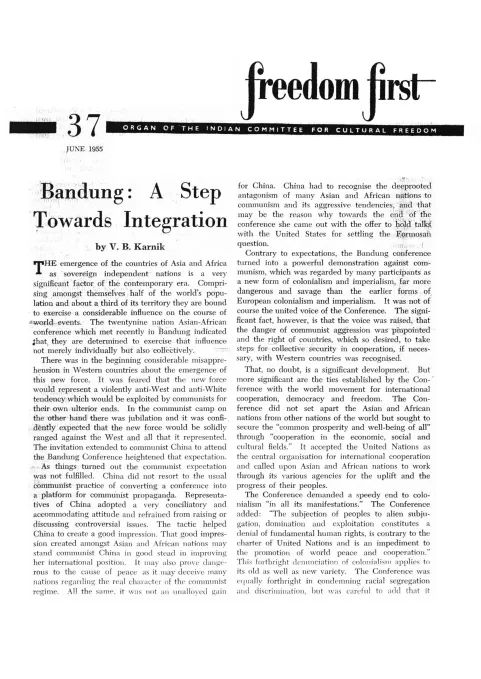
Bandung: A Step Towards Integration
By V. B. Karnik
V. B. Karnik’s lead essay argues that the Bandung Conference of 29 Asian-African nations, despite fears it would become either a pro-communist or an anti-Western platform, instead turned into a notable rebuke of communist expansion and a step toward integrating new nations into the free world. Communist China under Chou En-lai played a conciliatory role rather than using the conference for propaganda, but the conference’s final resolutions nonetheless condemned colonialism, affirmed human rights and UN principles, and called for economic and cultural cooperation among diverse Asian and African societies. Karnik contends the conference’s insistence on ‘social progress and better standards of life in larger freedom’ signals that the participating nations rejected both communist regimentation and narrow nationalist isolation, aligning instead with a broader vision of freedom, democracy, and international cooperation compatible with (though not identical to) the Western bloc.
- Western fears that Bandung would become a virulently anti-West, anti-White platform were not borne out.
- Communist expectations that China would use the conference for propaganda were also disappointed; China adopted a conciliatory posture.
- The conference became, in Karnik’s reading, an unexpectedly strong demonstration against communism, framed as a new and more dangerous form of imperialism.
- The conference’s ten principles affirmed human rights, UN principles, and a right to collective security in cooperation with Western countries if needed.
- The conference called for cultural cooperation among Asian-African nations but explicitly rejected exclusiveness or rivalry toward other cultures.
- Karnik frames integration of the new Asian-African nations into the free world — distinct from alignment with the Anglo-American bloc — as the great problem of the age and the true significance of Bandung.
Notes
An unsigned ‘Notes’ section covering six short items: Chinese Trade Union Federation’s attempts to draw Indian trade unionists into pro-communist conferences under the guise of May Day invitations (and the Indian delegates from non-communist unions who refused); the Congress Working Committee’s recommendation of stricter film censorship, criticized here as caving to ‘prudes and moralists’; endorsement of Acharya Vinoba Bhave’s and Morarji Desai’s calls for education free of state control, with the caveat (unlike Herbert Spencer) that state financing of education is acceptable, but not state control of content; Dr. John Matthai’s and Dr. R. P. Paranjpye’s remarks on the need for student discipline; the persecution and deportation of Kalmuck Buddhists in the Soviet Union; and a satirical item on monkeys invading MPs’ residences in Delhi, tying it to the absence of Western-style lobbying in Indian politics and a recent government export ban on monkeys.
- Some Indian trade union delegates who accepted Chinese Trade Union Federation invitations to Peking’s May Day parade returned as communist propagandists; others from the Hind Mazdur Sabha, Seafarers’ Federation, and Dock Workers’ Federation refused to be drawn into a communist-organized conference and are praised for it.
- The Congress Working Committee’s move toward stricter film censorship (following a memorandum from 64 MPs) is criticized; the essay cites Film Federation president S. S. Vasan’s warning that rigid censorship would push producers toward superstition-laden ‘stale stunts’ rather than contemporary themes.
- The piece endorses Vinoba Bhave’s and Morarji Desai’s calls for education free of state control, citing fascist and communist experience as proof that state control of education content denies freedom.
- Student indiscipline is raised as a matter of public concern, with reference to Dr. John Matthai and Dr. R. P. Paranjpye on cultivating a sense of responsibility among students.
- The disappearance and reported deportation to Siberian camps of the Kalmuck Buddhists (numbering about 220,725 in 1939) under Stalinist policy is presented as a human-rights concern.
- A satirical closing item notes the absence of British/American-style lobbying culture in India’s Parliament, illustrated by MPs’ residences being ‘invaded’ by monkeys amid a new government export ban on monkeys.
Out Shortly: Quest (advertisement)
Hasan Muhammad Tiro reports that Indonesia, the world’s sixth-largest nation, is on the verge of complete communist domination under the government of Premier Ali Sastroamidjojo, which has for a year and a half postponed general elections while purging anti-communist army officers, provincial governors, and civil servants, and promoting known communists and fellow-travellers to senior posts (including appointing convicted 1948 Madiun coup plotters Iwa Kusumasumantri and Mohamed Yamin as Ministers of Defence and Education respectively). Tiro details a newly formed Central Election Committee stacked with pro-communist parties while excluding the Masjumi and Socialist parties, and recounts a civil war in Sumatra, Java, Celebes, and Borneo between the regime and anti-communist Moslem forces under Tengu Daud Beureueh, alongside government-sponsored massacres and press suppression. He concludes that the international community, to whom he presented a list of human-rights violations at the UN General Assembly, has done nothing, and appeals to the free world’s sympathy and support for Indonesians resisting a second loss of their freedom, this time to communism.
- Indonesia’s Sastroamidjojo regime has avoided a general election for over a year and a half, fearing the anti- and non-communist Masjumi and Socialist parties would win.
- A newly formed Central Election Committee excludes the Masjumi (the country’s largest party) and the Socialists while including the PKI (Communist Party) and other pro-communist or fellow-traveller parties.
- Anti-communist army officers, provincial governors, and city officials have been purged and replaced by pro-communist or fellow-traveller figures; pro-communist officers who mutinied against superiors faced no insubordination charges and were promoted instead.
- Convicted participants in the 1948 Madiun communist coup attempt, Iwa Kusumasumantri and Mohamed Yamin, were pardoned by Soekarno and appointed Minister of Defence and Minister of Education respectively.
- A civil war has broken out between the regime and anti-communist Moslem forces led by Tengku Daud Beureueh, who hold de facto control of parts of North Sumatra, Java, Celebes, and Borneo.
- Tiro presented a list of human-rights violations by the regime to the UN General Assembly, but no international action followed.
- The essay ends with an appeal that Indonesians will resist losing their freedom to communism if they know they have the free world’s sympathy and support.
Red Threat In Indonesia
By Hasan Muhammad Tiro
This unsigned news item recounts how Dr. Lin Yu-tang, the celebrated Chinese scholar and philosopher, was invited from the United States to become founding Vice-Chancellor of Nanyang University in Singapore — envisioned as an intellectual center for free overseas Chinese independent of Peking — only to be forced to resign after sustained communist-directed opposition. Drawing on Lin’s own account (from Life magazine) and a companion piece by Edward Hunter, the piece describes Lin’s demands to British colonial authorities (deportation of communist student agitators and the alleged ringleader Mr. Lee Kong-chian) going unanswered, leading to what Lin calls the ‘suicidal indifference’ of British authorities and the effective destruction of Nanyang as a free institution. The University’s collapse was followed by rioting among Chinese students that cost four lives and forced the Labour government of Singapore to reimpose emergency regulations.
- Nanyang University was planned as an intellectual center for free overseas Chinese in Singapore, independent of Peking’s communist regime.
- Dr. Lin Yu-tang was invited from the U.S. to be founding Vice-Chancellor but faced communist opposition from Peking from the moment he began work.
- Lin refused to head a ‘second-rate’ university that would function as a front for a Red-infiltrated institution, and was ultimately forced to resign.
- Lin’s demands to British authorities — deporting known communist students and an alleged ringleader, and resisting ‘co-existence’ with communism in Singapore — were not acted upon.
- Lin foretold a gloomy prospect for Singapore, that it would ‘slip away towards oblivion.’
- The University’s destruction was followed by student rioting that cost four lives, prompting reimposition of emergency regulations by Singapore’s Labour government.
Dr. Lin Yu-tang And Nanyang University
Edward Hunter, author of Brain-Washing in Red China, gives a firsthand account (as a Singapore resident) of the communist campaign that destroyed Dr. Lin Yu-tang’s Nanyang University project. He describes how Peking ordered Singapore’s Chinese backers to remove Lin, and how communists — avoiding overt reference to their own ‘guerrilla warfare’ in Malaya as ‘communist’ to avoid offending Peking or jeopardizing British recognition of Red China — waged a coordinated smear campaign, intimidation of students, teachers, and parents, and exploitation of poor taxi drivers and dancehall girls who were pressured to contribute funds. Hunter links the campaign to Peking-based Chinese Red millionaire Tan Kah Kee, and concludes that the university’s fall left Nanyang’s original purpose — a refuge for overseas Chinese who did not want pro-communist education — unrealized.
- Peking ordered Nanyang’s Singapore backers to remove Dr. Lin Yu-tang as Chancellor after he refused to head a Red-dominated ‘second-rate’ university.
- The communists saw Nanyang as as important an intellectual base against them as Formosa was militarily, motivating their determination to destroy it.
- Hunter identifies Peking-based Chinese millionaire Tan Kah Kee as the key link between Peking and the Singapore subversion campaign.
- A smear campaign against Lin included whispered insinuations, forged/pre-lodged student protest statements, and intimidation of teachers (some disfigured with acid).
- Poor taxi drivers and dancehall girls contributed half the total funds raised for the university, despite Red claims to represent ‘the workers.’
- The original vision of Nanyang as a refuge for overseas Chinese throughout the region (not just Singapore) who did not want Red Chinese education was lost.
The Sabotage Of A Noble Plan
By Edward Hunter (author, Brain-Washing in Red China)
A book review signed ‘N.E.’ covers Maria Yen’s The Umbrella Garden (Macmillan, New York, $4), described as a sincere, concretely observed account of student life in Red China as witnessed firsthand by the author. The review praises the book’s honesty (noting Yen’s dismissal of sensationalized claims about sex among Chinese youth) and its narrow, unembellished focus on what she directly saw, which the reviewer says reinforces its credibility. It traces the arc the book describes: relatively benign early occupation-era discipline, then the introduction of state-directed ‘democracy,’ austerity, mandatory ‘communal living,’ endless political meetings, systemic surveillance among students, curriculum overhaul (abolition of philosophy, imposition of Mao Tse-tung’s Thought), and finally state assignment of graduates to jobs regardless of their preferences — a process the review calls ‘the most insidiously tyrannical process in history.’
- The review praises Maria Yen’s The Umbrella Garden for its honesty, citing her dismissal of sensationalized claims that sex plays a large role in the lives of Chinese youth.
- The book deliberately avoids drawing parallels to similar developments elsewhere, which the reviewer says strengthens the reader’s confidence in its accuracy.
- Early Communist occupation discipline (e.g. orders to ‘return what you borrow,’ ‘don’t beat or scold people’) gave way to encroachments on personal and academic life via mandatory political participation.
- The ‘People’s Study Aids’ system replaced prior subsidies with a public-shaming-based rationing scheme in which most students ended up worse off than before.
- Curriculum was reshaped: law courses deemed ‘reactionary,’ a translation of Mao Tse-tung’s Thought prescribed in the Department of Western Languages, and the Department of Philosophy abolished.
- Graduates are assigned jobs by the government regardless of their own taste and talent, sealing their fate.
Review: The Umbrella Garden by Maria Yen
By N. E.
No summary was extracted for this article. Listed for completeness.
Bandung: As Others See It
An unsigned companion piece, ‘Bandung: As Others See It,’ surveys international press commentary on the Bandung Conference, arguing that Indian newspapers gave distorted coverage focused excessively on V. K. Krishna Menon’s role. It draws on New York Times correspondents Tilman Durdin and Robert Aldon: Durdin stresses there was no single ‘Asian voice’ at Bandung and that Chou En-lai achieved his goals of consolidating China’s position while U.S. support proved stronger than expected; Aldon reports that Krishna Menon was dissatisfied with Nehru’s handling of the conference and that Burma’s U Nu was quietly effective. The piece characterizes three competing forces at Bandung — pro-Western, pro-communist, and neutralist — and closes with the Hindustan Times’ ‘Insaf’ column judging that no single country or leader could claim to speak for all of Asia.
- The essay criticizes Indian press coverage of Bandung as unobjective and overly focused on V. K. Krishna Menon’s role, citing the Bombay weekly Current and ‘Beachcomber’ of Thought.
- New York Times correspondent Tilman Durdin is quoted arguing there was ‘no single Asian voice’ at Bandung and that Chou En-lai succeeded in most of his diplomatic objectives.
- Durdin’s assessment: the U.S. fared better at the conference than expected, with friends of the U.S. remaining loyal and Chou En-lai less effective than anticipated at generating anti-U.S. sentiment.
- New York Times correspondent Robert Aldon reported that Krishna Menon was privately critical of Nehru’s handling of the conference, telling Brigadier General Romulo that Nehru was ‘inexperienced’ in international conferences.
- Burma’s U Nu is singled out by Aldon as quietly effective ‘behind the scenes’ even as ‘the Indian liberal faltered.’
- The Times identifies three competing forces at Bandung — pro-Western, pro-Communist (led by China), and neutralist (led by India) — with communist China judged to have enhanced its influence and prestige despite the conference’s broadly anti-communist tenor.
Letters to the Editor (The Role of Muslims in India; Fire Brigade or Hand Pump?)
By Zafar Fatehally; Raman Desai
Two letters to the editor: Zafar Fatehally (Bombay) reports on a meeting of leading Bombay Muslims convened by Saif F. B. Tyabji to discuss why Muslim citizens have withdrawn from India’s political and social life since 1947 and to encourage civic participation, concluding that existing organizations’ cooperation, rather than a new body, would suffice. Raman Desai (Patna) writes a more idiosyncratic letter on foreign policy, arguing India’s ancient spiritual heritage and instincts (contrasted with Western ideas ‘from Socrates to John Stuart Mill’) justify indifference to whether Formosa, Okinawa, or Indo-China ‘go’ one way or another, expressing confidence that spiritual truth will prevail regardless.
- Zafar Fatehally reports a Bombay meeting convened by Saif F. B. Tyabji to address Muslim political withdrawal from Indian public life since 1947.
- The meeting concluded Muslims should exercise their constitutional rights and privileges as citizens of a secular democracy.
- The meeting decided cooperation among existing organizations, rather than forming a new one, was the right approach.
- Raman Desai’s letter argues for a policy of near-total disengagement from Asian geopolitical questions (Formosa, Okinawa, Indo-China, Thailand), framed through an appeal to Indian ‘spiritual doctrines.’
- Desai explicitly rejects Western intellectual influence ‘from Socrates to John Stuart Mill’ as childish compared to inherited spiritual instinct.
With Many Voices
The closing ‘With Many Voices’ feature (prefaced by a Tennyson epigraph) is a curated digest of quotations from world newspapers and public figures on Bandung, communism, and international affairs, drawn from sources including the Times of India, Free Press Journal, New Leader, Manchester Guardian, Encounter, and The Times (London). Contributors quoted include Raymond Aron, Sir John Kotelawala, Chester Bowles, Mohamed Jamali, U. N. Dhebar, Lester B. Pearson, Arthur Koestler, and Lord Vansittart, among others, on topics ranging from the obligations of democracy, Bandung’s results, communism’s appeal to formerly colonized peoples, and Cold War diplomacy.
- The section compiles brief quotations from international press and statesmen on Bandung and Cold War themes, without original editorial commentary beyond selection and arrangement.
- Quotes range from serious diplomatic assessments (Lester B. Pearson on Bandung’s anti-communist statements carrying more weight coming from Asians) to satirical asides (an ‘Onlooker’ comparing Nehru’s followers’ white caps to Mussolini’s Blackshirts).
- Chester Bowles is quoted twice: on Asian revolutions being led by frustrated middle-class intellectuals rather than hungry peasants, and on the folly of assuming the Soviet Union has moderated its long-range objectives.
- Arthur Koestler’s quote captures a chastened postwar mood: ‘Once we hoped for Utopia; now… we can at best hope for a reprieve.’
Generated by the v1.5 extraction pipeline. Awaiting editorial review.
Metadata and summary are AI-extracted from the source PDF and reviewed for editorial accuracy. The original work is available via the Read PDF tab above (where present); paragraph-level citation inside the PDF is deferred to a future engagement.