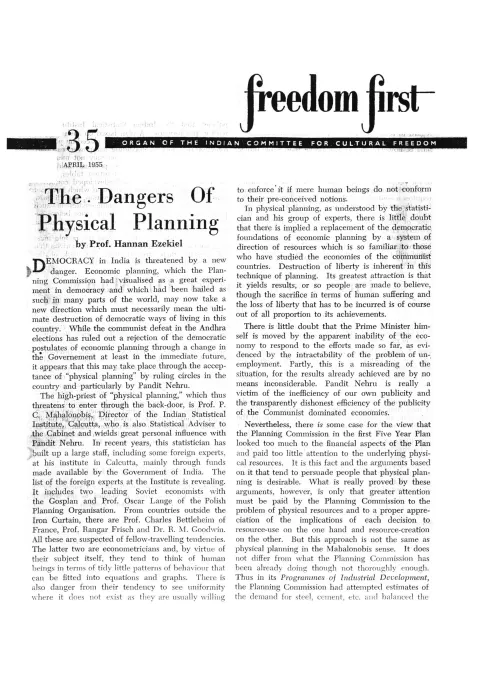
periodical issue
Freedom First
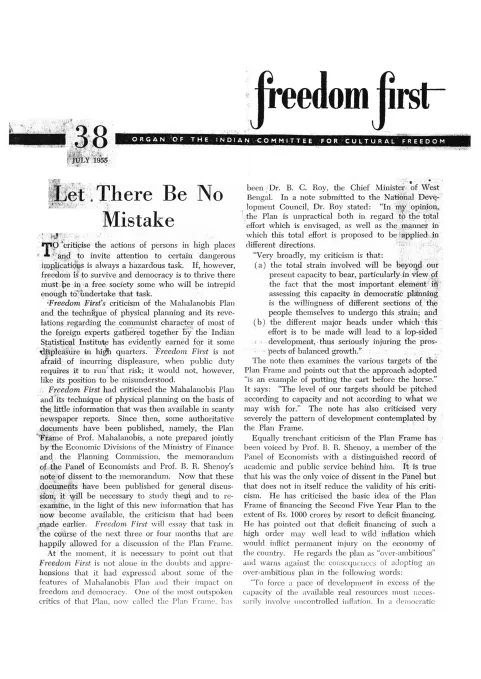
Let There Be No Mistake
By Prabhakar Padhye, Prof. W. Arthur Lewis, N. E.
printed & published by Prabhakar Padhye at The Kanada Press, 109 Parsi Bazzar Street, Bombay 1 · Bombay · 1955
12 pages
Freedom First
Summary
This is the July 1955 issue (No. 38) of Freedom First, the monthly bulletin of the Indian Committee for Cultural Freedom (edited by V. B. Karnik, printed by Prabhakar Padhye). The issue is organized around a sustained defense of the magazine’s earlier criticism of the Mahalanobis Plan Frame for the Second Five Year Plan, opening with the unsigned editorial “Let There Be No Mistake” and continuing across several other pieces. It also carries a reprinted British socialist article by W. Arthur Lewis on the tools of socialist economic policy, an original essay by Prabhakar Padhye on planning and freedom, a book review of a study of religious persecution behind the Iron Curtain, a statement on obscene-literature legislation from the Australian Committee for Cultural Freedom, a miscellany “Notes” section on current affairs (Soviet-Yugoslav relations, Tunisian home rule, Chinese payment-in-kind policy, the English-language debate, textbook shortages, obscenity law), news of Committee activities in India and abroad, and a closing column of quotations (“With Many Voices”) plus a membership appeal.
Key points
-
The unsigned editorial ‘Let There Be No Mistake’ defends Freedom First’s earlier criticism of the Mahalanobis Plan Frame now that primary documents are available, citing B. C. Roy’s and B. R. Shenoy’s dissenting notes, and rejects Congress General Secretary Shriman Narayan’s charge that the Committee is a capitalist mouthpiece.
-
Prof. W. Arthur Lewis’s reprinted ‘A Socialist Economic Policy’ argues Britain’s inherited socialist tools — progressive taxation, economic controls, nationalisation — have reached the limits of their usefulness and calls for redistributing property ownership more broadly instead of further nationalisation.
-
Prabhakar Padhye’s ‘Planning For Freedom’ questions whether a one-party-dominated legislature can meaningfully approve the Plan rather than merely rubber-stamp it, while welcoming cottage-industry provisions as a decentralising counterweight to heavy industry.
-
A review signed ‘N.E.’ of George N. Schuster’s Religion Behind the Iron Curtain documents systematic persecution of religion across the Soviet bloc, quoting a condemned man’s son’s 1952 letter and Cardinal Mindszenty’s final scribbled note to his mother.
-
A statement drafted by Sir John Latham for the Australian Committee for Cultural Freedom on obscene-literature legislation argues censorship is undesirable in principle except for customs control of imports, recommending court prosecution over an administrative Board of Review.
-
The ‘Notes’ section covers Soviet-Yugoslav relations, home rule in Tunisia, Chinese payment-in-kind labour policy, and debates over textbook shortages and the English-language question.
Essays
Let There Be No Mistake
The unsigned lead editorial “Let There Be No Mistake” defends Freedom First’s earlier, newspaper-based criticism of the Mahalanobis Plan Frame now that fuller documents (the Plan Frame itself, the joint Finance Ministry/Planning Commission note, the Panel of Economists’ memorandum, and B. R. Shenoy’s note of dissent) have been published. It marshals a chorus of authoritative critics — West Bengal Chief Minister B. C. Roy’s memorandum to the National Development Council, B. R. Shenoy’s dissent warning of uncontrolled inflation from deficit financing, editorials in The Hindu and Thought (Delhi), and a passage from Kingsley Martin in the New Statesman and Nation — to argue that the Plan’s emphasis on heavy industry paired with reservation of consumer-goods production for hand and cottage industries risks a lopsided economy and edges toward totalitarian planning methods resembling those of Soviet and East European regimes. It rebuts Congress General Secretary Shriman Narayan’s charge that the Committee is merely a mouthpiece for capitalists, insisting the Committee’s sole criterion is impact on individual freedom, not any economic dogma. The piece resumes later in the issue (pp. 10-11) to weigh the Prime Minister’s and Shriman Narayan’s reassurances that the Plan envisions decentralised, cooperative rather than totalitarian methods, citing Barbara Wooton’s Freedom Under Planning, the Radical Humanist, Asoka Mehta’s charge of using controls to ‘inveigle’ Sarvodayavadis, V. K. R. V. Rao’s suggestion of near-emergency presidential powers, G. D. Parikh’s alarmed response to that suggestion, Maurice Dobb’s comment on the Plan’s Soviet-influenced emphasis on heavy industry, and a Times of India ‘Onlooker’ column noting that a majority of the Plan’s foreign experts were Soviet, Polish, or fellow-traveller economists. It closes by warning against the ‘logic of events’ that could carry incremental centralising steps toward a fully totalitarian and regimented economy.
- Defends Freedom First’s prior criticism of the Mahalanobis Plan Frame now that primary documents are available for study
- Cites B. C. Roy’s dissenting note to the National Development Council calling the Plan ‘unpractical’ and warning of ‘lop-sided’ development
- Cites B. R. Shenoy’s warning that deficit financing of Rs. 1000 crores risks uncontrolled inflation that could erode liberty and democratic institutions
- Quotes The Hindu, Thought, and Kingsley Martin (New Statesman and Nation) as independent critical voices
- Rejects Shriman Narayan’s charge that the Committee favors capitalists, noting its members span Sarvodaya, socialist, and free-enterprise viewpoints
- Continuation (pp.10-11) surveys further reactions: Asoka Mehta, V. K. R. V. Rao, G. D. Parikh, Maurice Dobb, and Onlooker/Times of India on the Soviet-heavy composition of the Plan’s foreign expert panel
- Warns that accepting an initial ‘highly centralised plan’ risks a ‘logic of events’ pulling India toward totalitarian or regimented methods
A Socialist Economic Policy
By Prof. W. Arthur Lewis
Prof. W. Arthur Lewis’s reprinted article “A Socialist Economic Policy” (originally in the Socialist Commentary) reviews the three classic tools of British Labour socialist economic policy — budgetary policy (progressive taxation), economic controls, and nationalization — arguing that each has reached the limits of its usefulness or produced disappointing results. Progressive taxation has been pushed to the point of discouraging risk-taking; wartime-inherited controls proved cumbersome, unpopular, and often unnecessary once budgetary policy could achieve the same ends; and nationalization has transferred property to the state rather than to workers, failing to reduce inequality quickly or democratize industrial power. Lewis proposes that socialists must design new tools: taxation that rewards enterprise while still burdening the rich, controls that preserve economic stability without petty tyranny, ways of humanizing large organizations, more genuinely democratic public ownership, wage-and-profit restraint appropriate to Britain’s post-war problems of external solvency and productivity-linked wage growth, and mechanisms for redistributing property ownership more broadly rather than merely concentrating it in state hands.
- Identifies budgetary policy, economic controls, and public ownership as the three inherited tools of British socialist economic policy
- Argues Britain’s progressive taxation has reached a limit beyond which it discourages enterprise and risk-taking
- Argues wartime economic controls were dismantled because they were cumbersome, unpopular, and often unnecessary given budgetary alternatives
- Critiques nationalization for transferring power to a centralized state machine rather than democratizing it or reducing wealth concentration quickly
- Proposes redistributing property ownership broadly as a genuinely socialist alternative to further nationalization
- Identifies external solvency and sustained economic/productivity growth as two entirely new problems unaddressed by earlier socialist doctrine
- Calls for the Labour Party to accept high profits under a mixed economy provided ownership is either public or widely diffused
Planning For Freedom
By Prabhakar Padhye
Prabhakar Padhye’s essay “Planning For Freedom” interrogates the Prime Minister’s and Shriman Narayan’s assurances that the Second Five Year Plan’s physical-planning approach will not compromise democratic freedom. Padhye argues that a democratic constitution’s formal existence does not guarantee meaningful freedom unless the people genuinely participate in planning decisions, and warns that in a legislature dominated by nominees of one party, plan approval risks being a mere formality akin to Soviet rubber-stamping. He is encouraged by the Plan’s provision for hand and cottage industries as a decentralising counterweight to heavy industry, but doubts whether such protected industries can survive if government protection is later withdrawn, drawing a historical parallel to the collapse of Indian cottage industries under British mass-produced imports in the 18th-19th centuries. He calls for organic integration between village, small-scale, and heavy industry, and — invoking Aneurin Bevan’s language of workers’ and peasants’ ‘enfranchisement’ — asks whether workers and consumers, not just peasants, will get a genuine share in managing both big and small factories.
- Questions whether a formal democratic constitution alone secures meaningful freedom under Plan-style physical planning
- Warns that a one-party-dominated legislature risks reducing plan approval to a formality, as in Soviet rubber-stamping of five-year plans
- Welcomes cottage- and village-industry provisions in the Plan as a decentralising, freedom-broadening feature
- Doubts the durability of protected cottage industries once state protection is eventually withdrawn, citing their historical collapse under British imports
- Calls for organic integration of heavy, small-scale, and village industries rather than treating them as separate sectors
- Frames freedom as requiring the ‘enfranchisement’ (Bevan’s term) of workers and peasants, and asks whether workers and consumers will share in factory management
Review: Religion Behind the Iron Curtain
By N. E.
A signed review (initialled N. E.) of George N. Schuster’s Religion Behind the Iron Curtain (Macmillan, New York, $4) argues that the book documents, country by country across Eastern Germany, Czechoslovakia, Yugoslavia, Poland, Hungary, Albania, the Balkans, and Soviet Jewry, a systematic and thorough campaign to annihilate religious and personal dissent under communist rule. The reviewer, expecting the book to be ignored or dismissed in India despite Nehru’s ongoing engagement with Russia and China, quotes two documents — a son’s letter in the Czechoslovak journal Rude Prave demanding his condemned father’s execution, and Cardinal Mindszenty’s final scribbled note to his mother before arrest — as evidence that should compel scepticism toward Indian intellectuals’ credulity about communist methods.
- Reviews George N. Schuster’s Religion Behind the Iron Curtain, documenting religious persecution across the Soviet bloc
- Predicts the book will be ignored or dismissed by Indian intellectuals despite its thoroughness
- Cites documentation covering East Germany, Czechoslovakia, Yugoslavia, Poland, Hungary, Albania, the Balkans, and Soviet Jewry
- Quotes a 1952 Rude Prave letter from a condemned man’s son and Cardinal Mindszenty’s note to his mother as proof texts of communist terror
- Calls on Indian readers to refuse to forget or dismiss such evidence of regimes based on terror and ruthlessness
Notes (Soviet Delegation to Yugoslavia; Home Rule in Tunisia; Payment in Kind; Eliminating English?; An Onerous Gift; The Text-Book Muddle; Obscene Literature)
A statement on obscene publications, drafted by President Sir John Latham and approved by the Executive of the Australian Committee for Cultural Freedom, sets out principles for pending legislation: censorship is undesirable in principle but customs control of imported obscene material is justifiable; locally produced material should face court prosecution rather than an administrative ‘Board of Review’; and existing state laws, perhaps extended to cover low-grade exploitation of sex, cruelty, or horror, are about the best practical approach to a genuinely intractable problem. It insists sex and horror cannot be excluded from literature altogether, but that ‘undue emphasis’ for the purpose of unhealthy titillation is a legitimate target, while acknowledging any statute will necessarily leave courts wide discretion.
- States that censorship is undesirable in principle except for customs control of imports
- Recommends court prosecution over an administrative Board of Review for locally produced obscene material
- Argues sex and horror cannot be excluded from literature as subjects but ‘undue emphasis’ for titillation can be targeted by law
- Acknowledges any workable statute must leave substantial discretion to courts
Generated by the v1.5 extraction pipeline. Awaiting editorial review.
Metadata and summary are AI-extracted from the source PDF and reviewed for editorial accuracy. The original work is available via the Read PDF tab above (where present); paragraph-level citation inside the PDF is deferred to a future engagement.