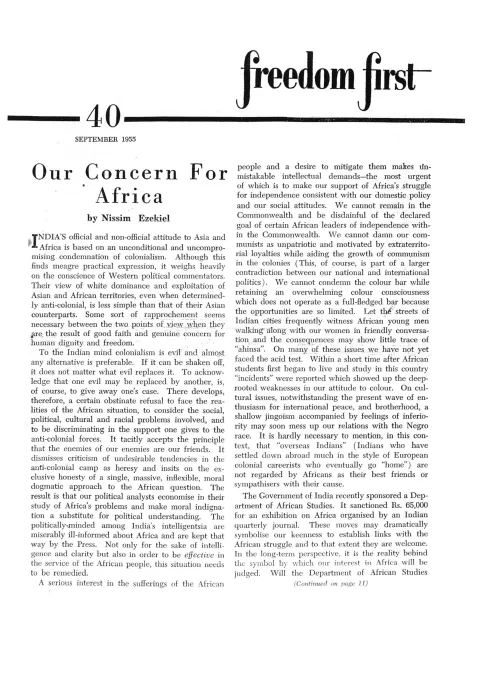
periodical issue
Freedom First
No. 39, August 1955
By Arthur Koestler, J. G. Tewari, Sudhir Hendre
printed & published by Prabhakar Padhye at The Kanada Press, 109 Parsi Bazzar Street, Bombay 1 · Bombay · 1955
12 pages
Freedom First
Summary
This is issue No. 39 (August 1955) of Freedom First, at this point still the organ of the Indian Committee for Cultural Freedom (I.C.C.F.). The issue’s editorial, “At The Post,” announces that this is the last number to appear under the I.C.C.F. banner: with the Committee’s new arts-and-ideas journal Quest launching the same month, Freedom First will continue instead as an independent journal published by a sister body, the Democratic Research Service, and will narrow its focus to political, social, economic and ideological questions. The rest of the issue is characteristic Cold War liberal-anti-communist commentary: a “Notes” section on Geneva diplomacy, Vietnamese elections, the Indonesian cabinet crisis, the right to travel, and a Kerala legislative dispute over a leaked Communist Party document (“Tactical Line”); the first instalment of Arthur Koestler’s essay “The Trail of the Dinosaur,” reprinted from Encounter, on the growing gap between humanity’s technological power and its moral development; an unsigned piece, “Planning and Democracy,” criticising Nehru’s suggestion that democracy might need to be reconsidered if it obstructs planning; J. G. Tewari’s “The Danger in Indo-China,” warning that the Nehru-Bulganin declaration’s call for early Vietnamese elections plays into a Communist strategy to absorb all of Vietnam; a book review of Robert St. John’s Through Malan’s Africa on apartheid; and a closing page of quoted press excerpts, “With Many Voices.”
Key points
-
The unsigned editorial ‘At The Post’ announces that this is the last issue of Freedom First published under the Indian Committee for Cultural Freedom banner, continuing instead under the Democratic Research Service as the new journal Quest takes over the literary and cultural brief.
-
A ‘Notes’ section warns against Great Power deals over Asian nations made without their elected representatives, argues Vietnam-wide elections would be meaningless unless northern voters can freely oppose Ho Chi Minh, and recounts the Kerala ‘Tactical Line’ controversy over a leaked Communist Party document.
-
Arthur Koestler’s ‘The Trail of the Dinosaur — I,’ reprinted from Encounter, charts humanity’s growing destructive power against a stagnant moral curve and argues atomic superiority cannot deter limited, camouflaged local aggression.
-
The unsigned ‘Planning And Democracy’ takes issue with Nehru’s reported remark that democracy’s ‘structure’ might need reconsidering if it obstructs planning, insisting democracy must come first and planning second, only as a means to a better life.
-
J. G. Tewari’s ‘The Danger In Indo-China’ argues the Nehru-Bulganin declaration’s call for prompt Vietnamese elections, without adequate safeguards against a Communist-controlled North holding 13 million people, plays into Communist strategy to conquer the whole country.
-
Sudhir Hendre reviews Robert St. John’s Through Malan’s Africa, describing apartheid South Africa’s brutal inequality and tracing discriminatory legislation against Natal Indians from an 1892 poll-tax to the 1946 Ghetto Act.
-
‘With Many Voices’ closes on N. V. Gadgil’s quip linking planning to rising unemployment and a West Bengal Congress leader’s statement that a violence-prone party flying ‘a foreign flag’ has no right to exist in India.
Essays
At The Post
The unsigned editorial “At The Post” announces that this is the last issue of Freedom First published as the organ of the Indian Committee for Cultural Freedom. With the Committee’s new journal Quest taking over the literary and cultural brief, Freedom First will continue independently under the Democratic Research Service, concentrating on practical political, social, economic and ideological issues. The editorial reaffirms the journal’s identity as a critic of totalitarianism and a defender of freedom and democracy, arguing that economic advancement without freedom is illusory (“there is no bread where freedom is lost”) and that the fight against international communism is fundamentally a battle for the minds of men, especially urgent in a newly independent country like India where poverty and impatience make people vulnerable to communist appeals. It closes by appealing to readers to subscribe now that the journal must support itself independently.
- This is the final issue of Freedom First under the Indian Committee for Cultural Freedom; it becomes an independent journal published by the Democratic Research Service.
- The new I.C.C.F. journal Quest (edited by Nissim Ezekiel) takes over the literary/cultural remit, freeing Freedom First to focus on political and economic issues.
- The editorial insists there is no genuine choice between ‘bread and freedom’ — economic advancement without freedom is impossible.
- It frames the Cold War as a battle for the minds of men, won through demonstrating a superior ideology and way of life, not force alone.
- It argues India’s democratic experiment, if successful, would be a model for the rest of Asia and Africa, and that this success alarms proponents of totalitarianism.
- The journal commits to continuing as ‘a stern critic of all forms of totalitarianism’ and appeals to readers to subscribe to sustain it financially.
Notes (Hands Off Asia; The Meaning of Free Elections; Crisis in Indonesia; The Right to Travel; Tactical Line)
The unsigned “Notes” section covers five short items. “Hands Off Asia” comments on the Geneva Big Four summit and warns against any deal on Korea, Vietnam, Laos, Cambodia, and Thailand made without those peoples’ elected representatives, invoking the Yalta precedent. “The Meaning of Free Elections” argues that the Geneva-mandated elections in a reunified Vietnam would be a sham unless the 13 million people in the Communist north have genuine freedom to vote against Ho Chi Minh’s regime, and calls for a UN trusteeship supervising the election six to twelve months in advance, backing South Vietnam’s Premier Diem’s demand for guarantees. “Crisis in Indonesia” reports on the resignation of Defence Minister Iwa Kusumasumantri, a Moscow-trained communist, after his attempt to install a junior officer as army chief provoked a crisis for Ali Sastromidjojo’s minority, communist-supported government. “The Right to Travel” praises a U.S. Court of Appeals ruling that citizens have a natural right to travel abroad without arbitrary State Department denial, contrasting this with restrictions communist states place on their own citizens (citing Chinese Muslim pilgrims to Mecca). “Tactical Line” recounts a Kerala Assembly controversy in which Chief Minister Panampally Govinda Menon read from a leaked Communist Party document called ‘Tactical Line’; the opposition called it a forgery, but the Democratic Research Service had already published the document and it was never disproved.
- Warns against Great Power deals over Asian nations (Korea, Vietnam, Laos, Cambodia, Thailand) made without their own elected representatives, invoking the Yalta betrayal.
- Argues Vietnam elections under the Geneva Agreement will be meaningless unless voters under Communist rule in the North have genuine freedom to vote against Ho Chi Minh.
- Reports the Indonesian cabinet crisis triggered by Defence Minister Iwa Kusumasumantri’s attempt to install a communist-friendly army chief.
- Praises a US court ruling affirming citizens’ natural right to travel abroad, contrasting it with Communist bloc travel restrictions on Chinese Muslim pilgrims.
- Recounts the Kerala ‘Tactical Line’ document controversy in which a leaked Communist Party paper advocating violent seizure of power was read into the Assembly record and never disproved by the Communist Party.
The Trail Of The Dinosaur—I
By Arthur Koestler
In the first instalment of “The Trail of the Dinosaur” (reprinted from Encounter), Arthur Koestler constructs a set of imaginary charts to argue that humanity’s material and destructive power has grown explosively over the last three hundred years while its moral and spiritual development has stagnated or declined — a divergence he calls catastrophic. He extends the metaphor to communications technology, arguing that the shrinking of physical distance through radio, television, and travel has not produced greater intellectual or moral cohesion between peoples; if anything, mass media has weakened the capacity for abstract thought in favor of passive perceptual consumption. Koestler then turns to the applied political problem: given that atomic war would be a collective suicide of the species, he weighs three options open to the West — continued nuclear development, one-sided disarmament, or preventive war — and rejects preventive war on both moral and prudential grounds, while noting that the Communist bloc, guided by dialectical materialism rather than Western ethical restraint, may not share the West’s reluctance. This portion (through page 7) also revisits the classical deterrence argument, showing that atomic superiority is a poor deterrent against limited, camouflaged, non-atomic aggression, since using nuclear weapons against small provocations is politically and morally impossible — leaving conventional readiness and civic resolve as the only real safeguard against Soviet expansion (with the essay explicitly marked ‘To be Continued’).
- Koestler charts humanity’s growing technological/destructive power against a stagnant or declining moral/spiritual curve, warning of a coming ‘explosion.’
- Argues that mass communications (radio, TV, cinema) have not increased intellectual or moral cohesion between peoples, and may be degrading the capacity for abstract thought.
- Frames the atomic dilemma as three options for the West: continue nuclear armament, disarm unilaterally, or wage preventive war — and rejects preventive war as based on the discredited ‘ends justify means’ fallacy applied to unmanageable, unpredictable factors.
- Contrasts Western ethical constraints on political leaders with the Soviet bloc’s unconstrained, historically-justified approach to means, including war.
- Argues atomic superiority cannot deter limited, camouflaged (‘non-atomic’) local aggression — a nuclear-armed power facing petty aggression is like a policeman with an atom bomb and nothing else.
- Concludes only conventional military strength and civic resolve (citing Finland 1939, contrasted with Czechoslovakia and Poland) can deter such aggression; essay to be continued in a subsequent issue.
Planning And Democracy
This unsigned article, “Planning And Democracy,” takes issue with a remark reportedly made by the Prime Minister (Nehru) at a press conference before his departure for Soviet Russia, that if planning proves incompatible with the democratic framework, ‘one will have to think again of the structure.’ The piece argues there is no inherent conflict between planning and democracy — planning is simply the rational arrangement of resources, which democracy does not oppose — but warns against subordinating democracy to economic reorganisation as an end in itself. It contends that economic progress divorced from democratic accountability risks serving the glorification of party, nation, or leader rather than popular well-being, citing the limited and uneven economic gains of totalitarian states (concentrated in heavy industry and war production) as proof that a ‘free man alone can strive for his economic betterment.’ It closes by insisting the country must place democracy first and planning second, only as a means to a better life within that democracy.
- Responds critically to Nehru’s reported remark that democracy’s ‘structure’ might need reconsideration if it obstructs planning.
- Argues there is no true conflict between planning and democracy: planning is rational resource arrangement, which democracy does not oppose.
- Warns that treating economic progress as an end in itself, rather than a means serving popular well-being, risks sliding into a fetishised, totalitarian planning culture.
- Points to the uneven, narrowly concentrated economic gains of totalitarian states (mainly heavy industry/war production) as evidence that unfreedom does not deliver general prosperity.
- Concludes that democracy must come first and planning second, purely as an instrument for a better democratic life, not a substitute for it.
The Danger In Indo-China
By J. G. Tewari
J. G. Tewari’s “The Danger In Indo-China” argues that the joint Nehru-Bulganin declaration’s call for prompt elections in a unified Vietnam, without adequate safeguards, plays directly into the Communist strategy to conquer the whole country, and that this clause has already been seized on by Chou En-lai and publicised by the Moscow-Delhi communist press as evidence of Indian alignment with the Soviet position. Tewari lays out extensive evidence from the Indo-China Armistice Commission and International Supervisory Committee reports that the North Vietnamese (Vietminh) government has systematically obstructed the free movement of refugees guaranteed under the Geneva Agreement, that roughly 700,000 Vietnamese have already fled south (with estimates of up to a million more wanting to), that Communist forces in Laos and Cambodia have gone underground rather than disbanding as required, and that the Vietminh maintains a large army built up with Chinese and Soviet support. He concludes that immediate elections without a neutral, adequately verified democratic guarantee (a demand South Vietnamese Premier Diem insists on) would let a Communist-controlled North, holding 13 million people under ‘iron grip,’ swamp any nationwide vote, and that the accusation that America is the obstacle to elections conceals the Vietminh government’s own repeated breaches of the Geneva Agreement.
- Argues the Nehru-Bulganin joint declaration’s call for Vietnam-wide elections, without safeguards, serves the Communist design to conquer all of Vietnam.
- Cites Indo-China Armistice Commission findings that North Vietnam’s government obstructed refugees’ guaranteed freedom of movement (citing 10,000 refugees found ‘congregated at a place and unable to move’).
- Reports roughly 700,000 Vietnamese have migrated from Communist to South Vietnamese territory, with estimates that up to a million more would migrate given full freedom.
- Notes Communist forces in Laos and Cambodia went underground instead of disbanding as the Geneva Agreement required, still receiving arms from the Vietminh government.
- Argues genuine, safeguarded elections (which Premier Diem demands) are essential because a Communist-controlled North holding 13 million people would produce fraudulent near-unanimous votes.
- Contends the Communist and ‘fellow traveller’ accusation that America obstructs Vietnamese elections conceals the Vietminh government’s own repeated breaches of the Geneva Agreement.
Review: Through Malan’s Africa (Robert St. John, Gollancz 13/6)
By Sudhir Hendre
A book review by Sudhir Hendre of Robert St. John’s Through Malan’s Africa (Gollancz, 13/6) describes the book as an intimate, unsparing account of apartheid South Africa, depicting the brutal inequality between the white minority and African majority, the confiscation of African lands, the pass and tax systems forcing African men into wage labour, and the total absence of basic amenities in African townships such as ‘Cook Bush.’ The review also notes the book’s chapter on the Natal Indian question and Manilal Gandhi’s advocacy of passive resistance, tracing the escalation of discriminatory legislation from an 1892 poll-tax on Indian traders to the 1946 Ghetto Act. Facing the review, a notice to members of the Indian Committee for Cultural Freedom explains that Freedom First will now be published by the Democratic Research Service and appeals for continued subscriptions, alongside a subscription form.
- Reviews Robert St. John’s Through Malan’s Africa, describing it as an intimate exposure of apartheid’s brutal inequalities.
- Highlights the book’s contrast between white middle-class comfort (multiple servants) and African townships like ‘Cook Bush’ lacking water, electricity, sewage, or privies.
- Notes Africans are confined to less fertile ‘reserves’ while more fertile land is taken by white settlers, and taxes force African men into wage labour in mines, factories and plantations.
- Covers the book’s treatment of the Natal Indian question and Manilal Gandhi’s advocacy of passive resistance, and traces discriminatory legislation from the 1892 poll-tax to the 1946 Ghetto Act.
- Accompanying notice informs ICCF members that Freedom First continues under the Democratic Research Service and solicits subscriptions.
With Many Voices
“With Many Voices” is the issue’s closing page of quoted press excerpts on current affairs from around the world (June-July 1955), framed by a Tennyson epigraph. It juxtaposes clippings from the Economist, Blitz, the Times of India, the New York Times, the Examiner, Current, and other outlets on themes including Nehru’s diplomacy with China and the Soviet Union, R. K. Karanjia’s laudatory framing of Nehru as fulfilling Lenin’s vision, Sir John Kotelawala’s remark equating Chinese claims on Formosa with a hypothetical Indian claim on Ceylon, Stalin’s cynicism about diplomacy and words versus actions, the free world’s tendency to judge itself and communist states by a double standard, and closing observations on planning-driven unemployment (N. V. Gadgil) and a West Bengal Congress leader’s statement that a party which resorts to violence and adopts a foreign flag (the Communist Party) has no right to exist in India. The page (and the issue) closes with the publication’s registration and printing details, naming V. B. Karnik as editor.
- A curated page of quotations from the international and Indian press (June-July 1955) on Cold War diplomacy, China, and communism.
- Includes R. K. Karanjia’s (Blitz) description of Nehru as history’s chosen executor of Lenin’s dream of India-China-Russia unity, quoted seemingly to illustrate a naive pro-Soviet framing the journal opposes.
- Quotes the Economist on free nations’ tendency to apply a ‘double standard,’ judging their own faults harshly while excusing communist states.
- Includes Stalin’s own cynical remark (as quoted in the Examiner) that words are a mask for concealing bad deeds and that sincere diplomacy is impossible.
- Closes with N. V. Gadgil’s quip on planning correlating with rising unemployment and Atulya Ghosh’s statement that a violence-prone party flying a ‘foreign flag’ has no right to exist in India — an implicit reference to the Communist Party.
- The masthead identifies V. B. Karnik as editor and names The Kanada Press (printer, Prabhakar Padhye) and Bombay as place of publication.
Generated by the v1.5 extraction pipeline. Awaiting editorial review.
Metadata and summary are AI-extracted from the source PDF and reviewed for editorial accuracy. The original work is available via the Read PDF tab above (where present); paragraph-level citation inside the PDF is deferred to a future engagement.