periodical issue
Freedom First
By V. B. Karnik, M. R. Masani, Aziz Madni, M.B.S.
Edited, printed & published for the Democratic Research Service by V. B. Karnik at The Kanada Press, 109 Parsi Bazar Street, Bombay 1. · Bombay · 1955
12 pages
Freedom First
Summary
This is the full November 1955 issue (No. 42) of Freedom First, the monthly periodical of the Democratic Research Service edited by V. B. Karnik. The issue is a compact Cold War-era anti-communist and pro-democracy digest: a lead essay by Karnik weighs whether the post-Stalin Soviet ‘thaw’ in foreign policy is a genuine shift or a tactical feint; an unsigned Notes section comments on Vietnam’s new republic, the North-East Frontier tribal problem, a Bombay speech on majority-minority democracy, trade-union opposition to NATO complicity with colonialism, the government’s National Book Trust proposal, and a Travancore-Cochin communist-conspiracy vindication; M. R. Masani reports at length on the Congress for Cultural Freedom’s Milan conference; an unsigned piece surveys Indonesia’s first general election as a dangerously fragmented result that could open the door to communist influence; an unsigned feature reproduces, side by side, the 1954 and 1955 Soviet Encyclopedic Dictionary entries on Malenkov to document Soviet historiographical revisionism; a Review section covers Philip Spratt’s Blowing Up India and Dagobert Runes’ The Soviet Impact on Society; and the issue closes with ‘With Many Voices,’ a column of quotations from world figures on Cold War themes, plus subscription details.
Key points
-
V. B. Karnik’s lead essay ‘A Tactic Or A New Policy?’ weighs whether the post-Stalin Soviet ‘thaw’ is genuine or tactical, citing the Austrian Treaty and Geneva summit against Khrushchev’s own warning that the smile does not mean abandoning Marx and Lenin.
-
A ‘Notes’ section welcomes South Vietnam’s new republic under Diem, endorses Nehru’s sympathetic approach to North-East Frontier tribal peoples while warning of Chinese infiltration, and criticises a proposed National Book Trust as risking political favouritism over private publishing.
-
M. R. Masani’s report on the Congress for Cultural Freedom’s Milan conference details debates on planning versus freedom, contested claims about Soviet economic progress, and his own intervention pressing Western delegates on solidarity with underdeveloped countries.
-
An unsigned report on Indonesia’s first general election describes a dangerously fragmented result — Nationalists, Masjumi, Nahdatul Ulama and Communists near-even — warning a nationalist-led coalition reliant on communist support could produce a Soviet-satellite ‘people’s democracy.’
-
‘History In The Making In Soviet Russia’ reproduces the 1954 and 1955 Soviet Encyclopedic Dictionary entries on Malenkov side by side, showing his biography cut from 108 to 53 lines after his resignation, and compares the practice to Orwell’s 1984.
-
Reviews cover Philip Spratt’s Blowing Up India, tracing his path from Comintern agent implicated in the Meerut Conspiracy case to disillusioned anti-communist writer (Aziz Madni), and Dagobert Runes’s The Soviet Impact on Society, arguing communism reproduced capitalism’s worst features once implemented (M.B.S.).
-
‘With Many Voices’ includes Picasso dismissing Soviet painting as monotonous and militaristic, and Acharya Kripalani’s self-description as ‘a paralysed socialist.‘
Essays
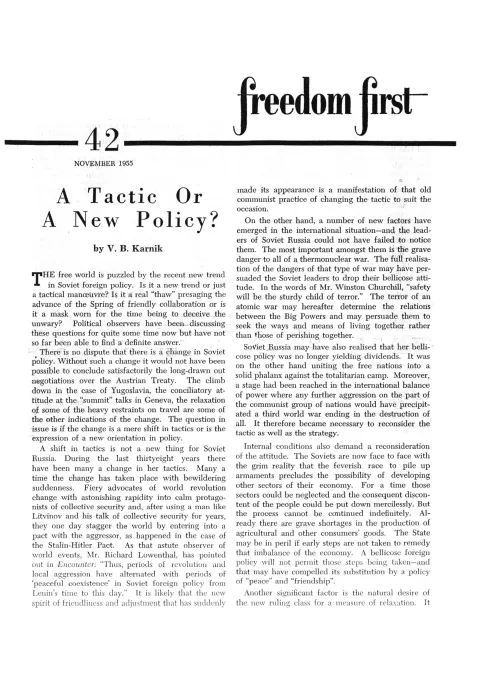
A Tactic Or A New Policy?
By V. B. Karnik
In ‘A Tactic Or A New Policy?’ V. B. Karnik examines whether the apparent ‘thaw’ in Soviet foreign policy after Stalin’s death represents a genuine reorientation or merely another tactical shift in a long Soviet history of such shifts. He surveys the evidence for change (the Austrian Treaty, reconciliation with Yugoslavia, the Geneva summit, eased travel restrictions) alongside structural pressures pushing the USSR toward relaxation (fear of thermonuclear war, the new ruling class’s desire for a higher standard of living, economic strain from the arms race). He then presents the skeptical counter-view, which holds that communists change tactics but never objectives, citing Khrushchev’s own warning that the smile should not be mistaken for abandonment of Marxist-Leninist goals. Karnik notes contrary signals — the treatment of East Germany after Adenauer’s departure and new Soviet arms aid to West Asia — that complicate any confident reading of Soviet intentions, and points to the upcoming Foreign Ministers’ Conference as the real test of whether the shift is durable.
- Frames the question as whether the Soviet ‘thaw’ is tactic or genuine policy change, not resolving it definitively.
- Lists concrete evidence of change: the Austrian Treaty, the Yugoslavia climbdown, the Geneva summit conciliatory tone, and eased travel restrictions.
- Identifies structural pressures for change: fear of thermonuclear war, a new Soviet ruling class wanting an easier life, and strain from prioritizing armaments over consumer goods.
- Presents the skeptical counter-argument via Khrushchev’s own remark that the smile does not mean abandoning Marx and Lenin.
- Points to contradictory signals (East Germany, new arms aid to West Asia) as reasons for caution.
- Identifies the upcoming Foreign Ministers’ Conference as the coming test of Soviet intentions on Germany, European security, and trade/travel barriers.
Essay 2
The unsigned ‘Notes’ section comments on several current events. It welcomes South Vietnam’s referendum ousting Bao Dai and the new republic under Diem as a democratic advance for Indo-China, and warns that the free countries of Asia now bear responsibility for its defence. A companion note on the North-East Frontier draws on Nehru’s 1952 tour note to officials, endorsing his sympathetic, non-bureaucratic approach to tribal peoples while warning that Chinese communist infiltration among border tribes, aided by comparatively favourable treatment across the Tibet border, is a real danger requiring both goodwill and vigilance.
- Welcomes the South Vietnamese referendum and Diem’s new Republic of Vietnam as a democratic gain, replacing the discredited Bao Dai regime.
- Frames defence of the three Indo-Chinese states against ‘totalitarian threat from the North’ as an obligation of the free world.
- Endorses Nehru’s 1952 note on the North-East Frontier tribal peoples, emphasising sympathy and non-bureaucratic handling over bureaucratic imposition.
- Warns that Chinese treatment of border people may be perceived as more favourable, creating an opening for communist infiltration and arms supply to Nagas.
- Calls on the Indian government to combine a sympathetic approach to tribal peoples with active resistance to Chinese communist infiltration.
Notes (A New Asian Republic; North East Tribal Problem; Essentials of Democracy; A Commendable Lead; National Book Trust; D. R. S. Vindicated)
A further set of Notes covers domestic Indian affairs. It reports Bombay Governor Dr. Harekrushna Mahtab’s Ahmedabad speech defining democracy as majority rule with minority consent, and warns against majoritarian degeneration into tyranny. It commends the International Confederation of Free Trade Unions for opposing NATO military support to colonial suppression of nationalist movements. It criticizes the Government of India’s proposed National Book Trust, arguing state control of book publication risks political favouritism and suppression of independent authors, urging instead private-sector encouragement. Finally, it reports that the Travancore-Cochin Legislative Assembly’s Privileges Committee upheld Chief Minister P. Govinda Menon’s contention that the ‘Madura thesis’ document (revealing the Communist Party’s real objective of overthrowing the Indian state, published in The Communist Conspiracy at Madurai by the Democratic Research Service) was genuine, despite communist protests.
- Reports Dr. Harekrushna Mahtab’s definition of democracy as majority rule with minority consent, delivered at the Harold Laski Institute in Ahmedabad.
- Praises the International Confederation of Free Trade Unions for condemning NATO-linked support for colonial suppression of nationalist movements.
- Criticizes the government’s planned National Book Trust as risking political patronage and suppression of independent authors and books.
- Advocates private publishers and market incentives over state control of book production.
- Reports the Travancore-Cochin Assembly’s Privileges Committee vindicating Chief Minister P. Govinda Menon and the authenticity of the Madurai communist conspiracy document against communist claims of fabrication.
The Milan Conference—A Report
By M. R. Masani
M. R. Masani’s report on the Milan conference of the Congress for Cultural Freedom describes a friendly, high-profile gathering (Hugh Gaitskell, George Kennan, Friedrich Hayek, Sydney Hook, Michael Polanyi, Raymond Aron and others among the notable attendees, with Patanjali Shastri and A. D. Gorwala representing India) and identifies its major defect as trying to cover too much ground with too many prominent people rather than smaller focused seminars. He recounts five debates: whether planning and freedom are reconcilable (most thought yes, viewing socialism-versus-capitalism as an increasingly dead framing); the extent of Soviet economic progress, sharply contested between Peter Wiles’ claim of unprecedented Soviet growth and rebuttals from George Kennan, Woytinsky and Bertram Wolfe questioning Soviet statistics and human costs; whether the post-Stalin ‘thaw’ is genuine or tactical, with Bertram Wolfe arguing historical precedent (NEP, Litvinov disarmament era, Popular Front) shows such openings are reversible; the conservatism of the intelligentsia, per Michael Polanyi’s ‘reluctant Columbuses’ framing; and a debate on underdeveloped countries where Masani himself pressed Western delegates on inadequate awareness, willingness to share prosperity, and openness to genuine solidarity, receiving a mixed response but general agreement from Gaitskell. The report closes with the Congress’s three passed resolutions (on underdeveloped regions, the persecution of Hu Feng in China, and the suppression of El Tiempo in Colombia) and the re-election of the Executive Committee.
- Names the Milan conference’s most prominent attendees, including Hugh Gaitskell, George Kennan, Friedrich Hayek, Sydney Hook, Michael Polanyi and Raymond Aron, plus the Indian delegation led by Patanjali Shastri and A. D. Gorwala.
- Identifies the conference’s chief defect as inviting too many senior people for the format, preventing deeper engagement.
- Summarizes the planning-versus-freedom debate: most delegates saw no inherent conflict, treating the capitalism/socialism dichotomy as an outdated framing.
- Details the sharply argued debate on Soviet economic progress, contrasting Peter Wiles’ pro-growth thesis against rebuttals questioning Soviet statistics and human cost.
- Covers the debate on whether the post-Stalin thaw is genuine, with Bertram Wolfe citing historical Soviet precedents for reversible openings.
- Reports Masani’s own intervention on underdeveloped countries, pressing Western delegates on awareness, shared prosperity, and solidarity — met with a mixed but partly encouraging response including from Gaitskell.
- Lists the three resolutions passed by the General Assembly of the Congress for Cultural Freedom: on underdeveloped regions, on persecuted Chinese writers including Hu Feng, and on suppression of the Colombian paper El Tiempo.
Indonesia; A Confused Picture
‘Indonesia; A Confused Picture’ analyses the results of Indonesia’s first general elections as dangerously fragmented: the Nationalist Party and the liberal Masjumi Party each won over 7.5 million votes, followed closely by the conservative Nahdatul Ulama and the Communist Party, with no party commanding a clear majority. The piece criticizes the Central Election Committee’s composition (dominated by nationalists and communists, with Masjumi and the Socialist Party excluded) as having distorted the outcome, laments the disappearance of the Socialist Party as a major force, and warns that a coalition government led nominally by nationalists but doing the will of the communists could open the door to a Soviet-style ‘people’s democracy.’ It welcomes Indonesian Vice-President Mohamed Hatta’s visit to India and his stated intent to keep communists out of government, while cautioning that Indonesia’s first democratic steps remain fragile.
- Reports the near-even split among the Nationalist Party, Masjumi, Nahdatul Ulama and the Communist Party in Indonesia’s first general election.
- Criticizes the Central Election Committee’s composition, which excluded Masjumi and the Socialist Party, as having skewed the vote.
- Laments the Socialist Party’s poor showing despite having what the author considers the best political programme.
- Warns that a coalition led nominally by nationalists but reliant on communist support could produce a Soviet-satellite-style ‘people’s democracy.’
- Welcomes Vice-President Mohamed Hatta’s visit to India and his stated commitment to excluding communists from government.
History In The Making In Soviet Russia
‘History In The Making In Soviet Russia’ documents Soviet historiographical revisionism by reproducing, in full, the April 1954 and February 1955 versions of the Soviet Encyclopedic Dictionary’s biography of Georgy Malenkov side by side. The piece opens by recalling how the Great Soviet Encyclopaedia’s publishers instructed readers to physically excise the entry and portrait of the purged Lavrenti Beria, comparing the practice to Orwell’s 1984. It then shows how, after Malenkov’s 1955 resignation, his encyclopedia entry was cut from 108 to 53 lines, with laudatory language (‘outstanding personality… a true pupil of V. I. Lenin and comrade-in-arms of I. V. Stalin’) replaced by flat, minimal biographical detail, and most of his wartime and Party record simply deleted.
- Opens with The Economist’s account of Soviet publishers instructing Great Soviet Encyclopaedia readers to remove pages containing Lavrenti Beria’s biography and portrait after his purge.
- Draws an explicit comparison to George Orwell’s 1984 and the concept of the ‘unperson.’
- Documents that Malenkov’s Encyclopedic Dictionary entry was cut from 108 to 53 lines between the April 1954 and February 1955 printings, following his resignation.
- Shows the original entry calling Malenkov an ‘outstanding personality… a true pupil of V. I. Lenin and comrade-in-arms of I. V. Stalin,’ replaced with the flatter ‘important personality.’
- Reproduces both full versions of the encyclopedia text side by side as documentary evidence of the editing.
Review: Blowing Up India (Philip Spratt); The Soviet Impact on Society (Dr. Dagobert D. Runes)
By Aziz Madni; M.B.S.
The Review section carries two pieces. Aziz Madni reviews Philip Spratt’s Blowing Up India (Praphi Prakashan, Calcutta), describing Spratt’s journey from a secret Comintern agent implicated in the Meerut Conspiracy case to a disillusioned anti-communist writer for Mysindia, noting his account of Marxism’s intellectual and missionary appeal, his disillusionment during imprisonment and after the Soviet invasion of Finland, and criticizing inconsistencies in his treatment of Korea, Indo-China, Chiang Kai-shek’s China, and religion. M.B.S. reviews Dr. Dagobert D. Runes’ The Soviet Impact on Society (Philosophical Library, New York), praising it as a sharp critique arguing that communism arose as a revolt against capitalism’s injustices but, once implemented, reproduced capitalism’s worst features while enslaving the Soviet people, and warning against underrating Soviet ideological and imperial threats amid the era’s ‘peaceful coexistence’ rhetoric.
- Reviews Philip Spratt’s Blowing Up India, tracing his path from Comintern agent and Meerut Conspiracy defendant to disillusioned anti-communist writer.
- Quotes Spratt on the psychological and missionary appeal Marxism held for him and other converts.
- Notes Spratt’s disillusionment intensifying during imprisonment and after the Soviet invasion of Finland.
- Criticizes inconsistencies in Spratt’s treatment of Korea, Indo-China, Chiang Kai-shek, and religion (Islam and Christianity vs. Hindu sentiment).
- Reviews Dagobert Runes’ The Soviet Impact on Society as arguing communism reproduces capitalism’s worst features once implemented and calls for continued vigilance against Soviet ideological threats despite the ‘thaw.‘
With Many Voices
‘With Many Voices,’ the closing column, gathers short quotations from world political and cultural figures on Cold War and contemporary themes, sourced from The Times, Thought, New Age, Times of India, New Leader, and the New York Herald Tribune, among others, including remarks attributed to Molotov, Truman, Nehru, Picasso, Dulles, William Henry Chamberlin, Reinhold Niebuhr, J. C. Kumarappa, the Shah of Iran, and Acharya Kripalani. The page also carries the subscription coupon and closing masthead noting the periodical is edited, printed and published for the Democratic Research Service by V. B. Karnik.
- Compiles brief quoted remarks from a wide range of contemporary political and cultural figures on Cold War-era themes.
- Sources span international and Indian press including The Times, Thought, New Age, Times of India, and New Leader.
- Includes Nehru’s remarks on Marx’s ‘outdatedness’ given American wealth, and on the nature of a political ‘Boss.’
- Includes Picasso’s comment dismissing Soviet painting as monotonous and militaristic in theme.
- Includes Acharya Kripalani’s self-description as ‘a paralysed socialist’ unable even to join the Congress.
- Closes the issue with a subscription form and the masthead crediting V. B. Karnik as editor, printer and publisher for the Democratic Research Service.
Generated by the v1.5 extraction pipeline. Awaiting editorial review.
Essay 8
No summary was extracted for this article. Listed for completeness.
Metadata and summary are AI-extracted from the source PDF and reviewed for editorial accuracy. The original work is available via the Read PDF tab above (where present); paragraph-level citation inside the PDF is deferred to a future engagement.