periodical issue
Freedom First
Edited, printed & published for the Democratic Research Service by V. B. Karnik at The Kanada Press, 109 Parsi Bazar Street, Bombay 1. · Bombay · 1956
16 pages
Freedom First
Summary
Freedom First No. 49 (June 1956), edited and published for the Democratic Research Service by V. B. Karnik, is a Bombay-based classical-liberal monthly focused on anti-communist reportage, critique of India’s Second Five-Year Plan, and news of allied bodies such as the Indian Committee for Cultural Freedom (I.C.C.F.). This issue leads with V. B. Karnik’s account of an international commission’s findings on slave labour camps in Communist China, followed by unsigned editorial ‘Notes’ on domestic and international affairs (the right to strike, communist infiltration of trade unions, Syngman Rhee’s South Korea, Vinoba Bhave’s Bhoodan appeal, film censorship, and the Singapore constitutional talks). M. A. Venkata Rao contributes a piece on Planning Commission member K. C. Neogy’s dissent from the Second Five-Year Plan’s financial assumptions, drawing on similar warnings from Prof. B. R. Shenoy, Prof. D. R. Gadgil, Prof. C. N. Vakil, and Dr. John Matthai. Other content profiles visiting American novelist James T. Farrell (Chairman of the American Committee for Cultural Freedom), analyses the CPI’s Fourth Congress at Palghat under the heading ‘Operation Lullaby,’ reports on I.C.C.F. programming (a Japanese cultural delegation, a lecture by Irving Brown of the AFL-CIO) and an I.C.C.F. seminar in Poona on casteism and Maharashtra’s liberal heritage, reviews Alwin H. Scaff’s book on the Philippine defeat of the Huk communist rebellion, and closes with a letter to the editor on income inequality in the USSR. A four-page supplement to this issue, ‘Social Democrats In Communist Jails,’ reproduces a letter from international labour and socialist leaders (including Julius Braunthal of the Socialist International, Norman Thomas, and A. Philip Randolph) to Khrushchev and Bulganin, followed by extensive partial name-lists of socialist, social-democratic, and free-trade-union leaders imprisoned or ‘vanished without trace’ in the USSR and its Eastern European satellites.
Key points
-
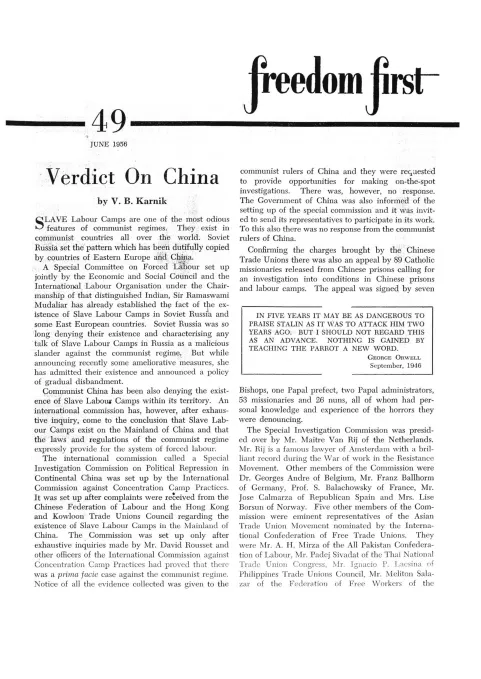
V. B. Karnik’s ‘Verdict On China’ reports an international Brussels commission’s findings, corroborated by 89 released Catholic missionaries, that forced labour in Communist China is economically embedded and ‘reform through labour’ constitutes ‘a true concentrationary system.’
-
M. A. Venkata Rao’s ‘Neogy Upsets The Apple Cart’ details Planning Commission member K. C. Neogy’s dissent, alongside B. R. Shenoy and C. N. Vakil, warning that deficit financing near Rs. 1200 crores would generate serious inflation.
-
A profile of visiting American novelist James T. Farrell situates him in the naturalist tradition of Dreiser and Sinclair Lewis, noting his refusal to let Marxism dictate his individual judgment despite earlier Trotskyite associations.
-
‘Operation Lullaby’ analyses the CPI’s Fourth Congress at Palghat as mirroring 1930s Popular Front tactics, warning of growing Congress tolerance toward the CPI as a legitimate opposition.
-
V.B.K.’s review of Alwin H. Scaff’s The Philippine Answer to Communism recounts President Magsaysay’s ‘all-out force and all-out friendship’ defeat of the Huk rebellion via the EDCOR resettlement programme.
-
A correspondent’s report on an I.C.C.F. seminar in Poona covers Maharashtra’s casteism and liberal heritage, with M. R. Masani forcefully countering claims that liberalism was ‘dead and gone.’
-
A four-page supplement, ‘Social Democrats In Communist Jails,’ reproduces a letter to Khrushchev and Bulganin from international socialist leaders including Julius Braunthal, Norman Thomas and A. Philip Randolph, demanding release of over 350 imprisoned socialists and trade unionists across the USSR and Eastern Europe.
Essays
Essay 1
V. B. Karnik reports on the findings of a Special Investigation Commission on Political Repression in Continental China, convened in Brussels (April 20-30, 1956) by the International Commission against Concentration Camp Practices, presided over by Maitre Van Rij of the Netherlands. Drawing on testimony, documents, and an appeal by 89 released Catholic missionaries, the Commission concluded that China’s penal system delivers citizens to arbitrary state action, that forced labour is a major and structurally embedded part of the economy, and that ‘reform through labour’ constitutes a degrading, dehumanising system rather than genuine rehabilitation. Karnik supplements the Commission’s findings with figures and quotations from Richard L. Walker’s book China Under Communism, including statements by Chinese officials Teng Tzu-hui and Fu Tso-yi on conscript and forced labour numbers.
- An international Special Investigation Commission, formed after complaints from the Chinese Federation of Labour and Hong Kong/Kowloon Trade Unions Council, met in Brussels in April 1956 to examine evidence of slave labour in Communist China.
- The Chinese government was invited to participate or send representatives but did not respond, mirroring the Soviet Union’s earlier denials of camps later admitted.
- 89 Catholic missionaries released from Chinese prisons (bishops, prefects, administrators, priests, nuns) signed an appeal corroborating the camps’ existence.
- The Commission’s four formal conclusions describe the penal system as arbitrary, the forced labour as economically integral and materially substandard, ‘reform through labour’ as dehumanising, and the overall system as ‘a true concentrationary system.’
- The Commission could not fix exact prisoner numbers but judged the total to be ‘several millions.’
- Richard L. Walker’s China Under Communism is cited for corroborating figures: 1,150,000 ‘native bandits’ inactivated in the Central-South Region between winter 1949-50 and November 1951, with 322,000 executed; a minimum of 575,000 slave labourers in that region by November 1951; over 10 million conscript workers used in water conservancy; over two million conscript labourers on the Chunking-Chengtu railway.
Verdict On China
By V. B. Karnik
This unsigned ‘Notes’ section covers several short editorial items: a defence of the workers’ right to strike against calls (including from the Labour Minister) to relinquish it under the Second Five-Year Plan; praise for the INTUC’s rejection of a communist-proposed united front with the AITUC, paired with a warning about communist infiltration tactics; a rebuttal of the charge that Syngman Rhee’s South Korea is a fascist dictatorship, citing the opposition’s vice-presidential win; an account of Vinoba Bhave’s appeal to writers to support the Bhoodan movement and the Indian Committee for Cultural Freedom’s commissioning of a book on Bhoodan by Rustom Masani; criticism of the government’s ban on eight foreign films for allegedly failing to portray Africans ‘in the proper perspective’; criticism of the failure of the London talks between Singapore’s David Marshall and the British Colonial Office, quoting Lord Attlee; and a closing item questioning why Dr. Syed Mahmoud, a minister, lent his name to a Helsinki conference linked to a communist front.
- The INTUC’s Surat conference reaffirmed workers’ right to strike despite pressure from Plan-era ‘socialism’ rhetoric to abandon it; the editorial argues collective bargaining, not surrender of the right to strike, is the correct remedy.
- The INTUC rejected a united-front proposal from the communist AITUC; the editorial warns communists may now pursue ‘infiltration’ instead and calls for unity among democratic forces.
- Dr. Syngman Rhee’s South Korea is defended against the charge of fascist dictatorship, citing the opposition Democratic Party’s vice-presidential victory over Rhee’s nominee.
- Vinoba Bhave asked writers/journalists to devote a portion of their talents to Bhoodan; the Indian Committee for Cultural Freedom persuaded Rustom Masani to write a book on Bhoodan, forthcoming from Collins, London.
- The government’s ban on eight foreign films with African settings is criticised as vague and dangerous precedent for press/artistic freedom.
- The failed Singapore-Colonial Office talks are blamed on British intransigence, with a warning that failure benefits communists in Southeast Asia.
- The piece questions Dr. Syed Mahmoud’s participation in a Helsinki ‘International Conference of Journalists’ organised via a communist-linked preparatory committee.
Neogy Upsets The Apple Cart
By M. A. Venkata Rao
M. A. Venkata Rao examines the dissent of Planning Commission member K. C. Neogy, recorded in the final report on the Second Five-Year Plan, against the Plan’s swollen size, taxation and deficit-finance proposals, treatment of free enterprise, and employment estimates. Neogy characterised the Plan’s financial resource calculations as ‘wishful thinking’ and warned that deficit financing of the order proposed could generate serious inflation, hurting fixed-income groups and provoking ‘forces of reaction and demoralisation.’ The article situates Neogy’s critique alongside similar warnings from Prof. B. R. Shenoy (dissenting from the Panel of Economists’ endorsement of Rs. 1000 crores deficit finance), Prof. C. N. Vakil (predicting prices could rise three to four times), and Dr. John Matthai (warning that ‘indiscriminate nationalisation’ of industries would overstrain administrative capacity). The piece credits Freedom First and the Democratic Research Service with having anticipated these criticisms since 1955, citing earlier warnings from Prof. Hannan Ezekiel and Jayaprakash Narayan about the Soviet/Polish-influenced, centralising character of the Mahalanobis Plan-frame, and closes by contrasting the USSR’s own admitted planning failures (per Khrushchev and Bulganin’s 20th Congress reports) with India’s imitation of Soviet-style centralisation.
- K. C. Neogy’s dissent, now part of the official Second Five-Year Plan report, criticises the Plan’s size, taxation, deficit-finance scale, treatment of private/free enterprise, and employment targets as unrealistic.
- Neogy warns deficit financing near Rs. 1200 crores would generate inflation harming fixed-income groups and could provoke social ‘forces of reaction and demoralisation.’
- Prof. B. R. Shenoy’s Minute of Dissent argued the economy could absorb at most about Rs. 200 crores of deficit finance without inflationary danger, citing risks to police constables’ and army jawans’ real incomes.
- Prof. C. N. Vakil (with a colleague) argued in a forthcoming work, excerpted in The Times of India, that the Plan’s deficit financing could raise general prices three to four times by mid-Plan.
- Dr. John Matthai, addressing the Bombay Rotary Club, warned that ‘indiscriminate nationalisation of industries’ would impose unwise administrative strain, though he conceded some deficit finance was necessary.
- Freedom First is credited with flagging the Mahalanobis Plan-frame’s totalitarian/Soviet-Polish influences as early as May-July 1955, quoting Jayaprakash Narayan’s remark that ‘the seven authors of Pandit Nehru’s plan are all men from behind the Iron Curtain.’
- The article contrasts Khrushchev’s and Bulganin’s own admissions (20th Congress) of Soviet agricultural and consumer-goods failure after five Five-Year Plans with India’s continued emulation of the Soviet emphasis on heavy industry over consumer goods.
James T. Farrell
A profile of the American novelist James T. Farrell, guest of the Indian Committee for Cultural Freedom, situating him within the tradition of American literary naturalism (Crane, Norris, Dreiser, Sinclair Lewis) descending from Emile Zola, and noting his intellectual debts to Voltaire, Marx, and American pragmatists Mead and Dewey, as well as his friendship with Sydney Hook and his role as a founder-member of the American Committee for Cultural Freedom. The piece emphasises Farrell’s independence from Freudian and existentialist literary fashions and his refusal to let Marxism, despite early sympathies and Trotskyite associations, dictate his individual judgment. A brief notice lists Farrell’s Bombay itinerary: arrival June 2, a P.E.N./Indian Committee lecture on ‘Some Observations on the 20th Century American Novel’ on June 4 (chaired by Prof. G. C. Banerjee), and a writers’ meeting on June 5.
- James T. Farrell, Chairman of the American Committee for Cultural Freedom, visited Bombay as a guest of the Indian Committee for Cultural Freedom.
- Farrell is placed in the American naturalist tradition (Crane, Norris, Dreiser, Upton Sinclair, Sinclair Lewis), itself descended from Emile Zola.
- His intellectual influences include Voltaire (scepticism of authority), Marx (aspiration to equality without doctrinaire attachment), and American pragmatists Mead and Dewey (value of experience, distrust of dogma), plus H. L. Mencken.
- Despite intimacy with Trotskyite circles and study of Marxism, Farrell never renounced his individualism or let ideology dictate his conclusions.
- His programme in Bombay included a public lecture on ‘Some Observations on the 20th Century American Novel’ at the Durbar Hall, Town Hall, on June 4, 1956.
Operation Lullaby
An unsigned analysis titled ‘Operation Lullaby’ examines the Fourth Congress of the Communist Party of India (CPI) at Palghat (April 19-29, 1956), held shortly after the 20th Congress of the CPSU debunked Stalin’s cult of personality. The article traces how the CPI adapted its programme to endorse India’s foreign policy and domestic Plan while pursuing a strategy of building ‘the broadest united front of all patriotic and democratic forces,’ aiming to separate ‘progressive’ from ‘reactionary’ elements within the Congress Party and to woo the masses behind communal parties while denying them a united front. The piece argues this mirrors the Comintern’s mid-1930s Popular Front tactics and Palme Dutt-Bradley Thesis-era manoeuvres, and warns that growing official tolerance of the CPI (e.g., government participation in the Palghat exhibition) signals dangerous complacency, especially given signs (per Khandubhai Desai’s INTUC remarks) that Congress circles are warming to the idea of the CPI as a legitimate opposition party.
- The CPI’s Fourth Congress at Palghat had to reconcile Stalin’s post-mortem denunciation (20th CPSU Congress) with continued adherence to Soviet-aligned foreign and domestic policy positions.
- The CPI’s Political Resolution divides India’s ‘democratic forces’ into a bloc including the Communist Party, PSP, and Socialist Party, versus a ‘reactionary bloc’ of unnamed communal parties.
- New CPI tactics aim to separate ‘progressive’ pro-communist Congress members from ‘reactionary’ independent liberal members, while also trying to win over the masses behind communal parties without allying with their leadership.
- The Congress’s seven-point foreign-policy programme includes recognition of Red China, UN entry for China, anti-colonialism, liberation of Goa, and Indo-Pak dispute settlement by mutual discussion.
- The article compares the tactics to the mid-1930s Popular Front strategy following the Comintern’s Seventh Congress (1935) and to the Palme Dutt-Bradley Thesis, invoking M. R. Masani’s Short History of the Communist Party and Jayaprakash Narayan’s first-hand experience of 1936-38 CPI ‘treachery.’
- The article criticises growing official/Congress tolerance of the CPI as a legitimate opposition, citing government participation in the Palghat exhibition and Khandubhai Desai’s suggestion the CPI could function as an opposition party if it eschews violence.
Review: The Philippine Answer to Communism (by Alwin H. Scaff)
By V.B.K.
A short unsigned news column, ‘I.C.C.F. News,’ reports on recent activities of the Indian Committee for Cultural Freedom: a dance and music recital on April 27 honouring a Japanese cultural delegation led by Prof. Tetsuzo Tanigawa, welcomed by Nissim Ezekiel (editor of Quest); a lecture on ‘Appreciation of Western Music’ by Mr. G. Pavey organised by the Committee’s Patna Group on April 30, with support from Philips Electrical Co.; and a lecture on ‘What is Happening in Soviet Russia?’ delivered on May 8 by Irving Brown, a member of the International Executive of the Congress for Cultural Freedom and representative of the AFL-CIO, presided over by V. B. Karnik. An adjoining advertisement promotes Quest, a bi-monthly of arts and ideas sponsored by the Indian Committee, edited by Nissim Ezekiel.
- The I.C.C.F. hosted a dance and music recital on April 27 for a visiting Japanese cultural delegation led by Prof. Tetsuzo Tanigawa.
- The Committee’s Patna Group organised a lecture on Western music appreciation by Mr. G. Pavey on April 30, supported by Philips Electrical Co.
- Irving Brown of the AFL-CIO and the Congress for Cultural Freedom’s International Executive lectured on Soviet Russia on May 8, chaired by V. B. Karnik.
- Quest, the I.C.C.F.-sponsored bi-monthly edited by Nissim Ezekiel, is advertised alongside the news items.
all-out force and all-out friendship
A book review, signed ‘V.B.K.’ (V. B. Karnik), of Alwin H. Scaff’s The Philippine Answer to Communism (Stanford University Press). The review recounts the Huk rebellion in the Philippines, its communist leadership and origins in wartime resistance and rural discontent, and the eventual defeat of the insurgency under President Magsaysay’s ‘all-out force and all-out friendship’ policy, including the EDCOR programme that resettled surrendered Huks as farmers. Karnik quotes Major General Jesus Vargas on the danger of communists shifting tactics after military defeat (infiltration, misleading alliances, sabotage) and concludes that the Philippine experience is instructive for other Asian countries facing communist insurgency, including India’s own experience with Telangana.
- The Huk rebellion originated in wartime anti-Japanese resistance but was organised and directed by communists seeking to capture state power, not merely an agrarian movement.
- President Magsaysay’s dual policy of ‘all-out force and all-out friendship’ combined stern military action with efforts to win over the population and resettle surrendered Huks.
- The EDCOR (Economic Development Corps) programme gave land on Mindanao and state support to help ex-Huks become independent farmers.
- Major General Jesus Vargas warned that defeated communists would shift tactics: infiltrating government, universities, civic organisations, and churches under misleading alliances.
- The reviewer situates the Philippine case among other Asian communist challenges (Malaya, Burma, India’s Telangana) and calls the book a reliable account based on interviews with ex-Huks.
I.C.C.F. Seminar In Poona
By (From A Correspondent)
A correspondent’s report on an I.C.C.F. seminar held at Patwardhan Hall, Poona (May 5-6, 1956), on the pattern of development in Maharashtra with special reference to casteism and linguistic integration, and on the liberal heritage in Maharashtra. About seventy intellectuals attended, including Dr. R. P. Paranjpye, Shankerrao Deo, Professors D. R. Gadgil and T. S. Shejwalkar, Tarkateerth Laxman Shastri Joshi, V. B. Karnik, and M. R. Masani. Discussions on casteism (opened by a paper from D. A. Dabholkar) covered the historical roots of caste consciousness and its persistence despite the national movement, and were followed by a Sunday session on Liberalism (opened by Sudarshan Desai’s paper ‘Liberalism—Definition, Experience and Expectations’), with M. R. Masani vigorously contesting claims that liberalism was ‘dead and gone’ and public lectures by V. B. Karnik and Masani (on Yugoslavia and Western Germany) rounding out the two days.
- The seminar’s two subjects were (1) Maharashtra’s development pattern, casteism, and the integration of its three Marathi-speaking regions, and (2) the liberal heritage in Maharashtra.
- About seventy intellectuals attended each day, including academics, politicians, and journalists from Poona, Bombay, and Wai.
- Prof. D. A. Dabholkar’s paper argued mere transfer of power between castes without diffusion to the masses is a poor substitute for democratic solutions to casteism.
- Prof. Bedekar and Prof. Gadgil discussed the uncertain future of Maharashtra’s middle class and cautioned against utopian long-range planning, while Laxman Shastri Joshi expressed hope that a rising secular non-Brahmin middle class would help erode caste-consciousness.
- On the Sunday session, Sudarshan Desai’s paper defined liberalism as an ‘unself-consciously tolerant attitude’ and argued Maharashtra’s Liberals had not served as a source of political education or liberation for the masses.
- M. R. Masani forcefully countered speakers who argued liberalism was ‘dead and gone,’ pointing to its living presence in European Social Democratic parties, trade unions, and cultural institutions.
- Prof. Kogekar, summing up, urged more attention to liberalism’s future than its past, and posed unresolved questions about how liberals should respond when rational persuasion fails or when confronted by illiberal force.
To The Editor: Inequality In Soviet Russia
By A Soldier
A letter to the editor, signed ‘A Soldier’ and dated May 21, 1956, responds to a Freedom First article titled ‘The End of Equality in the U.S.S.R.’ The correspondent expands on Mikoyan’s admission of a 62-to-1 income disparity between a leading scientist and an average Soviet worker, adding further data from Raymond L. Garthoff’s book How Russia Makes War (Allen & Unwin): a private Soviet soldier earns roughly £2-2-0 per month against a Major-General’s £570, a wage spread of 1 to 271, exceeding the pay gap of the Major-General’s American counterpart. The letter notes this detail was also cited by Lieut-General Sir Brian Horrocks in Why I Oppose Communism, previously reviewed in Freedom First.
- The letter responds to a prior Freedom First article, ‘The End of Equality in the U.S.S.R.,’ which quoted Mikoyan’s admission of a 62:1 pay disparity between a leading scientist and average worker in the Soviet Union.
- Citing Raymond L. Garthoff’s How Russia Makes War, the writer states a Soviet private soldier earns about £2-2-0 monthly versus roughly £570 for a Major-General, a spread of 1 to 271, exceeding the equivalent US military pay gap.
- The letter notes this data point was also used by Lieut-General Sir Brian Horrocks in Why I Oppose Communism, a symposium previously reviewed in Freedom First.
Social Democrats In Communist Jails: The List That Enraged Khrushchev (Supplement)
A four-page supplement to Freedom First No. 49 (June 1956) titled ‘Social Democrats In Communist Jails: The List That Enraged Khrushchev.’ It reproduces a letter addressed to N. S. Khrushchev and N. A. Bulganin by an international group of socialist and trade-union leaders (Fotis Makris, E. Lloyd Evans, Julius Braunthal, Franz Neumann, Stefan Thomas, Giulio Pastore, Adolph Heald, James B. Carey, Emil Mazey, David J. McDonald, Norman Thomas, and A. Philip Randolph, among others), demanding the release of imprisoned socialists, trade unionists, and cooperative leaders in the USSR and Eastern Europe, and noting Khrushchev’s furious reaction when Hugh Gaitskell had earlier presented a similar list. The letter is followed by extensive partial name-lists — running to hundreds of entries with role and party affiliation — of Socialist Revolutionaries, Social Democrats, Left Socialist-Revolutionaries, and Free Trade Union leaders arrested and ‘vanished without trace’ in the Soviet Union, plus country-by-country lists (Jewish Socialist Bund in Eastern Europe 1939-41, Bulgaria, Czechoslovakia, Hungary, Latvia, Lithuania, Poland, and Romania) of labour, peasant, and political leaders imprisoned, deported, or executed.
- The supplement reproduces a letter to Khrushchev and Bulganin from international socialist/trade-union leaders demanding release of political prisoners, noting Khrushchev’s angry reaction to a similar list presented earlier by Hugh Gaitskell.
- Signatories include Julius Braunthal (Socialist International), Franz Neumann (Berlin Social Democratic Party), Giulio Pastore (Confederazione Italiana dei Sindicati dei Lavoratori), James B. Carey (Int’l Union of Electrical Radio & Machine Workers), David J. McDonald (United Steel Workers of America), Norman Thomas, and A. Philip Randolph (Brotherhood of Sleeping Car Porters).
- The letter states the enclosed list covers over 350 outstanding Socialists and members of Trade Unions, Cooperatives, and Peasant Parties imprisoned or detained in the Soviet Union and other East European countries, explicitly noting the list ‘is by no means complete.’
- Named lists include Socialist Revolutionaries, Social Democrats, Left Socialist-Revolutionaries, and Free Trade Union leaders vanished in the USSR, plus leaders of the Jewish Socialist Bund arrested 1939-41.
- Country-specific partial listings cover Bulgaria (Agrarian and Socialist Party leaders), Czechoslovakia, Hungary, Latvia (many deported to Siberia in June 1941), Lithuania (many arrested July 1940 and deported or sentenced to slave labour), Poland (Christian Labour, Peasant, and Socialist Party leaders, including Underground Home Army commanders), and Romania (National Peasant Party and trade union leaders).
- A parallel list documents German Social Democrats imprisoned or vanished in the Soviet Occupation Zone of Germany, naming district secretaries, chairmen, and council members.
Generated by the v1.5 extraction pipeline. Awaiting editorial review.
Essay 9
No summary was extracted for this article. Listed for completeness.
Essay 10
No summary was extracted for this article. Listed for completeness.
Metadata and summary are AI-extracted from the source PDF and reviewed for editorial accuracy. The original work is available via the Read PDF tab above (where present); paragraph-level citation inside the PDF is deferred to a future engagement.