periodical issue
Freedom First
By M. A. Venkata Rao, Yu. P. Nasenko, V
Edited, printed & published for the Democratic Research Service by V. B. Karnik at The Kanada Press, 109 Parsi Bazar Street, Bombay 1. · Bombay · 1956
12 pages
Freedom First
Summary
This is the October 1956 issue of Freedom First, the monthly journal of the Democratic Research Service (Bombay), edited by V. B. Karnik. The issue is dominated by anti-communist and anti-Soviet reportage: it opens with an exclusive interview in which Jayaprakash Narayan disavows any ideological sympathy for the Communist Party of India while defending a limited electoral seat-adjustment with the CPI on tactical grounds; an editorial (‘Fresh Light on Communist Machinations’) describes secret CPI documents obtained and released by the Democratic Research Service exposing internal disarray and continued subservience to Moscow; V. B. Karnik’s own signed piece analyses JP’s position and warns against any accommodation with communists; M. A. Venkata Rao writes on U Nu’s resignation in Burma as a case study in communist infiltration tactics; a translated Soviet article by Yu. P. Nasenko (from a Moscow Institute of Eastern Studies publication) is reproduced to show how Soviet analysts view and seek to influence the Indian socialist movement; and ‘A Misleading Report’ (by ‘V’) criticizes an Indian government delegation’s report on Chinese agricultural collectivisation for whitewashing coercion. The issue also carries unsigned ‘Notes’ on domestic civil-liberties controversies (a book-related communal riot, film censorship, the Punjab Special Powers Press Act) and brief I.C.C.F. (Indian Committee for Cultural Freedom) news items and subscription/advertising matter for allied publications (Encounter, Quest).
Key points
-
An exclusive interview has Jayaprakash Narayan deny any ideological sympathy for the CPI while defending a narrowly tactical electoral seat-adjustment as a safeguard against near one-party Congress rule, explicitly ruling out any united front.
-
‘Fresh Light On Communist Machinations’ describes the Democratic Research Service’s disclosure of secret CPI Fourth Congress documents revealing internal ‘frustration and cynicism’ and continued fealty to Moscow even after de-Stalinisation.
-
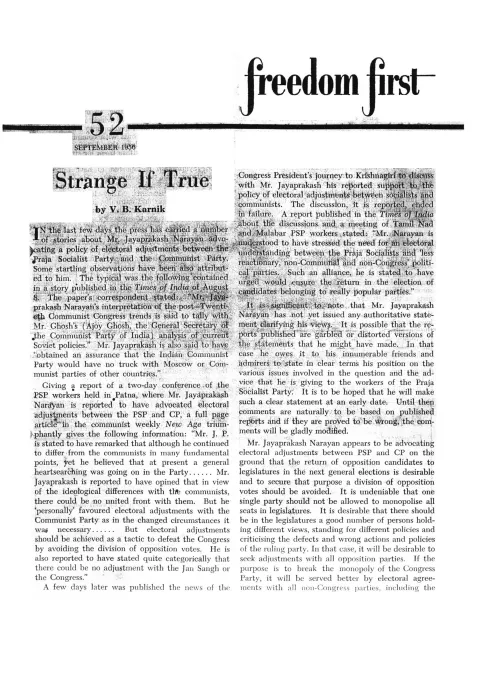
V. B. Karnik’s ‘The Danger To Democracy’ welcomes JP’s clarification but criticises his suggestion that communists be allowed to govern a state democratically, since once in power they entrench themselves and end free elections.
-
M. A. Venkata Rao’s ‘Behind U Nu’s Resignation’ attributes the Burmese leader’s surprise retirement to disillusionment with Soviet and Chinese embassy interference rather than his stated reason of party purification.
-
A translated Soviet article by Yu. P. Nasenko, reproduced as evidence of Moscow’s own analysis, dismisses Indian socialists’ ‘democratic socialism’ as cover for hostility to Marxism and alleges American funding of the 1951-52 Socialist election campaign.
-
‘A Misleading Report’ criticises an Indian delegation’s report on Chinese agricultural collectivisation for taking propaganda at face value while its own text admits middle and upper farmers were eliminated ‘through terror and coercion.’
-
The ‘Notes’ section covers a communal riot linked to a republished book, film censorship of the American documentary ‘With These Hands,’ and the Punjab Special Powers Press Act’s pre-censorship provisions.
Essays
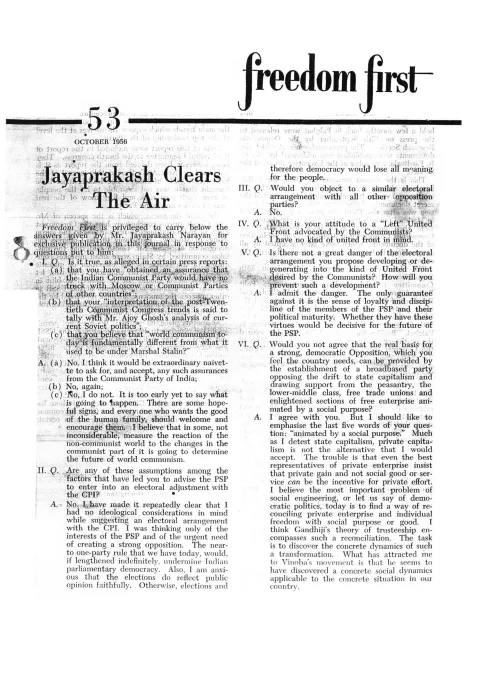
Jayaprakash Clears The Air
By Jayaprakash Narayan
Freedom First reprints, exclusively, Jayaprakash Narayan’s answers to a set of questions about his position on Communist Party of India collaboration. JP flatly denies having sought or received assurances that the CPI would break with Moscow, denies that his reading of post-Twentieth-Congress trends aligns with CPI general secretary Ajoy Ghosh’s, and says it is too early to judge whether world communism has fundamentally changed under Khrushchev. He clarifies that his advocacy of an electoral adjustment with the CPI for the PSP was purely tactical — driven by the danger of near one-party rule in India — and involved no ideological considerations, no united front, and no post-election coalition. Asked about the risk that such an arrangement could degenerate into a Communist-desired United Front, he admits the danger exists and says the only safeguard is the PSP’s internal discipline. He closes by arguing that neither state capitalism nor private capitalism motivated purely by private gain is acceptable, and that the central problem of democratic politics is reconciling private enterprise and individual freedom with social purpose — a reconciliation he sees intimated in Gandhi’s trusteeship theory and in Vinoba Bhave’s movement.
- JP denies any assurance was given or sought regarding CPI’s independence from Moscow.
- JP denies his views on post-20th-Congress communism match Ajoy Ghosh’s, and says it is too early to judge if world communism has fundamentally changed.
- The proposed PSP-CPI electoral adjustment is described as tactical only, with no ideological basis, aimed at avoiding one-party rule.
- JP explicitly rules out a united front, post-election coalition, or joint campaigning with communists.
- He acknowledges the risk that weak PSP candidates or communist bad faith could push the arrangement toward a Popular-Front-style outcome, and says only party discipline guards against this.
- He rejects both state capitalism and profit-only private capitalism, calling for enterprise reconciled with social purpose, citing Gandhi’s trusteeship theory and Vinoba’s Bhoodan movement as models.
Fresh Light On Communist Machinations
An unsigned editorial reports that the Democratic Research Service (D.R.S.) released, at a 13 September press conference addressed by H. R. Pardivala, secret internal CPI documents from its Fourth Congress at Palghat: the Central Committee’s report, a Polit Bureau report on organisational crisis, and the text of Ajoy Ghosh’s closed-session speech on the 20th CPSU Congress. The article (continued on page 8) quotes the Polit Bureau report’s admissions of internal ‘frustration and cynicism’ and a Party ‘divided from top to bottom,’ and argues Ghosh’s speech proves the CPI remains ideologically and organisationally tied to Moscow even after the de-Stalinisation debate, since Ghosh defended Stalin’s ‘gigantic achievements’ and CPSU primacy. The piece (continuing on page 8) further argues the CPI’s talk of ‘peaceful transition to socialism’ is tactical camouflage, notes that the Congress’s own on-the-spot notes flagged a suppressed reference identifying the so-called ‘Zhukov letter’ as the previously denied Shepilov letter, records the Central Committee election results (a P. C. Joshi-line amendment defeated 244-126), and catalogues the CPI’s and the crypto-communist weekly Blitz’s furious but evasive reactions to the disclosures.
- The D.R.S. obtained and publicised secret CPI Fourth Congress (Palghat) documents on 13 September 1956, its second such disclosure after the 1953 ‘Communist Conspiracy at Madurai’ documents.
- The Polit Bureau’s internal report admits the Party is ‘divided from top to bottom’ and suffering ‘frustration and cynicism,’ with Polit Bureau members criticised for individualism.
- Ajoy Ghosh’s closed-session CPSU speech is presented as proof the CPI remains tied to Moscow, defending Stalin’s ‘gigantic achievements’ even after de-Stalinisation.
- The CPI’s ‘peaceful transition to socialism’ rhetoric is characterised as a tactic that still requires Communist Party leadership and mass revolutionary struggle, not genuine gradualism.
- The notes reveal the so-called ‘Zhukov letter’ Ghosh referenced is identified as the same Shepilov letter to the CPI whose existence the CPI had previously denied.
- Central Committee election results are disclosed: a P. C. Joshi-line amendment was defeated 126 votes to 244.
- The CPI (via Ajoy Ghosh) called the Shepilov letter revelation ‘a crude forgery’ and ‘slanderous document’; the weekly Blitz is accused of anger because the disclosures damaged CPI-PSP united-front prospects.
Notes
This is the unsigned ‘Notes’ department, a set of short editorial comments on current civil-liberties and press-freedom controversies. ‘Riots And Counter-Riots’ discusses communal violence sparked by the Bharatiya Vidya Bhavan’s republication of Living Biographies of Religious Leaders, arguing communalist agitators (not the publisher) were responsible, criticising Pakistan’s opportunistic use of the episode, but also defending freedom to publish historical/biographical material about religious figures. ‘A Wrong Decision’ condemns the Board of Film Censors’ refusal to renew the licence for the pro-union American documentary ‘With These Hands’ as unjustified suppression. ‘The Punjab Special Powers Press Act’ criticises the Punjab Vidhan Sabha’s unanimous enactment of press pre-censorship powers as a dangerous curtailment of Article 19(1)(a) free-expression rights, arguing punishment through due process rather than prior restraint is the proper remedy for communal incitement. ‘Distinctly Unsporting!’ is a satirical item mocking Soviet protests over the arrest of a Soviet athlete for shoplifting in London. ‘Our British Namesake’ introduces the British Freedom First, published by the Society for Individual Freedom, noting its shared anti-collectivist, anti-totalitarian aims under the chairmanship of philosopher Dr. John Murray.
- Communal riots followed republication of a book of religious biographies by Bharatiya Vidya Bhavan; the Notes blame communalist agitators, not the publisher, and criticise Pakistan’s exploitation of the episode.
- The Board of Film Censors’ refusal to renew the licence for the American labour documentary ‘With These Hands’ is condemned as an unwarranted, unnecessary restriction that has embarrassed India internationally.
- The Punjab Special Powers Press Act, granting pre-censorship powers over the press, is criticised as an unconstitutional overreach violating Article 19(1)(a) and setting a dangerous precedent for other states.
- A satirical note mocks Soviet outrage over the arrest of athlete Nina Ponomareva for shoplifting in London, framing it as Soviet hypocrisy about ‘justice.’
- The British journal Freedom First (Society for Individual Freedom) is introduced as a like-minded namesake sharing anti-collectivist, anti-totalitarian goals.
The Danger To Democracy
By V. B. Karnik
Byline reads ‘V. B. Karnik’ — see thinker resolution note below. This signed piece analyses Jayaprakash Narayan’s clarified position (published on page 1 of the same issue) and his letter to the PSP National Executive. Karnik argues JP has now made clear that he opposes any ideological alliance or united front with the CPI, seeking only a narrow ‘agreement to avoid contests’ among opposition candidates, and welcomes this clarification as reassuring to democrats and socialists who had been alarmed by earlier rumours. He nonetheless criticises JP’s suggestion that communists be allowed to form state governments if they can win them democratically as naive, arguing that once communists gain power they entrench themselves and end free elections, unlike other opposition parties. Karnik endorses JP’s broader diagnosis of the danger to Indian democracy — near one-party Congress rule, a too-powerful bureaucracy, drift toward state capitalism, and a growing cult of personality — as more important than the specific remedy of electoral adjustments, and argues effective opposition can be built through varied political, economic, and cultural organisations rather than any single prescribed method.
- Karnik welcomes JP’s clarification that the PSP-CPI arrangement is a limited seat-adjustment only, not a coalition or united front.
- He argues it is ‘difficult to appreciate’ JP’s view that communists should be allowed to govern a state democratically if they can win it, since once in power communists make elections irreversible.
- Karnik quotes JP’s own warnings about near one-party rule, bureaucratic over-concentration, drift to state capitalism, and the ‘cult of personality’ as the more significant analytical contribution.
- He argues effective democratic opposition need not follow one single method, and can be built via a variety of independent political, economic, social, and cultural organisations.
Behind U Nu’s Resignation
By M. A. Venkata Rao
Byline reads ‘M. A. Venkata Rao’ (matches authority entry MA Venkata Rao). This piece analyses U Nu’s surprise decision not to head the new Burmese government after the April-May 1956 elections, despite AFPFL’s electoral success. Venkata Rao argues U Nu’s stated reason — devoting himself to purifying the AFPFL of unreliable elements suborned during the election — masks deep disillusionment with foreign (Soviet and Chinese) embassy interference and covert financing of opposition and rebel elements in Burma. The article quotes extensively from U Nu’s fiery 23 April election speech branding the opposition ‘stooges’ of a foreign power practising infiltration rather than conquest, from Prime Minister U Ba Swe on vote-buying and intimidation by rebels, and from Home Minister Bo Khin Maung Gale on assassination threats. It closes by citing Chinese media reactions and Burmese press commentary framing the episode as exposing the true, exploitative character of China’s ‘Panchshila’ friendship rhetoric toward Burma.
- U Nu declined to head Burma’s new government despite AFPFL’s electoral win, citing a need to purify the party of elements suborned during the campaign.
- The article attributes the deeper cause to U Nu’s disillusionment with Soviet and Chinese embassy interference, including inviting hostile local leaders to Russia/China for clandestine contacts.
- U Nu’s 23 April election speech is quoted describing the contest as one between ‘stooges’ serving a foreign power and ‘genuine patriots.’
- New PM U Ba Swe and Home Minister Bo Khin Maung Gale are cited describing opposition vote-buying, threats, and a rebel assassination slogan against the Home Minister.
- The piece frames the episode as revealing the true character behind China’s Panchshila (five principles of peaceful coexistence) declarations toward Burma, including Chinese maps claiming Burmese territory.
Indian Socialist Leaders
By Yu. P. Nasenko
Byline reads ‘Yu. P. Nasenko’ — a translated article from the Moscow Institute of Eastern Studies’ Brief Reports, reproduced by Freedom First as evidence of how Soviet analysts view and seek to influence the Indian socialist movement. Nasenko narrates the founding of the Congress Socialist Party in 1934 and its 1948 split from Congress to become the Indian Socialist Party (later PSP), attributing to Jayaprakash Narayan and other ‘right-wing’ leaders a strategy of ‘democratic socialism’ that Nasenko dismisses as a device to mask hostility to Marxism, the Soviet Union, and China while cynically courting rank-and-file socialists. He accuses right-wing socialist leaders (Narayan, Lohia, Kripalani, Ram Manohar Lohia’s ‘decentralised economy’ ideas) of demagogically promising land reform without compensation for landlords, breaking the 1951 railwaymen’s strike, accepting Baroda-related political payoffs (the Kapadia/Mehta scandal), and receiving substantial American dollar funding (45,000 dollars via Lohia, 30,000 via Narayan from a US Embassy agent named Timberlake) for the 1951-52 election campaign. The piece concludes that the Socialist Party is in deepening crisis and leaderless, with rank-and-file members increasingly drawn to the Communist-led united democratic front.
- Traces the Congress Socialist Party’s 1934 founding and its 1948 secession from Congress to form the Indian (later Praja) Socialist Party.
- Frames Indian right-wing socialists’ ‘democratic socialism’ as ideological cover masking a fundamental hostility to Marxism, the USSR, and China.
- Cites Dr. Ram Manohar Lohia as the ‘theoretician’ of the decentralised-economy strand of this ‘democratic socialism.’
- Accuses right-wing socialist leaders of demagogic, uncompensated land-reform rhetoric alongside covert opposition to full agrarian redistribution.
- Alleges American funding of the Socialist Party’s 1951-52 election campaign: $45,000 via Lohia and $30,000 via Narayan, sourced from a U.S. Embassy agent named Timberlake.
- Cites the Kapadia/Mehta financial scandal involving payments from the Maharajah of Baroda’s adviser Pathak.
- Concludes the Socialist Party is in deepening leadership crisis, citing Lohia’s 1954 resignation as general secretary and Kripalani’s resignation as chairman.
A Misleading Report
By “V”
Byline reads ‘V’ (pseudonymous). The piece criticises an interim report submitted by Mr. Thapar, Secretary to the Ministry of Food and Agriculture, on behalf of an Indian delegation to China led by Deputy Minister M. V. Krishnappa. The author argues the report takes Chinese agricultural collectivisation achievements at propaganda face value, recommends imitation by India, and glosses over coercion, even while its own text — quoted at length — admits that enthusiasm was concentrated among landless peasants who received land and inputs ‘free from the State,’ while middle and upper farmers were eliminated via terror and coercion. The author calls this ‘proletarianising’ of the peasant a Marxist-Leninist-Stalinist strategy to control farmers totally, warns that Chinese-style industrial and agricultural gains would come at the cost of individual happiness and democratic values, and calls on India to clarify objectives and evolve its own policies suited to a society of free peasant proprietors.
- Critiques the Thapar delegation report on Chinese agriculture for taking Chinese Communist claims at propaganda value and recommending imitation.
- Notes the report itself admits Chinese farmer ‘enthusiasm’ for cooperatives was concentrated among landless peasants receiving state largesse, undercutting its own claim that enthusiasm was purely voluntary.
- Argues middle and upper farmers in China were eliminated from agriculture ‘through terror and coercion,’ following Marxist-Leninist-Stalinist ‘proletarianising’ doctrine.
- Warns that even if China achieves greater industrial/agricultural output and military power, there is no guarantee of individual happiness or distributed prosperity.
- Calls for India to base its agricultural policy on peasant proprietorship with voluntary community/state assistance rather than Chinese-style forced collectivisation.
I. C. C. F. News
A short unsigned ‘I.C.C.F. News’ column reports on activities of the Indian Committee for Cultural Freedom: a Patna Group reception for M.P. and actor Prithviraj Kapoor at the Bankipur Club; an informal Delhi meeting of members with Dr. Sampurnanand (Chief Minister of U.P.) and M. R. Masani; and a Bombay reception for Prof. Mahamahopadhyaya D. V. Potdar ahead of his departure to an International Archives Conference in Europe as an Indian government delegate.
- The Patna Group of the I.C.C.F. held a reception for M.P. and actor Prithviraj Kapoor and his troupe at the Bankipur Club, presided over by Advocate General Mahabir Prasad.
- An informal Delhi meeting discussed the Committee’s work with Dr. Sampurnanand, Chief Minister of U.P., and M. R. Masani in attendance.
- A Bombay reception was held for Prof. Mahamahopadhyaya D. V. Potdar before his departure to Europe as a Government of India delegate to the International Archives Conference.
Generated by the v1.5 extraction pipeline. Awaiting editorial review.
Metadata and summary are AI-extracted from the source PDF and reviewed for editorial accuracy. The original work is available via the Read PDF tab above (where present); paragraph-level citation inside the PDF is deferred to a future engagement.