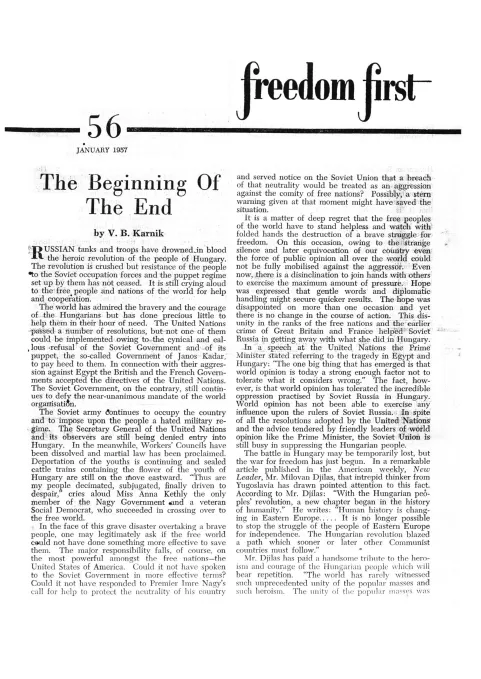
periodical issue
Freedom First
Edited, printed & published for the Democratic Research Service by V. B. Karnik at The Kanada Press, 109 Parsi Bazar [Street], Bombay 1. · Bombay · 1957
12 pages
Freedom First
Summary
This is the December 1957 issue of Freedom First, the monthly journal of the Democratic Research Service (Bombay), published in association with the Indian Committee for Cultural Freedom. In the rendered pages, the issue opens with M. A. Venkata Rao’s lead essay “The Challenge Of The Sputniks,” which argues that the Soviet satellite launches have shattered the military logic of Western containment and calls for a reorganised, long-term global partnership (on the model of Truman’s Point Four) between advanced and developing nations, alongside a stepped-up ideological and propaganda offensive for democracy. A “Notes” section covers several contemporary developments through a Cold War and anti-communist lens: the purge of Marshal Zhukov, Chinese repression of nominally independent “democratic parties,” President Ngo Dinh Diem’s visit to India, alleged communist infiltration in Kashmir via G. M. Sadiq’s Democratic National Conference, the Dravida Kazhagam’s anti-Constitution agitation in Madras, press commentary from the All India Newspaper Editors’ Conference, and a critical stock-take of the new Communist government’s performance in Kerala. Richard Lowenthal’s “Another Turn Of The Wheel” (condensed from Commentary, New York) analyses Khrushchev’s consolidation of power over the Soviet party presidium as a reassertion of party-machine primacy over the state apparatus. Thomas P. Whitney’s “Humanist Specter In Eastern Europe” (condensed from The New Leader) surveys a nascent humanist, anti-totalitarian current of thought surfacing in Soviet and East European writing, quoting Polish poets and Vladimir Dudintsev. A Review section covers Imre Nagy’s On Communism and K. K. Sinha’s Towards Pluralist Society. The issue closes with ICCF and Democratic Research Service news notes and the “With Many Voices” column, a compilation of quoted commentary on Sputnik, Zhukov, Kashmir, and Kerala from world newspapers and politicians.
Key points
-
M. A. Venkata Rao’s lead essay, “The Challenge Of The Sputniks,” argues the Soviet satellite launches have shattered Western military containment strategy, criticises Rajagopalachari’s proposed nuclear ban as naive, and calls for a Point Four-style global partnership plus an intensified “crusade for democracy.”
-
The Notes section links the purge of Marshal Zhukov to the Sputnik launches as evidence of persisting Soviet political primitivism, reports Communist China compelling token “democratic parties” to self-remould under the Hundred Flowers crackdown, and welcomes President Ngo Dinh Diem’s visit to India as a corrective to assumptions about the Soviet bloc.
-
Further Notes items warn that G. M. Sadiq’s new Democratic National Conference in Kashmir shows communist leanings, condemn the Dravida Kazhagam’s calls to burn the Constitution, and catalogue the new Communist government’s failures in Kerala after six months, including stalled investment and an alleged rice-deal fraud.
-
Richard Lowenthal’s “Another Turn Of The Wheel,” condensed from Commentary, reads Khrushchev’s defeat of his presidium rivals as the reassertion of party-machine rule over the Soviet state rather than genuine de-Stalinisation, and warns the informal amnesty for Stalin-era crimes is breaking down.
-
Thomas P. Whitney’s “Humanist Specter In Eastern Europe” traces a growing current of “socialist humanist” writing across the Soviet bloc, citing Adam Wazyk’s poetry and Vladimir Dudintsev’s Not by Bread Alone, as a serious internal challenge to Leninism that the Party’s own journal Kommunist felt compelled to attack.
-
Aziz Madni reviews Imre Nagy’s smuggled memoir On Communism as a devoted communist’s defence of his “New Course” against rival Matyas Rakosi, while V.B.K. reviews K. K. Sinha’s Towards Pluralist Society, noting its “triangular state” proposal echoes M. N. Roy’s ideas on partyless democracy.
-
The issue closes with I.C.C.F. and D.R.S. news of a Patna conference and a seminar on “Russian Revolution and Human Freedom,” alongside a “With Many Voices” column quoting Clement Attlee, Eisenhower and Khrushchev on Sputnik, Zhukov and Kerala.
Essays
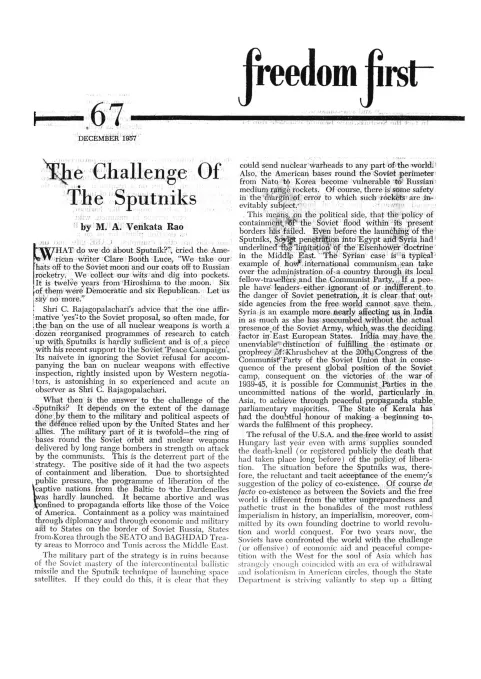
The Challenge Of The Sputniks
By M. A. Venkata Rao
M. A. Venkata Rao’s lead essay asks what the free world’s response should be to the Soviet Sputnik launches, given their demonstration of intercontinental missile capability. He argues the military logic of Western “containment and liberation” has collapsed, since Soviet rockets now threaten bases the U.S. relied on for deterrence, while liberation of the captive nations was never seriously pursued. He is critical of C. Rajagopalachari’s proposal that banning nuclear weapons alone would answer the Sputnik challenge, calling it naive given the Soviets’ refusal of inspection. Rao calls for a two-track response: continued military containment plus a positive, long-term global partnership between developed and developing nations modelled on Truman’s Point Four, financed and administered through international rather than purely bilateral channels, alongside an intensified propaganda and moral campaign (a “crusade for democracy”) to expose Soviet imperialism, expand on Khrushchev’s own admissions about Stalin, and press claims about captive peoples’ lack of liberties.
- Argues that Sputnik has proven Soviet intercontinental missile capacity, undermining the ring of Western bases and the military containment strategy.
- Criticizes Rajagopalachari’s proposed nuclear weapons ban as naive given Soviet refusal of inspection.
- Calls Soviet penetration of Syria and Egypt evidence that outside aid cannot save states whose leaders are complicit or indifferent to communist infiltration; warns India could follow, citing Kerala.
- Proposes reframing foreign aid as a genuine two-way global partnership (a Point Four-style scheme) rather than one-sided charity, citing Indo-Japanese and World Bank examples.
- Insists military containment alone is insufficient without pursuing liberation of captive peoples, including within the Soviet Union itself.
- Calls for an intensified propaganda and moral “crusade for democracy” leveraging Khrushchev’s own admissions about Stalin’s crimes.
Notes (Dancing A ‘Gopak’; Sputniks And Purges; Clearing The Air; New Danger In Kashmir; Dravida Kazhagam Agitation; Socratic Midwife; Communist Performance In Kerala)
This unsigned “Notes” section (running pp. 3-6) collects several short editorial commentaries. “Dancing A ‘Gopak’” and “Sputniks And Purges” discuss the purge of Marshal Zhukov alongside the Sputnik launches, arguing the episode shows Soviet Russia remains politically primitive even as its science advances, and praises Nehru’s call for an “ethical” fourth dimension of progress. “Clearing The Air” describes Communist China’s crackdown on nominally independent “democratic parties” after some members took Mao’s “hundred flowers” slogan seriously and criticized government policy, concluding the episode exposes the parties as facades for one-party rule. “President Diem’s Visit” praises South Vietnamese President Ngo Dinh Diem’s state visit to India, framing him alongside Nehru and U Nu as leaders of resurgent Asian nationalism and welcoming the corrective his views offered to Indian assumptions about the Soviet bloc’s friendliness. “New Danger In Kashmir” warns that G. M. Sadiq’s Democratic National Conference, formed after his defeat by Bakshi Ghulam Mohammed, shows clear communist sympathies and poses a threat to Kashmir’s stability. “Dravida Kazhagam Agitation” condemns E. V. Ramaswami Naicker’s call at a Tanjore convention to burn the Constitution and “kill the Brahmins,” while also criticizing the Madras Government’s legislative response as short-sighted. “Socratic Midwife” reports approvingly on Eric da Costa’s address to the All India Newspaper Editors’ Conference urging the press to become more analytically engaged. “Communist Performance In Kerala” catalogues the new Communist state government’s failures six months into office: unrest, stalled industrial investment, alleged corruption in a rice-purchase deal, and repressive police measures including a lathi charge at Cannanore.
- Frames the Zhukov purge and Sputnik launch together as showing Soviet political primitivism persisting alongside scientific advance; approvingly cites Nehru’s Hong Kong speech calling for an ‘ethical’ dimension to match technological progress.
- Describes Communist China compelling token ‘democratic parties’ to ‘self-remould’ into Socialist Parties after some members criticized government policy under Mao’s ‘hundred flowers’ slogan.
- Welcomes President Ngo Dinh Diem’s visit to India as a useful corrective to Indian assumptions about the Soviet bloc, given South Vietnam’s frontline position against communist subversion.
- Warns that G. M. Sadiq’s new Democratic National Conference in Kashmir shows clear communist leanings and direct involvement of Communist Party members from New Delhi.
- Condemns Dravida Kazhagam calls to burn the Constitution and ‘kill the Brahmins,’ while also criticizing the Madras Government’s anti-burning legislation as likely to aggravate tensions rather than resolve them.
- Details the new Kerala Communist government’s failures: rising lawlessness, stalled industrial investment, worsening food position, an alleged Rs. 16 lakh rice-deal fraud, and repressive police measures including lathi charges.
Another Turn Of The Wheel
By Richard Lowenthal
Richard Lowenthal’s essay, condensed from Commentary (New York), analyses Khrushchev’s defeat of his rivals in the Soviet party presidium on the eve of the fortieth anniversary of the Bolshevik Revolution as marking the definitive end of the post-Stalin ‘collective leadership’ fiction. Lowenthal argues the change is not de-Stalinization, decentralization, or democratization, but the reassertion of direct party-machine rule over the state apparatus and economy, with the government reduced to a representative rather than executive body. He traces the process from Stalin’s death, through Malenkov’s premiership and the downgrading of the secret police, to Khrushchev’s 20th Congress victory and his eventual restructuring of economic planning, arguing that the current crisis stems from Khrushchev’s push to reorganise the top-heavy planning bureaucracy along regional/party lines. He closes by warning that the informal ‘moral guarantee’ among Soviet leaders not to be held accountable for Stalin-era crimes is now breaking down, citing renewed attacks on Malenkov, Molotov, and Kaganovich, and suggesting further purges are likely if Khrushchev’s economic reforms fail.
- Argues Khrushchev’s victory over his presidium rivals ends the ‘collective leadership’ fiction and restores the primacy of the party machine over the state.
- Frames this as neither de-Stalinization nor democratization but a reassertion of direct party rule over the economy and administration, styled as the state ‘withering away’ only in the sense of party absorbing its bureaucracy.
- Traces the post-Stalin sequence: Malenkov’s initial ascendancy, the downgrading of the secret police after Beria’s execution, and Khrushchev’s use of the 20th Congress to pack the Central Committee.
- Attributes the current governmental crisis to Khrushchev’s drive to reorganize the top-heavy central planning bureaucracy, a move that dissolved 25 industrial ministries.
- Notes Khrushchev shored up support by a triple ‘moral guarantee’ to the party elite: the secret speech on Stalin, allowing defeated rivals to remain on the Central Committee, and elevating Marshal Zhukov.
- Warns the informal amnesty for participation in Stalin’s crimes is collapsing, with renewed public attacks on Malenkov (the ‘Leningrad affair’) and on Molotov and Kaganovich for 1930s purges, suggesting further purges to come.
Humanist Specter In Eastern Europe
By Thomas P. Whitney
Thomas P. Whitney’s essay, condensed from The New Leader, surveys a growing current of ‘humanist’ or ‘socialist humanist’ thought emerging across Eastern Europe and the Soviet Union, which he presents as a genuine ideological challenge to Soviet Marxism-Leninism. He cites Polish and Hungarian examples — Adam Ważyk’s 1955 ‘Poem for Adults,’ Zoltan Zelk’s 1956 poem in Irodalmi Ujsag, and commentary by journalists Edda Werfel and Jerzy Urban — alongside the Soviet Communist Party’s own alarmed response in the journal Kommunist, and Vladimir Dudintsev’s novel Not by Bread Alone, which Khrushchev denounced as ‘slanderous.’ Whitney argues this humanism, though not a fully worked-out philosophical system, coheres around a rejection of the idea that the end justifies the means, a demand for unconditional truthfulness, and patient long-term resistance, and constitutes a serious internal threat to Leninism precisely because it draws on ideas with deep roots in Western civilization. He closes by challenging Western thinkers to develop and extend this humanist idea-system rather than merely negating communism, framing it as key to eventually ‘reconciling and reuniting mankind.’
- Identifies a ‘humanist specter’ - a concern for human dignity and freedom - spreading through Soviet and East European writing since the mid-1950s.
- Cites Adam Ważyk’s ‘Poem for Adults’ (1955) and Zoltan Zelk’s 1956 poem as literary expressions of the demand to be treated as human beings rather than instruments of the state.
- Notes the Soviet Communist Party’s own journal Kommunist devoted an editorial and article attacking humanism, claiming a Leninist monopoly on the concept.
- Discusses Vladimir Dudintsev’s novel Not by Bread Alone as a landmark expression of humanist concern within Soviet literature, denounced by Khrushchev as ‘slanderous.’
- Argues the common thread across these disparate voices is a rejection of the idea that the end justifies the means, and a demand for unconditional truthfulness.
- Calls on Western thinkers to develop this humanist idea-system further and faster, framing it as a chance to ‘shame Western thinkers into action.‘
Review: Imre Nagy on Communism
By Aziz Madni
An unsigned Review section carries two book notices. Aziz Madni reviews Imre Nagy’s On Communism (Frederick A. Praeger, New York), describing the smuggled-out memoir by Hungary’s ousted Prime Minister as a devoted communist’s insider defence of the ‘New Course’ and indictment of rival Matyas Rakosi, notable for its candid critique of Party unity used to cover crimes and its assertion of Hungary’s sovereign right to determine its own international alignment. V.B.K. reviews K. K. Sinha’s Towards Pluralist Society (Calcutta), a loosely connected essay collection on democracy, foreign policy, and a proposed ‘triangular state’ of three separate assemblies, noting the author’s arguments echo those earlier advanced by M. N. Roy on partyless democracy, while criticizing the book’s repetitiveness and lack of concentrated development of its ideas.
- Reviews Imre Nagy’s smuggled memoir On Communism, calling it valuable ‘inside information’ defending his liberal ‘New Course’ against rival Matyas Rakosi.
- Notes the reviewer’s view that Nagy remained a devoted communist even in exposing Party terror and unity-as-cover-for-crime.
- Quotes Nagy’s assertion of Hungary’s sovereign right to choose its own international status, deemed treasonous by Soviet standards.
- Reviews K. K. Sinha’s Towards Pluralist Society, describing it as repetitive stray essays on democracy and foreign policy.
- Highlights Sinha’s proposed ‘triangular state’ of three separate assemblies for political, economic, and cultural functions, with the reviewer skeptical of its practicality.
- Notes Sinha’s arguments for partyless democracy are seen as similar to those earlier advanced by M. N. Roy.
Review: Towards Pluralist Society
By V.B.K.
This closing section combines brief institutional news notices with a compiled quotations column. The I.C.C.F. News item announces the Indian Committee for Cultural Freedom’s General Meeting and Conference in Patna on December 14-15, 1957, chaired by Mrs. Rukminidevi Arundale, M.P., with seminars on the ‘Democratic Alternative’ and tribal integration, plus a note on a flute performance at the Committee’s office. The D.R.S. News item reports on a two-day Democratic Research Service seminar, ‘Russian Revolution and Human Freedom,’ held November 26-27, chaired by M. Harris, with papers by Adam Adil and S. R. Mohan Das and additional circulated articles by Bertram D. Wolfe and Sydney Lens, attended by over thirty people including V. B. Karnik, Sitaram Goel, and Dr. Fredi Mehta. The issue closes with ‘With Many Voices,’ a compiled column of quotations from world newspapers and public figures (Clement Attlee, Dodds Parker, Aneurin Bevan, President Eisenhower, Khrushchev, G. M. Sadiq, Frank Moraes, and others) commenting on Sputnik, the Zhukov purge, Kashmir, and the Kerala communist government, framed by an epigraph from Tennyson.
- Announces the ICCF General Meeting and Conference in Patna, December 14-15, 1957, chaired by Mrs. Rukminidevi Arundale, M.P., with seminars on the Democratic Alternative and tribal integration.
- Reports a Democratic Research Service seminar on ‘Russian Revolution and Human Freedom’ with papers by Adam Adil and S. R. Mohan Das, and circulated pieces by Bertram D. Wolfe and Sydney Lens.
- Lists over a dozen named attendees at the DRS seminar including V. B. Karnik, Sitaram Goel, and Dr. Fredi Mehta.
- ‘With Many Voices’ compiles international press and political commentary on the Sputnik launches, the Zhukov purge, Kashmir, and Kerala’s communist government.
- Includes quotations attributed to Clement Attlee, President Eisenhower, Khrushchev, Aneurin Bevan, G. M. Sadiq, and Frank Moraes among others.
Generated by the v1.5 extraction pipeline. Awaiting editorial review.
Metadata and summary are AI-extracted from the source PDF and reviewed for editorial accuracy. The original work is available via the Read PDF tab above (where present); paragraph-level citation inside the PDF is deferred to a future engagement.