periodical issue
Freedom First
By V. B. Karnik, Max Lerner, Howard Fast, Adam Adil, A Correspondent, B. K. Desai
Edited, printed & published for the Democratic Research Service by V. B. Karnik at The Kanade Press, 109 Parsi Bazar Street, Bombay 1. · Bombay · 1958
12 pages
Freedom First
Summary
This is the January 1958 issue (No. 68) of Freedom First, the journal of the Democratic Research Service edited by V. B. Karnik, published in Bombay. The issue is anchored by extensive coverage of the fourth Conference of the Indian Committee for Cultural Freedom, held in Patna in December 1957 under the presidency of Mrs. Rukminidevi Arundale, with two reports (an editorial piece by Karnik and a fuller correspondent’s report) covering seminars on ‘The Democratic Alternative’ (planning versus Gandhian decentralisation) and the integration of tribal peoples, plus addresses by Jayaprakash Narayan and others. Alongside the conference coverage, the issue carries Max Lerner’s first-person account of visiting Milovan Djilas’s wife in Belgrade while Djilas was imprisoned; an extract from Howard Fast’s The Naked God recounting his break with the Communist Party over the fate of Soviet writers and poets (notably Itzik Feffer); a profile of Bertrand Russell by Adam Adil; unsigned ‘Notes’ on Sino-Soviet bloc tensions, the Indonesia/West Irian crisis, Morarji Desai’s remarks on Kerala’s communist government, and the persistence of untouchability; a review of Louis Fischer’s Russia Revisited by B. K. Desai; and a closing page of quoted political soundbites (‘With Many Voices’) from Indian public figures. The volume’s throughline is anti-communist, pro-democratic classical liberalism, combining domestic Indian politics (planning, Kerala, untouchability, tribal integration) with international coverage of communist repression (Yugoslavia, USSR, Indonesia).
Key points
-
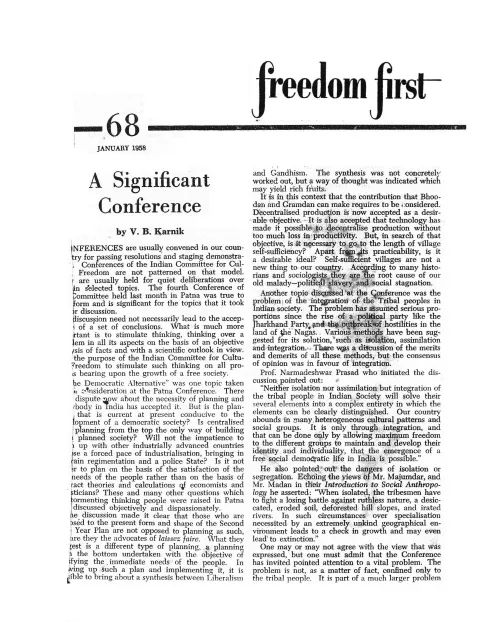
V. B. Karnik’s “A Significant Conference” reports on the ICCF’s fourth Patna conference, where a seminar on “The Democratic Alternative” questioned whether centralised Second Plan-style planning is compatible with democracy and floated Bhoodan-based decentralisation as a synthesis of liberalism and Gandhism.
-
Max Lerner recounts a visit to the wife of imprisoned Yugoslav dissident Milovan Djilas in Belgrade, describing her modest, guarded life and Djilas’s prison conditions, including developing arthritis and restricted reading.
-
An unsigned Notes item argues the Moscow summit of twelve communist parties failed to suppress “national communism,” citing Yugoslavia’s refusal to sign its declaration, while a companion item argues Communists are exploiting Indonesia’s West Irian crisis to seize Dutch enterprises.
-
Further Notes praise Union Minister Morarji Desai’s candid criticism of communist-ruled Kerala’s illegal “Cell Courts,” and respond to a Lok Sabha revelation of a Harijan boy’s murder in Uttar Pradesh by arguing untouchability persists despite constitutional abolition.
-
Howard Fast, in an extract from The Naked God, recounts his break with the American Communist Party over the killing of Soviet Jewish writers David Bergelson and the poet Itzik Feffer, while insisting he retains faith in socialism despite rejecting Party dogma.
-
Adam Adil’s profile “The Passionate Sceptic” traces Bertrand Russell’s path from Hegelian influence to founding the analytic movement, his disillusionment after an 1920 visit to Soviet Russia, and his 1955 campaign against the hydrogen bomb.
-
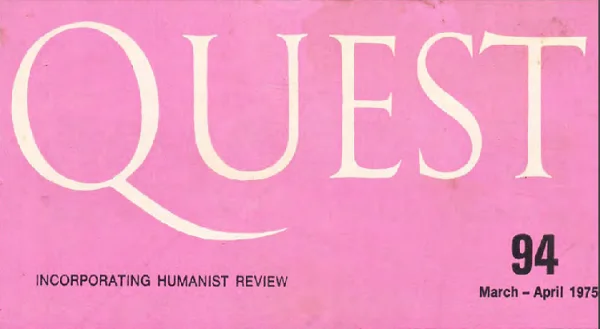
A correspondent’s detailed report on the Patna conference covers Mrs. Rukminidevi Arundale’s presidential address on the danger of politicising art, the conversion of the journal Quest into a quarterly, and closing addresses by M. R. Masani and Jayaprakash Narayan on individualism versus collectivism.
-
B. K. Desai reviews Louis Fischer’s Russia Revisited, crediting it with tracing disillusionment across Eastern Europe toward the Polish and Hungarian uprisings and closing on Fischer’s cautious optimism that “freedom must win.”
-
The closing “With Many Voices” column quotes Jayaprakash Narayan calling parliamentary democracy a failed experiment in India and Shriman Narayan describing communalism and communism as “two facets of the same…phenomenon.”
Essays
A Significant Conference
By V. B. Karnik
V. B. Karnik reports on the fourth Conference of the Indian Committee for Cultural Freedom held in Patna in December 1957, describing it as a forum for quiet deliberation rather than resolution-passing. The piece summarizes the seminar on ‘The Democratic Alternative,’ which questioned whether centralised Second Five Year Plan-style planning is compatible with a democratic society, and floated Bhoodan/Gramdan-based decentralised production as a possible synthesis of liberalism and Gandhism. It also reports a seminar on integrating tribal peoples into Indian society, where Prof. Narmadeshwar Prasad argued for integration over isolation or assimilation, warning that isolated tribal communities face ecological and social collapse. Karnik closes by praising the conference’s diversity of participants united only by a shared commitment to freedom and democracy.
- The ICCF’s fourth conference (Patna, Dec 1957) was designed for deliberation, not resolutions.
- A seminar on ‘The Democratic Alternative’ questioned whether the current Second Five Year Plan’s centralised planning is compatible with democracy.
- Bhoodan/Gramdan and decentralised production were discussed as a possible synthesis of Liberalism and Gandhism.
- A separate seminar addressed integration of tribal peoples in India, prompted partly by unrest linked to the Jharkhand Party and Naga hostilities.
- Prof. Narmadeshwar Prasad argued integration (not isolation or assimilation) was the consensus solution.
- Jayaprakash Narayan called for a ‘human revolution’ to change the individual alongside institutional change, per his public address at the conference.
A Meeting With Djilas’ Wife
By Max Lerner
Max Lerner recounts a personal visit to the wife of Milovan Djilas, the imprisoned Yugoslav dissident and author of The New Class, whom Lerner could not interview directly since Djilas was jailed in Sremska Mitrovica prison and his book was on trial. Mrs. Djilas is portrayed as stoic and guarded, living modestly with her young son Alexei and Djilas’s bedridden mother, refusing foreign mail and food parcels but willing to speak to the press out of a sense of duty. The piece (continued from page 2 to page 10) details Djilas’s prison conditions—solitary confinement, monthly visits, developing arthritis, restricted reading—and closes with details about the fraught publication history of The New Class and an unfinished second manuscript about Montenegrin history that Djilas wrote before imprisonment.
- Lerner visits Mrs. Djilas in Belgrade because Djilas himself is imprisoned in Sremska Mitrovica and unreachable.
- Mrs. Djilas is depicted as reserved, financially strained, and living with Djilas’s bedridden mother and their son Alexei.
- She refuses foreign mail/parcels but agrees to speak to journalists as a matter of principle.
- Djilas is allowed monthly visits and one letter a month; he has developed arthritis in the cold prison and cannot get outside books.
- The piece recounts controversy over how manuscripts of The New Class reached its American publisher, Frederick Praeger.
- Djilas is reportedly working on a new, non-political book about a Montenegrin prince-bishop, and has another unpublished manuscript about his own life and Montenegro between the wars.
Notes (Spectre Of National Communism / Events In Indonesia / Frank Appraisal / Curse Of Untouchability)
An unsigned ‘Notes’ column examines the Moscow summit of communist parties and its declaration of unity, arguing that despite the formal show of solidarity, tensions among Soviet-bloc parties (illustrated by Yugoslavia’s refusal to sign and Gomulka’s admission of unresolved disagreements) reveal that Moscow has failed to suppress ‘national communism’ within the bloc. A second item discusses unrest in Indonesia over the West Irian dispute with the Netherlands, arguing communists are exploiting the crisis and that the seizure of Dutch enterprises threatens Indonesia’s economic stability and foreign investment climate.
- The Moscow summit of twelve communist parties issued a declaration of unity, but internal tensions were evident (Yugoslavia refused to sign).
- Gomulka’s post-summit remarks conceded persistent disagreements among the parties.
- The piece argues ‘the spectre of national communism’ still haunts the Kremlin despite formal re-Stalinisation attempts.
- On Indonesia, the piece argues communists are exploiting anti-Dutch sentiment over West Irian to inflame a crisis.
- The seizure of Dutch enterprises is characterized as chaos rather than socialism, and a threat to foreign investment confidence in Indonesia.
This unsigned ‘Notes’ segment praises Union Minister Morarji Desai’s candid public account of conditions in communist-ruled Kerala, including his criticism of illegal ‘Cell Courts’ and his remarks contrasting democracy and dictatorship. A following item, ‘Curse of Untouchability,’ responds to a Lok Sabha discussion revealing shocking details of discrimination against Scheduled Castes, including the murder of a Harijan boy in Uttar Pradesh, and argues that untouchability persists in practice despite constitutional abolition, calling for vigorous social and educational campaigns to eradicate it.
- Morarji Desai is praised for frankly describing insecurity, poor investment climate, and illegal ‘Cell Courts’ in communist-run Kerala.
- Desai distinguishes democracy (where rulers can be criticised or unseated) from dictatorship (where opposition has no raison d’etre).
- A Lok Sabha discussion revealed a Harijan boy was murdered in Bulandshahr district, Uttar Pradesh, for scoring higher than caste Hindu boys.
- The piece argues untouchability persists in practice despite constitutional abolition and legal reforms, and calls for sustained social/educational campaigns against it.
The Writer And The Commissar
By Howard Fast
Howard Fast, in an extract from his book The Naked God, describes the isolation and moral burden of the writer under tyranny and recounts his own painful break with the American Communist Party. The heart of the piece traces the fate of Soviet Jewish writers, especially the poet Itzik Feffer, who was arrested and killed alongside David Bergelson after refusing to abandon him despite pressure, and Fast’s inability to get answers from Soviet and Communist Party contacts about what happened. Fast concludes with a meditation on the meaning of ‘commissar’ and a forceful renunciation of Communist Party dogma, insisting that despite disillusionment he retains faith in socialism, justice, and the eventual defeat of Soviet authoritarianism.
- Fast argues writers are uniquely burdened as ‘creatures of conscience’ who cannot function under tyranny.
- He describes his own persecution as a writer in the US (forced self-publishing) versus far worse fates for Soviet colleagues.
- The core narrative concerns the arrest and death of David Bergelson and the poet Itzik Feffer, a decorated Red Army colonel who tried to help Bergelson and was killed alongside him.
- Fast recounts confronting a Pravda correspondent over the murder of Soviet Jewish writers before finally breaking with the Communist Party.
- Fast distinguishes his continued belief in socialism and human progress from the Communist Party’s dogmatic practice, comparing the Party’s structure to religious hierarchy and superstition.
- The piece closes with a rejection of the label ‘Trotskyite’ for critics like himself and a call to keep speaking against organisations that ‘bid men to deaden their minds.‘
The Passionate Sceptic: Bertrand Russell
By Adam Adil
Adam Adil profiles Bertrand Russell as ‘the passionate sceptic,’ tracing his intellectual development from early Hegelian influence through his central role founding the analytic movement in philosophy, and examining his ethical theory of ‘compossible’ desires borrowed from Leibniz. The essay discusses Russell’s critique of pseudo-principles like ‘uniformity of nature,’ his 1920 visit to Soviet Russia as part of an Unofficial Labour Delegation which left him disillusioned with Bolshevism, and his early book The Practice and Theory of Bolshevism, which argued that Soviet ‘dictatorship of the proletariat’ was really dictatorship by the Communist Party. It closes by praising Russell’s wit, his outstanding contributions including Principia Mathematica, and his contemporary campaigning against nuclear weapons, while criticizing him as a sceptic who can demolish old beliefs but offers no constructive replacement.
- Adil frames Russell as one of the greatest philosophers because he is a ‘questioner,’ quoting his view that philosophers exist to ask questions rather than answer them.
- Russell moved from Hegelian influence, to metaphysical realism with G.E. Moore, to founding the analytic movement in philosophy alongside Wittgenstein and Carnap.
- Russell’s ethical theory in Human Society in Ethics and Politics is built on Leibniz’s concept of ‘compossible’ desires—those capable of being jointly satisfied.
- Russell visited Soviet Russia in 1920 with an Unofficial Labour Delegation and quickly became disillusioned, finding Bolshevism ‘fanatically’ opposed to the free intellect.
- His book The Practice and Theory of Bolshevism argued that Soviet ‘dictatorship of the proletariat’ meant, in practice, dictatorship of the Communist Party or clique.
- Adil praises Principia Mathematica as one of the supreme achievements of the human mind but criticizes Russell for being able to ‘demolish the old dilapidated world’ without constructing a new one.
- The essay notes Russell’s 1955 press conference (with Nobel laureates) opposing hydrogen bomb development.
I. C. C. F. Conference: A Report
By A Correspondent
A correspondent’s detailed report on the fourth ICCF conference in Patna (Dec 14-15, 1957) covers an exhibition of paintings and photographs, two seminars (‘The Democratic Alternative’ and integration of tribal peoples), the inaugural and general meetings, and the election of a new Executive Committee. Mrs. Rukminidevi Arundale’s presidential address is quoted at length on the balance between intellect and heart and the danger of politicizing art. The report details institutional business: adoption of the annual report, conversion of the journal Quest into a quarterly under new joint editors, formation of four study groups (on repressive laws, import restrictions on books/periodicals, Gramdan land relations, and state patronage of arts), and closing addresses by M. R. Masani and Jayaprakash Narayan on individualism versus collectivism.
- The conference featured an exhibition of paintings (Gopal Ghosh, K. K. Hebbar, Ara, and others) and photographs by Sunil Janah.
- Mrs. Rukminidevi Arundale’s presidential address warned against using art for political purposes, arguing this destroys the spirit of the creative artist.
- The General Meeting adopted the annual report and converted the journal Quest into a quarterly under joint editors Abu Syed Ayyub and Amlan Datta.
- Four study groups were formed: on repugnant laws/procedures, import restrictions on books and periodicals, Gramdan land relations, and state patronage of arts and literature.
- A new Executive Committee was elected, including Mrs. Arundale, Jayaprakash Narayan, M. R. Masani, and others; V. B. Karnik and Philip Spratt were later co-opted, with Karnik and one other elected Honorary Secretaries.
- M. R. Masani and Jayaprakash Narayan addressed the closing public meeting; Narayan called individualism vs. collectivism the central dilemma facing civilisation and urged a ‘human revolution.‘
Review: Russia Revisited (by Louis Fischer)
By B. K. Desai
B. K. Desai reviews Louis Fischer’s Russia Revisited, noting the book’s title undersells its scope since it covers both Fischer’s 20-day visit to post-Stalin Russia and a survey of East European satellite states, especially Poland and Hungary. Desai summarizes Fischer’s findings: material conditions in Russia are unchanged but the political climate is freer than under Stalin, though people remain wary of testing the limits of this freedom given decades of ingrained fear. The review highlights Fischer’s account of the disillusionment with the communist myth spreading through Eastern Europe, culminating in Poland’s and Hungary’s uprisings, and closes on Fischer’s cautiously optimistic conclusion that ‘freedom must win.’
- The review corrects the book’s title, noting its scope extends beyond Russia to Poland and Hungary.
- Fischer finds post-20th Congress Russia freer in mood but with material conditions largely unchanged.
- Desai stresses that decades of terror have created a docile population unwilling to test the state’s tolerance for dissent.
- The review credits Fischer with tracing how national independence and personal-freedom urges combined to fuel unrest and disillusionment with communism across Eastern Europe.
- Fischer’s book concludes on cautious optimism that Soviet communism is disintegrating, ending with the line ‘freedom must win… it is only a matter of time.‘
D. R. S. News
No summary was extracted for this article. Listed for completeness.
Young Asian Artists Exhibition
No summary was extracted for this article. Listed for completeness.
With Many Voices
The closing page, ‘With Many Voices,’ is a column of short quoted excerpts from Indian public figures and periodicals on current political topics, epigraphed by a Tennyson verse. Quotes come from Finance Minister T. T. Krishnamachari, Prime Minister Nehru, Jayaprakash Narayan, Shriman Narayan, and others, touching on the Second Plan, the Bhoodan/Gramdan movement, communism’s relationship to Marxism and communalism, and the state of parliamentary democracy in India. The page closes with brief ICCF news items, including a Bangalore seminar on ‘Education for Democracy’ inaugurated by Mysore Chief Minister S. Nijalingappa, and a Jayaprakash Narayan address in New Delhi on the prospects of parliamentary democracy in India.
- The column collects contrasting quoted opinions from Indian politicians and commentators on planning, communism, and democracy.
- Jayaprakash Narayan is quoted as saying the experiment with parliamentary democracy has completely failed in India (Hindustan Times, Dec 18).
- Shriman Narayan is quoted calling communalism and communism ‘two facets of the same sociological and political phenomenon.’
- Nehru is quoted remarking that communism’s easy interpretation of history explains its fascination.
- A brief news item reports a three-day ‘Education for Democracy’ seminar in Bangalore inaugurated by Mysore Chief Minister S. Nijalingappa.
Generated by the v1.5 extraction pipeline. Awaiting editorial review.
Metadata and summary are AI-extracted from the source PDF and reviewed for editorial accuracy. The original work is available via the Read PDF tab above (where present); paragraph-level citation inside the PDF is deferred to a future engagement.