periodical issue
Freedom First
By V. B. Karnik, B. K. Desai, Adam Adil, Leon Dennen
Edited, printed & published for the Democratic Research Service by V. B. Karnik at The Kanade Press, 109 Parsi Bazar Street, Bombay 1. · Bombay · 1958
12 pages
Freedom First
Summary
This is issue No. 69 of Freedom First (February 1958), a monthly periodical of the Democratic Research Service edited by V. B. Karnik, aligned with the Indian Committee for Cultural Freedom (ICCF) and classical-liberal, anti-communist politics of the period. The issue opens with Karnik’s lead essay on the fragility of national integration in India, followed by a Notes section covering Hungarian political trials, communist troubles in Kerala, the US loan to India, Sheikh Abdullah’s release, and ICCF news. Feature articles cover the Cairo Afro-Asian Solidarity Conference as a vehicle for Soviet penetration of Third World nationalism (B. K. Desai), the stage-managed nature of guided tourism in Maoist China (Adam Adil), a report on an ICCF-organised seminar on education for democracy in Bangalore, an American commentator’s essay on Dudintsev’s Not By Bread Alone as a symptom of dissent within the USSR (Leon Dennen), and a report on the international controversy over the suppression of Pasternak’s Doctor Zhivago. The issue closes with a page of quoted excerpts from contemporary public figures (“With Many Voices”) and a subscription form. The volume’s argumentative center is a sustained anti-communist, pro-liberal-democratic framing across domestic Indian politics, international communist movements, and Soviet-bloc literary dissent.
Key points
-
V. B. Karnik’s “Emotional Integration” argues Indian national unity, forged mainly by shared opposition to British rule, remains superficial, citing the states-reorganisation dispute, the Hindi-English controversy, Ramnad riots and Naga and Jharkhand separatism, and calls for forward-looking economic development rather than appeals to a shared past.
-
The Notes section reports secret trials and executions of 1956 Hungarian revolutionaries including children, catalogues corruption and fund under-utilisation in Kerala’s Communist ministry, and welcomes a $225 million US loan as narrowing India’s foreign-exchange gap while criticising Krishna Menon’s “impertinence” toward the West.
-
B. K. Desai’s “Afro-Asian Solidarity Conference” reports on the December 1957 Cairo gathering as evidence of Soviet Russia positioning itself as leader of Afro-Asian nationalism, noting the Indian delegation was entirely communists or fellow-travellers.
-
Adam Adil’s “Guided Tourism In China” describes how Maoist China stage-manages nearly identical itineraries for foreign visitors, including a suspiciously rehearsed “model jail,” while barring access to Tibet, border regions and forced-labour camps.
-
A report on the ICCF’s three-day Bangalore seminar on “Education for Democracy” covers addresses by M. A. Venkata Rao on history’s role in democratic education and Philip Spratt on how totalitarian states control thought across education and the sciences.
-
Leon Dennen’s “The Revolt Is Rising” casts Vladimir Dudintsev’s Not By Bread Alone, denounced by Khrushchev as “unhealthy” and “obnoxious,” as the first post-Stalinist novel to indict the one-party system itself, situating Dudintsev among purged writers Pilnyak, Olesha and Babel.
-
An unsigned report on “The Affair Of Dr. Zhivago” traces Moscow’s reversal on publishing Boris Pasternak’s novel and the Union of Soviet Writers’ ruling that its “cumulative effect casts doubt on the validity of the Bolshevik Revolution,” recalling the earlier arrest and execution of Boris Pilnyak.
-
The closing “With Many Voices” column quotes Asoka Mehta criticising Kerala’s Communist government and Cambodia’s Norodom Sihanouk warning against underestimating communism after Hungary.
Essays
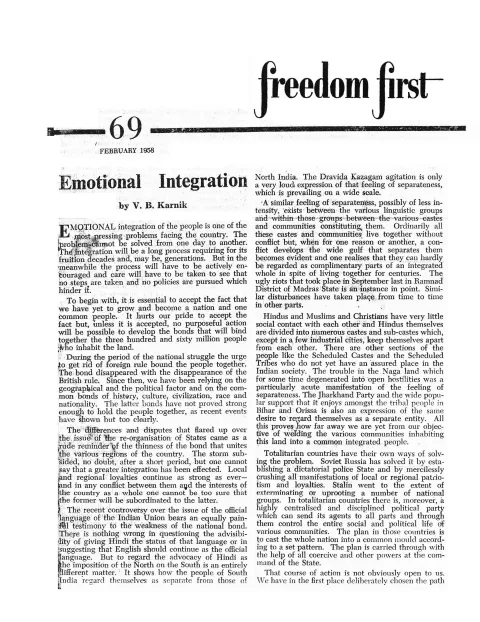
Emotional Integration
By V. B. Karnik
V. B. Karnik argues that Indian national integration remains superficial, held together during the independence struggle mainly by shared opposition to British rule rather than by durable bonds of history, culture, or nationality. He surveys recent evidence of fragmentation — the states reorganisation controversy, the Hindi-versus-English language dispute framed by southern India as northern imposition, the Ramnad riots, Naga hostilities, and the Jharkhand Party’s tribal separatism — and rejects the Soviet model of enforced unity through a centralised, coercive party-state. Instead he calls for an appeal to the future rather than the past, arguing that emotional integration must be built through demonstrable, even economic development across all regions and inclusive democratic participation in policy-making, rather than appeals to religion, language, or historical memory, which reopen old wounds instead of healing them.
- National integration in India is incomplete and requires generations, not a single policy stroke.
- The independence-era bond (opposition to British rule) has dissolved and not been replaced by an equally strong unifying force.
- Recent flashpoints cited: states reorganisation dispute, the Hindi-vs-English official language controversy, the Ramnad riots (Madras State, September prior year), Naga hostilities, and Jharkhand Party tribal separatism in Bihar and Orissa.
- Totalitarian states (the essay cites Soviet Russia under Stalin) solve integration by coercive suppression of regional/national identity — a path the author says is closed to a democracy.
- The essay argues appeals to a shared ‘golden age’ fail because no such common past exists for all Indian communities; appeals must instead be forward-looking.
- Even economic development across all regions, not just concentrated growth, is framed as essential to building the sentiment of national unity.
- V. K. Krishna Menon (Defence Minister) is cited for the view that nationalism itself produces sub-nationalism.
- Y. B. Chavan (Chief Minister of Bombay) is quoted on emotional understanding between regions as the true basis of national survival.
Notes
An unsigned Notes section comprising five short items: ‘Terror In Hungary’ reports on secret trials and executions of Hungarian dissidents, including the prosecution of children, following the 1956 uprising, citing the Civil Liberties Bulletin’s account of a Communist regime ‘final drive’ against surviving 1956 rebels including General Maleter and Colonel Kopacksy. ‘Kerala Communists In Trouble’ describes the Kerala communist ministry’s declining popularity, its conflicts with the Centre over the Education Bill referral to the Supreme Court, and allegations of corruption and nepotism. ‘American Loan To India’ welcomes a $225 million US loan to help India’s foreign exchange gap, contrasting it favourably with Soviet aid and criticising Krishna Menon’s ‘snobbish impertinence’ toward the West. ‘Sheikh Abdullah’ comments cautiously on his release from four years’ detention without trial, urging reconciliation between Abdullah, Bakshi Gulam Mahommed, and New Delhi as the path to a Kashmir settlement. ‘I.C.C.F. News’ briefly notes a visit by Prof. Abraham Kaplan of UC Berkeley’s philosophy department to the Committee’s office.
- Hungary item: reports secret mass trials and executions of 1956 revolution participants, including a case of children being prosecuted, drawing on the Civil Liberties Bulletin.
- Kerala item: describes the state’s communist ministry as beleaguered, accused of shifting blame to the Centre and facing corruption allegations; cites Chief Minister’s admission of poor Five-Year Plan fund utilisation (only Rs. 4.21 crores of Rs. 17.90 crores spent).
- US loan item: welcomes the $225 million offer (partly from Export-Import Bank, partly Development Loan Fund) as narrowing India’s foreign exchange gap, noting total US aid to India since independence would reach $1,275 million, five times Soviet aid.
- Sheikh Abdullah item: frames his release after four years’ detention as requiring reconciliation, not further recrimination, between him, Bakshi Gulam Mahommed, and the Delhi government.
- ICCF News item: records a visit by Prof. Abraham Kaplan, Chairman of the Department of Philosophy at the University of California, on 3 January 1958.
Afro-Asian Solidarity Conference
By B. K. Desai
B. K. Desai reports on the December 1957 Afro-Asian Solidarity Conference in Cairo, arguing it demonstrated the convergence of Afro-Asian nationalism with international communism. He traces its origins to the 1955 Bandung Conference, the Soviet-sponsored ‘Asian Conference for the Relaxation of Tension’ in New Delhi, and the Asian Solidarity Committee, describing how the Cairo conference — attended overwhelmingly by hand-picked delegates including large Soviet and Chinese delegations — produced anti-Western resolutions on imperialism, racial discrimination, and disarmament while claiming to represent ‘the people’ rather than governments. Desai concludes that the Soviet Union successfully used the conference to position itself as leader and champion of Afro-Asian aspirations, and calls on Western powers to develop a ‘totally new approach and vision’ rather than relying solely on military and economic aid to counter this propaganda success.
- The Cairo conference (late December 1957) is presented as evidence of an alliance between Afro-Asian nationalism and international communism.
- Traces communist strategy from the 1955 Bandung Conference through the Delhi ‘Asian Conference for the Relaxation of Tension’ (under the All-India Peace Council) to the Asian Solidarity Committee and finally the Afro-Asian Solidarity Movement.
- The Cairo conference established a permanent Afro-Asian Solidarity Council headquartered in Cairo, with an Egyptian Secretary-General and a Russian secretary.
- Describes lopsided delegation composition: ~500 hand-picked delegates from 45 countries; Soviet delegation of 40 (largest), Communist Chinese delegation of 25; the Indian delegation of 10 was entirely communists or fellow-travellers, including Dr. Anup Singh, Smt. Rameshwari Nehru, and Mr. A. K. Gopalan.
- Documents specific propaganda themes pushed at the conference: American imperialism, British racial discrimination, and Soviet-style ‘unconditional aid’ framed via the Suez Canal and Indonesia precedents.
- Notes that even Dr. Anup Singh admitted the conference’s decisions tended, by implication, to follow the communist line.
- Argues the Soviet delegation was the most popular and effectively dominated the proceedings, deemed a strategic success for Moscow.
- Calls for the West to develop a new, non-military, non-purely-economic approach to compete for the loyalty of Afro-Asian nationalist sentiment.
Guided Tourism In China
By Adam Adil
Adam Adil describes the elaborate system by which Maoist China stage-manages ‘guided tourism’ for foreign delegations, arguing that visitors are shown a nearly identical, pre-arranged itinerary of showcase sites (the Great Wall, model factories, collectives, Mao’s birthplace, a model jail near Peking) via the China International Tourist Service and the Chinese Peoples’ Society for Cultural Relations, with minimal freedom to see anything unscheduled. He draws on the accounts of numerous visitors — India’s Brajkishore Shastry, James Cameron, Adalbert de Segonzac, Robert Guillain, Dhirendranath Das Gupta, and others — to show the remarkable uniformity of their reported experiences, including a suspiciously rehearsed ‘model jail’ visit and a bilingual minder who ‘by chance’ always accompanied Cameron. The essay (continuing past the rendered page range) notes that no foreign visitor has ever been permitted into Tibet, minority areas, border regions, or forced labour camps, and that the absence of a free press compounds the difficulty of learning the truth about conditions in China.
- Guided tourism is described as a deliberate, near-universal Communist-bloc technique, with China’s version singled out as especially subtle and effective.
- Peking reported over 4,700 visitors from 63 countries in 1955, rising to over 5,200 from 65 countries in 1956; 1,243 Japanese visitors in 1956 per the Japanese China Friendship Association.
- Visitors are handled by the China International Tourist Service, an agency of the Chinese Peoples’ Society for Cultural Relations (CPSCR).
- Brajkishore Shastry (1953 labour delegation visitor) is cited comparing conditions under Mao to Orwell’s 1984.
- Describes a standard itinerary: Canton-Honkow-Peking train route, Manchuria industrial tour, sometimes Sian, Lanchow, Yumen oil centre, and Chungking, with visits to a staged ‘model jail’ near Peking reported near-identically by James Cameron, Adalbert de Segonzac, Robert Guillain, and G. S. Gale.
- James Cameron’s account describes a suspiciously well-rehearsed peasant interviewee and an English-speaking minder present ‘by chance’ throughout his visit.
- The essay (continued on page 8, beyond what is fully captured here) states no foreign visitor has been permitted to see Tibet, minority areas, border regions, the South China coastline, defense works, forced labour camps, or famine/flood areas, and that all news media in China are officially controlled.
Seminar On Education For Democracy
An unsigned report on a three-day ICCF-organised Seminar on Education for Democracy held in Bangalore (22-24 December) at the Kannada Literary Academy hall, inaugurated by Mysore Chief Minister S. Nijalingappa and Education Minister V. Venkatappa. The report summarises addresses by multiple speakers — Prof. B. Venkatesachar on mathematics’ role in cultivating objective truth-consciousness, Prof. M. A. Venkata Rao on history’s role in democratic education, Philip Spratt on how totalitarian states control thought across education, history, and the sciences, and M. V. Balakrishna Rao (a delegate of the R. L. Foundation of Bombay) on the value of social sciences for democratic policy — alongside a symposium on democratic values presided over by M. P. L. Sastry invoking Vedantic ideas of universal spiritual equality as a foundation for democracy, and sessions led by M. V. Krishna Rao, C. V. Srinivasa Murthy, and M. Yamunacharya on the components of democratic attitude.
- Three-day seminar (22-24 December) organised by the Bangalore Group of the ICCF, held at the Kannada Literary Academy hall.
- Inaugurated by Mysore Chief Minister S. Nijalingappa, who spoke of the world’s division between Soviet Russia and the USA and the need to control politics to achieve welfare and harmony.
- Education Minister V. Venkatappa opened the symposium, stressing educated people’s responsibility to preserve free life and combat corruption.
- M. P. L. Sastry presided over the opening symposium, using the Vedantic idea of the untouchable’s dialogue with Shankaracharya on the equality of all souls as a foundation for democracy.
- Prof. B. Venkatesachar spoke on mathematical training’s role in developing consciousness of truth as an objective fact independent of human passions.
- Prof. M. A. Venkata Rao addressed history’s role in democratic education, contrasting willed human action with totalitarian determinism.
- Philip Spratt sketched the ways totalitarian states control thought across education, history, science, and the arts.
- M. V. Balakrishna Rao, a delegate of the R. L. Foundation of Bombay, presented a paper on the value of social sciences for sound democratic policy.
The Revolt Is Rising
By Leon Dennen
Leon Dennen argues that the furore over Vladimir Dudintsev’s novel Not By Bread Alone reflects a genuine, historically recurring current of dissent within Russian literature, comparing it to the nineteenth-century subversive impact of Dostoyevsky, Gogol, and Pushkin despite those authors’ own professed loyalty to Tsar and Church. He traces a lineage of censors and critics (a Tsarist censor’s alarmed report on The House of the Dead, Alexander Herzen’s declaration in The Bell that ‘the revolt is rising’) to argue that Dudintsev, likely unconsciously, has become the spokesman of the Soviet Union’s disenfranchised and disillusioned, indicting not just individual bureaucrats but the one-party system itself. Dennen situates Dudintsev among other post-Stalin dissenting voices (Pilnyak, Olesha, Babel — all later purged — and the more compromised Ilya Ehrenburg) and closes (in content continued beyond the excerpt captured here) with an assessment of the novel’s aesthetic modesty but historic significance, contrasting its hero Lopatkin’s idealism with the villain Drozdov’s cynical bureaucratic careerism.
- Frames Not By Bread Alone as evidence that Russian revolutionary/literary history is ‘repeating itself,’ with Dudintsev cast as heir to Dostoyevsky, Gogol, and Pushkin’s subversive influence despite their personal orthodoxy.
- Cites a Tsarist Ministry of Interior censor’s 1860 report worrying that Dostoyevsky’s The House of the Dead might be read as a call for penal-system leniency.
- Quotes Alexander Herzen’s 1860s-era journal The Bell declaring ‘the revolt is rising’ across the Russian empire.
- Notes Khrushchev personally denounced Dudintsev as a ‘calumniator’ whose book is ‘unhealthy, tendentious and obnoxious.’
- Situates Dudintsev among purged Soviet writers Boris Pilnyak, Yuri Olesha, and Isaac Babel, contrasted with the more compromised Ilya Ehrenburg.
- Argues Dudintsev is the first post-Stalinist novelist to indict the fundamental one-party Communist system itself, not merely individual abuses.
- Describes the novel’s plot conflict between the idealist inventor Lopatkin and the cynical, power-grasping factory director Drozdov as an embodiment of proletarian virtue versus ‘the new class’ (citing Milovan Djilas).
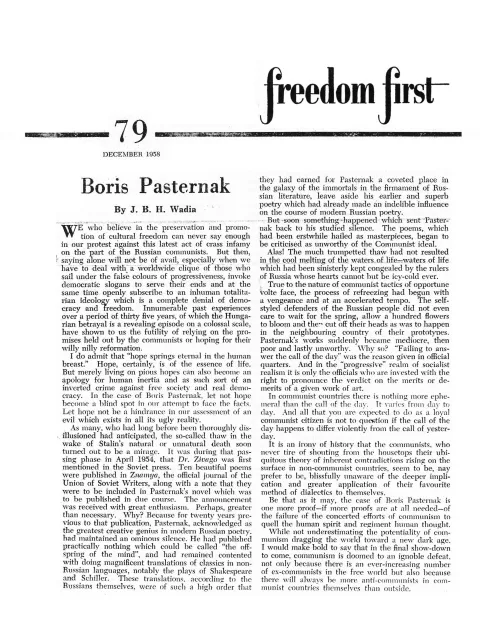
The Affair Of Dr. Zhivago
By (Contributed)
An unsigned, contributed report summarises the plot of Boris Pasternak’s newly published novel Doctor Zhivago and recounts the political controversy surrounding its publication. The Italian publisher Giangiacomo Feltrinelli resisted intense Soviet pressure — including a personal visit from Alexi Surkov, director of the League of Soviet Writers — to abandon publication after Moscow reversed its earlier approval, with the Union of Soviet Writers ruling that the novel’s ‘cumulative effect casts doubt on the validity of the Bolshevik Revolution.’ The piece summarises the novel’s plot (Yura Zhivago’s life through World War I, the Revolution, partisan captivity, and his relationships with his wife Tonya and his lover Lara) and quotes several of its more anti-Communist-flavoured passages on Marxism, collectivization, and enforced conformity, closing with concern over what fate might befall Pasternak given the earlier arrest and execution of Boris Pilnyak after a similar episode, and reporting the Soviet Party’s public humiliation of the poetess Margaret Aliger, who was pressured into a published recantation in the Literary Gazette for defending Doctor Zhivago’s right to appear.
- Doctor Zhivago, by Boris Pasternak, was published in Italian in Milan by Feltrinelli; an English translation is announced as forthcoming from Collins.
- Describes the reversal: Moscow’s publishing house Gozlitizdat had originally planned publication, poems from the book had appeared in a Soviet review, and October 15 had been set as a Russian/international publication date, before Kremlin bosses reversed course.
- The Union of Soviet Writers ruled the novel’s cumulative effect casts doubt on the validity of the Bolshevik Revolution ‘as if it were a great crime in Russian history.’
- Alexi Surkov, Director of the League of Soviet Writers, personally travelled to Milan to pressure the publisher into abandoning the book; Feltrinelli refused.
- Summarises the novel’s plot across roughly fifty years of Russian history, centering on Yura Zhivago, his wife Tonya, his lover Lara, and Lara’s husband Pasha Antipov.
- Quotes several passages voiced by novel characters critical of Marxism as pseudo-science, of forced collectivization, and of enforced ideological conformity.
- Draws a parallel to the 1930 case of Boris Pilnyak’s Bois des Iles, which was banned in Russia, after which Pilnyak was arrested and executed — raising fear for Pasternak’s fate.
- Reports the humiliation of poetess Margaret Aliger, a Communist Party member who defended young Literary Moscow contributors and was publicly attacked by Khrushchev before being pressured into a recantation published in the Literary Gazette.
With Many Voices
The issue’s final page, ‘With Many Voices,’ is a miscellany of short quoted excerpts from contemporary public figures and newspapers, framed by an epigraph from Tennyson. It includes quotations from Soviet Foreign Minister Gromyko on Vatican-Soviet common ground on banning the atomic bomb, an unattributed Hindu editorial on the absence of major-power clashes, Asoka Mehta on the Kerala communist government’s declining standards, Adlai Stevenson’s quip about camels, Lakshmi Menon on India’s socialist pattern, Prime Minister Nehru on the dangers of oil in world politics, Dr. R. Fray on the two fundamental errors of communism, Dr. Ram Manohar Lohia contrasting India’s and Pakistan’s international alignments, Cambodia’s Ex-King Norodom Sinhanouk on the danger of underestimating communism (citing Hungary), and Ilya Ehrenburg on artistic freedom despite political change.
- A compilation of short quotations from public figures and newspapers dated January 1958, framed by a Tennyson epigraph.
- Includes Soviet Foreign Minister Gromyko’s remark on Vatican-Soviet convergence over banning the atomic bomb.
- Asoka Mehta is quoted criticising the Kerala communist government’s record on efficiency, impartiality, and incorruptibility.
- Prime Minister Nehru is quoted on oil as a dangerous, slippery cause of world trouble.
- Dr. R. Fray is quoted describing communism’s two fundamental errors: practical failure and intolerable arrogance in usurping ‘the right of God.’
- Dr. Ram Manohar Lohia is quoted contrasting India’s position as a ‘servant’ with Pakistan’s as a ‘slave’ between the Atlantic and Soviet camps.
- Cambodia’s Ex-King Norodom Sinhanouk’s warning about underestimating communism, citing Hungary, is quoted twice (appears duplicated across the two columns).
- The issue closes with subscription details, an advertisement for Girilal Jain’s pamphlet ‘Chinese Panchsheela in Burma,’ and the publication’s registration and printing details (V. B. Karnik, The Kanado Press, Bombay).
Generated by the v1.5 extraction pipeline. Awaiting editorial review.
Metadata and summary are AI-extracted from the source PDF and reviewed for editorial accuracy. The original work is available via the Read PDF tab above (where present); paragraph-level citation inside the PDF is deferred to a future engagement.