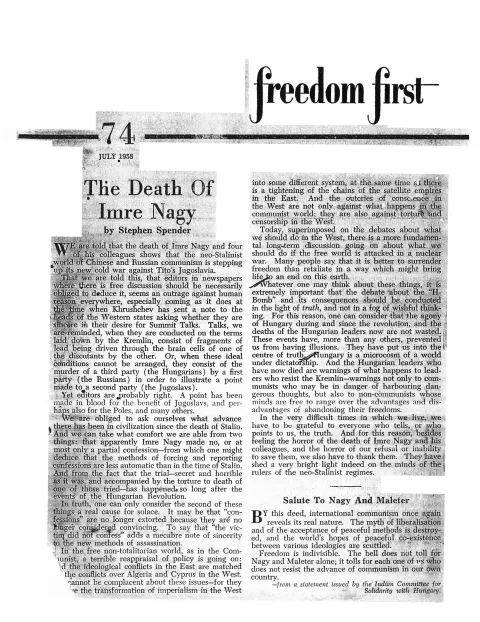
periodical issue
Freedom First
By V. B. Karnik, A Correspondent, Adam Adil, S. Sharangpani, Ida Dhami
Edited, printed & published for the Democratic Research Service by V. B. Karnik at The Kanada Press, 109 Parsi Bazar Street, Bombay 1. · Bombay · 1958
12 pages
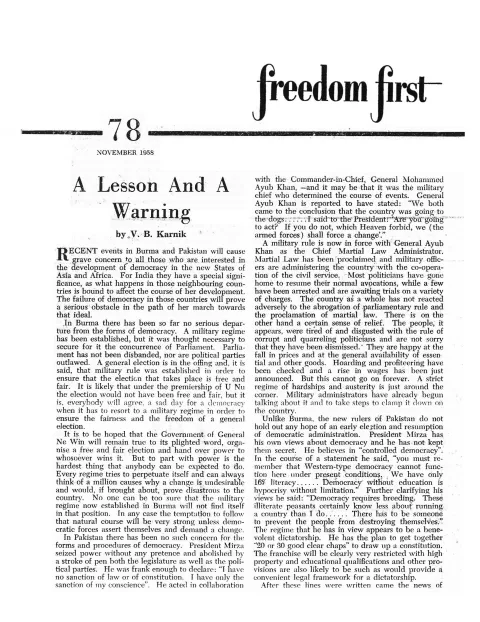
Freedom First
Summary
This is issue No. 78 of Freedom First (November 1958), the monthly journal of the Democratic Research Service edited by V. B. Karnik, covering the full 12-page issue. The issue is dominated by anxiety about the fragility of democracy in Asia’s new states: the lead article by Karnik reads the collapse of parliamentary rule in Burma and Pakistan as “a lesson and a warning” for India, while a report on the Congress for Cultural Freedom’s Rhodes seminar surveys parallel debates about representative government and public liberties across new African and Asian states. Other contributors extend the anti-authoritarian theme outward: Adam Adil details the coercive mechanics of China’s new “people’s communes,” S. Sharangpani assesses the geopolitical stakes of India’s Himalayan buffer states (Nepal, Sikkim, Bhutan) against Chinese pressure, and Ida Dhami covers both de Gaulle’s referendum triumph in France and reviews Robert Guillain’s book on Maoist China. A running “Notes” section covers police firings against communist-led plantation workers in Kerala, repression in post-1956 Hungary, and the defection of a Polish writer, while a closing “With Many Voices” column strings together contemporary press quotations on democracy’s prospects in Asia.
Key points
-
V. B. Karnik’s “A Lesson And A Warning” contrasts Burma’s military takeover, which preserved parliamentary trappings, with Pakistan’s outright abrogation under Iskander Mirza and then Ayub Khan, warning India shares the same cultural and economic conditions and that a “cult of personality” could itself threaten its democracy.
-
Notes criticise Kerala’s Communist government for siding with a communist-led union in a plantation strike that ended in police firings killing four workers, and report continued persecution of Hungarian intellectuals two years after 1956, including disbarment of Budapest lawyers.
-
A correspondent’s report on the Congress for Cultural Freedom’s Rhodes seminar on “Representative Government and Public Liberties in New States” records the largest delegation being Indian, and notes international curiosity about India’s democracy and Jayaprakash Narayan’s partyless-democracy ideas.
-
Adam Adil’s “‘People’s Communes’ Of China” details how communes strip peasants of private property in exchange for wage labour and communal mess halls, with pay docked for insufficient ideological diligence, covering 99.98% of one province’s households by August 1958.
-
S. Sharangpani’s “India, Bhutan And China” surveys the Himalayan buffer states’ historical treaty relationships, warning some Bhutanese show signs of ideological drift toward “red Tibet” as China builds roads and bases in southern Tibet, framing Nehru’s first prime-ministerial visit to Bhutan as overdue engagement.
-
Ida Dhami’s “France Bows To De Gaulle” analyses the September 1958 referendum’s 80% approval of the Fifth Republic constitution, including a surprising 93% “yes” vote in Algeria, and notes the French Communist Party’s losses including Maurice Thorez’s defeat.
-
Dhami also reviews Robert Guillain’s The Blue Ants, framing accurate understanding of Maoist China as a precondition for genuine Sino-Indian friendship and noting Guillain’s argument that Chinese communism is an extension of, not a rival to, Russian communism.
-
The closing “With Many Voices” juxtaposes Pakistan’s President Iskander Mirza defending his seizure of power as resting on “the sanction of my conscience” against RSS chief M. S. Golwalkar’s comparison of Communist rule in Kerala to “foreign rule.”
Essays
A Lesson And A Warning
By V. B. Karnik
V. B. Karnik’s lead article surveys the near-simultaneous collapse of parliamentary forms in Burma and Pakistan during 1958 and asks what lesson India should draw. In Burma, he notes, the military takeover under General Ne Win at least preserved the trappings of parliamentary process (Parliament not dissolved, parties not outlawed, an election promised), whereas in Pakistan President Iskander Mirza abolished the legislature and political parties outright before himself being displaced by General Ayub Khan, who assumed sole power under martial law. Karnik traces a regional pattern in which parliamentary democracy of the Western type, transplanted onto former colonies from Indonesia to Egypt, gives way to military or authoritarian rule once elected leaders fail to satisfy a population weary of corruption and disorder. He argues India should not be complacent: it shares the same cultural and social stock and unresolved economic problems as its neighbours, and its advantages (a more developed administrative system, a strong national party in Congress, eminent leaders) are real but insufficient guarantees, especially given the risk that reverence for an eminent individual curdles into a personality cult that itself blocks democracy’s growth. The piece closes by warning that India’s own democratic institutions have not yet become part of the people’s lived experience, and that its survival depends on a “living faith in democracy” that is “yet to be created.”
- Burma’s military regime under Ne Win kept Parliament and political parties intact, framing itself as a temporary guarantor of a free election, unlike Pakistan’s outright abrogation of constitutional rule.
- Pakistan’s President Iskander Mirza abolished the legislature and parties by decree, then was himself removed, leaving General Ayub Khan as sole Chief Martial Law Administrator.
- Mirza favoured a restricted, propertied franchise and a small drafting committee for a new constitution rather than full parliamentary democracy, which he called incompatible with Pakistan’s low literacy.
- Karnik reads events in Burma and Pakistan as part of a broader pattern across new Asian and African states in which parliamentary democracy degenerates into military dictatorship.
- India’s administrative maturity and the Congress party’s national reach are cited as advantages over Pakistan, but Karnik warns against complacency given shared cultural and economic conditions.
- The danger of a ‘cult of personality’ around an eminent leader is flagged as a threat to India’s democratic development in its own right.
- The article concludes that India’s democratic experiment has not yet won a durable ‘living faith’ among its people.
Notes
The unsigned ‘Notes’ section (running pp.3-4, continued into the D.R.S. News item that spills onto p.8) covers five items. ‘Firing In Kerala’ criticises the Communist state government’s handling of a plantation workers’ strike in the Hill Ranges, alleging that the Labour Minister sided with the communist-led union, refused INTUC’s request for adjudication, and thereby allowed a strike to escalate into police firings that killed four workers. ‘Hungary After Two Years’ reports on continued persecution of intellectuals two years after the 1956 revolution’s suppression, including death sentences at secret trials, disbarment of Budapest lawyers, and revocation of licenses for actors deemed to glorify ‘bourgeois and decadent ideas.’ ‘Writers And Communism’ recounts the defection of Polish writer Marek Hlasko to the West, framing it as exposing the ‘fraudulent and phoney character’ of the Asian-African Writers’ Conference at Tashkent. ‘Good News From Algeria’ reads De Gaulle’s orders restraining the French army’s political role, and reciprocal signals from Ferhat Abbas’s provisional government, as grounds for cautious optimism about a negotiated Algerian settlement. The final item reports on a talk by Ralph Borsodi, ex-Chancellor of Melbourne University, on ‘Morality of Democracy and Communism,’ in which he argued democracy alone is an insufficient answer to communism and proposed seven essentials of a moral economic order: free markets, free trade, abolition of monopolies, cooperative ownership of natural monopolies, free banking, a just property system distinguishing ownership from natural-resource title, and just land tenure with publicly captured ground rent.
- Kerala’s Communist government is accused of partisan handling of a plantation workers’ strike, culminating in police firings that killed four workers.
- Hungary two years after 1956 is described as entering a phase of systematic persecution of intellectuals, lawyers, and artists.
- Polish writer Marek Hlasko’s flight to the West is presented as undercutting the Tashkent Asian-African Writers’ Conference’s narrative about Western-caused ills.
- De Gaulle’s restraint of the French army and reciprocal gestures from Algerian nationalist leader Ferhat Abbas are read as opening the door to a negotiated Algerian settlement.
- Ralph Borsodi’s talk argued neither democracy nor communism alone suffices and proposed seven principles for a moral economic order (free market, free trade, anti-monopoly, cooperative ownership of natural monopolies, free banking, just property, just land tenure).
Rhodes Seminar, A Report
By A Correspondent
An unsigned correspondent’s report on the third Congress for Cultural Freedom seminar, held in Rhodes, Greece (5-13 October 1958) on ‘Representative Government and Public Liberties in New States,’ funded with Ford Foundation assistance. About thirty-five participants from over twenty countries, from both old and new states, attended, including several prominent Indians (Asoka Mehta as co-Director, M. R. Masani, V. K. N. Menon, D. R. Gadgil, V. K. Narasimhan, Raghavan Iyer, Daya Krishna) alongside Western figures such as Raymond Aron, Bertrand de Jouvenel, Ignazio Silone, Galbraith, Louis Fischer, Robert Hutchins, and Gunnar Myrdal. The report summarises key debates: Kukrit Pramoj of Thailand and Maung Maung of Burma gave contrasting accounts of democracy’s failure in their countries; a dispute over the two-party versus multi-party system pitted Gaitskell’s paper (via Strachey) against Jakobson of Denmark, with Raymond Aron noting that democracy can function even with one dominant party, as in India; Daya Krishna’s opening paper on the meaning of democracy eventually shifted the seminar’s consensus toward valuing public liberties over representative institutions per se; and a debate on democracy versus rapid economic progress, with Strachey and Masani on opposing sides, concluded that democracy requires some baseline of economic progress to survive. Gunnar Myrdal’s emphasis on building autonomous ‘infra-structure’ institutions below the level of parliament was also noted, alongside a caution that such institutions can become strongholds of reaction in backward regions. The report closes noting considerable international curiosity about India’s experiment combining democracy with rapid economic development, and about Jayaprakash Narayan’s ideas of partyless democracy and decentralised economy.
- The Rhodes seminar was the third in a Congress for Cultural Freedom series (after Vienna and Venice), organised with Ford Foundation assistance.
- Indian participants formed the largest national contingent, including Asoka Mehta (co-Director), M. R. Masani, D. R. Gadgil, V. K. Narasimhan, Raghavan Iyer, and Daya Krishna.
- Kukrit Pramoj (Thailand) and Maung Maung (Burma) gave contrasting national accounts of democratic breakdown.
- A debate over two-party versus multi-party systems saw Jakobson of Denmark and Raymond Aron push back on Gaitskell’s/Strachey’s British-centric model, with Aron noting India as a case of democracy functioning under one dominant party.
- The seminar’s consensus shifted toward prioritising public liberties over representative institutions as such, following Daya Krishna’s framing paper.
- Gunnar Myrdal argued for building autonomous and semi-autonomous ‘infra-structure’ institutions below parliament, though participants warned these could become strongholds of reaction in backward areas.
- International participants expressed strong interest in India’s attempt to combine democracy with rapid economic progress, and curiosity about Jayaprakash Narayan’s partyless democracy and decentralised economy.
”People’s Communes” Of China
By Adam Adil
Adam Adil’s article describes the Chinese Communist Party’s 1958 drive to merge agricultural cooperatives into ‘people’s communes,’ which fuse industry, agriculture, exchange, education, and militia functions under unified Party control. Drawing on official Chinese sources (New China News Agency, People’s Daily, Red Flag, Red Star), the piece details how communes strip peasants of remaining private property (homes, gardens, animals, tools) in exchange for wage labour and communal mess-halls, with wages docked for members judged insufficiently ‘diligent’ or ideologically enthusiastic. By the end of August 1958, 38,478 cooperatives had been converted into 1,378 communes covering 99.98% of peasant households in one province, with the process being extended rapidly nationwide. Adil frames this as the deliberate destruction of family life and rural diversity in the name of eliminating rich/poor, urban/rural, and peasant/intellectual distinctions — quoting the Red Star’s admission that levelling is being achieved not by raising the poor to the standard of the well-off but by dragging the well-off down to the level of the masses.
- China’s ‘people’s communes’ merge agricultural cooperatives with appropriated private property (homes, gardens, livestock, tools) into a single unit combining industry, agriculture, education, and militia functions under Party control.
- Commune members are paid wages but can have pay docked or be ‘educationally criticised’ for insufficient diligence, and must contribute unpaid labour and meet ideological conditions to qualify for bonuses.
- By end of August 1958, official figures cited show 38,478 cooperatives converted into 1,378 communes covering 99.98% of peasant households in one province.
- Adil argues the supply/coupon system for communal mess-halls replaces household grain allocation, eroding the family as an economic unit.
- The article quotes Red Star’s claim that equalisation in Chinese society is being achieved by levelling down the well-off to the standard of the masses, not by raising the poor up.
India, Bhutan And China
By S. Sharangpani
S. Sharangpani’s article uses Prime Minister Nehru’s visit to Bhutan to examine India’s strategic stake in the Himalayan buffer states of Nepal, Sikkim, and Bhutan, given rising Chinese pressure following the loss of Tibetan autonomy. The piece traces the history of India’s (and previously Britain’s) treaty relationships securing these states’ independence from Chinese claims — the 1890 Anglo-Chinese treaty over Sikkim, the 1910 Anglo-Bhutanese treaty, and the 1914 Simla Convention fixing the McMahon Line — while noting China never ratified the McMahon Line and continues to depict Bhutan and the Nefa region as Chinese territory on official maps. Sharangpani frames Bhutan as strategically critical (18,000 square miles, 14 Himalayan passes into Tibet) and warns that some Bhutanese are showing signs of ideological drift toward ‘red Tibet’ as China builds roads and military bases in southern Tibet. Nehru’s visit — the first by an Indian premier — is read as overdue evidence of active Indian engagement, including advice to Bhutan to restrict outside access and a pledge of Indian aid for economic development and direct road links between India and Bhutan.
- Nepal, Sikkim, and Bhutan form a Himalayan buffer between India and China; Sikkim and Bhutan are Indian protectorates while Nepal is sovereign.
- Historical treaties (1890 Anglo-Chinese, 1910 Anglo-Bhutanese, 1914 Simla Convention/McMahon Line) established British and then Indian control over these states’ foreign affairs, but China never ratified the McMahon Line.
- Chinese official maps continue to show Bhutan and the Nefa region as part of Chinese territory, which the article treats as evidence of continuing Chinese intransigence.
- Some sections of the Bhutanese population are reported to be growing ‘indifferent’ and absorbing tendencies from communist-ruled Tibet as China builds roads and military bases in southern Tibet.
- Nehru’s visit to Bhutan (the first by an Indian Prime Minister) is presented as a needed signal of Indian engagement, including advice against admitting too many outsiders and pledges of economic aid and new road links.
France Bows To De Gaulle
By Ida Dhami
Ida Dhami’s article analyses the outcome of France’s September 28, 1958 constitutional referendum, in which 85% of voters turned out and 80% endorsed the new Fifth Republic constitution, including 83% turnout and 93% ‘yes’ votes in Algeria despite FLN calls for a boycott. Dhami reads the overwhelming metropolitan French vote as an emotional ‘blank cheque’ given to de Gaulle by a public exhausted by a decade of political instability and economic stagnation, while attributing the surprising Algerian result to a mix of colon support for integration, war-weary Moslem voters distrustful of the FLN, and confidence in de Gaulle’s long-declared liberal instincts on Algeria. She notes the new constitution grants the President near-unlimited transitional powers, and reports on de Gaulle’s Constantine speech outlining a five-year economic and social programme for Algeria (land redistribution, mining and housing schemes, education, wage increases), while he deliberately avoided committing to a specific political status for Algeria. The piece concludes that the referendum’s true significance lies less in solving France’s problems than in demonstrating a decisive rejection of both political chaos and communist influence, noting the French Communist Party’s losses including the defeat of Maurice Thorez and Jacques Duclos in their own constituencies.
- France’s September 28, 1958 referendum saw 85% turnout and 80% approval nationally for the new Fifth Republic constitution.
- In Algeria, 83% of voters turned out and 93% voted ‘yes’ despite the FLN’s call for a boycott, a result Dhami calls ‘all the more remarkable’ given de Gaulle’s silence on his Algerian solution.
- The new constitution grants the President near-unlimited powers during a transitional phase before a new Parliament is established.
- De Gaulle’s Constantine speech proposed a five-year programme for Algeria covering land redistribution, mining and housing development, education, and wage increases, while avoiding a clear statement on Algeria’s ultimate political status.
- The French Communist Party suffered notable losses, including the defeat of leaders Maurice Thorez and Jacques Duclos in their own constituencies.
Review: The Blue Ants (by Robert Guillain)
By Ida Dhami
Ida Dhami reviews Robert Guillain’s ‘The Blue Ants’ (Secker & Warburg, London, 1957), a before-and-after account of Maoist China by a French journalist who had known Kuomintang China. Dhami frames the book as essential reading if ‘Hindi Chini Bhai Bhai’ is to be more than a slogan, since good-neighbour policy requires accurate understanding of China. She summarises Guillain’s account of China’s material achievements (elimination of flies, begging, prostitution; rising industrial investment and production) set against the human cost: the destruction of individual opinion, family life, and traditional culture under ‘commissar censorship,’ the persecution of intellectuals via forced collectivisation (‘the Law of the peasant’), and the imposition of ‘socialist realism’ in art and literature. She highlights Guillain’s argument that Chinese communism is not a distinct, milder variant of Russian communism but explicitly modelled on and subordinate to it, contra those in India who hope for a Sino-Soviet divergence. Dhami calls the book an ‘honest and unprejudiced’ account valuable to Indian readers assessing China’s growing regional impact, though she notes Guillain’s original Le Monde articles were, in her view, more stimulating in style.
- The review frames accurate understanding of Maoist China as a precondition for a genuine Sino-Indian ‘Hindi Chini Bhai Bhai’ relationship rather than a mere slogan.
- Guillain’s book documents both China’s material/social achievements (no flies, begging, prostitution) and the human costs of ideological regimentation, censorship, and loss of individual opinion.
- The review disputes the figure Guillain cites for China’s reinvestment rate (20% of revenue vs. India’s over 10%), suggesting inaccuracy in comparison.
- Guillain argues Chinese communism is an extension of, not a distinct rival to, Russian communism, contrary to hopes some in India hold for a Sino-Soviet split.
- Dhami praises the book as an honest, unprejudiced account valuable for Indian readers assessing China’s regional impact, though she found Guillain’s earlier Le Monde series more stylistically engaging.
I.C.C.F. News
A short I.C.C.F. (Indian Committee for Cultural Freedom) news item on p.11 reports three events: a Jack Teagarden Sextet jazz concert arranged by the Patna Group on October 14 at Lady Stephen’s Hall; a public lecture by young Hungarian writer Tibor Meray on ‘The Hungarian Prospects’ in Bombay on October 10, chaired by H. R. Pardiwala; and a talk by Dr. Daya Krishna of Saugar University on October 24 about the discussions at the Rhodes seminar on ‘Representative Government and Public Liberties in New States,’ introduced by V. B. Karnik.
- The Patna Group of the I.C.C.F. hosted a Jack Teagarden Sextet jazz concert on October 14.
- Hungarian writer Tibor Meray lectured in Bombay on October 10 on ‘The Hungarian Prospects,’ chaired by H. R. Pardiwala.
- Dr. Daya Krishna of Saugar University gave a talk on October 24 reporting back on the Rhodes seminar discussions, introduced by V. B. Karnik.
With Many Voices
The closing ‘With Many Voices’ column (p.12) is a compilation of contemporary press quotations, framed by an epigraph from Tennyson, on the state and prospects of democracy in Asia and beyond. It juxtaposes Indian political figures’ contradictory assessments (Ananthasayanam Ayyangar declaring parliamentary democracy ‘100 per cent’ successful in India, and separately noting neither Lenin nor Stalin ever stood for election; Jayaprakash Narayan calling the party system ‘totally unsuited to India’) with foreign commentary questioning democracy’s viability in Asia (C. L. Sulzberger, News Chronicle London) and remarks from Asian and international leaders — President Iskander Mirza of Pakistan defending his extra-constitutional ‘sanction of my conscience’ and view that ‘democracy without education is hypocrisy without limitation’; U Nu of Burma rejecting guided democracy; S. Bandaranaike of Ceylon downplaying military takeovers as ‘teething troubles’; Nehru on industrialisation as a shared god of both communist and non-communist industrial states; and M. S. Golwalkar of the RSS comparing Kerala’s Communist government to ‘foreign rule.’
- The column compiles contradictory Indian assessments of democracy’s health: Ayyangar calling it ‘100 per cent’ successful versus JP Narayan calling the party system ‘totally unsuited to India.’
- President Iskander Mirza of Pakistan is quoted defending his seizure of power as resting on ‘the sanction of my conscience’ and calling democracy without education ‘hypocrisy without limitation.’
- Burmese PM U Nu is quoted rejecting ‘guided democracy’ even as his own government had just fallen to military rule.
- Nehru is quoted twice: on industrialisation as a shared ‘god of the machine’ across communist and non-communist states, and on hunger mattering more than freedom ‘except in odd individuals.’
- RSS chief M. S. Golwalkar is quoted comparing Communist rule in Kerala to ‘foreign rule’ because communists look to foreign countries for guidance.
Generated by the v1.5 extraction pipeline. Awaiting editorial review.
Metadata and summary are AI-extracted from the source PDF and reviewed for editorial accuracy. The original work is available via the Read PDF tab above (where present); paragraph-level citation inside the PDF is deferred to a future engagement.