periodical issue
Freedom First
By S. R. Mohan Das, Kurt Gratz, K. K. Sinha, Adam Adil
Edited, printed & published for the Democratic Research Service by V. B. Karnik at The Kanada Press, 109 Parsi Bazar Street, Bombay 1. · Bombay · 1959
12 pages
Freedom First
Summary
This is issue No. 80 of Freedom First (January 1959), a monthly published in Bombay by the Democratic Research Service for the Indian Committee for Cultural Freedom. In the rendered pages the issue opens with S. R. Mohan Das’s polemic against the government’s abrupt decision to nationalise wholesale foodgrain trade, reading it as a symptom of unaccountable, Prime-Minister-driven policymaking and a step toward a ‘socialistic pattern of society.’ Kurt Gratz’s travel report ‘Weekend In Budapest’ describes everyday scarcity and black-market economics in Hungary two years after the 1956 uprising. An unsigned ‘Notes’ section comments on the political vacuum in post-monarchy Iraq, the removal of Soviet security chief Ivan Serov, and Mao Zedong’s stepping down as PRC chairman. K. K. Sinha analyses the shifting balance between the Congress party and a fractious ‘Leftist’ bloc (led organisationally by the CPI) in West Bengal after the 1957 elections, with statistical appendices on population, refugees, and party vote shares. Adam Adil’s ‘Mao’s Short-cut To Communism’ is a detailed and hostile account of China’s people’s-commune system as forced collectivisation and family destruction. An institutional report, ‘Life In East Germany,’ compiled by the Congress for Cultural Freedom’s West Berlin refugee centre, recounts professionals’ testimonies of political coercion under the East German regime. The issue closes with ‘Visitors To India,’ a news digest on lecture tours by Frode Jakobson, Sidney Hook, and Arthur Koestler, and ‘With Many Voices,’ a page of quoted press commentary on Indian and world politics. The volume’s throughline, in the rendered pages, is anti-communist and anti-statist commentary spanning Indian economic policy, Chinese and Eastern European communism, and West Bengal party politics.
Key points
-
S. R. Mohan Das’s “The Spectre Of State Monopoly” argues Nehru’s abrupt, unilateral decision to nationalise wholesale foodgrain trade, reversing the government’s earlier rejection of the Asoka Mehta Committee’s recommendation, reveals that policy in India is made by the Prime Minister’s personal initiative rather than accountable process.
-
Kurt Gratz’s “Weekend In Budapest” describes pervasive shortages, black-market currency arbitrage, and tightly guarded internal travel restrictions in Hungary two years after 1956, noting tourists become suddenly eloquent critics of the dictatorship only once across the Austrian border.
-
Notes survey the unstable post-monarchy situation in Iraq, where Communists have entrenched themselves in Defence, Press and Judicial departments, and read the removal of Soviet security chief Ivan Serov and Mao’s resignation of the PRC chairmanship as milestones in shifting communist leadership, with Khrushchev privately calling China’s communes “actually reactionary.”
-
K. K. Sinha’s “West Bengal—Problems And Prospects” analyses the CPI’s rising dominance within West Bengal’s “Leftist” bloc after the 1957 election, warning that unless democratic groups distinguish themselves on libertarian grounds, conditions favour a Communist takeover in the province.
-
Adam Adil’s “Mao’s Short-cut To Communism” details China’s people’s-commune system, including a militarised “Saturday-night system” limiting conjugal privacy and reports that elderly dead are processed into fertiliser in some Kwantung communes, concluding communes redistribute poverty rather than raise living standards.
-
“Life In East Germany,” compiled from a Congress for Cultural Freedom refugee centre in West Berlin, documents professionals, a music professor, a lawyer, a clergyman, pressured to conform to Party expectations at the cost of their careers.
-
A digest reports the December visits of Frode Jakobson, Sidney Hook and Arthur Koestler, the last touring Bombay for a programme organised by Marathi, Gujarati and Hindi writers’ bodies and the ICCF.
-
The closing “With Many Voices” quotes D. R. Mankekar warning the threat to Indian democracy comes “not from bullets but the ballot,” and demographer S. Chandrasekhar describing China’s communes as “a new colonialism.”
Essays
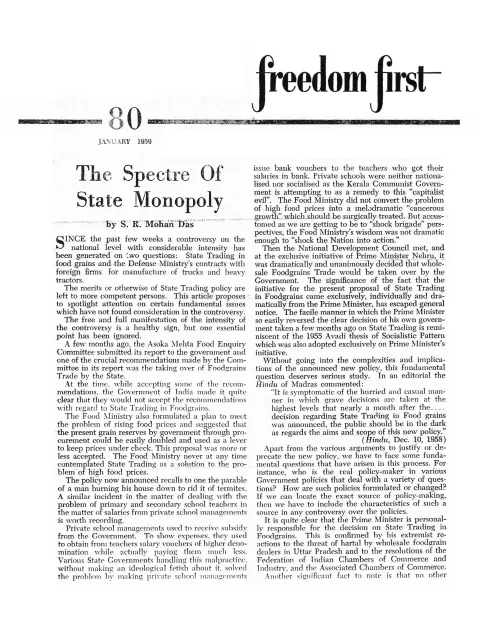
The Spectre Of State Monopoly
By S. R. Mohan Das
S. R. Mohan Das argues that the Nehru government’s sudden decision to have the state take over wholesale foodgrain trade — reversing its own earlier rejection of the Asoka Mehta Committee’s recommendation — exposes a deeper problem: policy in India is made unilaterally and dramatically by the Prime Minister rather than through visible, accountable deliberation. He likens the move to ‘burning a house down to rid it of termites’ and traces a parallel logic in Defence Ministry truck-manufacturing contracts. The essay closes by warning that Nehru’s rhetoric about a ‘socialistic pattern of society’ and readiness to ‘sweep away’ obstacles reveals an ideological partisanship that threatens democratic values in India.
- The Asoka Mehta Food Enquiry Committee had recommended state trading in foodgrains, but the government initially rejected this and instead adopted a milder procurement-doubling plan.
- The Prime Minister then reversed this position abruptly and unilaterally at the National Development Council, without public debate on aims and scope.
- The Hindu (Madras) is quoted criticizing the ‘hurried and casual manner’ in which the decision was taken.
- The author frames this as evidence that the real locus of policymaking in India is the Prime Minister’s personal initiative, not institutional process.
- A parallel is drawn with Defence Ministry truck-manufacturing contracts, where a ‘mere 2,000 trucks’ rationale is used to justify future nationalisation claims.
- Nehru’s declared goal of a ‘socialistic pattern of society’ and threat to ‘sweep out’ obstacles ‘with broomsticks’ is read as revealing an ideological partisanship inconsistent with democratic commitments.
Weekend In Budapest
By Kurt Gratz
Kurt Gratz’s travel report, reproduced from New Leader, describes a weekend visit to Budapest roughly two years after the 1956 uprising. He contrasts the city’s faded elegance with pervasive shortages, absurd black-market price differentials for imported goods across Communist-bloc countries, restricted internal travel, and a fatalistic unwillingness among Hungarians to save money given the risk of devaluation or confiscation. The piece ends with the observation that tourists leaving Hungary become suddenly eloquent in denouncing the Communist dictatorship once they cross into Austria.
- Budapest in 1958 is compared to Vienna in 1949: people are not starving but consumer goods, especially imports, are scarce, expensive, or of poor quality.
- Black-market currency and goods arbitrage flourishes between Communist bloc countries (e.g., coffee, wristwatches, nylon shirts) due to artificial official exchange rates.
- Internal travel within Hungary, e.g. to the Austrian border region, requires special permission and is tightly guarded with watchtowers, machine guns, barbed wire and minefields.
- A Hungarian worker (‘Laszlo’) faces an unannounced 16 percent wage cut with no possibility of striking in protest.
- There is a general feeling of helplessness and disappointment that the West did not intervene to aid the 1956 uprising.
- The government has rebuilt war/uprising-damaged streets to look exactly as before, papering over the physical evidence of ‘the events’ (the Communist-preferred term for the uprising, avoiding ‘revolution’).
Notes (Whither Iraq?; Exit Serov; Mao Steps Down)
An unsigned ‘Notes’ section covers three international developments. ‘Whither Iraq?’ surveys the unstable post-monarchy political situation, noting arrests of pro-Nasser figures by Brigadier Kassem and warning that Kassem’s reliance on Communists to consolidate power is allowing Iraqi Communists and fellow-travellers to entrench themselves in the Defence, Press, Propaganda and Judicial departments, alarming other Arab leaders. ‘Exit Serov’ discusses the removal of Soviet security chief Ivan Serov as a milestone in post-Stalin purges, contrasting his fortune in surviving his post (unlike predecessors Yagoda, Yezhov, and Beria) with his brutal record, including suppression of the Hungarian uprising. ‘Mao Steps Down’ speculates on the reasons behind Mao Tse-tung’s decision to relinquish the PRC chairmanship, linking it to setbacks over Quemoy/Matsu and unrest surrounding the people’s communes programme, and notes that even Khrushchev privately called the Chinese commune system ‘actually reactionary.’
- Brigadier Kassem’s post-revolution Iraq is described as an uneasy equilibrium in which Colonel Aref and other pro-UAR, pro-Nasser figures have been arrested.
- Kassem’s reliance on Communists to hold power has let Iraqi Communists gain control of Defence, Press, Propaganda, and Judicial departments, alarming Cairo and other Arab leaders.
- Ivan Serov’s removal as Chairman of the Committee of State Security is read as another step away from the police state, though his eventual fate (unlike predecessors) remains uncertain.
- Serov is described as having overseen mass deportations of Baltic, Ukrainian, Polish, Caucasus, Crimean and East German populations, and playing a leading role in suppressing the Hungarian uprising.
- Mao’s resignation of the state chairmanship (while retaining Party chairmanship) is analysed as possibly linked to setbacks over Quemoy and Matsu and internal Party criticism over the pace of the communes programme.
- Khrushchev is reported to have privately described the Chinese communes system as ‘actually reactionary’ in conversation with U.S. Senator Humphrey.
West Bengal—Problems And Prospects
By K. K. Sinha
K. K. Sinha examines West Bengal’s political landscape after the 1957 general election, in which the Congress consolidated rural strength but was seriously weakened in Calcutta and refugee areas by a ‘Leftist’ bloc within which the CPI had become the dominant, organising force. He analyses the CPI’s strategy of embedding itself in the leftist coalition before asserting political dominance over it, the PSP’s growing wariness of Communist co-option, and major grievances (refugee rehabilitation, food prices, unemployment, sanitation) driving unrest. He closes by warning that if democratic groups fail to distinguish themselves from the Communists on democratic and libertarian grounds, conditions favour a Communist takeover in the province; statistical appendices on population, refugees, and 1952/1957 party vote shares follow.
- Congress retained its rural base in the 1957 West Bengal election but was badly weakened in Calcutta, suburban towns, and refugee areas.
- The Leftists’ total assembly strength rose from 94 (before 1957) to 100 of 252 seats, with the CPI’s own strength rising from 28 to 46, making it the dominant force within the Leftist alliance.
- The CPI’s strategy is described as embedding itself within the broader leftist movement first, then gradually asserting dominance, playing rival groups against each other.
- Major unresolved grievances include the refugee problem, high cost of living, unemployment, and sanitation/housing pressures from migration into Calcutta.
- The PSP is shown becoming wary of Communist co-option post-Hungary/Nagy execution/Yugoslavia break/Pasternak episode, taking steps to distinguish itself from the CPI.
- The author’s prescription: democratic groups must emphasise democratic and libertarian values in contrast to totalitarianism to isolate the Communists politically and ideologically and avert a Communist takeover.
- Statistical appendices give 1951/1957 population figures, refugee counts (31.63 lakhs in West Bengal, 2.64 lakhs in camps), and comparative 1952/1957 party vote and seat shares.
Mao’s Short-cut To Communism
By Adam Adil
Adam Adil offers a hostile, detailed account of China’s people’s-commune system following a Chinese Communist Party Central Committee resolution to extend communes to every city and rural area. He describes communes as total collectivisation of land, factories, schools, housework and meals, comparing the scheme to a form of colonialism (citing demographer Dr. S. Chandrasekhar) and arguing it destroys family life, individual choice, and personal property. The essay details forced ‘volunteering,’ militarised daily routines (citing the Chao Yin commune’s dawn assembly-bell regimen), the ‘Saturday-night system’ limiting conjugal privacy, and disposal of the elderly dead as fertiliser in some Kwantung communes. It concludes that the commune programme has produced only uniformity of poverty rather than raised living standards, and questions whether Mao will succeed given rising discontent.
- A CCP Central Committee resolution declared the people’s commune the permanent ‘basic unit’ of the future communist society, to be extended to cities as well as villages.
- Communes pool not just land and implements but factories, schools, nurseries, housework and meals — described as forced collectivisation abandoned by the Russians as impractical in 1933.
- Over 120 million households (99%+ of peasant households) are claimed to have joined communes; some rural communes reportedly have up to 300,000 members.
- Joining a commune requires surrendering all personal property; members become ‘all-purpose production units’ subject to militarised daily schedules.
- The ‘Saturday-night system’ allows married couples only occasional, scheduled privacy in factory dormitories.
- In some Kwantung communes, the bodies of deceased elderly residents are reportedly processed into fertiliser.
- The author argues communes have redistributed poverty downward rather than raising living standards, and questions whether rising discontent will force the CCP to abandon or slow the scheme.
Life In East Germany
This unsigned institutional report, compiled from testimonies gathered at a Congress for Cultural Freedom refugee centre in West Berlin (opened since September 1958 for intellectuals fleeing East Germany), documents patterns of political coercion in East Germany. It recounts cases of a music professor, a lawyer, a physician, a Protestant clergyman, a gynecology professor, and an art museum director, each pressured to conform to Party expectations (informing, propaganda work, ideological conformity) at the cost of their careers, and describes children compelled to join Communist youth organisations. A second portion notes that despite hardship, former East Germans retain small civilities (‘please’ and ‘thank you’) absent from ‘Communist officialdom.’
- The Congress for Cultural Freedom set up a West Berlin centre in September 1958 for refugee intellectuals fleeing East Germany.
- None of the refugees interviewed left for material reasons — many had enjoyed high salaries and privileged status (e.g. a Dresden Conservatory music professor with three concert pianos).
- Children are pressured from an early age to join the ‘pioneers’ or the R.D.J. (‘Free German Youth’); refusal brings discrimination at school.
- Specific professional cases: a lawyer refusing to let his office be used as secret police headquarters; a physician ordered to head an electoral propaganda committee; a Protestant clergyman who resigned his ministry rather than see supporters publicly vilified; a Catholic gynecology professor transferred for his faith; an art museum director accused of failing to sufficiently praise the Soviet Union in his writing.
- A veterinarian fled after criticizing discriminatory treatment of peasant proprietors versus collective farms; his wife was later jailed for ‘smuggling’ his typewriter to him.
- Refugees at the Congress house are struck that ordinary civility (‘please,’ ‘thank you’) persists in West Berlin daily life but had disappeared from East German officialdom.
Visitors To India
A news digest, ‘Visitors To India,’ reports on the December visits of three foreign intellectuals: Frode Jakobson (who toured Calcutta, Madras, Kerala, Bombay, Poona and Delhi, meeting Dr. B. C. Roy, E. M. S. Namboodiripad, and Prime Minister Nehru, and lecturing on democracy and socialism), Prof. Sidney Hook (who lectured widely on ‘Dialectical Materialism,’ ‘Freedom and Responsibility,’ and ‘The Meaning of Democracy’ across Calcutta, Banares, Lucknow, New Delhi, and elsewhere under Congress for Cultural Freedom and university auspices), and Arthur Koestler (whose Bombay itinerary of receptions and lectures for January 1959 is listed).
- Frode Jakobson toured Calcutta, Madras, Kerala, Bombay, Poona and Delhi in November–December, meeting West Bengal CM Dr. B. C. Roy, Kerala CM E. M. S. Namboodiripad, and PM Jawaharlal Nehru.
- Jakobson lectured on ‘Communism and the Intellectual,’ Scandinavian democracy, and ‘Socialism and Ethics.’
- Prof. Sidney Hook (NYU) arrived in Calcutta on December 1 after touring Japan, Burma and the Philippines, lecturing on ‘Dialectical Materialism,’ ‘Science and Human Wisdom,’ ‘Freedom and Responsibility,’ ‘The Meaning of Democracy,’ and ‘Philosophical Basis of Modern Economics’ across multiple Indian cities.
- Hook attended the annual session of the Indian Philosophical Congress in Ahmedabad and was scheduled in India until January 10, with further stops in Bangalore, Madras and Poona.
- Arthur Koestler arrived in Bombay on December 30 for a programme of receptions and lectures organised by Marathi, Gujarati and Hindi writers’ organisations, the PEN All-India Centre, the Indian Committee for Cultural Freedom, and Bombay University, running through January 8.
With Many Voices
‘With Many Voices’ is a compilation of quoted press commentary, prefaced by a Tennyson epigraph, gathering statements from Indian and international newspapers on democracy, communism, and world affairs — including remarks on the threat of ‘a communist dictatorship installing itself through constitutional means,’ demographer Dr. S. Chandrasekhar’s comparisons of Chinese communes to a zoo or beehive and his description of Chinese communism as ‘a new colonialism,’ and commentary from figures such as D. R. Mankekar, Michael Adams, Tom Mboya, and Ghana’s Prime Minister Nkrumah.
- The page opens with a Tennyson epigraph (‘The deep / Moans round with many voices…’) framing the compilation.
- D. R. Mankekar (Indian Express) warns that the threat to Indian democracy comes ‘not from bullets but the ballot’ — a communist dictatorship installing itself through constitutional means.
- Dr. S. Chandrasekhar is quoted multiple times comparing China’s communes to a ‘zoo’ and ‘beehive’ and describing the loss of individual freedom there as ‘a new colonialism’ and ‘the greatest tragedy of modern China.’
- Michael Adams (Manchester Guardian Weekly) frames Iraq as the current battleground between Arab nationalism and the Communist East.
- Ghana’s Prime Minister Nkrumah warns that colonialism and imperialism may return ‘in different guise, not necessarily from Europe.’
- Dr. K. Shridharani is quoted describing V. K. Krishna Menon as ‘an orphan of Indian politics’ and Nehru as ‘Democracy’s Tito.’
Generated by the v1.5 extraction pipeline. Awaiting editorial review.
Metadata and summary are AI-extracted from the source PDF and reviewed for editorial accuracy. The original work is available via the Read PDF tab above (where present); paragraph-level citation inside the PDF is deferred to a future engagement.