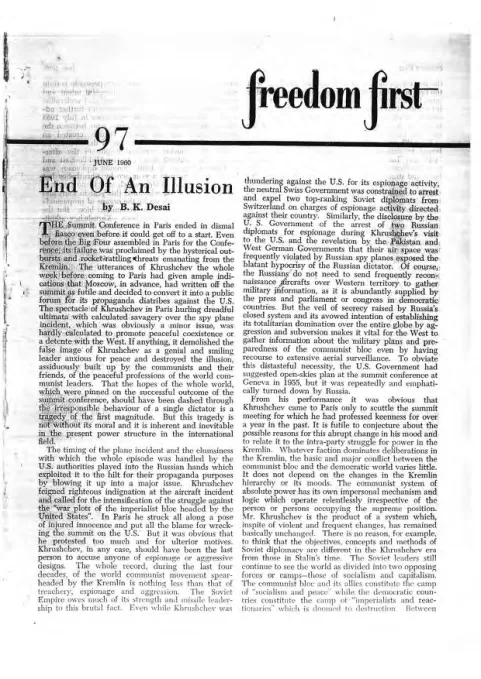
periodical issue
Freedom First
By Onlooker, William Henry Chamberlin, Thubten Nyenjik
Published for the Democratic Research Service by B. K. Desai at 127 Mahatma Gandhi Road, Bombay 1; printed at Inland Printers, 55 Gamdevi Road, Bombay 7 · Bombay · 1959
12 pages
Freedom First
Summary
This is issue No. 85 (June 1959) of Freedom First, the monthly periodical published by the Democratic Research Service, Bombay, and edited by V. B. Karnik. The rendered pages cover the full 12-page issue. Its lead article, “Where Is The Enthusiasm?” by a writer using the pen name Onlooker, attacks the Congress party’s Nagpur resolution on joint cooperative farming, arguing that the scheme has been met with public indifference and even hostility rather than the enthusiasm claimed by Nehru and the Congress President, and citing a listless All India Congress Committee meeting as proof. William Henry Chamberlin’s “Why We Have A Cold War” rebuts the idea that the Cold War stems from American rigidity, laying blame on Soviet expansionism and quoting Tocqueville on democracies’ difficulty conducting foreign affairs. An unsigned “Notes” section takes up the Dalai Lama’s asylum in India, Nehru’s defence of the Sino-Indian Tibet agreement, the rejected India-Pakistan joint defence proposal, the Hindi-versus-English official-language dispute, and the controversy over Nabokov’s Lolita. A short editorial pays tribute to the late John Foster Dulles. “Communist Rule In Tibet” reproduces, in full, an open letter from Thubten Nyenjik, Abbot of Gyantse Monastery and Governor of Gyantse Province, addressed to Asian and world governments, cataloguing Chinese military repression, forced labour, cultural destruction, and economic exploitation in occupied Tibet since 1950. “Long Live Personality!” is a satirical compilation of sycophantic Pravda tributes to Khrushchev from Soviet officials, mocking the persistence of a leader personality cult despite Khrushchev’s own 1956 denunciation of Stalin’s cult of personality. The issue closes with a Science and Freedom Committee protest cable against apartheid in South African universities, a “News & Views” digest (Chinese workers’ wages, East German student trials and intellectual flight, declining Communist vote shares across Western Europe, East German medical politics, a banned-film scandal in Prague), and “With Many Voices,” a page of press quotations on the Tibet crisis from Indian and international commentators, plus a subscription form and back-page publisher’s imprint.
Key points
-
Writing as “Onlooker,” “Where Is The Enthusiasm?” argues the Nagpur resolution’s joint cooperative farming has met public indifference rather than enthusiasm, citing a listless All India Congress Committee meeting reported as “listless, inattentive and indifferent” with barely two dozen members present.
-
William Henry Chamberlin’s “Why We Have A Cold War” rejects the view that the Cold War stems from American rigidity, laying blame on Soviet expansionism in Greece, Poland, Lithuania and Galicia, and invokes Tocqueville’s scepticism about democracies’ capacity for sustained foreign policy.
-
Notes defend India’s asylum for the Dalai Lama while questioning restrictions on his movements, challenge Nehru’s Lok Sabha defence of the Sino-Indian Tibet agreement, and discuss Rajagopalachari’s petition against imposing Hindi as sole official language.
-
A brief tribute marks the death of US Secretary of State John Foster Dulles, praising his steadfastness against Soviet overtures.
-
An open letter dated 20 July 1956 from Thubten Nyenjik, Abbot of Gyantse Monastery, catalogues six years of Chinese occupation in Tibet, describing the bombing of Litang, forced labour on military roads, and Chinese-run schools offering only indoctrination.
-
A satirical piece compiles obsequious Pravda tributes crediting Khrushchev personally for achievements from agriculture to guided missiles, contrasting them with his own 1956 denunciation of Stalin’s personality cult and closing that “the cult is dead, but long live personality.”
-
A cable from the International Committee on Science and Freedom, signed by representatives of 296 universities in 52 countries, condemns South Africa’s compulsory university segregation policy to Prime Minister Verwoerd.
-
A “News & Views” digest reports Radio Peking’s admission that Chinese workers earn only about US$12.60 a month, the sentencing of eighteen East German students for treason, and 119,300 East Germans fleeing to the West in 1958, disproportionately young professionals.
-
The closing “With Many Voices” quotes Acharya Kripalani criticising the Panchsheel framework and China’s People’s Daily defending its conduct in Tibet, alongside Nehru’s own acknowledgment that “autonomy” may carry different meanings for India and China.
Essays
Essay 1
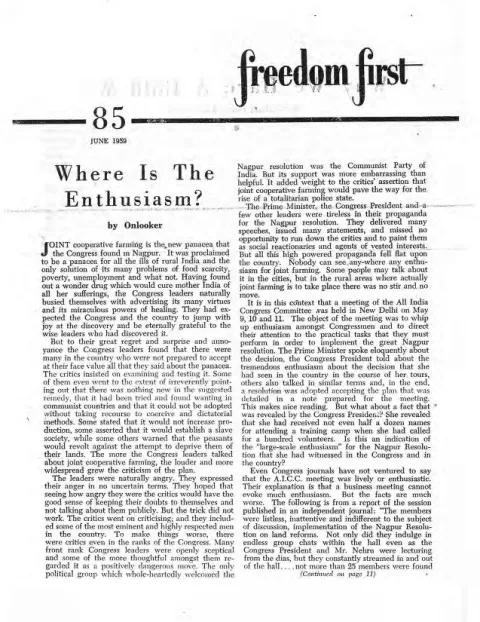
Writing under the pseudonym “Onlooker,” the author argues that the Congress party’s Nagpur resolution promoting joint cooperative farming has failed to generate the popular enthusiasm its leaders claim. The piece surveys criticism of the scheme (that it borrows from Communist-bloc failures, requires coercion, and threatens to dispossess peasants of land), notes that even Congress’s own ranks include sceptics, and singles out Communist Party of India’s endorsement of the scheme as embarrassing rather than helpful since it lends credence to charges the plan is a step toward a totalitarian police state. The piece then reports on a listless All India Congress Committee meeting in New Delhi (May 9-11) called to whip up enthusiasm for implementing the Nagpur resolution, quoting an independent journal’s account of members as “listless, inattentive and indifferent,” with barely two dozen present at any time and constant traffic in and out of the hall. The article continues onto page 11, closing with a call for Congress leaders to accept that their programme lacks genuine grassroots support and that only coercion and administrative measures, not persuasion, are propping it up.
- The Nagpur resolution’s joint cooperative farming scheme is framed by Congress leaders as a cure-all for rural India’s poverty, food scarcity, and unemployment
- Critics — including some within Congress — warned the plan required coercive, dictatorial methods and risked provoking peasant revolt
- The Communist Party of India’s support for the scheme was embarrassing to Congress because it reinforced fears of a slide toward a totalitarian police state
- An A.I.C.C. meeting in New Delhi (May 9-11, 1959) intended to build enthusiasm for the resolution was reported as listless and poorly attended
- The Congress President revealed she received fewer than half a dozen names for a training camp meant to draw a hundred volunteers
- The Times of India and other independent press coverage are cited as evidence contradicting Congress’s own claims of widespread enthusiasm
- The piece concludes that manufactured enthusiasm cannot substitute for real popular consent, and that coercion is being used to compensate for the plan’s unpopularity
Where Is The Enthusiasm?
By Onlooker
William Henry Chamberlin argues against the view — which he attributes to figures like Nikita Khrushchev, Anastas Mikoyan, and philosophy professor John Somerville — that the Cold War is a product of American rigidity or intolerance that would dissolve if Washington were merely more accommodating. He contends the war’s fundamental cause is Soviet imperial expansion beyond legitimate Russian ethnic limits, citing Soviet-incited unrest in Greece, Western-backed guerrilla resistance in Poland/Lithuania/Galicia, the Berlin blockade, and the invasion of South Korea as evidence of where aggression actually originated. He criticizes Western tendencies toward appeasement dressed as “flexibility” or “realism,” invokes Alexis de Tocqueville’s skepticism about democracies’ capacity to conduct sustained foreign policy, and calls for firm resolve rather than concession as the German peace treaty dispute over Berlin unfolds.
- Chamberlin rejects the framing (associated with Khrushchev, Mikoyan, and John Somerville) that the Cold War stems from American intolerance rather than Soviet design
- He cites Soviet incitement in Greece and repression in Poland, Lithuania, and Galicia as evidence of the true source of aggression
- He argues the U.S. and allies acted defensively in Korea and West Berlin, not as aggressors
- He criticizes the Soviet ultimatum on Berlin and demand for a German peace treaty as bad-faith diplomacy akin to a thug’s tactics
- He warns against Western appeasement disguised as flexibility or realism
- He quotes Alexis de Tocqueville’s argument that democracies are poorly suited to conducting sustained, disciplined foreign policy
- He frames responsibility on the West to prove Tocqueville’s pessimism about democracies wrong
Why We Have A Cold War
By William Henry Chamberlin
An unsigned editorial “Notes” section covering five items. It defends India’s grant of asylum to the Dalai Lama while criticizing restrictions placed on his movements and press access, and questions whether the Government of India is improperly limiting a political refugee’s rights. It then scrutinizes Nehru’s Lok Sabha defence of the Sino-Indian Tibet agreement, arguing that China’s own admitted historical claims to Tibetan “overlordship” do not establish legitimate sovereignty, and pressing Nehru to unambiguously support Tibetan independence rather than accept China’s autonomy framing. A short item criticizes Nehru’s rejection of Pakistani President Ayub Khan’s proposal for joint sub-continental defence, arguing India’s 2000-mile border with an aggressive China warrants reconsideration. A “Language Problem” item discusses Rajagopalachari’s petition to Parliament opposing the imposition of Hindi as sole official language and urging retention of English, and praises the Communications Minister’s support for including English and Sindhi in the Eighth Schedule. A final item on Nabokov’s Lolita describes the international obscenity controversy around the novel and argues against banning it under the Sea Customs Act, noting Customs officers lack competence to judge literary obscenity.
- The Dalai Lama’s asylum is defended but restrictions on his movement and access to visitors like Heinrich Harrer are criticized as an improper use of government power
- Nehru’s Lok Sabha defence of the Sino-Indian Tibet agreement is challenged: China’s own admission of historical ‘overlordship’ claims does not make Tibet legitimately part of China
- The editorial urges Nehru to unambiguously back Tibetan independence rather than accept Chinese-framed ‘autonomy’
- Nehru’s rejection of Ayub Khan’s joint India-Pakistan defence proposal is criticized given the scale of Chinese aggression on India’s northern border
- Rajagopalachari’s petition against imposing Hindi and for retaining English as official language is presented sympathetically, alongside support for adding English and Sindhi to the Eighth Schedule
- The Lolita obscenity controversy is discussed, concluding that banning it under the Sea Customs Act would hand arbitrary censorship power to Customs officers unqualified to judge literary merit
Notes (Restrictions on Dalai Lama; Nehru And Tibet; Joint Defence; Language Problem; Lolita; John Foster Dulles)
A brief unsigned tribute marking the death of U.S. Secretary of State John Foster Dulles, praising his dedication to defending the free world against “imperialist communism” and crediting him with steadfastness against Soviet overtures even amid criticism and unpopularity.
- The piece honors John Foster Dulles following his death, framing him as a steadfast Cold War statesman
- It credits him with resisting the allure of superficially conciliatory Soviet gestures
- It frames his work as building the moral and material strength of free nations against communism
Communist Rule In Tibet
By open letter by Thubten Nyenjik, Abbot of Gyantse Monastery and Governor of Gyantse Province
This piece reproduces in full an open letter dated July 20, 1956, from Thubten Nyenjik, Abbot of Gyantse Monastery and Governor of Gyantse Province, written after fleeing to India, addressed to Asian and world governments. The letter describes six years of Chinese occupation of Tibet as a colonization disguised as “liberation,” detailing the bombing and razing of Litang and Dzachukha, mass killings, guerrilla resistance by Tibetans from multiple regions, forced labour used to build military roads, destruction of indigenous education and medicine in favour of Communist indoctrination, and crushing taxation reducing Tibetans to poverty. It argues China’s claim to historic “overlordship” does not justify annexation, criticizes pressure placed on the Dalai Lama to praise the regime, and calls the world’s silence on Tibet’s occupation a blot on the international conscience.
- The letter is written by Thubten Nyenjik, Abbot of Gyantse Monastery and Governor of Gyantse Province, as a refugee in India, dated July 20, 1956
- It calls the phrase ‘liberation of Tibet’ a ‘deadly mockery’ given the invasion occurred in 1950 against a self-sufficient, contented country
- It documents the bombing of Litang and Dzachukha, with over four thousand killed in Litang alone and the capital razed
- It describes forced Tibetan labour and requisitioned grain and silver used to build military roads and subjugate the population
- It says Chinese-run schools serve only Communist indoctrination, offer no vocational training, and displace indigenous schools and Ayurvedic medicine
- It states Chinese economic policy has driven up the cost of living nine to tenfold and turned a food-exporting economy into an importer
- It criticizes pressure on the Dalai Lama to read Chinese-prepared speeches praising the regime under threat implied by 100,000 Chinese soldiers stationed in Tibet
- It calls the world’s failure to act on Tibet’s occupation a ‘blot on the conscience of the world’
Long Live Personality!
A satirical unsigned piece compiles a series of obsequious tributes to Nikita Khrushchev published in Pravda and other Soviet outlets between January and February 1959, from officials in agriculture, alcohol production, the army, atomic physics, chemistry, cotton-growing, education, electric power, guided missiles, literature, and Soviet nationalities. The piece contrasts these encomiums with Khrushchev’s own 1956 ‘secret speech’ denunciation of Stalin’s cult of personality, arguing that a new cult — around Khrushchev himself — was visibly forming by the 21st Party Congress in 1959, and notes Khrushchev’s May 16 award of the Lenin Peace Prize, at which an Indian delegate, Mr. Sunderlal, praised him as one of the world’s most religious leaders despite his atheism.
- The piece contrasts Khrushchev’s 1956 secret-speech condemnation of Stalin’s personality cult with a new cult of personality forming around Khrushchev himself by 1959
- It compiles quotations crediting Khrushchev personally for achievements in agriculture, alcohol policy, the armed forces, atomic physics, chemistry, cotton production, education, electric power, missile programmes, and literature
- Soviet officials from multiple Central Asian and Baltic republics are quoted thanking Khrushchev personally for national policy outcomes
- The piece notes Khrushchev received the Lenin Peace Prize on May 16, 1959, and quotes Indian peace activist Sunderlal’s effusive praise of him as among the world’s most religious leaders
- The piece closes with the ironic line that ‘the cult is dead, but long live personality’
Science And Freedom Committee’s Protest
A short news item reproducing the text of a cable from the International Committee on Science and Freedom, signed by representatives of 296 universities in 52 countries, addressed to South African Prime Minister Dr. H. F. Verwoerd. The cable condemns South Africa’s university apartheid policy as a denial of human brotherhood and a threat to academic standing, and calls on the government to abandon compulsory racial segregation in universities.
- The International Committee on Science and Freedom, representing 296 universities across 52 countries, cabled Prime Minister Verwoerd protesting compulsory race segregation in South African universities
- The cable expresses admiration for South African universities resisting the government’s segregation policy
- It calls the policy a denial of human brotherhood that damages the international standing of South African universities
- A copy of the cable was also sent to the National Union of South African Students
News & Views (Chinese Workers’ Earnings; Students Sentenced For Treason; Flight of Physicians; Intellectuals Flee East Germany; Elections In Europe Show Decline In Communist Influence; Secret Film Performances In Prague)
A “News & Views” digest of short items drawn from international sources: Radio Peking’s admission that Chinese workers earn only Y60 a month (about US$12.60 at the market exchange rate), far below peasant incomes reported by Premier Chou En-lai; the sentencing of eighteen East German students and young workers for treason after organizing a reunification programme and ‘anti-state’ cabaret; a wave of 813 doctors and 114 pharmacists fleeing East Germany in early 1958, prompting new Communist Party assurances to physicians; mass flight of 119,300 East Germans to the West in 1958, disproportionately young professionals; a survey of declining Communist Party vote shares across fourteen Western European countries between the late 1940s and late 1950s; and a report on secret screenings of American and Western films organized in Prague, leading to the arrest of organizer Vlastimil Mynarik on charges linked to contact with the U.S. Embassy press attaché.
- Radio Peking’s own broadcast revealed Chinese workers earn about Y60/month, or roughly US$12.60 at the market exchange rate, far below official propaganda claims
- Eighteen East German students and workers were sentenced (three to fifteen years) for treason for organizing a German-reunification programme and a cabaret seen as hostile to the state
- 813 doctors and 114 pharmacists fled East Germany in early 1958, prompting new official assurances to keep physicians from emigrating further
- 119,300 East Germans fled to West Germany in 1958, with a disproportionately high share of young people and professionals (teachers, doctors, engineers)
- Communist Party vote shares fell across all 14 surveyed Western European countries between their post-war peaks and the late 1950s, with Italy and France showing the steepest declines
- A Prague organizer, Vlastimil Mynarik, was arrested for secretly screening smuggled American and Western films, allegedly with help from the U.S. Embassy press attache
With Many Voices
A closing page, “With Many Voices,” epigraphed with a Tennyson quotation, that compiles brief press quotations — mostly on the Tibet crisis — from Acharya Kripalani, B. G. Verghese, the Manchester Guardian, B. T. Randive, the Amrita Bazar Patrika, a satirical Thought column, and China’s People’s Daily, alongside a quotation from Nehru’s Lok Sabha reply on Tibet acknowledging the ambiguity of the term ‘autonomy.’ The page also carries the issue’s subscription form and closing publication details (edited by V. B. Karnik, printed at Inland Printers, published by B. K. Desai for the Democratic Research Service).
- The page compiles short press quotations, mostly critical of China’s actions in Tibet and of Nehru’s response to them
- Acharya Kripalani is quoted twice criticizing the Panchsheel framework and Chinese disregard for Asian opinion
- B. T. Randive’s Monthly New Age piece is quoted questioning Nehru’s inconsistency on land reform given his acceptance of monastic land monopoly in Tibet
- China’s People’s Daily is quoted defending Chinese conduct and India’s non-interference, and distinguishing ‘autonomy’ for Tibet from full regional autonomy under China’s constitution
- Nehru is quoted from his May 8 Lok Sabha reply acknowledging that the word ‘autonomy’ may carry different meanings for India and China
- The page includes the subscription form and closing masthead crediting editor V. B. Karnik and publisher B. K. Desai
Generated by the v1.5 extraction pipeline. Awaiting editorial review.
Essay 9
No summary was extracted for this article. Listed for completeness.
Metadata and summary are AI-extracted from the source PDF and reviewed for editorial accuracy. The original work is available via the Read PDF tab above (where present); paragraph-level citation inside the PDF is deferred to a future engagement.