periodical issue
Freedom First
By V. B. Karnik, A Special Correspondent, Hemalata Acharya, (Contributed), B. J. Fernandes, Raman Desai, M. R. Dalvi
Edited by V. B. Karnik and printed at Inland Printers, 55 Gamdevi Road, Bombay 7 and published for the Democratic Research Service by B. K. Desai at 127 Mahatma Gandhi Road, Bombay 1. · Bombay · 1959
12 pages
Freedom First
Summary
This is issue No. 86 of Freedom First (July 1959), the monthly journal of the Democratic Research Service, Bombay, edited by V. B. Karnik. The issue’s editorial centerpiece, ‘A People’s Upsurge’ by Karnik, defends the anti-communist agitation in Kerala against the elected EMS Namboodiripad communist ministry, arguing (citing Nehru’s own on-the-spot assessment and Jayaprakash Narayan) that the movement is a genuine mass upsurge rather than a communal conspiracy, and calls for dissolution of the Kerala legislature and fresh elections. Other contributions in the rendered pages include a report on the All-India Tibet Convention (continued across pages 2 and 11-12), an essay on the merits and limits of co-operative farming in India by Hemalata Acharya (continued from page 4 to page 8), a polemical piece on the communist-organised Vienna Youth Festival, an account of Soviet press censorship (‘Press In Bondage’ by B. J. Fernandes), a book review section covering Nabokov’s Lolita and A. D. Gorwala’s Of Matters Administrative, and a closing page of quoted political statements (‘With Many Voices’) plus a subscription form. The volume’s overall stance is classical-liberal and anti-communist, closely tied to the Forum of Free Enterprise/Swatantra milieu associated with Karnik and M. R. Masani.
Key points
-
V. B. Karnik’s “A People’s Upsurge” defends the anti-communist Kerala agitation as, in Nehru’s own words after an on-the-spot visit, “essentially a people’s upsurge,” citing vote-share arithmetic showing the communist ministry won only 35% against a united 60% opposition, and calls for its resignation and fresh elections.
-
A special correspondent’s report on the All-India Tibet Convention notes Nehru’s dismissal of the gathering as a “wrong approach” before it was even held, yet records it drew over 1,700 delegates and a passionate Jayaprakash Narayan speech declaring “Tibet will not die.”
-
Hemalata Acharya’s essay on co-operative farming draws on a Programme Evaluation Organisation study of 22 societies to argue most were formed on government waste land or to evade land-ceiling legislation rather than from genuine cooperative conviction, and finds the programme’s production and employment gains largely unrealised.
-
A contributed piece on the communist-organised Vienna Youth Festival reports 78 of 130 delegates at a preparatory Stockholm meeting were confirmed communists, and that all Austrian democratic youth organisations refused to associate with the event despite four million dollars in Soviet backing.
-
B. J. Fernandes’s “Press In Bondage” contrasts the free press’s ethic that “news is sacred, comment free” with Soviet doctrine that news must be organised propaganda, detailing the layered censorship of TASS, GLAVLIT and AGITPROP.
-
Raman Desai reviews Vladimir Nabokov’s Lolita as a serious, artistically rigorous novel whose refusal of a softened ending gives it moral integrity, while M. R. Dalvi reviews A. D. Gorwala’s Of Matters Administrative as a diagnosis of nepotism and inefficiency in Indian administration.
-
The closing “With Many Voices” quotes Nehru declaring “I fear nobody… I do not fear even god,” met by C. Rajagopalachari’s rejoinder invoking Old Testament psalms, and V. P. Menon’s aphorism that “Communists and constitution are contradiction in terms.”
Essays
A People’s Upsurge
By V. B. Karnik
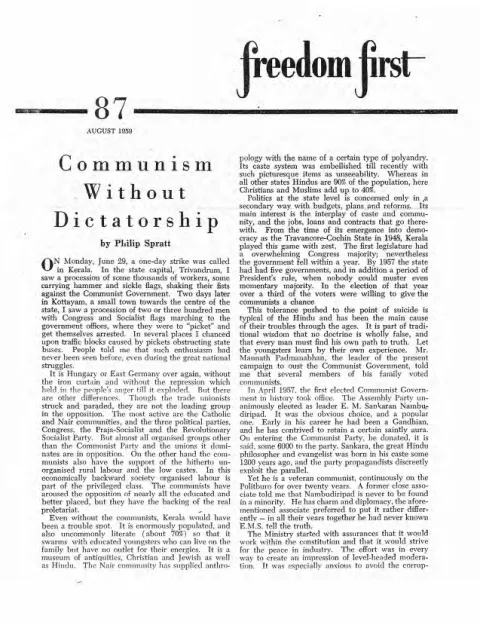
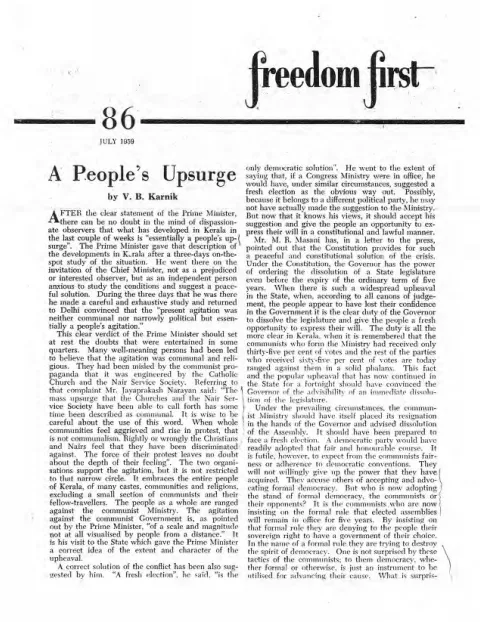
V. B. Karnik’s lead editorial argues that the popular agitation against the communist ministry in Kerala in mid-1959 is, in the Prime Minister’s own words after a personal three-day visit, ‘essentially a people’s upsurge’ rather than a communal or narrowly political movement engineered by the Catholic Church and the Nair Service Society, as communist propaganda claimed. Karnik marshals Nehru’s and Jayaprakash Narayan’s assessments, M. R. Masani’s constitutional argument that the Governor has the power to dissolve the state legislature, and the electoral arithmetic (the communists received only 35% of votes against a united 60% opposition) to argue that the Kerala ministry should resign and face fresh elections rather than cling to a ‘formal rule’ of completing its five-year term. He criticizes both the communist ministry for refusing to resign and commentators who reflexively call any direct action against an elected government undemocratic, insisting Kerala is an exceptional case where formal democratic process is being used to defeat the people’s actual will.
- Nehru, after a three-day on-the-spot study in Kerala, described the agitation as ‘essentially a people’s upsurge’, not communal or narrowly political.
- Jayaprakash Narayan defended the Church/Nair Service Society-backed protests as legitimate: ‘It is wise to be careful about the use of this word [communal]… The force of their protest leaves no doubt about the depth of their feeling.’
- M. R. Masani argued in the press that the Constitution empowers the Governor to dissolve a state legislature before the end of its term when the government has lost popular confidence.
- Karnik cites vote-share arithmetic: the communist ministry was elected with only 35% of the vote while parties now opposing it together won 60%.
- The essay frames the communists as invoking ‘formal democracy’ cynically to entrench power while the opposition’s direct action is framed as the truer expression of democratic will.
- Karnik calls on the Ministry to resign and place itself in the Governor’s hands to enable a fresh election, warning that further delay prolongs ‘misery and hardship’ in Kerala.
All-India Tibet Convention
By A Special Correspondent
A special correspondent reports on the All-India Tibet Convention, opening with Nehru’s dismissive parliamentary remark (May 8) that the proposed Convention, associated with a ‘certain Majumdar’ (historian R. C. Majumdar), represented a ‘wrong approach’ that would do more harm than good. The piece defends Majumdar, noting he resigned from a government-commissioned history of the 1857 uprising rather than compromise his conclusion that it did not constitute a genuine War of Independence, and criticizes Nehru’s dismissive tone as well as his government’s simultaneous silence on a rival, China-aligned ‘West Bengal Conference’ in Calcutta. It records that Indira Gandhi and Congress figures echoed the Prime Minister’s line calling the Convention ‘contrary’ to government views on Tibet policy. The essay (continued on pages 11-12) concludes that the Convention succeeded despite official disapproval, drawing over 1,700 delegates, support from the Praja Socialists, Jan Sangh, and Hindu Mahasabha, messages of goodwill from prominent Asian anti-communist figures (U Ba Swe, Dato Abdul Razak, former Ceylon PM Dudley Senanayake, and others), a speech by Tibetan representative Sonam Gyatso rebutting Chinese claims that the Tibetan revolution was reactionary, and a widely reported, passionate speech by Jayaprakash Narayan declaring ‘Tibet will not die because there is no death for the human spirit’ and that Tibet will be resurrected. It ends noting the Convention resolved to form an Afro-Asian Committee on Tibet as a counter to the Soviet-aligned Afro-Asian Solidarity Committee.
- Nehru dismissed the proposed All-India Tibet Convention in Parliament (May 8) as a ‘wrong approach’ associated with ‘a certain Majumdar’, before it was even held.
- The correspondent defends historian R. C. Majumdar, noting he resigned a government-commissioned history project after concluding the 1857 revolt did not constitute a genuine War of Independence.
- The government stayed silent on a rival pro-Beijing ‘West Bengal Conference’ held in Calcutta around the same time, which the piece frames as hypocrisy.
- Indira Gandhi and other Congress figures publicly echoed Nehru’s line calling the Convention’s likely stance ‘contrary’ to government Tibet policy.
- Despite official disapproval, the Convention drew over 1,700 delegates and support from the Praja Socialists, Jan Sangh, Hindu Mahasabha, and prominent Asian anti-communist leaders.
- Tibetan representative Sonam Gyatso rebutted Chinese communist claims that the Tibetan uprising was engineered by ‘upper strata reactionaries.’
- Jayaprakash Narayan delivered a widely reported speech declaring Tibet would not die and would be resurrected.
- The Convention resolved to form an Afro-Asian Committee on Tibet to counter the Moscow-aligned Afro-Asian Solidarity Committee.
Co-operative Farming
By Hemalata Acharya
Hemalata Acharya’s essay examines the contested meaning and practice of co-operative farming in India, framed around a review of the Democratic Research Service’s publication ‘Co-operative Farming - The Great Debate.’ She surveys the Nagpur Resolution’s push toward collectivization, distinguishes co-operative joint farming, collective farming, and tenant farming societies, and draws on a Programme Evaluation Organization study of 22 co-operative farming societies (P.E.O. Publication No. 18, December 1956) plus a Nasik District case study to argue that most such societies were organized on government waste land for displaced or landless persons, that members largely joined not out of co-operative spirit but to evade land-ceiling legislation, and that the promised gains in production and employment have not materialized. She concludes (in the continuation on page 8) that co-operative farms surveyed showed inadequate finance, poor management, low yields relative to individual farms, and member disputes, and that any co-operative farm must be paired with a cottage-industry unit or mixed farming to absorb surplus labor, since the underlying problem of un/under-employment is ‘sui generis’ and cannot be solved by farm organization alone.
- The essay reviews the Democratic Research Service publication ‘Co-operative Farming - The Great Debate’ as a timely intervention amid the controversy following the Nagpur Resolution.
- Acharya distinguishes co-operative Joint Farming, Collective Farming, and Tenant Farming societies, and cites Dr. Otto Schiller’s characterization of the tenant model as ‘individual farming on co-operative lines.’
- Draws on the Programme Evaluation Organization’s December 1956 study of 22 co-operative farming societies and a Nasik District case study (Indian Journal of Agricultural Economics, Vol. 13, No. 1) as empirical evidence.
- Argues most existing co-operative societies were formed on government waste land for displaced persons or landless labourers, or by landowners seeking to evade land-ceiling legislation, rather than from genuine co-operative conviction.
- Finds the two central objectives of the co-operative farming programme — increased production and increased employment — did not materialize in most surveyed societies.
- Concludes surveyed societies suffered from inadequate finance, inexperienced management, and yields no better than individual farms in the same neighbourhood.
- Argues co-operative or individual farms alike must be paired with a cottage industry or mixed-farming component to relieve unemployment pressure, since unemployment is a problem ‘sui generis’ not solvable through farm organization alone.
Vienna Youth Festival
By (Contributed)
This contributed piece attacks the communist-organized 7th World Youth Festival planned for Vienna, arguing it is another stage-managed propaganda exercise by international communism following six previous festivals held in Prague, Budapest, East Berlin, Bucharest, Warsaw, and Moscow. It details how the Preparatory Committee, dominated by Iron Curtain delegations and fellow-travellers (78 of 130 delegates at a Stockholm preparatory meeting were confirmed communists, 27 more fellow-travellers), secretly selected Vienna as the venue over the objections of the Swiss and other national youth unions, and how Austrian democratic youth and student organisations unanimously refused to lend their name to the Festival despite the Soviet Union bankrolling it with four million dollars. The piece frames the episode as a case study in how ostensibly neutral international gatherings are captured by disciplined communist organizing while nominally democratic and non-communist national bodies are out-maneuvered.
- The essay situates the Vienna Festival as the seventh in a series of communist-sponsored world youth festivals (Prague 1947, Budapest 1949, East Berlin 1951, Bucharest 1953, Warsaw 1955, Moscow 1957).
- At the Stockholm preparatory meeting, 78 of 130 delegates were confirmed communists and 27 more were fellow-travellers; several delegations (e.g. West Germany, England) were represented by private individuals rather than national organisations.
- The Swiss Union of Students withdrew from the Preparatory Committee, its president stating that ‘control of policy and finance is in communist hands.’
- All Austrian democratic youth and student organisations refused to associate with the Festival and formally protested its being held in Vienna without their consent.
- The Soviet Union pledged four million dollars to defray Festival expenses, and 85% of the Vienna Secretariat’s staff were trained in Russia.
- The essay frames the Festival as ‘yet another communist circus designed to attract and rope in gullibles and opportunists.‘
Press In Bondage
By B. J. Fernandes
B. J. Fernandes examines press censorship in communist states, drawing on a two-part International Press Institute (Zurich) survey, ‘The Press in Authoritarian Countries.’ Contrasting the free press’s ethic (“news is sacred, comment free”) with Khrushchev’s and TASS director N. G. Pulgunov’s explicit doctrine that news must be an organised, didactic instrument of party purpose, the essay traces Lenin’s own admission that the ‘Russian Government can only survive by living in the dark’ through to the Soviet press’s institutional architecture: over 7,500 newspapers all controlled by the state or party, editors vetted for political reliability, TASS as monopoly news distributor and primary censor, and GLAVLIT (the Chief Administration for Literary and Publishing Affairs) and AGITPROP as further layers of ideological screening. Fernandes lists the specific purposes served by this suppression — concealing Communist Party mistakes, concealing Soviet public opinion, concealing bloc dissension, and shielding the public from truths about the free world — and closes noting internal Soviet complaints about the press’s drabness persist without resolution.
- Contrasts the free press’s ethic (‘news is sacred, comment free’) with the Soviet doctrine that news must be organised, agitational, and didactic.
- Cites Lenin’s own pre-revolutionary indictment of Czarist secrecy as ironically prophetic of later Soviet press control.
- Describes the International Press Institute’s two-part survey covering the USSR, China, Yugoslavia and East European satellites, and separately Spain, Portugal, Latin America, Egypt and the Far East.
- Details three institutional layers of Soviet press control: TASS (monopoly news distribution and primary censorship), GLAVLIT (literary/publishing censorship and control over anti-Soviet content and book imports), and AGITPROP (the Communist Party’s Agitation and Propaganda Department).
- Lists the specific state purposes served by press suppression: concealing Party mistakes, concealing genuine Soviet public opinion, hiding bloc dissension, and blocking free-world truths from reaching Soviet citizens.
- Notes internally voiced Soviet complaints about the drabness of the press persist without the authoritarian system being able to resolve them.
Review: Lolita
By Raman Desai
A review by Raman Desai of Vladimir Nabokov’s Lolita (G. P. Putnam’s Sons, New York, $5, pp. 319), arguing against readers seeking titillation or pornography, and defending the novel as a serious, artistically rigorous account of Humbert Humbert’s degraded obsession with ‘nymphets,’ particularly the 12-year-old Lolita. Desai traces the plot — Humbert’s marriage to Lolita’s widowed mother, her death, the cross-country journey with Lolita, her eventual escape with another man, and Humbert’s murder of the seducer — and argues the novel’s stark, unsentimental tragic ending (Humbert dying before trial, Lolita dying in childbirth) constitutes its moral seriousness, denying readers any comforting resolution. He praises Nabokov’s prose craftsmanship as that of ‘a writer’s writer’ whose stylistic control — oscillating between lyrical and vulgar registers — makes the novel’s disturbing content bearable and artistically justified, comparing its unflinching realism to war art by Doré and Goya.
- Desai warns readers seeking pornography away from the book, framing it instead as a serious novel of passion with ‘a unique theme.’
- Summarizes the plot: Humbert’s calculated marriage to Lolita’s mother, her death, the road-trip existence with Lolita, her escape with a rival, and Humbert’s murder of that rival.
- Argues the novel’s refusal of a softened ending (Humbert dying awaiting trial, Lolita dying in childbirth soon after) is what gives it artistic and moral integrity rather than pity or sentimentality.
- Compares the novel’s unflinching depiction of a ‘battle scene’ of human depravity to war art by Doré and Goya that likewise refuses to prettify horror.
- Praises Nabokov as ‘a writer’s writer’ whose sentence-level craftsmanship — alternating lyrical and deliberately vulgar phrasing — carries the book despite (or through) its disturbing subject.
Of Matters Administrative (review)
By M. R. Dalvi
M. R. Dalvi reviews A. D. Gorwala’s Of Matters Administrative (Popular Book Depot, Bombay, Rs. 8), a collection of Gorwala’s newspaper articles on Indian public administration written between 1951 and 1958. Dalvi frames sound, efficient, and honest administration as a precondition for the legitimacy of any state’s laws and leaders, and praises Gorwala — whose reputation as a fearless administrator is ‘universally acknowledged’ — for applying his expertise to expose the ‘dreadful disease of inefficiency and corruption’ afflicting Indian administration, including nepotism, favouritism, communalism, and casteism. The review recommends the book to those in power as a panoramic diagnosis of the malaise afflicting India’s administrative machinery and the scale of the task of reforming it.
- Of Matters Administrative collects A. D. Gorwala’s newspaper articles on Indian administration from 1951-1958, published in Bombay, Calcutta and Delhi dailies.
- Dalvi frames efficient, honest, impartial administration as the foundation on which the legitimacy of any government’s laws rests.
- The review credits Gorwala’s ‘universally acknowledged’ reputation as a fearless administrator with lending authority to his diagnosis of nepotism, favouritism, communalism, and casteism in Indian administration.
- Recommends the book to those currently in power as a ‘panoramic view’ of the administrative malaise and the scale of reform needed.
With Many Voices
The issue’s back-page ‘With Many Voices’ column collects short quoted statements from prominent political figures in the press during May-June 1959, most concerning the Kerala crisis, Nehru’s leadership, and communism. Quotes include Nehru’s insistence he fears neither man nor God, C. Rajagopalachari’s rejoinder invoking Old Testament psalms on the fear of God, sharp criticism of Nehru’s economic policy and leadership style from M. R. Masani and D. F. Karaka, Blitz editorials on the Kerala crisis, and V. P. Menon’s aphorism that communism and constitutionalism are a contradiction in terms.
- Nehru is quoted (Indian Express, June 2) saying ‘I fear nobody. I am not religious and I do not fear even god.’
- C. Rajagopalachari responds in the Times of India (June 6) invoking two Old Testament psalms on the fear of God and the folly of despising wisdom.
- M. R. Masani is quoted twice: criticizing Nehru’s economic policies as ‘fifty years out of date’ and characterizing Kerala’s political extremes.
- D. F. Karaka accuses Nehru of creating a ‘One Man Democracy’ in the country.
- V. P. Menon states that ‘Communists and constitution are contradiction in terms.’
- Blitz editorials (June 20) simultaneously defend and criticize Nehru’s handling of the Kerala crisis.
Generated by the v1.5 extraction pipeline. Awaiting editorial review.
Metadata and summary are AI-extracted from the source PDF and reviewed for editorial accuracy. The original work is available via the Read PDF tab above (where present); paragraph-level citation inside the PDF is deferred to a future engagement.