periodical issue
Freedom First
By B. K. Desai, A Keralite, "Democrat", Victor Zorza
Published for the Democratic Research Service by B. K. Desai at 127 Mahatma Gandhi Road, Bombay 1. Printed at Inland Printers, 55 Gamdevi Road, Bombay 7. · Bombay · 1959
12 pages
Freedom First
Summary
This is the complete issue no. 89 of Freedom First (October 1959), the monthly journal of the Democratic Research Service, edited by V. B. Karnik and published by B. K. Desai in Bombay. The issue is dominated by the fallout from the 1959 Sino-Indian border crisis and the Tibetan uprising: a lead essay indicts Nehru’s China policy as a failure of Panchsheel-based appeasement; an editorial ‘Notes’ section covers Laos’s vulnerability to Chinese/North Vietnamese subversion and de Gaulle’s new self-determination proposal for Algeria; a profile lauds Mannath Padmanabhan as the octogenarian leader who broke Kerala’s Communist ministry; a polemical piece attacks Defence Minister V. K. Krishna Menon as a communist fellow-traveller unfit to hold his post; the Tibetan government-in-exile’s 1958 manifesto to Nehru is reprinted in full excerpt describing the Chinese occupation; a reprinted Manchester Guardian Weekly piece by Victor Zorza discusses unearned income and inheritance law in the USSR; and a closing page of press quotations (‘With Many Voices’) showcases the range of Indian political opinion on the China crisis, from Nehru and Indira Gandhi to A. K. Gopalan and Krishna Menon himself.
Key points
-
B. K. Desai’s “Dilemma Of Mr. Nehru” argues Nehru’s China policy collapsed under the 1959 Tibetan uprising and border incursions, showing his 1954 legalistic acceptance of Chinese sovereignty over Tibet boomeranging into China’s own claim over the McMahon Line.
-
An unsigned Notes item criticises India’s passivity toward Chinese and North Vietnamese subversion of Laos, while a companion note welcomes President de Gaulle’s new proposal offering Algeria a choice of secession, integration or self-government.
-
A profile under the byline “A Keralite” celebrates the 82-year-old Nair Service Society leader Mannath Padmanabhan, tracing his 1914 founding of the N.S.S., his reform of Nair inheritance customs, and his role organising the mass movement that toppled Kerala’s Communist ministry.
-
Writing pseudonymously as “Democrat,” an essay attacks Defence Minister V. K. Krishna Menon over the 1959 Defence Ministry crisis, cataloguing his communist associations since the 1930s League Against Imperialism and his pro-Soviet UN voting record on Hungary.
-
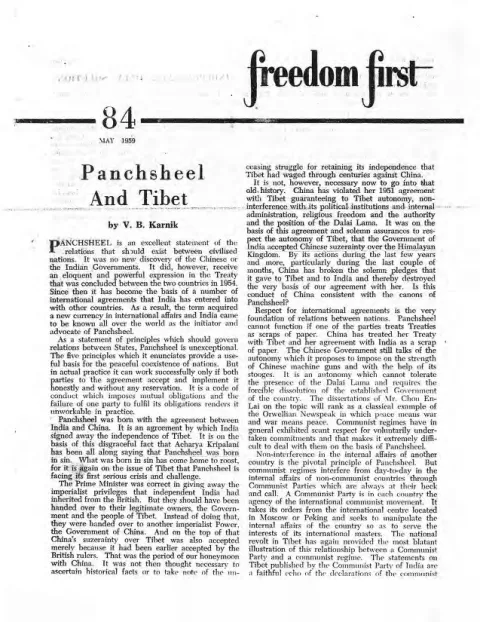
A reprint of the Tibetan government-in-exile’s 1958 manifesto to Nehru describes the coerced “17-point agreement,” confiscation of gold and grain, and the 1956 uprising in eastern Tibet met with bombing and destroyed monasteries.
-
Victor Zorza’s essay, reproduced from the Manchester Guardian Weekly, examines a Soviet legal debate over “unearned income” from inherited savings, noting high officials’ heirs can now live off interest alone in an officially egalitarian state.
-
The closing “With Many Voices” spans Nehru’s assurance no army will be sent into Tibet, Indira Gandhi calling Indian communists “fifth columnists,” and repeated demands from A. D. Gorwala and others for Krishna Menon’s removal.
Essays
Dilemma Of Mr. Nehru
By B. K. Desai
B. K. Desai’s lead essay argues that Jawaharlal Nehru’s China policy has collapsed under the weight of the 1959 Tibetan uprising and Chinese incursions across India’s northern frontier. Desai traces the failure to Nehru’s foundational misjudgment of the Chinese revolution: India’s friendship policy amounted to one-way appeasement, ignoring that the new Chinese rulers were expansionist communists first and foremost. The essay walks through Nehru’s own statements from 1950 to 1959 defending China, his sponsorship of Panchsheel in 1954, the steady escalation of border violations after 1954, and the contradiction the author sees in Nehru’s 1954 legalistic defence of China’s claim to Tibet now being turned against India via the same logic applied to the McMahon Line. Desai concludes that Nehru is trapped by his own past commitments, unable to admit that Communist China is an imperialist power while still refusing to back Tibetan independence.
- Nehru’s China policy, built on Panchsheel and non-alignment, is described as having collapsed following Chinese incursions and the Tibetan uprising
- The friendship between India and China is characterised as one-way traffic, with India appeasing Chinese demands from the outset
- The Indian government is accused of failing to recognise Chinese communism’s expansionist character across Korea, Indo-China and Tibet
- Nehru’s 1950 and 1954 statements defending Chinese intentions and disputing U.S. apprehensions are quoted as evidence of misjudgement
- Nehru’s 1954 legalistic acceptance of Chinese sovereignty over Tibet is shown boomeranging into China’s claim over the McMahon Line in 1959
- The essay depicts Nehru as caught in a self-created dilemma: recognising Chinese imperialism in practice while refusing to support Tibetan self-determination
Mannath Padmanabhan
By A Keralite
An unsigned editorial ‘Notes’ section opens with ‘Another Victim?’, condemning the Government of India’s passivity toward Chinese and North Vietnamese subversion of Laos, contrasted with India’s insistence on reviving the 1954 Geneva International Commission machinery rather than supporting the UN Security Council’s four-nation inquiry. A second note, ‘New Move On Algeria’, discusses President de Gaulle’s proposal offering Algeria a choice between secession, integration, or self-government after a four-year transition, viewing it as a genuinely fresh and hopeful departure from prior French positions, opposed mainly by French reactionaries and communists as well as extremist elements within the Algerian liberation movement.
- Criticises the Government of India for failing to support the small, landlocked kingdom of Laos against Chinese and North Vietnamese-backed subversion
- Notes India’s objection to the UN Security Council’s four-nation sub-committee sent to inquire into Laos, favouring instead the 1954 Geneva-era International Commission
- Cites Times of India correspondent Sudhakar Bhat’s report that Laos scrupulously honoured the Geneva accords while its communist neighbours did not
- Welcomes President de Gaulle’s new Algeria proposal offering secession, integration, or self-government via free election after four years
- Identifies the proposal’s opponents as French reactionary and Communist Party elements plus extremist Algerian nationalists
Case Of Comrade Krishna Menon
By “Democrat”
A short unsigned note on the ‘Zinzaka Tragedy’, in which fifty-eight people died in a stampede in a Saurashtra village during a staged ‘miracle’, the third such tragedy after Orissa in 1950 and Kumbh Mela in 1954. The piece blames police carelessness in crowd control but identifies the deeper cause as popular superstition and credulity toward miracle-mongers, calling for a sustained campaign to spread critical and rational outlook.
- Reports fifty-eight deaths, many women and children, in a stampede at a staged miracle event in Zinzaka village, Saurashtra
- Compares the tragedy to two earlier incidents: Orissa (1950) and Kumbh Mela near Allahabad (1954)
- Criticises police and local authorities for failing to organise or supervise the crowd
- Identifies public superstition and credulity toward miracle-mongers as the root cause requiring a long-term campaign of rational education
Tibetan Manifesto
Writing under the byline ‘A Keralite’, this profile celebrates Mannath Padmanabhan, the 82-year-old Nair Service Society leader credited with organising the mass movement that toppled Kerala’s Communist ministry in 1959. The piece traces his rise from poverty through teaching and law into founding the N.S.S. in 1914, his role reforming Nair matriarchal inheritance customs, his support for temple-entry and anti-untouchability campaigns alongside Narayana Guru and T. K. Madhavan, and his emergence as the ‘Patriarch’ of Kerala’s anti-communist mass agitation, which the piece calls the most spectacular mass movement in India since independence.
- Introduces Mannath Padmanabhan, born 1878 in Perunna near Changanacherry, as the top leader of the Kerala anti-communist struggle
- Describes his founding of the Nair Service Society (N.S.S.) in 1914 with thirteen associates and his role reforming Nair matriarchal inheritance law (1924-25)
- Credits him with championing removal of caste inequality, supporting the Vaikom Satyagraha (1924) and Guruvayur Satyagraha (1931-32)
- Recounts his initial tacit approval of the Communist ministry followed by disillusionment, leading him to organise the mass movement that led to its dismissal
- Portrays him as a vigorous, ascetic figure (teetotaller, strict vegetarian, khadi-wearer) working twenty-hour days at age 82 and now launching a ‘Save India Forum’ against communism nationally
Unearned Incomes In Russia
By Victor Zorza
Writing pseudonymously as ‘Democrat’, this essay attacks Defence Minister V. K. Krishna Menon over the 1959 Defence Ministry crisis, arguing that his mishandling of the services and his long record as a communist fellow-traveller make him unfit for the post. The piece catalogues Menon’s history with the British Labour Party and the communist-linked League Against Imperialism in the 1930s, his pro-Soviet voting record at the UN (including on Hungary in 1956), his suppression of Congress criticism of Soviet and Chinese actions in Kerala, and his alleged use of political favouritism within the armed forces, concluding that his continued tenure endangers national security.
- Describes deep discontent in the armed forces and Parliamentary distrust of Krishna Menon following the 1959 Defence Ministry crisis
- Details Menon’s communist associations in Britain since 1936, his role in the League Against Imperialism, and his refusal to disassociate from communists as a Labour candidate
- Recounts his pro-Soviet voting at the UN, including justifying Chinese seizure of Tibet and defending Soviet suppression of the Hungarian uprising
- Describes communist electoral support for Menon in the 1957 General Election in Bombay despite Samyukta Maharashtra Samiti’s opposing candidate
- Alleges Menon prevented Congressmen in Kerala from criticising Soviet, Chinese, or local Communist ministry actions, and favoured the communist-dominated Naval Dockyard Employees’ Union
- Concludes that Menon’s fellow-traveller loyalties and ‘temperamental’ conduct make him a liability to the Defence Ministry at a time of external threat
Notes (Another Victim?; New Move On Algeria; Zinzaka Tragedy)
This is a reprint of excerpts from the Tibetan Manifesto presented to Prime Minister Nehru in summer 1958 by Tibetan leaders including former Prime Minister Sitzud Locangua, trade delegation head Shacab-ba, and Thondup, brother of the Dalai Lama. The manifesto describes the 1949-50 Chinese invasion of Tibet, the coerced ‘17-point agreement’, subsequent political subjugation via the Chinese-controlled Regional Autonomous Government Preparatory Committee, economic exploitation including forced land reforms, confiscation of gold and grain, suppression of Buddhist religious practice, use of Tibetan monks and children for indoctrination and forced labour, and the 1956 uprising in eastern Tibet met with bombing, executions, and destroyed monasteries.
- Recounts the 1949-50 Chinese invasion of Tibet across eight fronts and the failure of Tibetan appeals to the UN General Assembly and Security Council
- Describes the coerced ‘17-point agreement’ signed under threat, using a Chinese-forged official seal since the document was never properly sanctioned
- Details the Chinese-controlled Regional Autonomous Government Preparatory Committee established after 1951, giving China effective veto over Tibetan governance
- Documents economic exploitation: confiscated gold and grain reserves, forced twelve-hour labour on Tibetan farmers, land redistribution to Chinese settlers
- Describes religious suppression, including use of monk-scholars like Geyshey Sherab Gyatso to propagate Marxist doctrine and forced starvation of monks refusing to abandon faith
- Reports the February 1956 uprising in eastern Tibet and subsequent Chinese repression: destroyed monasteries, bombing of civilians, and over fifteen thousand injured
Essay 7
Victor Zorza’s essay, reproduced from Manchester Guardian Weekly, examines a Soviet legal debate over ‘unearned income’ triggered by a court case over a 500,000-rouble legacy reported in the Moscow paper Literature and Life. Zorza explains the tension between the Soviet constitutional principle that personal property and inheritance are protected and the socialist principle that ‘he who does not work, neither shall he eat’, noting that high-earning Soviet officials’ heirs can now live off interest alone, creating a politically awkward new high-income class in a state that proclaims equality.
- Reports a Soviet court case over a 500,000-rouble legacy raising the question of unearned income from inherited savings
- Explains that Soviet savings banks pay 2-3% interest with no deposit limit, meaning large legacies can yield income exceeding the average wage
- Traces the history of the 1926 Soviet decision to remove restrictions on inheritance, originally intended to encourage investment during Lenin’s New Economic Policy
- Notes only one contributor to the ‘Literature and Life’ debate opposed loosening inheritance restrictions, citing incentive effects, while the debate concluded calling for revised legislation
- Observes that Khrushchev’s regard for material incentives works against curbing this emergent high-income class, creating political tension in an officially egalitarian society
Essay 8
The closing ‘With Many Voices’ column collects short press quotations from Indian politicians and officials on the 1959 China crisis, spanning early September 1959, illustrating the spectrum of Indian opinion from Nehru’s reassurance that no army would be sent into Tibet, to Indira Gandhi’s charge that Indian communists are fifth columnists, to A. K. Gopalan’s dismissal of the border intrusion as a Western-imperialist-inspired bogey, to sharply critical remarks aimed at Krishna Menon from A. D. Gorwala and others demanding his removal.
- Nehru is quoted assuring that no army will be sent into Tibet, comparing it to inaction over Hungary
- H. N. Kunzru is quoted worrying that Panchsheel had been used as ‘an opiate’ inducing false security
- Indira Gandhi calls Indian communists ‘fifth columnists’ amid the border crisis
- A. K. Gopalan dismisses the China border intrusion reports as a bogey raised by a Western-imperialist-driven press
- Multiple quotes (A. D. Gorwala, Premjibhai Asar) call for Krishna Menon’s removal from the Cabinet over his perceived divided loyalties
- Krishna Menon himself is quoted defending his record and denying he is undermining national defences
Generated by the v1.5 extraction pipeline. Awaiting editorial review.
Metadata and summary are AI-extracted from the source PDF and reviewed for editorial accuracy. The original work is available via the Read PDF tab above (where present); paragraph-level citation inside the PDF is deferred to a future engagement.