periodical issue
Freedom First
By M. R. Masani, S. Sharangpani, Gilbert Jonas, Bertram D. Wolfe, Adam Adit
published for the Democratic Research Service by B. K. Desai at 127 Mahatma Gandhi Road, Bombay 1 · Bombay · 1959
12 pages
Freedom First
Summary
This is the December 1959 issue of Freedom First, the Bombay-based journal of the Forum of Free Enterprise, published in the immediate aftermath of the Chinese incursions into Ladakh and NEFA that autumn. The issue is dominated by the Sino-Indian border crisis: M. R. Masani’s Lok Sabha speech attacks Jawaharlal Nehru’s China policy as appeasement rooted in the sentimental fiction of Sino-Indian friendship; S. Sharangpani catalogues India’s military and infrastructural unpreparedness on the Himalayan frontier; and a closing page of press excerpts (‘With Many Voices’) shows Indian editors and politicians turning sharply against non-alignment. The issue also carries a report on Burma’s tilt toward Western aid following a Soviet propaganda debacle in Rangoon (Gilbert Jonas), an ideological essay by Bertram D. Wolfe arguing that the communist bloc is vulnerable if the free world has the will to exploit its contradictions, and a review by Adam Adit of Saul Rose’s book on socialism in South-East Asia. Together the pieces frame a single argumentative center: that non-alignment and wishful diplomacy have left India dangerously exposed to Chinese communist expansion, and that clear-eyed anti-communism, not conciliation, is the only realistic response.
Key points
-
M. R. Masani’s Lok Sabha speech, “An End To Appeasement,” accuses Nehru of years-long suppression of facts about Chinese frontier activity, invoking Mao’s 1948 remark that neutrality “is a fraud,” and lists three demands: a trusted Defence Minister, frontier roads and airfields, and military parity with China.
-
S. Sharangpani’s “India’s Amazing Unpreparedness” documents the near-total absence of survey maps and roads on India’s Himalayan frontier compared to China’s completed Sinkiang-Tibet road, and details the October 20, 1959 Chinese attack in Ladakh against Indian police armed only with rifles.
-
Gilbert Jonas’s “Burma Moves Toward The West” traces Burma’s 1959 acceptance of $37 million in American aid to a Soviet Tass fabrication accusing pro-Western Rangoon newspapers of taking bribes, which provoked public fury and two Soviet defections.
-
Bertram D. Wolfe’s “Communist Vulnerability” argues the free world’s passivity, not communist strength, explains the West’s failure to exploit the gap between original Bolshevik promises and their totalitarian inversion, framing communism as waging a single “protracted war.”
-
A review of Saul Rose’s Socialism in South-East Asia traces the fragmentation of the Congress Socialist Party as Masani rejected socialism, Patwardhan retreated to an ashram, and Jayaprakash Narayan drifted toward Sarvodaya, alongside a similar collapse of Burmese socialism under U Ba Swe and U Kyaw Nyein.
-
The closing “With Many Voices” quotes C. Rajagopalachari declaring non-alignment terminated “by the East” and G. B. Pant warning Indian communists could not be trusted against a communist aggressor.
Essays
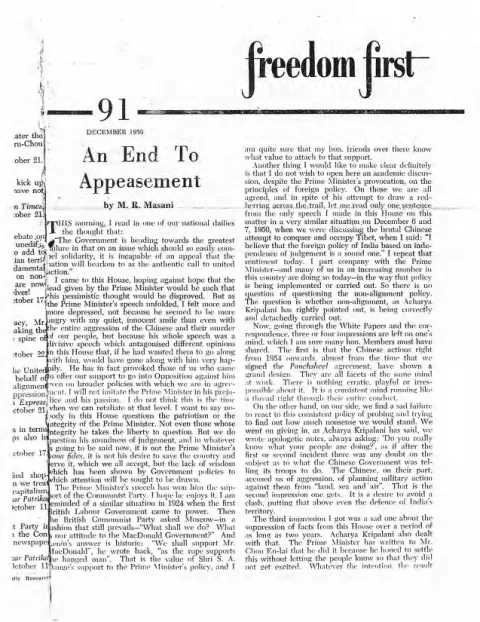
An End To Appeasement
By M. R. Masani
M. R. Masani’s Lok Sabha speech (delivered November 25, 1959) is a sustained attack on Nehru’s handling of the Chinese border incursions, arguing that the Prime Minister’s speech that morning was divisive rather than unifying and that his policy of non-alignment has been implemented with a naivety amounting to appeasement. Masani reconstructs the record of warnings — his own 1950 speech on Tibet, the ten members who cautioned Nehru in the 1950 Lok Sabha debate, and Mao Tse-Tung’s 1948 statement that neutrality ‘is a fraud’ — to argue that the government suppressed facts from Parliament and the public for years while China surveyed the border, built roads, and consolidated its position. He rejects the idea that resisting non-alignment means abandoning it, arguing instead that non-alignment is compatible with equipping the army adequately, recognising a dangerous neighbour, and defending Indian territory; he invokes Yugoslavia, Sweden, and Switzerland as non-aligned states that nonetheless arm heavily. The speech closes by listing three concrete popular demands — a trusted Defence Minister, better roads and airfields on the frontier, and matching Chinese military equipment — and warns that continued Chinese refusal to withdraw should trigger the removal of restraints on Indian forces.
- Masani accuses Nehru of years-long suppression of facts about Chinese frontier activity from Parliament and the public.
- He cites his own 1950 warning on Tibet and Mao’s 1948 statement that neutrality is ‘a fraud’ as proof the danger was foreseeable.
- Ten of nineteen members who spoke in the December 1950 Lok Sabha debate warned that the invasion of Tibet was a first step toward India.
- He argues non-alignment does not preclude arming adequately, citing Yugoslavia, Sweden, and Switzerland as heavily armed neutral states.
- He frames the crisis as part of a broader Chinese communist objective to dominate all of South and South-East Asia, not India alone.
- He lists three concrete demands: a trusted Defence Minister, frontier road/airfield construction, and military parity with China.
- He warns that if China does not withdraw, all restraints on Indian armed forces should be removed.
India’s Amazing Unpreparedness
By S. Sharangpani
S. Sharangpani’s article catalogues the scale of India’s military and infrastructural unpreparedness on its Himalayan frontier, arguing the failure was not accidental but the inevitable result of a foreign and defence policy biased toward treating the northern border as a ‘frontier of peace and friendship’ rather than a security risk. He notes that even after twelve years of independence India lacked detailed survey maps of border regions like NEFA, while China had secretly surveyed the NEFA-Tibet border in 1956-57, sometimes crossing illegally into Indian territory to do so. The piece details the near-total absence of roads connecting frontier areas in Ladakh, Himachal Pradesh, the Punjab, and Uttar Pradesh to the rest of India, contrasting this with China’s vigorous road-building program connecting Tibet to its mainland and right up to the Indian border. It closes (continued from page 4, resuming on page 6) with an account of the October 20 Chinese attack on Indian guards in Ladakh, noting Indian patrol police were armed only with rifles against Chinese troops equipped with grenades, mortars, and automatic weapons, and describes acute shortages of radios, binoculars, and high-altitude helicopters.
- India lacked detailed survey maps of its own NEFA border regions even after twelve years of independence, while China secretly surveyed the same border in 1956-57.
- Frontier road communications were essentially absent across Ladakh, Himachal Pradesh, the Punjab, and parts of Uttar Pradesh, making troop deployment and supply extremely difficult.
- China, by contrast, built roads connecting Tibet to Rudokh and Ladakh, including the Sinkiang-Tibet road through the Aksaichin plateau, which India only learned had been completed in September 1957.
- The October 20, 1959 Chinese attack on Indian guards in Ladakh showed Chinese troops equipped with grenades, mortars, and automatic weapons versus Indian patrol police armed only with rifles.
- Indian frontier posts in Sikkim and the Nathu La frontier lacked automatic weapons, proper radio transmitters, and binoculars, leaving them unable to monitor Chinese troop movements.
- India lacked helicopters capable of operating at the ~20,000-foot altitudes of Ladakh, hampering resupply of border outposts.
- The author attributes the unpreparedness to a deliberate government policy bias favouring the Panchsheel framework over realistic defence planning.
Burma Moves Toward The West
By Gilbert Jonas
Gilbert Jonas reports on Burma’s decision in mid-1959 to reverse a decade of neutralist policy and accept a $37 million American economic aid package, tracing this shift to a Soviet propaganda blunder in Rangoon. The episode began when the Soviet news agency Tass fabricated a story, attributed to a nonexistent ‘Delhi Times’ correspondent, accusing three pro-Western Burmese newspapers of taking American bribes to abandon neutralism; the fabrication was quickly exposed, provoking a wave of Burmese public anger that included a Soviet attaché’s botched defection attempt, mob protests at the Soviet embassy, and the defection of a Soviet information officer to the American embassy in June. Jonas situates this within Burma’s broader position: a decade of guerrilla warfare against domestic communist insurgents, deep concern about the 1,000-mile border with Communist China, and shock at China’s suppression of the Tibetan revolt, to which Burmese public opinion — being racially and religiously close to Tibetans — reacted strongly. He concludes that while the shift toward American aid does not mean Burma will formally align with the West, it reflects a marked drop in communist prestige and reduced vulnerability to communist overtures relative to other Asian neutralist states.
- Burma announced in July 1959 its readiness to accept American economic grants, alongside a US offer of $37 million in aid over four years, reversing a decade of neutralist refusal of Western aid.
- The reversal followed a Soviet Tass news agency fabrication accusing three pro-Western Rangoon newspapers of accepting American bribes, sourced to a nonexistent ‘Delhi Times’ correspondent.
- The fabrication provoked Burmese public fury: mob protests at the Soviet embassy, manhandling of journalists, and the embarrassing defection attempt and forced return of a Soviet military attaché.
- A second Soviet information officer defected to the American embassy in Rangoon in June 1959 with a written statement accusing the Soviet government of terror and subversion.
- China’s brutal suppression of the Tibetan revolt deeply affected Burmese public opinion given racial and religious closeness to Tibetans, further damaging communist prestige.
- Burma continues to fight domestic communist guerrillas and faces infiltration and propaganda from Communist China across their shared 1,000-mile border.
- The article frames the shift as reflecting reduced Burmese vulnerability to communist overtures rather than a full alignment with the West.
Communist Vulnerability
By Bertram D. Wolfe
Bertram D. Wolfe argues that the free world’s passivity, not communist strength, is responsible for the West’s failure to exploit the many structural vulnerabilities of the communist bloc. He contends the communists wage a single, unending ‘protracted war’ in which every negotiation is a tactical move, while the West treats each issue as separately resolvable and thereby only cedes ground. Wolfe catalogues the gap between original Bolshevik promises — land to the peasants, perpetual peace, production for use, plenty, the withering away of the state, freedom, a workers’ paradise, national self-determination — and the totalitarian reality of collectivized farming, permanent war footing, engineered scarcity, and the abolition of all freedoms, arguing each of these broken promises is itself a potential ideological weapon for the West if wielded with a coherent revolutionary counter-strategy. The essay urges that the West must first understand the unitary and unending nature of the conflict and then develop a strategy commensurate with the scale of the vulnerabilities available to it.
- Wolfe argues communist vulnerability only becomes real when an opponent is alert, determined, and ready to exploit weaknesses — conditions he says the free world currently lacks.
- He characterizes the communist approach as a single ‘protracted war,’ citing Robert Strausz-Hupe’s Foreign Policy Research Institute, in which every negotiation is a move in a war to the finish.
- The West, by contrast, treats persuasion and reassurance of the Soviets as ends in themselves, which Wolfe says only invites the Kremlin to bank concessions and continue the fight from a stronger position.
- He lists eight original Bolshevik promises (land to the peasants, perpetual peace, production for use, plenty, the withering of the state, freedom, a workers’ paradise, national self-determination) that have each inverted into their opposite after four decades of Soviet power.
- Wolfe argues these broken promises constitute genuine ideological vulnerabilities that a determined, strategy-driven West could turn into weapons.
- The piece frames the stakes as the shape of the world for the rest of the century, contingent on whether the free world develops the will and strategy to exploit communism’s contradictions.
Review: Socialism in South-East Asia (by Saul Rose; Oxford University Press, 1959)
By Adam Adit
Writing under the byline ‘Adam Adit,’ the reviewer assesses Saul Rose’s ‘Socialism in South-East Asia’ (Oxford University Press, 1959), a documentary history of two decades of socialist movements across the region. The review traces socialism’s import into Asia as an adjunct to nationalist struggle, discusses the Congress Socialist Party’s rise under Jayaprakash Narayan within the Indian National Congress, and the movement’s later fragmentation as Masani rejected socialism, Achyut Patwardhan retreated into an ashram, Jayaprakash drifted toward Sarvodaya, and Rambanjan Lohia pursued ‘equidistance,’ with the Praja Socialist Party’s subsequent electoral collapse. The review extends the comparison to Burma (where the Socialists under U Ba Swe and U Kyaw Nyein achieved dominance in the AFPFL before scandal and factional failure), Indonesia, and Pakistan, and closes by describing Rose’s book as painful, gloomy reading that nonetheless documents the failures dispassionately and conveys urgency about the unresolved contest between democratic socialism and totalitarianism in Asia.
- The review covers Saul Rose’s ‘Socialism in South-East Asia’ (OUP, 1959, Rs. 17.50, pp. 278), a documentary history of the region’s socialist movements over two decades.
- It traces Indian socialism’s rise inside the Indian National Congress under the Congress Socialist Party, led by Jayaprakash Narayan with Nehru’s encouragement.
- It describes the movement’s later fragmentation: Masani rejected socialism, Patwardhan withdrew into an ashram, Jayaprakash drifted toward Sarvodaya, and Lohia pursued ‘equidistance.’
- The Praja Socialist Party’s electoral performance collapsed badly in successive general elections, driving it toward opportunistic alliances with communists.
- In Burma, socialists under U Ba Swe and U Kyaw Nyein achieved dominance in the AFPFL but were undone by corruption scandal and factional missteps similar to India’s.
- Indonesia and Pakistan are described as even less hospitable to socialism, ceding ground to communist consolidation or religio-political nationalism respectively.
- The reviewer characterizes the book as dispassionate, well-documented, but ultimately ‘painful’ and ‘gloomy’ reading that nonetheless conveys urgency about defeating totalitarianism in Asia.
With Many Voices
The closing page, ‘With Many Voices,’ is an uncredited compilation of press and political statements from mid-to-late November 1959, assembled to show the rapid collapse of elite Indian support for non-alignment in the wake of the Chinese border crisis. It quotes C. Rajagopalachari declaring non-alignment terminated ‘by the East,’ G. B. Pant warning that Indian communists could not be trusted against a communist aggressor, V. K. Krishna Menon and Indira Gandhi offering more equivocal remarks, and Orissa Chief Minister Harekrishna Mahtab rejecting the premise of historic Sino-Indian amity. The page also includes an advertisement for the Democratic Research Service’s ‘Kerala Under Communism’ report and for Encounter magazine.
- The page compiles roughly a dozen short quotations from Indian newspapers and political figures dated November 1959, reacting to the Chinese border incursions.
- C. Rajagopalachari is quoted twice (Hindu, November 15) declaring that non-alignment has been automatically terminated by China’s actions and would now only mean preferring peace at any price.
- G. B. Pant, Minister for Home Affairs, is quoted warning that in an organized military operation by a communist country against India, Indian communists would likely side with the enemy.
- Dr. Harekrishna Mahtab, Chief Minister of Orissa, rejects the idea of historic Sino-Indian amity, arguing China has always been aggressive toward neighbours when it held power.
- R. K. Karanjia (Blitz) is quoted twice, including a claim that Nehru has adapted Marxism to the nuclear age and remarks about nationalist-socialists like Namboodiripad.
- V. K. Krishna Menon and Indira Gandhi are quoted with more equivocal or rhetorical statements about the frontier and Indian communists.
- The page carries advertisements for the Democratic Research Service pamphlet ‘Kerala Under Communism’ and for Encounter magazine’s December 1959 issue.
Generated by the v1.5 extraction pipeline. Awaiting editorial review.
Metadata and summary are AI-extracted from the source PDF and reviewed for editorial accuracy. The original work is available via the Read PDF tab above (where present); paragraph-level citation inside the PDF is deferred to a future engagement.