periodical issue
Freedom First
By V. B. Karnik, S. R. Mohan Das, A Special Correspondent, J. B. Kripalani, Francois Bondy, (Contributed)
published for the Democratic Research Service by B. K. Desai at 127 Mahatma Gandhi Road, Bombay 1 · Bombay · 1960
12 pages
Freedom First
Summary
This is issue No. 93 of Freedom First (February 1960), the monthly journal of the Forum of Free Enterprise published from Bombay and edited by V. B. Karnik. The issue is dominated by the Sino-Indian border crisis and the question of how India, the Swatantra Party, and international communism are responding to it. V. B. Karnik’s editorial “Paramount Need” welcomes the thaw in India-Pakistan relations and argues that the real threat to India is Chinese expansionism, criticising Nehru for rejecting proposals for Indo-Pakistani joint defence and noting the Swatantra Party’s more forthright call for a firm policy against Chinese Communist aggression. J. B. Kripalani’s piece (styled as a foreword to the pamphlet “Thought on China”) presses the same theme, faulting the government’s earlier self-deception about Chinese intentions in Tibet and Nepal. S. R. Mohan Das’s “Russian Communists Are ‘Different’” and the contributed “Soviet Propaganda—A Study” both interrogate Nehru and Krishna Menon’s claims about a benign, evolving Soviet Communism, arguing that Soviet propaganda’s substance and ultimate aims toward world communist expansion remain unchanged despite cosmetic softening after Stalin’s death. A special correspondent’s report from Kerala describes the Communist Party’s isolation ahead of the 1960 state elections, attributing it to popular disillusionment with the recently dismissed Communist ministry’s record. Rounding out the issue are a tribute to Albert Camus by Francois Bondy (occasioned by Camus’s death), a book review section covering works on public administration, meeting procedure, British Communism, Tibet/China, and Arab refugees, and the “With Many Voices” column of press quotations on Nehru, non-alignment, and the China question.
Key points
-
V. B. Karnik’s “Paramount Need” welcomes the thaw in India-Pakistan relations and argues China, not Pakistan, is now the paramount threat, criticising Nehru for rejecting Ayub Khan’s proposal for joint subcontinental defence and quoting the Swatantra Party’s call for a firm anti-China policy.
-
S. R. Mohan Das’s “Russian Communists Are ‘Different’” draws a parallel between Nehru’s 1950 view that Chinese communism was benign and his 1959-60 claim that Soviet communism is now the more liberal one, citing an episode at Cairo’s Afro-Asian Solidarity Committee where a Russian delegate blocked an Indian cable calling for Sino-Indian settlement.
-
A special correspondent’s report on Kerala ahead of the 1960 elections describes the Communist Party’s near-total isolation, with enquiry commissions substantiating corruption charges in cooperative societies and Toddy Tappers’ Cooperatives.
-
J. B. Kripalani’s “Menace Of Chinese Imperialism,” styled as a foreword to the pamphlet Thought on China, recalls warning Parliament in 1950 about Chinese occupation of Tibet and argues aggression, like pain, needs no formal definition to be felt.
-
Francois Bondy’s tribute to Albert Camus, written shortly after his death, recalls his wartime editorship of the Resistance paper Combat and his quiet interventions on behalf of imprisoned Algerians despite avoiding public pronouncements on Algeria.
-
A contributed study argues Soviet propaganda’s cosmetic post-Stalin softening, more science and culture coverage, tolerance of internal policy debate, masks unchanged, aggressive messaging on foreign policy and the inevitable global triumph of communism.
-
The Review section covers A. D. Gorwala’s Of Matters Administrative, “The British Road to Stalinism” on the declining British Communist Party’s subservience to Moscow, and “Thought on China,” crediting the weekly Thought with foreseeing Chinese aggression as early as 1950-51.
-
The closing “With Many Voices” quotes West German Chancellor Konrad Adenauer dismissing communism as belonging to “the hoary past” and a satirical Mysindia item comparing calls for Krishna Menon’s removal to Cato’s “Delenda est Carthago.”
Essays
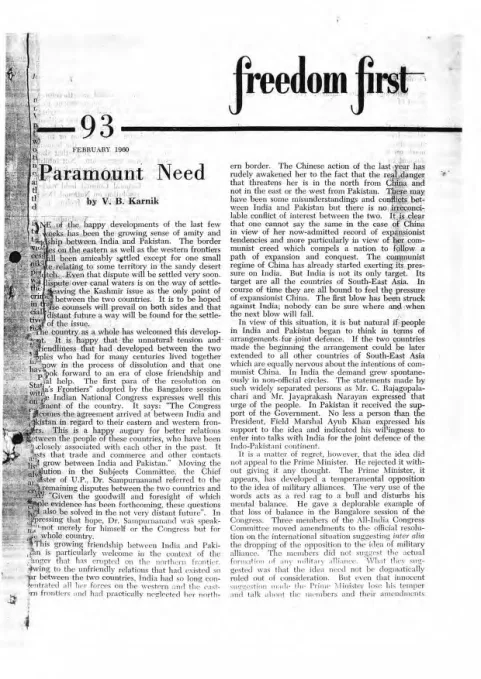
Paramount Need
By V. B. Karnik
V. B. Karnik’s lead editorial welcomes the recent thaw in India-Pakistan relations, noting that border disputes (apart from Kashmir) have been amicably settled and crediting the Bangalore session of the Indian National Congress and remarks by C. Rajagopalachari and Jayaprakash Narayan for articulating the public mood. Karnik argues the real danger to India now comes from China in the north, not Pakistan, and criticises Prime Minister Nehru for dismissing, without serious consideration, proposals (including one from Pakistan’s President Ayub Khan) for Indo-Pakistani joint defence against Chinese expansionism. He quotes the Swatantra Party’s General Council resolution calling for a firm and vigilant policy toward Chinese Communist aggression, including settlement of outstanding issues with Pakistan, regional security consultations, and vigilance against fifth-column activity, and closes by urging the government to set aside doctrinaire objections to military alliances and pursue joint defence of the subcontinent.
- Welcomes growing India-Pakistan amity and near-total settlement of border disputes apart from Kashmir.
- Cites the Bangalore Congress resolution on India’s frontiers as reflecting the public mood of reconciliation with Pakistan.
- Argues China, not Pakistan, is now the paramount threat to India’s security.
- Criticises Nehru for rejecting, out of hand, ideas of Indo-Pakistani or South/South-East Asian joint defence against China.
- Notes Pakistani President Ayub Khan’s expressed willingness to discuss joint defence of the subcontinent.
- Quotes the Swatantra Party’s General Council resolution calling for a firm policy against Chinese aggression and consultations with South and South-East Asian countries.
- Concludes that no old prejudices or doctrinaire objections to alliances should stand in the way of the paramount need of defending the northern frontier.
Russian Communists Are “Different”
By S. R. Mohan Das
S. R. Mohan Das examines Nehru’s stated views following Chinese incursions into Indian territory: that Chinese expansionism has nothing to do with communist character, that there is no coordinated international communism, that communists behave differently in different countries, and that Indian communists are unpatriotic compared to Chinese or Russian counterparts. The author draws a parallel between Nehru’s 1950 view that Chinese communism was “different” (more humane, tempered by Confucian tradition) and his current, reversed claim that Soviet communism is now the more liberalised and humane one as against an aggressive China — arguing this is the same rhetorical move repeated with a different target. The essay catalogues instances of continuing Soviet support for China against India, including the Soviet Union’s failure to disapprove of Chinese action and an episode at the Afro-Asian Solidarity Committee in Cairo where the Russian delegate blocked an Indian secretary’s cable calling for a peaceful Sino-Indian settlement. It concludes that the Soviet Union continues, through defector testimony (a former Soviet intelligence agent), to subvert non-communist countries in coordination with China, and mocks Nehru’s claim that Indian communists are the world’s worst communists as failing to recognise that Indian communists’ “patriotism” would evaporate the moment their own leaders (Ranadive or Namboodiripad) came to power.
- Lists five claims made by Nehru about the non-ideological, disunified, and nationally variable character of world communism.
- Draws a parallel between Nehru’s 1950 characterisation of Chinese communism as ‘different’/humane and his 1959-60 characterisation of Soviet communism as ‘different’ from an aggressive China.
- Argues China has selectively refrained from expansionism against countries with military alliances, while acting aggressively toward non-aligned/undefended neighbours.
- Cites the Cairo Afro-Asian Solidarity Committee episode as evidence the Soviet Union blocked Indian efforts even at rhetorical solidarity with India over the border dispute.
- References a defected Soviet intelligence agent’s claim that the USSR continues coordinated subversion of non-communist states with China.
- Concludes Indian communists’ loyalty is contingent and would flip if their own leaders (Ranadive, Namboodiripad) attained power.
Kerala On The Eve Of Elections
By A Special Correspondent
An unnamed special correspondent reports from Kerala ahead of the 1960 state elections on the political isolation of the Communist Party, which — unlike in previous elections — no longer enjoys a broad United Leftist Front and finds even splinter groups (RSP, KSP, Jan Sangh) opposing it as their main target. The correspondent attributes this to the popular experience of Communist rule: corruption and cronyism under the dismissed Communist ministry, exposed by enquiry commissions, contrasted with a basic difference the public perceives between parties that operate within democratic values and one that sought to subvert democratic institutions. The report notes the Communists have lost support among writers, intellectuals, and some Scheduled Caste and toddy-tapper constituencies that previously formed their base, describes vigorous campaigning by opposition groups (Anti-Communist Front, Voice of Kerala, Kerala Pradesh Congress Committee), and closes with an anecdote of a communist MP admitting privately that the party is not hopeful about the elections, though he predicted the same historical forces that brought them to power once would eventually do so again nationally.
- Unlike previous elections, the Communist Party in Kerala faces near-total isolation without a united left front, opposed even by splinter parties.
- The correspondent attributes this to disillusionment with the dismissed Communist ministry’s record of alleged corruption and machinery misuse, not to the Chinese border issue.
- Enquiry commissions have substantiated opposition charges of fraud within cooperative societies, Harijan welfare schemes, and Toddy Tappers’ Cooperatives.
- Communists have lost support among writers/intellectuals and are showing cracks in their traditional base among Ezhava and Scheduled Caste communities and toddy tappers.
- Opposition groups across Trichur, Ernakulam, and Trivandrum are running vigorous, well-organised pamphleteering campaigns.
- A communist MP, speaking off the record, admitted the party was ‘not very hopeful’ about the elections but insisted the same historical forces would eventually bring communism to power nationally.
Menace Of Chinese Imperialism
By J. B. Kripalani
In this piece — presented as the foreword to the Democratic Research Service pamphlet “Thought on China” — J. B. Kripalani argues it is necessary to know the facts about the Himalayan border troubles with China because the issues have been deliberately and unconsciously clouded by communists and fellow-travellers invoking slogans of Hindi-Chini Bhai Bhai and fears of jeopardising India-China friendship. He recounts having warned Parliament as early as the end of 1950 about the implications of the Chinese occupation of Tibet, arguing that if the same ‘liberation’ logic were applied to Nepal, India would have to go to war regardless of preparedness. Kripalani criticises the Defence Minister for saying aggression is difficult to define, arguing that just as one need not define pain to feel it, aggression by Red China is self-evident and must be resisted in deeds rather than eloquent words, closing with a call to resist this new and more ruthless imperialism using the same spirit that guided the independence movement.
- Argues the border crisis with China has been deliberately and unconsciously obscured by communists and fellow-travellers using ‘war psychosis’ and ‘Hindi-Chini Bhai Bhai’ rhetoric.
- Recalls warning Parliament at the end of 1950 about the danger of accepting the Chinese occupation of Tibet as none of India’s concern.
- Argues that the same reasoning, if the Chinese ‘liberation’ pattern extended to Nepal, would force India into war regardless of preparedness.
- Criticises the Defence Minister’s statement that aggression is difficult to define, comparing it to pain, which need not be defined to be felt.
- Welcomes the Prime Minister’s recognition of Red China’s actions as aggression but insists that only deeds, not eloquent words, can convince China of India’s resolve.
- Closes by invoking the spirit, devotion, and fearlessness of the independence movement to resist the new imperialism.
Albert Camus
By Francois Bondy
Francois Bondy’s tribute to Albert Camus, written shortly after Camus’s sudden death, situates him as the youngest Nobel laureate in Literature and traces his enduring influence among readers in Russia’s satellite states, Spain, Japan, and India, despite his refusal to align himself with any journal or clique (unlike Sartre or Mauriac). Bondy portrays Camus as a man who dared extremes while distrusting nihilism and doctrinaire nationalism, recalling his wartime editorship of the Resistance paper “Combat” and his interventions on behalf of imprisoned Hungarian writers like Tibor Dery. He also discusses Camus’s deep and conflicted relationship with Algeria, noting Camus avoided grand pronouncements on the Algerian drama despite quietly interceding with French Residents-General on behalf of prisoners condemned to death and interned Algerians, and closes by comparing the loss of Camus’s influence to that of Simone Weil.
- Frames Camus as the youngest winner of the Nobel Prize for Literature, whose influence was especially strong behind the Iron Curtain, in Spain, Japan, and India.
- Notes Camus stood apart from cliques (unlike Sartre and Mauriac) and was recognised by younger generations across political lines.
- Describes Camus’s wartime role editing the Resistance newspaper Combat alongside contributors like Malraux, Aron, and Sartre.
- Highlights his ‘Letter to a German Friend’ as among the first human voices to reach individuals in defeated Germany, alongside Saint-Exupery’s ‘Letter to a Hostage.’
- Recounts Camus’s quiet interventions with French colonial officials in Algeria on behalf of condemned prisoners and internees, despite avoiding public pronouncements on Algeria.
- Compares Camus’s unique influence in French letters to that of Simone Weil.
Soviet Propaganda—A Study
By (Contributed)
This contributed, unsigned study argues that while Soviet propaganda has undergone superficial changes since Stalin’s death — reduced volume of overt political agitation, more coverage of science and culture, occasional frank internal discussion, and a less crudely uniform tone — its underlying nature and ultimate aims remain unchanged. The author walks through examples: increased material on science/culture on Soviet television, permitted debate on education reform and the future of sovkhozes, and occasional articles favourable to the American people offset by sustained attacks on American policy. It argues these concessions were driven by the regime’s need to retain the loyalty of specialists (economists, Party members, students) rather than any real liberalisation, and that in foreign policy and international communist strategy Soviet propaganda remains uniform, aggressive, and unchanged, citing Pravda, Kommunist, and Molodoi Kommunist statements proclaiming the inevitable triumph of communism and terming the West spiritually bankrupt. It concludes these are proclamations of continuation of the Cold War in support of Soviet power and the world communist movement.
- Identifies four observable changes in Soviet propaganda since Stalin’s death: less political agitation, more science/culture content, more human feeling in depicting Soviet life, and tolerance of differing opinions on internal policy.
- Attributes these changes to the regime’s practical need to retain the loyalty of specialists and educated Soviet citizens, not to genuine liberalisation.
- Notes debates have opened in the Soviet press over education reform, compulsory manual labour for youth, and the future of the sovkhoz (state farm) system.
- Points out official Soviet denial of class distinctions is contradicted by an admission in the journal Kommunist that class distinctions persist in the USSR.
- Argues foreign policy propaganda and messaging on the world communist movement have remained completely unchanged and uniform across all Soviet organs.
- Concludes that recent claims of communism’s inevitable global triumph amount to a proclamation of continued Cold War against the free world.
Review: Of Matters Administrative
By V. B. K.
The review section of this issue covers five publications. V. B. Karnik (V.B.K.) reviews A. D. Gorwala’s “Of Matters Administrative” (Popular Book Depot), praising Gorwala’s courage in critiquing Indian public administration but noting Gorwala’s preference for changing ‘the men at the top’ rather than administrative procedures inherited from British rule is hard to accept given India’s shift to a welfare state. M.N.D. reviews “The Conduct of Meetings” by G. H. Steroford, adapted for Indian use by Minoo Masani (Oxford University Press), as a useful practical guide for chairmen and secretaries of organisations. V.B.K. also reviews “The British Road to Stalinism” (Industrial Research and Information Services Ltd.), a report on the Communist Party of Great Britain’s decline and its complete subservience to Soviet Russia, and separately reviews “Thought on China” (Siddhartha Publications, Delhi), the republished collection of the weekly Thought’s prescient writings on Tibet and Chinese cartographic aggression, with a foreword by J. B. Kripalani. R. V. Raghavan reviews Walter Pinner’s “How Many Arab Refugees?” (Macgibboor and Kee), noting it makes a serious factual case on the Arab refugee problem but is largely silent on Israel’s own responsibility, leaving it open to charges of one-sidedness.
- Karnik praises Gorwala’s collected articles on Indian public administration for their candour but disagrees with his conclusion that the remedy lies in changing personnel rather than administrative procedures.
- M.N.D. recommends ‘The Conduct of Meetings’ (adapted for India by Minoo Masani) as a concise practical manual for chairmen and secretaries.
- V.B.K.’s review of ‘The British Road to Stalinism’ documents the precipitous decline of the British Communist Party’s membership and its complete subservience to Soviet Russia.
- V.B.K.’s review of ‘Thought on China’ credits the weekly Thought with foresight in warning, as early as 1950-51 and 1954, about Chinese aggression toward Tibet and India, with a foreword contributed by J. B. Kripalani.
- R. V. Raghavan’s review of ‘How Many Arab Refugees?’ finds the book a serious, fact-based treatment of the refugee problem, but criticises its silence on Israel’s role as leaving it one-sided.
Review: The Conduct of Meetings
By M.N.D.
“With Many Voices” is the issue’s closing column of quotations from the contemporary press and public figures, prefaced by an epigraph from Tennyson. It gathers commentary critical of Nehru’s leadership and non-alignment policy (from Swarajya, Examiner, and Hindustan Times), remarks by V. K. Krishna Menon minimising the significance of the Sino-Indian dispute, a sharp Mysindia item mocking Krishna Menon by paraphrase of Cato’s Delenda est Carthago, a quote from West German Chancellor Konrad Adenauer dismissing communism as reactionary and belonging to the past, and an Italian commentator’s wry remark on the relative ease of Soviet space achievements versus Soviet tolerance for artistic freedom.
- Assembles press quotations questioning whether Nehru remains a safe leader once his ‘glamour’ is set aside (Swarajya).
- Includes criticism of non-alignment rhetoric as isolating and weakening India’s front (Examiner, Kali Mukherji).
- Features two V. K. Krishna Menon quotations minimising the scale of the India-China dispute.
- Includes a satirical item from Mysindia comparing calls for Krishna Menon’s removal from office to Cato’s refrain ‘Delenda est Carthago.’
- Quotes West German Chancellor Konrad Adenauer characterising communist theory as reactionary and belonging to the hoary past.
- Includes a quip from Giovanni Radicati contrasting Soviet ease at rocketry with its difficulty granting artistic freedom.
Generated by the v1.5 extraction pipeline. Awaiting editorial review.
Metadata and summary are AI-extracted from the source PDF and reviewed for editorial accuracy. The original work is available via the Read PDF tab above (where present); paragraph-level citation inside the PDF is deferred to a future engagement.