periodical issue
Freedom First
By Phiroze J Shroff, Jawaharlal Nehru, Piloo Mody
Edited by V. B. Karnik and printed at Indian Printers, 55 Gamdevi Road, Bombay 7 and published for the Democratic Research Service by B. K. Desai at 127 Mahatma Gandhi Road, Bombay 1. · Bombay · 1960
12 pages
Freedom First
Summary
This is issue No. 95 of Freedom First (April 1960), a Bombay-based classical-liberal periodical edited by V. B. Karnik and published by the Democratic Research Service. The issue is dominated by the Sino-Indian crisis on the eve of the Nehru-Zhou Enlai summit: the lead editorial by Karnik frames the meeting as a test of Indian resolve against Chinese territorial aggression, while a compiled dossier of Nehru’s own statements (“Nehru On China And Tibet”), a polemical essay by Piloo Mody (“The Roof Has Fallen”) indicting India’s diplomatic surrender of Tibet, a review of Frank Moraes’s book on Tibet by M. Devadas Kini, and a round-up of press editorials (“With Many Voices”) all converge on criticizing Nehru’s China policy and non-alignment stance as naive or self-defeating. Alongside this, the issue covers the Swatantra Party’s first National Convention at Patna (reported by an unnamed correspondent), an essay on the history and mechanics of international law and the United Nations by Phiroze J. Shroff, a defence of the continued use of English in India by J. B. H. Wadia, a report on a discussion group convened by the Indian Committee for Cultural Freedom around Jayaprakash Narayan’s thesis on political reconstruction, and a resolution condemning the Sharpeville massacre in South Africa. The overall center of gravity is a classical-liberal critique of the Nehru government’s foreign policy (appeasement of Communist China, betrayal of Tibetan autonomy) paired with sympathetic coverage of the fledgling Swatantra Party as a liberal, anti-socialist opposition force.
Key points
-
V. B. Karnik’s “Great And Grave Responsibility” frames the April 1960 Nehru-Zhou Enlai summit as a test of India’s resolve, endorsing Rajagopalachari’s proposal for a defensive regional alliance and insisting there can be no compromise on the traditional India-China boundary.
-
An Indian Committee for Cultural Freedom Discussion Group on Jayaprakash Narayan’s thesis for reconstructing Indian polity meets in Bombay, with Narayan’s closing reply arguing parliamentary democracy has proven inadequate in India and should not be blindly copied from the West.
-
A correspondent’s report on the Swatantra Party’s First National Convention at Patna records over 750 delegates adopting a 50,000-word Statement of Policy, “To Prosperity Through Freedom,” and a resolution declaring solidarity with Tibet against Chinese “aggressive and imperialist communism.”
-
Phiroze J. Shroff traces the failure of the League of Nations’ lack of enforcement sanctions, evidenced by Japan’s invasion of Manchuria and Italy’s attack on Ethiopia, through to the founding of the United Nations and its International Court of Justice.
-
J. B. H. Wadia defends retaining English as an important second language in India, opposing a “closed vocabulary” built solely from Sanskrit roots and citing Panikkar’s tribute to Burke, Sir William Jones and Macaulay.
-
A compilation of Nehru’s own statements from 1949 to 1959 traces his shifting position on China and Tibet, from early confidence China sought no expansion to 1959 remarks calling talk of conflict “absurd” over “two miles of mountainous territory where no one lives.”
-
Piloo Mody’s “The Roof Has Fallen” argues India’s 1950 rush to recognise Communist China and subsequent deference to Chinese “suzerainty” through the 1954 Panchsheel agreement effectively “sold the Tibetan people to their Han conquerors.”
-
An unsigned report describes a March 1960 Bombay public meeting, chaired by M. R. Masani, condemning the shooting of roughly a hundred African civilians in South Africa as a direct result of apartheid policy.
-
M. Devadas Kini reviews Frank Moraes’s The Revolt in Tibet, arguing Chinese communism represents a “Red man’s burden” succeeding the old “White man’s burden” and citing an International Commission of Jurists warning of the risk of “the full act of genocide” in Tibet.
-
The closing “With Many Voices” quotes C. Rajagopalachari declaring “The Communist Party is ruling India through Mr. Nehru,” alongside a boxed advertisement for the ICCF-sponsored book Tibet Fights For Freedom with a foreword by the Dalai Lama.
Essays
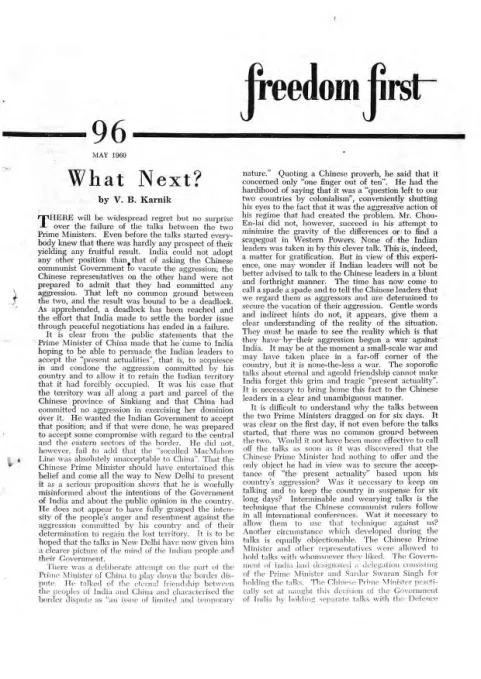
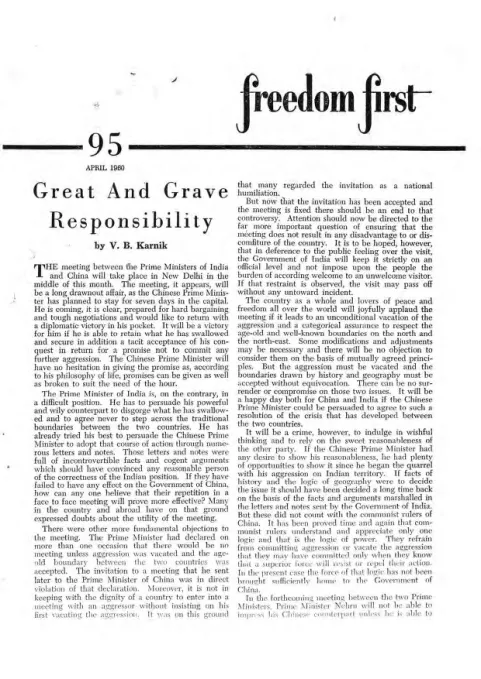
Great And Grave Responsibility
By V. B. Karnik
V. B. Karnik’s editorial addresses the forthcoming April 1960 meeting between Nehru and Chinese Premier Zhou Enlai in New Delhi. He argues the Chinese premier arrives seeking to retain territorial gains extracted through aggression while offering only a hollow promise of non-aggression, whereas Nehru bears the “great and grave responsibility” of forcing a genuine Chinese climbdown. Karnik is skeptical that repeating facts and legal arguments already rejected in prior correspondence will move Beijing, since in his view communist regimes respond only to the logic of power, not reasoned appeal. He endorses Rajagopalachari’s proposal for a defensive regional alliance of South and Southeast Asian nations against Chinese expansionism, stresses that India must convince China of its resolve and capacity to resist aggression, and warns that a compromise settlement over the Himalayan border would weaken the cause of freedom and democracy across Asia.
- The Nehru-Zhou Enlai summit in New Delhi (mid-April 1960) is framed as a test of India’s resolve, not a genuine peace negotiation.
- Karnik argues the Chinese Premier seeks to keep his territorial gains while offering an easily-broken promise not to commit further aggression.
- Prior Indian letters and notes making factual/legal arguments have already failed to move China, casting doubt on the value of face-to-face talks.
- Karnik endorses a proposed defensive regional alliance (raised by Rajagopalachari and others) among South/Southeast Asian nations against Chinese aggression, compatible with non-alignment.
- Communist rulers are said to understand only the ‘logic of power’; aggression is only vacated when a superior resisting force is evident.
- The piece insists there can be no surrender or compromise on the traditional India-China boundary.
Swatantra Party Convention
By A Correspondent
This unsigned report describes a Discussion Group set up by the Indian Committee for Cultural Freedom to examine Jayaprakash Narayan’s thesis “A Plea for Reconstruction of Indian Polity.” The group’s first meeting, held in Bombay on March 16-17, drew a roster of prominent liberal and academic figures; discussion centered on the prospects of parliamentary democracy in India, with participants split between those who saw it developing successfully despite incidental defects and those who doubted it could succeed under Indian conditions and favored an alternative system ensuring both political freedom and popular participation. In his closing reply, Narayan reiterated his view that parliamentary democracy had proven an inadequate and unsatisfactory form of government in India and other Asian countries and argued against blindly copying Western models, advocating instead a self-reliant, self-governing community structure.
- The Indian Committee for Cultural Freedom convened a Discussion Group on Jayaprakash Narayan’s thesis for reconstructing Indian polity.
- First meeting held in Bombay, March 16-17, with attendees including G. L. Mehta, Prof. G. D. Parikh, P. H. Patwardhan, A. H. Somjee, R. Kothari, P. G. Mavalankar, Jayantilal Dalal, Sooryakant Parikh, Dr. Sirsikar, Dr. M. P. Mangudkar, Prof. Ram Joshi, D. K. Kunte, and A. D. Gorwala.
- Debate split between defenders of parliamentary democracy’s prospects in India and skeptics favoring an alternative system.
- Prof. Mukherjee agreed to prepare a follow-up thesis on concrete institutional changes based on Narayan’s ideas.
- Narayan’s closing reply argued parliamentary democracy had not succeeded in India or other Asian countries and should not be copied blindly from the West.
International Law
By Phiroze J. Shroff
An unnamed correspondent reports on the Swatantra Party’s First National Convention, held recently at Patna, describing large and enthusiastic crowds that the correspondent says silenced critics who had dismissed the party as representing “vested interests” or “big business.” The Convention adopted a Constitution and a 50,000-word Statement of Policy (“To Prosperity Through Freedom”), plus resolutions on the party flag, the General Secretary’s report, national defence (favoring regional cooperation against communist threats while opposing bloc alignment), and Tibet (declaring solidarity with the Tibetan people against Chinese “aggressive and imperialist communism”). Rajaji’s presidential address framed the coming decade as a choice between Nehru’s centralized planning and a decentralized alternative, and the Statement of Policy laid out positions on food security, trade unions, collective bargaining, and decentralized industrial development. The correspondent concludes that the party, founded only eight months earlier, has rapidly become an all-India organization (over 336,000 members, branches in nearly every state) and represents a genuine alternative to Congress.
- Swatantra Party’s First National Convention took place at Patna; General Council and Central Organising Committee meetings preceded it.
- Convention adopted a Constitution, a 50,000-word Statement of Policy (‘To Prosperity Through Freedom’), a party flag (five-pointed white star on blue), and resolutions on national defence and Tibet.
- Rajaji’s inaugural address argued India faced a ‘courageous choice’ between Nehru-Gandhi style centralized planning/totalitarian governance and decentralized governance.
- The Statement of Policy pledged support for food/clothing/housing security, workers’ right to organise and strike, and decentralized, competitive industry with safeguards against unreasonable profits.
- Membership reported at ‘well over 3,36,000’ with branches in all states except Kerala and Kashmir; Patna Convention drew over 750 delegates and roughly one lakh visitors.
- A Public Opinion Survey cited found 68.9% had no opinion and only 14.3% opposed (‘Yes’ to opposing a liberal, non-socialist opposition party), read by the party as evidence of a ‘ready minority.‘
The Role Of English
By J. B. H. Wadia
Phiroze J. Shroff surveys the development of international law and organization from the late nineteenth century through 1960. He traces how colonial rivalry and Germany’s grievance as a ‘have-not power’ produced the First World War, leads through the founding and structural weaknesses of the League of Nations (its lack of enforcement sanctions, illustrated by Japan’s 1931 invasion of Manchuria and Italy’s 1935 attack on Ethiopia), and Hitler’s defiance of the Treaty of Versailles culminating in the Second World War. He then describes the founding of the United Nations at the San Francisco Conference (1945), its seven basic charter principles, its membership (82 as of writing), and the structure and jurisdiction of the International Court of Justice, closing with a hope that faithful adherence to the UN Charter and the Court’s rulings could banish war from the earth.
- Traces failure of pre-WWI colonial order and Germany’s ‘have-not power’ grievance as root causes of the First World War.
- Describes the League of Nations’ founding principles (maintenance of peace, dispute resolution, international cooperation) and its Assembly/Council/Secretariat structure.
- Identifies the League’s fatal weakness as lack of adequate sanctions, evidenced by Japan’s invasion of Manchuria (1931) and Italy’s aggression against Ethiopia (1935).
- Frames Hitler’s rearmament and territorial revisionism as a direct consequence of half-hearted League enforcement and appeasement.
- Details the United Nations’ founding at the San Francisco Conference (1945), its seven basic principles, and its structure including the International Court of Justice (15 judges, nine-year terms).
- Closes with the hope that adherence to the UN Charter and ICJ rulings could eliminate war.
Nehru On China And Tibet
J. B. H. Wadia argues for retaining English as an important second language in India despite the passions of national independence. He contends English played a genuine, positive role in shaping modern India through a procession of British administrators, scholars and jurists, and that no amount of nationalist emotion can erase this historical fact or eliminate the practical need for English amid India’s engagement with the free world. He supports Hindi as national language but insists it must remain an open, absorptive language (including borrowing from English) rather than a closed vocabulary artificially built from Sanskrit roots. He cites Panikkar’s tribute to Edmund Burke, Sir William Jones, and Lord Macaulay as Englishmen whose legacy is inseparable from Indian history, and insists English literature and thought are part of the common heritage of mankind that India, like China, has adopted and built upon. He closes (continued from page 7 onto page 10, cut off there) reiterating that this is not advocacy of ‘English only’ but recognition of English as a valuable second language during India’s ongoing renaissance.
- Wadia argues English’s historical contribution to modern India is a fact that nationalist sentiment cannot erase.
- He supports Hindi as national language but opposes a ‘closed vocabulary’ built solely from Sanskrit roots, favoring free borrowing including from English.
- Cites Panikkar’s ‘A Survey of Indian History’ naming Edmund Burke, Sir William Jones, and Lord Macaulay as permanently significant in Indian history.
- Frames English literature and thought as part of a universal human heritage that India has rightly adopted, alongside French, German, Italian and other literatures.
- Clarifies he is not an advocate of ‘English only’ but of retaining English as an important second language during India’s contemporary renaissance.
The Roof Has Fallen
By Piloo Mody
This unsigned compilation assembles quotations from Jawaharlal Nehru’s speeches, press conferences, and parliamentary statements from 1949 to late 1959, tracing the evolution of his public position on China and Tibet. Early quotes (1949-1953) emphasize friendly relations with Tibet, Nepal and China and doubt about any Chinese desire to expand. A 1950 parliamentary speech acknowledges the Himalayas as India’s essential frontier while affirming Tibet’s right to self-determination apart from China. Later 1959 statements, following border incidents at Longju and Ladakh, show Nehru downplaying the seriousness of Chinese incursions (‘absurd’ to fight over remote territory) while also insisting India would resist any aggression. The piece (continued on page 12, not included in this chunk’s boundary) captures a chronological arc used implicitly to critique Nehru’s shifting and, in the editors’ view, overly conciliatory stance toward Chinese expansion.
- Compiles direct Nehru quotations from 1949 through 1959 on India’s relations with China, Tibet, Nepal and Afghanistan.
- 1950 parliamentary speech: the Himalayas provide India’s ‘magnificent frontier’ and Tibet’s fate should follow the wishes of its own people, not legal/constitutional argument.
- 1953-54 statements express confidence China does not desire territorial expansion and characterizes relations with China as friendly.
- 1959 statements (post-Longju, post-Ladakh incidents) show Nehru calling talk of conflict ‘absurd’ over ‘two miles of mountainous territory where no one lives’ while also vowing India will not tolerate aggression.
- Nehru states he considers the Soviet Union ‘territorially satis[fied]’ — quote cut off at page break.
Red Man’s Burden And Yellow Peril
By M. Devadas Kini
Piloo Mody delivers a sharp polemic against India’s handling of Tibet, arguing that India’s 1950 rush to recognize Communist China and its subsequent diplomatic passivity effectively ‘sold the Tibetan people to their Han conquerors.’ He recounts the sequence of missed opportunities—Britain’s failure to recognize Tibetan independence between 1911 and 1947, India’s failure to do so between 1947 and 1949, and repeated Indian deference to Chinese ‘suzerainty’ claims through 1954 and 1959—culminating in India’s support of the 1954 Panchsheel agreement that recognized Tibet as ‘the Tibet region of China.’ He argues India suppressed Tibet’s 1950 complaint to the United Nations, relying naively on Zhou Enlai’s assurances even as Chinese forces occupied Tibet. Mody closes with a broader argument that global powers, including Britain and the US, share responsibility for tolerating aggression (citing the Manchuria and Ethiopia precedents implicitly) and that peace bought through territorial concession to aggressors is neither just nor durable.
- Mody argues India’s 1950 diplomatic recognition of Communist China, ahead of most Western nations, was a ‘crude and savage recourse to political expediency.’
- Traces a chronology of missed opportunities to secure Tibetan independence: British inaction 1911-1947, Indian inaction 1947-1949, and continued deference to Chinese ‘suzerainty’ through the 1954 Panchsheel agreement.
- China proclaimed the ‘liberation’ of Tibet two days after India recognized the Communist government in 1950.
- India suppressed Tibet’s November 1950 complaint to the United Nations about Chinese aggression, relying on assurances from the Chinese Premier.
- The 1954 Sino-Indian agreement invoking Panchsheel recognized Tibet as the ‘Tibet region of China’ for the first time.
- Mody frames India’s conduct as a betrayal of its own professed ideals of freedom fought for during its independence struggle.
Massacre In South Africa
An unsigned report describes a public meeting held under the auspices of the Africa Society on March 24, 1960, chaired by M. R. Masani, M.P., to condemn the shooting of African civilians in the Union of South Africa (the Sharpeville massacre, though not named as such). Speakers included Miss Maniben Kara, Mr. Mustafa Faki, and Mr. Kodua. The meeting unanimously adopted a resolution condemning the killing of about a hundred persons and injury to hundreds more as a direct result of South Africa’s racial policies and apartheid, expressing solidarity with the African struggle for freedom and racial equality, and calling for international mobilization of opinion against the South African government’s policies.
- Public meeting held March 24, 1960 under the auspices of the Africa Society, chaired by M. R. Masani, M.P.
- Speakers: Maniben Kara, Mustafa Faki, and Kodua.
- Resolution condemns firing on African citizens resulting in about a hundred deaths and severe injuries to several hundred more.
- Resolution attributes the tragedy directly to South Africa’s apartheid policy and the perpetuation of minority rule.
- Meeting calls for mobilizing world opinion against apartheid and assures solidarity with the Indian people’s support for the African freedom struggle.
Red man
By M. Devadas Kini reviews Frank Moraes
M. Devadas Kini reviews Frank Moraes’s book ‘The Revolt in Tibet’ (Macmillan, 223 pp., Rs 7.50), using it as a springboard for an argument that Chinese communism represents a ‘Red man’s burden’ succeeding the old ‘White man’s burden’—a new imperialism dressed in the language of liberation. He argues Chinese Communists invoke self-determination selectively (supporting Pakistan’s formation but denying Tibet the same right) because ultimately the Communist Party alone decides which nationalities may be independent. Citing Moraes’s book and a report from the International Commission of Jurists, Kini details mass killings, deportations, forced labor, and attempts by China to extinguish Tibetan culture, religion, and government, describing the situation as verging on genocide. He frames the episode as evidence that ‘the communist leopard cannot change its spots’ and warns that non-communist Asian nations must unite in collective defense before China’s territorial appetite grows further, given its ‘cartographic aggression’ nibbling at Indian borders.
- Reviews Frank Moraes’s ‘The Revolt in Tibet’ (MacMillan, 223 pp., Rs 7.50).
- Argues Chinese Communist support for self-determination is selective and cynical: backing Pakistan’s independence while denying the same to Tibet.
- Cites the Chinese Communist Party’s own Tibet Work Committee report (pp.75-6) admitting Han chauvinism, discrimination against Tibetans, and violation of religious freedom.
- Cites an International Commission of Jurists report warning of the risk of ‘the full act of genocide’ in Tibet absent prompt action (p.78).
- Cites Moraes’s claim that Tibetans functioned as a free people for around 3,500 years with only two ~200-year interruptions (p.152), and a historical claim of Chinese tribute paid to Tibet under Ti-Song Detsan (p.35).
- Concludes non-communist Asian nations must unite in collective defense against Chinese territorial ‘cartographic aggression.‘
With Many Voices
This unsigned compilation, titled with an epigraph from Tennyson (‘With Many Voices’), gathers critical press editorials and commentary from March 1960 attacking Nehru’s China policy ahead of the Nehru-Zhou Enlai summit, alongside a continuation of the ‘Nehru On China And Tibet’ quote dossier from page 8. Commentators from Searchlight, the Indian Express (Deen Dayal Upadhya), Swarajya (Saka, and separately Rajagopalachari), The Mail, the Eastern Economist, and Prem Bhatia (Times of India) variously accuse Nehru of secret diplomacy that sacrifices national interest for personal legacy, of treating dissent as service to vested interests, and of governing under undue influence from the Defence Minister; Rajagopalachari is quoted as saying ‘The Communist Party is ruling India through Mr. Nehru.’ A boxed advertisement announces the book ‘Tibet Fights For Freedom,’ with a foreword by the Dalai Lama, edited by Raja Hutheesing, published for the Indian Committee for Cultural Freedom by Orient Longmans.
- Compiles critical press commentary from March 1960 on Nehru’s approach to the China-India border dispute, ahead of the Nehru-Zhou summit.
- C. Rajagopalachari (Hindu, March 17) is quoted: ‘The Communist Party is ruling India through Mr. Nehru.’
- Deen Dayal Upadhya (Indian Express) accuses Nehru of ‘secret diplomacy’ driven by a desire to be remembered as ‘the greatest peacemaker of his age.’
- Saka in Swarajya (twice quoted) accuses Nehru of hailing ‘concurrence as wisdom and damning dissent as service to some vested interest.’
- Eastern Economist and Prem Bhatia pieces criticize Nehru’s handling of the Defence Minister and his self-conception as an economist as national dangers.
- A boxed advertisement for ‘Tibet Fights For Freedom’ (foreword by the Dalai Lama, ed. Raja Hutheesing, pub. Orient Longmans, for the Indian Committee for Cultural Freedom) appears alongside the editorial round-up.
Generated by the v1.5 extraction pipeline. Awaiting editorial review.
Essay 10
No summary was extracted for this article. Listed for completeness.
Metadata and summary are AI-extracted from the source PDF and reviewed for editorial accuracy. The original work is available via the Read PDF tab above (where present); paragraph-level citation inside the PDF is deferred to a future engagement.