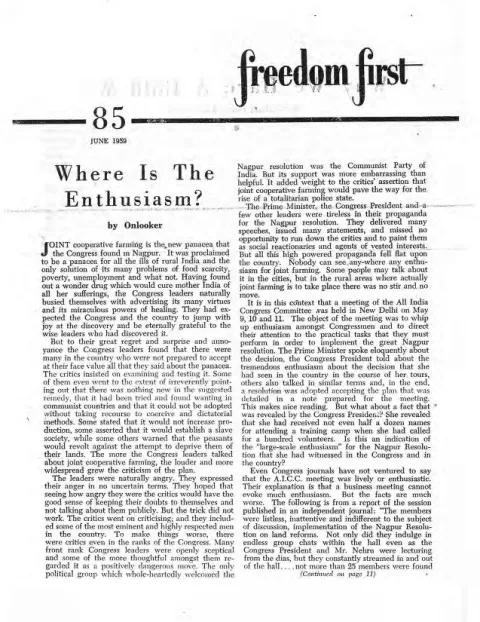
periodical issue
Freedom First
By B. K. Desai, Gabriel Gersh
published for the Democratic Research Service by B. K. Desai at 127 Mahatma Gandhi Road, Bombay 1 · Bombay · 1960
12 pages
Freedom First
Summary
This is the June 1960 issue (No. 97) of Freedom First, the monthly journal of the Democratic Research Service (Bombay), edited by V. B. Karnik. In the rendered pages, the issue opens with B. K. Desai’s lead essay ‘End Of An Illusion,’ a polemical account of the collapse of the May 1960 Paris summit conference, blaming Khrushchev’s manufactured outrage over the U-2 incident for wrecking a meeting the author regards as having been built on illusory Soviet ‘peaceful coexistence’ rhetoric all along. An unsigned item, ‘Nazis In Office In East Germany,’ turns the tables on West German de-Nazification criticism by cataloguing former Nazi officials serving in the East German government and judiciary. The ‘Notes’ section comments on Indian domestic politics: a Communist Party by-election win in Calcutta, factional strain inside the Samyukta Maharashtra Samiti as the P.S.P. considers quitting it, Khrushchev’s Paris conduct, the newly signed Indo-U.S. 17-million-ton foodgrains (PL-480) agreement, and the Punjab government’s detention of Akali leader Master Tara Singh. A correspondent’s report, ‘Maharashtra Seminar,’ covers a mid-May 1960 gathering of intellectuals in Bombay (organised by the Indian Committee for Cultural Freedom with Sadhana) on the problems of the newly formed Maharashtra state, with addresses by Chief Minister Y. B. Chavan, Justice P. B. Gajendragadkar, and Dr. C. D. Deshmukh, and small-group discussions on economic development, integration, education/culture, and politics. Gabriel Gersh’s essay ‘Universities Behind The Iron Curtain’ describes the Sovietisation of East German universities — class-based admission quotas favouring ‘worker’ and ‘peasant’ students, compulsory Marxist-Leninist curricula, and a network of missing/imprisoned students and professors. An unsigned piece, ‘A Tribute To Stalin!’ (reproduced from The Economist, London), analyses Alexander Tvardovsky’s Pravda poem ‘So It Was,’ reading it as a veiled literary indictment of Stalin’s cult of personality. ‘A Message From Berlin’ reprints a solidarity statement from West German public figures (Willy Brandt among them) on the plight of East Berlin and the Soviet-occupied zone. The issue closes with ‘With Many Voices,’ a column of short excerpted quotations from the contemporary Indian and international press on the Paris summit collapse, Khrushchev, and communism, followed by the subscription form and imprint.
Key points
-
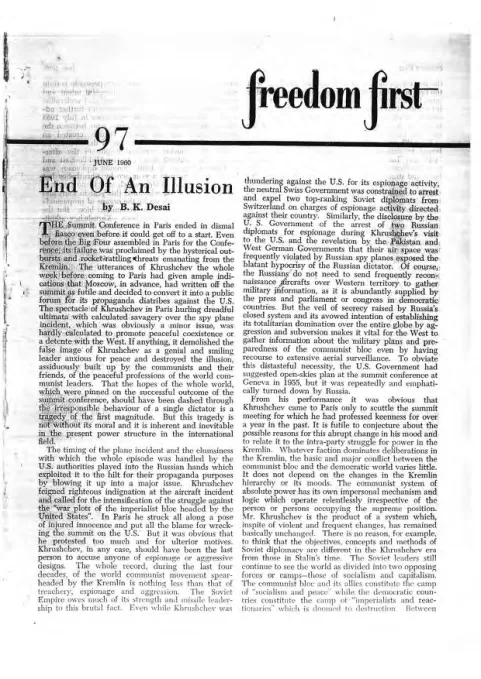
B. K. Desai’s “End Of An Illusion” blames Khrushchev’s manufactured outrage over the U-2 incident for wrecking the May 1960 Paris summit, arguing that Soviet “peaceful coexistence” rhetoric was illusory from the start.
-
An unsigned item, “Nazis In Office In East Germany”, turns Western de-Nazification criticism back on East Germany by cataloguing former Nazi officials serving in its government and judiciary.
-
The Notes section surveys Indian domestic politics: a Communist by-election win in Calcutta, strain within the Samyukta Maharashtra Samiti as the P.S.P. weighs quitting it, the newly signed Indo-U.S. 17-million-ton foodgrains agreement, and the Punjab government’s detention of Akali leader Master Tara Singh.
-
A correspondent’s report on the Maharashtra Seminar covers a mid-May 1960 Bombay gathering on the new state’s problems, addressed by Chief Minister Y. B. Chavan, Justice P. B. Gajendragadkar, and Dr. C. D. Deshmukh.
-
Gabriel Gersh’s “Universities Behind The Iron Curtain” describes the Sovietisation of East German universities through class-based admission quotas, compulsory Marxist-Leninist curricula, and a network of missing or imprisoned students and professors.
-
An unsigned piece, “A Tribute To Stalin!”, reproduced from The Economist, reads Alexander Tvardovsky’s Pravda poem “So It Was” as a veiled literary indictment of Stalin’s cult of personality.
-
“A Message From Berlin” reprints a West German solidarity statement, signed by figures including Willy Brandt, on the plight of East Berlin under Soviet occupation.
-
The closing “With Many Voices” column compiles Indian and international press quotations on the Paris summit’s collapse and closes with London Times statistics on the proportion of Soviet officials executed since 1917.
Essays
End Of An Illusion
By B. K. Desai
B. K. Desai’s lead essay argues that the May 1960 Paris summit conference was doomed from the start because Moscow had, in advance, written it off as futile and planned to use it as a propaganda forum. Desai contends that Khrushchev’s furious response to the U-2 spy-plane incident was a pretext — a ‘minor issue’ seized upon to demolish the carefully cultivated image of Khrushchev as a genial peacemaker, and to justify continued Soviet bellicosity. The essay surveys the history of Soviet espionage (citing Swiss and Pakistani disclosures of Soviet spying) to argue that Khrushchev, of all people, had no standing to protest Western aerial reconnaissance, given the scale of Soviet covert activity worldwide. Desai closes by arguing that the ‘summit spirit’ was never more than a Soviet diplomatic expedient, and that any future East-West progress will rest on the balance of nuclear terror rather than genuine detente.
- The Paris summit collapsed because Moscow had already dismissed it as futile before the Big Four assembled.
- Khrushchev used the U-2 incident, called a ‘minor issue’ by the author, to wreck the summit and posture as an aggrieved victim.
- The episode is presented as demolishing the illusion of Khrushchev as a genial, peace-seeking leader.
- The essay catalogues recent Soviet espionage disclosures (Switzerland expelling two Soviet diplomats; Pakistan and West Germany reporting Soviet aerial overflights) to argue Soviet moral inconsistency in protesting U.S. spying.
- The U.S. proposed an ‘open skies’ surveillance plan at the 1955 Geneva summit, repeatedly rejected by Russia.
- The communist bloc and democratic world remain locked in irreconcilable conflict regardless of changes in Kremlin leadership or mood.
- Any future East-West negotiation will succeed, if at all, because of the balance of nuclear terror, not because of a ‘summit spirit.‘
Nazis In Office In East Germany
An unsigned news item reporting that, contrary to the heavy Western and East German propaganda focus on ex-Nazis holding office in West Germany, the East German (‘German Democratic Republic’) government and judiciary themselves employ numerous former Nazi Party and SS members in senior posts, per a booklet from the Committee of Free Jurists. Named examples include two East German cabinet ministers, a court chairman, a judicial-affairs committee chairman, a general, and several university rectors, plus a defence counsel for the (banned) West German Communist Party who was himself an ex-Nazi and SS member. The piece closes (per the page 8 continuation) by noting the irony that the East German Socialist Unity Party chairman, Walter Ulbricht, though never accused of being an ex-Nazi, was a prominent apologist for the 1939 Hitler-Stalin pact.
- The Committee of Free Jurists’ booklet ‘Former Nazis in the service of Pankow’ documents former Nazi officials in senior East German government and judicial posts.
- Two East German cabinet ministers (Agriculture, Supply) are named as former Nazi party members; two other ex-ministers held office until about a year before writing.
- University rectors in East Berlin, Greifswald, and the Potsdam Teacher Training College are identified as ex-Nazis, one having trained with an SS brigade.
- The defence counsel for the banned West German Communist Party was himself a former Nazi party and SS member, hired from East Germany.
- The item ends by noting Walter Ulbricht’s defence of the 1939 Hitler-Stalin pact, framed as ironic given his party’s anti-Nazi posture.
Notes
The unsigned ‘Notes’ section comprises several short editorial items on current Indian and international affairs. ‘Warning From Calcutta’ reads the Communist candidate’s decisive Lok Sabha by-election win over Congress and P.S.P. rivals as reflecting popular frustration with Congress’s failure on food, unemployment, and corruption, despite the Communists’ own compromised record on the Sino-Indian border dispute. ‘United Front Politics In Maharashtra’ discusses the Samyukta Maharashtra Samiti’s loss of purpose after the bifurcation of Bombay State, the P.S.P.’s consequent desire to exit the Samiti, and warnings that the Samiti (and allied groups) are becoming vehicles for Communist infiltration of the labour movement. ‘Khrushchev’s Outbursts’ (continuing to the next page) criticises Khrushchev’s staged indignation over the U.S. spy-plane incident at the Paris summit. Further notes cover the Indo-U.S. 17-million-ton foodgrains agreement (praised as evidence of genuine U.S. developmental support, while noting it does not solve India’s underlying food problem) and the Punjab government’s Preventive Detention Act arrest of Akali leader Master Tara Singh and others, which the author condemns as an ill-considered, civil-liberties-violating overreaction likely to worsen unrest.
- The Communist candidate Indrajit Gupta’s decisive Lok Sabha by-election win in Calcutta south-west is attributed to public frustration with Congress’s record on food, unemployment, and corruption.
- The Samyukta Maharashtra Samiti has lost its ‘raison d’etre’ after Bombay State’s bifurcation into Gujarat and Maharashtra, and the P.S.P. is considering withdrawal amid concern over Communist domination of the Samiti.
- Khrushchev’s staged outrage over the U-2 incident at the Paris summit is criticised as reasons other than genuine indignation.
- The Indo-U.S. 17-million-ton (10 million wheat, 1 million rice, plus additional annual allotments) PL-480-style foodgrains agreement is described as generous and beneficial for India’s foreign-exchange position and buffer stocks, though not a solution to the underlying food-supply problem.
- The Punjab Government’s arrest of Master Tara Singh and other Akali leaders under the Preventive Detention Act, despite peaceful agitation, is condemned as unwarranted and damaging to civil liberties and likely to raise tension in the state.
India, Tibet and China (advertisement for book by B. K. Desai)
By B. K. Desai
No summary was extracted for this article. Listed for completeness.
Maharashtra Seminar
By (From A Correspondent)
This correspondent’s report covers a seminar on the problems facing the newly formed State of Maharashtra, held in Bombay in mid-May 1960 and organised jointly by the Indian Committee for Cultural Freedom, its Asian Office, Congress for Cultural Freedom, and the Marathi weekly Sadhana. Chief Minister Y. B. Chavan inaugurated the seminar, urging a non-partisan approach to development and integration; Justice P. B. Gajendragadkar delivered the presidential address calling for objective discussion of social problems including caste and communal tension; and Dr. C. D. Deshmukh chaired the general sessions, urging intellectuals to focus on institutional review rather than duplicating planners’ work. Three discussion groups addressed economic development, regional integration (Vidharbha and Marathwada), and education/culture, with wide-ranging debate on private-sector incentives, cooperative farming versus ceilings on landholding, university medium-of-instruction policy (a phased shift from English to Marathi), and yellow journalism. The seminar recommended an Administrative Reform Committee, continuation as an annual body, and a standing sub-committee (chaired by Dr. Deshmukh) to pursue follow-up.
- The seminar was inaugurated by Chief Minister Y. B. Chavan and addressed by Justice P. B. Gajendragadkar and Dr. C. D. Deshmukh, with wide participation from Maharashtra’s political, academic, and journalistic elite.
- Group II recommended an Administrative Reform Committee and highlighted integration difficulties between Vidharbha, Marathwada, and the rest of Maharashtra, plus caste/communal tensions and the position of untouchables.
- Group I (economic development) debated Third Plan allocation to Maharashtra’s regions, the private sector’s role, cooperative enterprise, and sharply divided views on ceilings on landholdings and cooperative farming.
- Group III (education and culture) discussed university coordination, a proposed joint board of Vice-Chancellors, and a phased shift in the medium of instruction from English to Marathi.
- The seminar concluded it should become a permanent, annual body, and set up a subcommittee chaired by Dr. Deshmukh to pursue recommendations.
Universities Behind The Iron Curtain
By Gabriel Gersh
Gabriel Gersh’s essay describes how, since German reunification’s failure, universities east of the Elbe (Leipzig, Dresden, Halle, and others) have been transformed into instruments of Soviet-style ideological and technical training rather than centres of independent scholarship. Admission is now organised around a ‘working-class’ quota (about 70% of students classed as children of peasants, miners, and factory workers, with the definition loosened to admit some from bourgeois backgrounds who worked two years in mines or factories), while genuinely proletarian, ‘progressive’ (Communist-youth-affiliated) applicants receive a state scholarship without needing to pass rigorous entrance tests, unlike middle-class candidates who must pass strict intelligence tests and receive smaller scholarships insufficient to live on. Every faculty is compulsorily taught ‘Gesellschaftswissenschaftliche’ (Marxist-Leninist dialectical materialism), Russian language study is compulsory in nearly all faculties, and lectures across all subjects begin with ten minutes of party-line commentary on current events, with even ancient history and philosophy taught through a Marxist-Leninist lens. The essay closes describing the West Berlin Committee on East German Universities’ list of roughly 1,000 students and professors who have disappeared since the war, most believed arrested and sentenced to lengthy terms for ‘sabotage against democratic reconstruction’ under a 1959 ‘law for the protection of peace.’
- East German universities have been reorganised on Soviet ideological lines, with the traditional titled/propertied classes displaced from the student body.
- About 70% of students are classified as ‘working class’ (peasants, miners, factory workers), a category loosened by decree to include middle-class students who worked two years in mines or factories.
- Genuinely proletarian ‘progressive’ students qualify automatically for a state scholarship of 180 marks/month regardless of academic merit; middle-class students must pass strict intelligence tests and receive only a smaller 130-mark scholarship.
- Every faculty must teach ‘gesellschaftswissenschaftliche’ (Marxist-Leninist dialectical materialism), and Russian is compulsory except in theology.
- Every lecture, regardless of subject, opens with ten minutes of party-line commentary on current events.
- A West Berlin committee has documented roughly 1,000 missing East German students and professors, most believed arrested by Soviet or East German security police and sentenced to up to 25 years under a 1959 ‘law for the protection of peace.‘
A Tribute To Stalin!
By Reproduced from Economist, London
This unsigned item, reproduced from The Economist (London), discusses the political significance of Pravda’s April 1960 publication of extracts from Alexander Tvardovsky’s poem, in which the Stalin-prize-winning poet obliquely indicts the Stalin personality cult and the collective guilt of a generation that dared not speak against it. The piece quotes several passages depicting Stalin as an all-controlling, god-like figure whose purges swept away former companions, and situates the poem within Khrushchev’s still-unpublished 1956 ‘secret speech’ denunciation of Stalin, suggesting its timing may coincide with internal Kremlin debate over the USSR’s relations with the outside world following the collapsed Paris summit.
- Pravda’s unusual dedication of a full page to Tvardovsky’s poem ‘So It Was’ is read as a literary echo of Khrushchev’s ‘secret’ anti-Stalin speech, still unpublished in Russia at the time of writing.
- The poem depicts Stalin as ruling ‘like God’ and being praised even by writers who ‘put into our mouths poems about his own person.’
- The poem assigns collective guilt to Soviet society for the Stalin cult, while also offering a partial justification citing wartime achievements under Stalin’s banner.
- The Economist speculates the poem’s publication timing may not be coincidental, occurring as Soviet leaders debated relations with the West after the summit’s collapse.
A Message From Berlin
A reprinted statement, described as an expression of solidarity rather than an advertisement, from a broad range of West German public figures across political and religious lines, addressed to the situation of Berlin. The statement describes West Berlin as a divided city bordering the Soviet-occupied zone and the ‘German Democratic Republic,’ emphasises the personal ties between West Berliners and their 16 million fellow Germans living under Communist rule in the East, and frames West Berlin as a symbolic ‘haven of freedom’ that the Communist authorities seek to eliminate. It characterises the Berlin Crisis as provoked arbitrarily and as a matter concerning human freedom and international peace generally, not merely a German national dispute.
- The statement is signed by a wide range of West German public figures (including Governing Mayor Willy Brandt) across party and religious lines.
- It frames West Berlin as a ‘hearth of freedom’ for East Germans and describes the dividing line within the city as the last crossing point between the two systems.
- It characterises the Berlin Crisis as arbitrarily provoked by the Soviet side and warns that it threatens self-determination and international peace, not only German unity.
- The publisher’s note clarifies the statement is printed as an expression of solidarity, not as a paid advertisement.
With Many Voices
The closing column, ‘With Many Voices,’ collects short excerpts from the contemporary Indian and international press (Swarajya, Hindustan Times, Tide, Mysindia, Manchester Guardian Weekly, Newsweek, Radical Humanist, and others) commenting on the Paris summit’s collapse, Khrushchev’s conduct, Indian territorial losses to China, V. K. Krishna Menon’s remarks, and Communist Party behaviour generally. It closes with a set of London Times-sourced statistics on the fate of Soviet officials under Stalin (e.g., proportions of Cabinet ministers, Central Executive Committee presidents, and Communist Party secretaries who were executed), followed by the subscription form and journal imprint.
- The column compiles brief quotations from multiple Indian and international publications on the failed Paris summit and Khrushchev’s motives.
- Quotations include V. K. Krishna Menon’s defence of criticism directed at Nehru and his claim that India cannot survive as a democracy without going socialist.
- One excerpt (from a Soviet Academy of Sciences publication) accuses the Indian National Congress of being actually opposed to real socialism while claiming to defend an Indian socialist model.
- The column closes with London Times statistics on the proportion of Soviet officials executed since 1917, including 9 of 11 Russian Cabinet Ministers who held office since 1936 and 43 of 53 Communist Party Central Organisation secretaries.
Generated by the v1.5 extraction pipeline. Awaiting editorial review.
Metadata and summary are AI-extracted from the source PDF and reviewed for editorial accuracy. The original work is available via the Read PDF tab above (where present); paragraph-level citation inside the PDF is deferred to a future engagement.