periodical issue
Freedom First
Published for the Democratic Research Service by B. K. Desai at 127 Mahatma Gandhi Road, Bombay 1 · Bombay · 1960
12 pages
Freedom First
Summary
This is the July 1960 issue (No. 98) of Freedom First, the Bombay-based liberal monthly. The issue centers on a debate over method in confronting political disorder and authoritarian drift: V. B. Karnik’s lead piece defends Vinoba Bhave’s non-violent ‘human approach’ to the Chambal ravine dacoits against the Madhya Pradesh police’s public criticism of the Bhoodan mission, arguing the two methods are complementary rather than opposed. Adam Adil’s ‘The Lesson of Turkey’ reads the May 1960 military overthrow of Adnan Menderes as a verdict on authoritarian, corrupt democratic rule, alongside the fall of Syngman Rhee in Korea. D. G. Nadkarni profiles Boris Pasternak on the anniversary of his death, framing Doctor Zhivago as a testament to non-conformism against Soviet regimentation. An unsigned piece recounts the 1952 kidnapping and 1953 death in Soviet custody of West Berlin jurist Dr. Walter Linse. M. A. Sreenivasan’s ‘The Three Techniques’ is a polemic against the Congress government’s Third Five Year Plan, accusing it of ruling through sedation (planning as opiate), confusion (euphemistic jargon), and distraction (spectacle). A feature marks the tenth anniversary of the Congress for Cultural Freedom, listing its activities and reproducing anniversary messages from Jayaprakash Narayan, Hugh Gaitskell, George Kennan, C. Rajagopalachari, Lionello Venturi, and Hermann J. Muller. Unsigned ‘Notes’ cover Algeria (hopeful ceasefire moves), Tibet (continued Chinese consolidation and Tibetan resistance), and unrest in Punjab over the Punjabi Suba demand. The issue closes with ‘With Many Voices,’ a compilation of quoted commentary from world figures and publications on Cold War and decolonisation topics.
Key points
-
V. B. Karnik’s “The Saint And The Police” defends Vinoba Bhave’s non-violent mission among the Chambal dacoits against Madhya Pradesh police criticism, arguing the two approaches are complementary.
-
Unsigned Notes cover a hopeful turn in Algeria’s war for independence, continued Chinese military consolidation and Tibetan resistance near the Indo-Nepalese border, and Communist Party opportunism in backing the Akali Dal’s Punjabi Suba demand.
-
Adam Adil’s “The Lesson Of Turkey” reads the May 1960 military overthrow of Adnan Menderes, alongside Syngman Rhee’s fall in Korea, as proof that Asian peoples will no longer tolerate corrupt authoritarian rule.
-
D. G. Nadkarni’s tribute to Boris Pasternak situates him as the last of a vanished generation of European liberal-humanist writers and reads Doctor Zhivago as a protest against regimentation rather than anti-Soviet propaganda.
-
An unsigned, contributed piece recounts the 1952 kidnapping and 1953 death in Soviet custody of West Berlin jurist Dr. Walter Linse of the Free Jurists’ Committee.
-
M. A. Sreenivasan’s “The Three Techniques” attacks the Congress government’s Third Five Year Plan as ruling through sedation, confusion, and distraction rather than serving the people.
-
An unsigned feature marks the tenth anniversary of the Congress for Cultural Freedom, reproducing anniversary messages from Jayaprakash Narayan, Hugh Gaitskell, George Kennan, and C. Rajagopalachari.
-
The closing “With Many Voices” column gathers press quotations on Khrushchev, the Paris summit, and decolonisation.
Essays
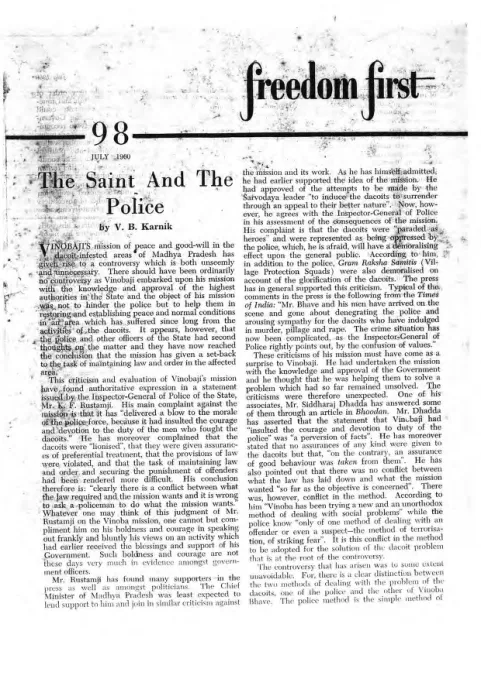
The Saint And The Police
By V. B. Karnik
V. B. Karnik’s lead article defends Vinoba Bhave’s peace mission among the dacoits of the Chambal valley in Madhya Pradesh against criticism from the state’s Inspector-General of Police, Mr. K. F. Rustamji, who charged that the mission had demoralised the police and ‘lionised’ the dacoits. Karnik argues that the police’s punitive approach alone has never solved the dacoit problem, since social conditions in the Chambal region continually produce new recruits, and that Vinobaji’s method of moral appeal secured the voluntary surrender of twenty-two dacoits who then pleaded guilty. He concludes the two approaches — police suppression and the saint’s rehabilitative appeal — can be complementary rather than in conflict.
- MP Inspector-General K. F. Rustamji publicly criticised Vinoba Bhave’s dacoit-peace mission, saying it insulted police morale and ‘lionised’ surrendered dacoits.
- Vinobaji’s associate Siddharaj Dhadda rebutted the charges in an article in Bhoodan, denying any assurances of preferential treatment were given to dacoits.
- Karnik argues the police method (hunting and shooting dacoits) has failed for years because social conditions in the Chambal valley continually regenerate the dacoit population.
- Twenty-two dacoits surrendered during Vinobaji’s mission and pleaded guilty to their crimes, an outcome Karnik reads as vindicating the human approach.
- Karnik concludes the two methods can be complementary, especially in an area where social rehabilitation matters as much as punishment.
Notes (Hopeful Turn in Algeria; Pointers From Tibet; Unrest In Punjab)
The unsigned ‘Notes’ section covers three developments. ‘Hopeful Turn in Algeria’ welcomes the Algerian Provisional Government’s decision to send an envoy to Paris and President de Gaulle’s renewed offer of self-determination, reading it as an opening toward a negotiated end to the five-and-a-half-year war. ‘Pointers From Tibet’ reports continued heavy fighting between Chinese forces and Tibetan resistance in the Mansarovar, Everest, and Gyantse regions, alongside Chinese military build-up along the Indo-Nepalese border, arguing this belies Chinese claims of restored normalcy and should alert India to the danger of unchecked Chinese consolidation. ‘Unrest In Punjab’ criticizes the Communist Party’s opportunistic reversal to back the Akali Dal’s Punjabi Suba demand after its own candidates were routed in Gurudwara elections, and warns that continued linguistic agitation in a border state exposes India to security risks given Chinese pressure on the frontier.
- Algeria: the FLN’s decision to send an envoy to Paris and de Gaulle’s June 14 speech renewing self-determination guarantees are read as a hopeful step toward ending the war.
- Tibet: Chinese forces are reported fighting Tibetan resistance near Mansarovar, Everest, and Gyantse, with reinforcements sent to garrisons like Parkha; the piece says this contradicts Chinese claims of normalcy.
- Tibet: large Chinese troop concentrations along the Indo-Nepalese border and reports of Tibetans occupying grazing land in north-west Sikkim are flagged as warning signs for India.
- Punjab: the Communist Party reversed its prior opposition to a Punjabi Suba after its Congress-aligned Desh Bhagat Board allies were defeated by the Akali Dal in Gurudwara elections.
- The piece frames continued linguistic agitation in Punjab as a security risk given Chinese aggression on India’s northern borders.
The Lesson Of Turkey
By Adam Adil
Adam Adil’s ‘The Lesson of Turkey’ reads the May 27, 1960 military coup that overthrew Adnan Menderes alongside the earlier fall of Syngman Rhee in South Korea as evidence that Asian peoples will no longer tolerate corrupt, authoritarian regimes. The article traces Menderes’s dictatorial turn — press censorship, suspension of judicial independence, suppression of opposition parties, courting of religious conservatism against Ataturk’s secularism, and economic mismanagement leading to inflation and bankruptcy — and credits General Cemal Gursel’s National Union Council with a largely bloodless, restrained transition that released political prisoners and promised free elections. It closes by predicting Ismet Inonu’s likely return to power and warning that no Asian government can survive without delivering genuine democracy and rising living standards.
- Adil links Menderes’s fall in Turkey to Syngman Rhee’s fall in Korea as parallel instances of student-led revolt against corrupt regimes, though Turkey’s outcome was army-led rather than a return to democratic rule.
- Menderes is charged with dismantling press freedom, judicial independence, and parliamentary checks, and with jailing opposition politicians and journalists.
- Menderes revived support for conservative religious leaders (the Maulvis) against Ataturk’s secularising legacy for tactical political gain.
- Economic mismanagement — lax expenditure control, an overambitious development plan, and inflation — pushed Turkey toward bankruptcy despite earlier US and West German aid.
- General Cemal Gursel’s junta is portrayed favourably: it freed political prisoners, restored civil liberties, and pledged free elections and continuity in foreign policy (NATO, CENTO membership).
- The article predicts Ismet Inonu, ‘the political heir of Ataturk,’ will likely return to power, but flags his age as a concern for Turkey’s future leadership.
Boris Pasternak
By D. G. Nadkarni
D. G. Nadkarni’s tribute to Boris Pasternak, written after the poet’s death on May 30, situates him as the last representative of a vanished era of European liberal enlightenment, alongside Kafka, Thomas Mann, and other modernist figures. It traces his intellectual formation (music, philosophy at Marburg, poetry), his refusal to leave the Soviet Union despite opportunities, and his retreat into obscurity under Stalinist purges even as friends like Mayakovsky and patrons like Bukharin were destroyed. The essay reads Doctor Zhivago not as anti-Soviet propaganda but as a humanist protest against ‘all inhuman regimentation,’ and recounts how the Nobel Prize forced upon him by international attention entangled him in Cold War politics, worsening his isolation until his death, after which the Soviet press blacked out the news.
- Pasternak is framed as belonging to a dying breed of European liberal-humanist artists (grouped with Kafka, Thomas Mann, Rilke, Matisse, Lorca).
- His family circle included figures like Scriabin, Rilke, and Tolstoy, exposing him early to a cosmopolitan artistic culture.
- He refused to leave the USSR even when he had the chance (e.g., an international conference in 1936), and receded into obscurity during Stalin’s purges rather than conform.
- Doctor Zhivago is interpreted as a humanist protest against regimentation in general, not primarily anti-Soviet political propaganda.
- His rejection of the Nobel Prize was reportedly coerced by the Soviet government, and the prize episode entangled his reputation in Cold War politics.
- His death on May 30 was met with a complete Soviet press blackout, though his funeral drew mourners who saw him as a link to Dostoevsky and Tolstoy’s era.
Case Of Dr. Linse
By (Contributed)
This unsigned, contributed piece recounts the July 8, 1952 kidnapping of West Berlin lawyer and economist Dr. Walter Linse from a street near his home by East German agents connected to Soviet intelligence, and his later confirmed death in a Soviet prison camp on December 15, 1953. Linse was a leading member of the Free Jurists’ Committee, an organisation of lawyers working to expose abuses of the East German communist legal system by collecting complaints from defectors. The piece details the abduction (a gang known as ‘MSS’ made up of professional criminals released from prison to work for the kidnapping ring), the West German pursuit that was blocked at the sector border, the Soviet Union’s repeated denials of knowledge despite West Berlin police uncovering the kidnappers’ full confession, and the eventual, belated Soviet admission of Linse’s death via the Red Cross.
- Dr. Walter Linse, a West Berlin lawyer and leading member of the Free Jurists’ Committee, was abducted in front of his home on July 8, 1952.
- The kidnapping ring, ‘MSS’, was composed of professional criminals (murderers, burglars, embezzlers) released from prison by East German communists in exchange for carrying out such operations.
- West Berlin police pursuers were blocked at the East Berlin sector border, which had been raised in advance, suggesting East German foreknowledge.
- The USSR denied all knowledge of Linse despite West Berlin police uncovering the names of the kidnappers, one of whom fully confessed after later fleeing to the West.
- The Soviet Red Cross eventually informed the West German Red Cross that Linse had died in a Soviet prison camp on December 15, 1953.
The Three Techniques
By M. A. Sreenivasan
M. A. Sreenivasan’s polemic ‘The Three Techniques’ attacks India’s Third Five Year Plan and the ruling Congress party’s method of governance, arguing that any plan should be judged by whether it serves the people or subordinates them to itself. He accuses the government of deploying three techniques of control historically used to keep subject populations quiet: sedation (planning as a narcotic dream of future prosperity that excuses present hardship), confusion (euphemistic jargon such as calling Chinese incursions merely ‘activisation of the border’ or currency printing a mere ‘disequilibrium’), and distraction (elaborate spectacle, as at the Sadashivanagar AICC session’s kitchens and ‘wordage’ record). He closes by noting that even a Congress minister’s resolution at that session admitted a widening gap between government promises and performance, attributing it vaguely to ‘the temper of the people’ and administrative failure rather than to leadership.
- Sreenivasan frames the fundamental test of any plan as whether it serves the people or subordinates them to the plan.
- He criticizes the Third Plan’s currency-printing-based deficit financing, calling the Nasik press a ‘red monstrosity’ funding an ‘ill-conceived spendthrift plan’.
- He identifies three techniques of political control: sedation (planning as opium, echoing Marx’s ‘religion is the opium of the people’), confusion (euphemistic technical jargon), and distraction (spectacle and scale, e.g. the Sadashivanagar Congress session’s massive kitchen and 50,000-word daily telegraph traffic).
- He criticizes official language that describes Chinese territorial incursions as mere ‘incursion’ or ‘activisation of the border’ rather than aggression.
- He notes that a Congress Minister’s resolution at the Sadashivanagar AICC session admitted a gap between government promises and performance, blaming ‘the temper of the administration’ and ‘the people generally’ rather than leadership.
Congress For Cultural Freedom
This unsigned feature marks the tenth anniversary of the Congress for Cultural Freedom, founded in Berlin in June 1950, and reviews its decade of activity: its founding principle of rejecting totalitarianism while uniting intellectuals of differing political views; its worldwide network of national committees and correspondents (from Argentina to Vietnam, with Asia and Latin America regional offices); its publications (Encounter, Preuves, Cuadernos, Soviet Survey, and nationally, Quest in India, Quadrant in Australia, Tempo Presente in Italy, Der Monat in Germany); its seminar programme held in cities including Milan, Tokyo, Ibadan, Rhodes, and Hamburg on topics like economic growth and public liberties; its arts festivals (a 1952 Paris festival of twentieth-century masterpieces, a 1954 Rome gathering of composers, exhibitions of young painters); and its aid programme for Hungarian intellectuals after the 1956 uprising, including support for the ‘Philharmonia Hungarica’ orchestra and a white book on the Hungarian revolution (paralleling Indian support for a white book on Tibet). The piece reproduces anniversary messages sent to the Berlin conference by Jayaprakash Narayan, Hugh Gaitskell, George Kennan, C. Rajagopalachari, Lionello Venturi, and Hermann J. Muller, each praising the Congress’s role in defending intellectual freedom against totalitarianism.
- The Congress for Cultural Freedom was founded in Berlin in June 1950 and marked its tenth anniversary with an international conference in the same city in June 1960.
- Its founders were united by rejection of totalitarianism despite differing political and ideological affiliations.
- It maintains national committees and correspondents worldwide (Asia and Latin America regional offices; correspondents in Athens, Cairo, Ibadan, Manila) and publishes journals including Encounter, Preuves, Cuadernos, Soviet Survey, and India’s Quest.
- Its activities include international seminars (Milan, Tokyo, Ibadan, Rhodes, Hamburg), arts festivals (Paris 1952, Rome 1954, young-painter exhibitions in Rome/Paris/Brussels and Tokyo), and an aid programme for Hungarian intellectuals after 1956, including a ‘white book’ on the Hungarian revolution.
- Anniversary messages are reproduced from Jayaprakash Narayan, Hugh Gaitskell, George Kennan, C. Rajagopalachari, Lionello Venturi, and Hermann J. Muller, all endorsing the Congress’s role in defending intellectual and cultural freedom.
- Rajagopalachari’s message frames the Congress’s work as helping ‘defend the rights of spiritual life and the freedom of culture against all compromise.‘
With Many Voices
‘With Many Voices’ is a compilation of short quoted excerpts from world political figures and publications on contemporary events, including remarks on Khrushchev by Labour MP Jack Jones, on the collapsed Paris Summit by Salvador de Madariaga, on Cold War tension by President Eisenhower, on mass movements and independent thinking by Anthony Hartley in Encounter, on decolonisation statistics by Eisenhower, on Nepal by Prime Minister B. P. Koirala, on Soviet self-determination double standards by Taya Zinkin, on Indian public apathy toward Chinese aggression by Congress President Sanjeeva Reddy, and on Soviet-Western relations by David Margnand and Nikita Khrushchev. The page ends with a subscription form for Freedom First.
- Jack Jones (Labour MP) is quoted questioning Khrushchev’s standing to criticize others, from the Economist, London.
- Salvador de Madariaga is quoted twice (Thought, June 4) criticizing the Paris Summit’s failure and Eisenhower’s decision to attend it at all.
- President Eisenhower is quoted (Time, June 4 and June 27) on communist intolerance of anything it cannot control, and on 33 nations achieving self-determination since 1945 versus 12 forcibly absorbed into the Sino-Soviet sphere.
- Anthony Hartley (Encounter, July) is quoted comparing mass movements to a drug as destructive as cocaine to independent thinking.
- Taya Zinkin (United Maharashtra, June) is quoted arguing the Indian Government does not truly believe in self-determination for Hungarians, Tibetans, or Uzbeks.
- Congress President Sanjeeva Reddy (Radical Humanist, June 5) is quoted blaming Congress workers for failing to alert Indian masses to the implications of Chinese aggression.
Generated by the v1.5 extraction pipeline. Awaiting editorial review.
Metadata and summary are AI-extracted from the source PDF and reviewed for editorial accuracy. The original work is available via the Read PDF tab above (where present); paragraph-level citation inside the PDF is deferred to a future engagement.