periodical issue
Freedom First
By M. R. Pai
Published for the Democratic Research Service by B. K. Desai at 127 Mahatma Gandhi Road, Bombay 1; printed at Indsind Printers, 35 Gamdevi Road, Bombay 7 · Bombay · 1960
20 pages
Freedom First
Summary
This is the hundredth issue of Freedom First (September 1960), the Bombay-based monthly of classical-liberal and anti-communist opinion associated with the Forum of Free Enterprise circle. The editorial, ‘At The Post’, marks the milestone by restating the journal’s founding mission — defending freedom and democracy against totalitarianism, criticizing Soviet-style planning, and warning against the country’s drift into a ‘Perquisitive Society’ of bureaucratic privilege. The issue assembles a wide range of contributors — J. B. H. Wadia on education and cinema censorship, Philip Spratt and Adam Adil on the international communist threat (world communism and Soviet policy toward Islam respectively), the sociologist Edward Shils on the alienation of the Indian intellectual, M. R. Masani and S. R. Mohan Das on the 1960 Central Government employees’ strike and the crisis it exposed in the trade union movement, Devadas Kini and ‘Aristide’ on the failures and economic costs of socialist planning, Anand Mohan on the prospects for multi-party government in India, and K. K. Sinha on the linguistic unrest in Assam and the meaning of Indian national unity. A closing miscellany, ‘With Many Voices’, gathers press quotations on Cold War and domestic political themes. Across the issue the recurring argumentative center is a defence of economic and civil liberty against both Nehruvian planning and international communism, paired with anxiety about administrative overreach, bureaucratic perquisites, and the fragility of party democracy in India.
Key points
-
The unsigned editorial “At The Post” marks the journal’s hundredth issue, restating its founding mission against totalitarianism and warning that rapid industrialisation risks pushing India toward the Soviet model.
-
J. B. H. Wadia’s “Thoughts On Education” defends the Indian film industry against Vinoba Bhave’s blanket charge that it corrupts youth, calling for informed rather than reflexive criticism.
-
Philip Spratt’s “World Communism Today” argues forty years of Soviet experience have disproved communism’s claim to have solved humanity’s problems, contrasting Russian diplomatic tactics with Chinese revolutionary action.
-
Edward Shils’s “India: Traditional Past & Western Future” examines the malaise of India’s modern intellectual class, torn between charismatic Indian tradition and imported Western rationalism and socialism.
-
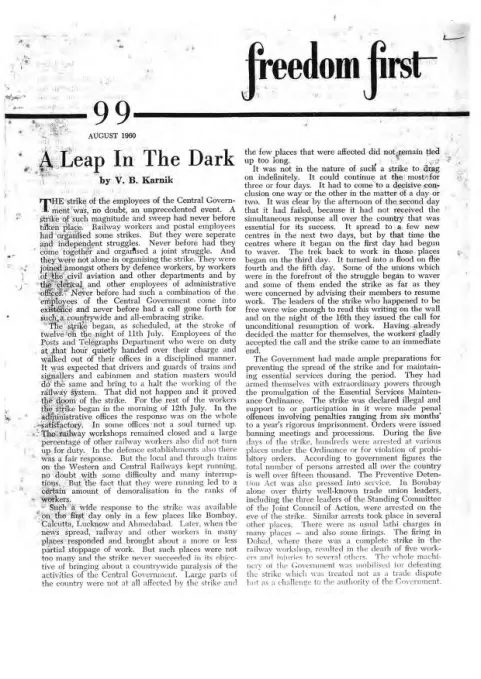
M. R. Masani’s “Conflict Of Principles” analyses the 1960 employees’ strike as a clash between the right to strike and the need for essential services, recommending compulsory arbitration over an outright ban.
-
S. R. Mohan Das’s “Crisis In Trade Union Movement” faults both government and union leadership for blurring the line between the strike as economic action and political challenge, exposing organisational weakness.
-
Devadas Kini’s “End Of A Dogma” argues trade unions and social legislation have already civilised capitalism into a welfare-oriented “People’s Capitalism” without requiring nationalisation.
-
“Aristide“‘s “Effects Of Socialism” documents a growing “Perquisitive Society” of ministerial privilege, citing Defence Minister Krishna Menon’s costly Calicut visit, alongside a three-fold attack on free enterprise.
-
Anand Mohan’s “Prospect For Party Government In India” argues Congress’s dominance rests on charisma rather than pluralist conviction, framing the new Swatantra Party as the first genuine challenger through the party system.
-
K. K. Sinha’s “Linguistic Frenzy Or Bharatiyata?” responds to the Assam disturbances by calling for a deliberate, merit-based Bharatiyata to counter linguistic parochialism, while Adam Adil’s “Soviet Union And Islam” documents the suppression of Islamic institutions in Soviet Central Asia.
Essays
At The Post
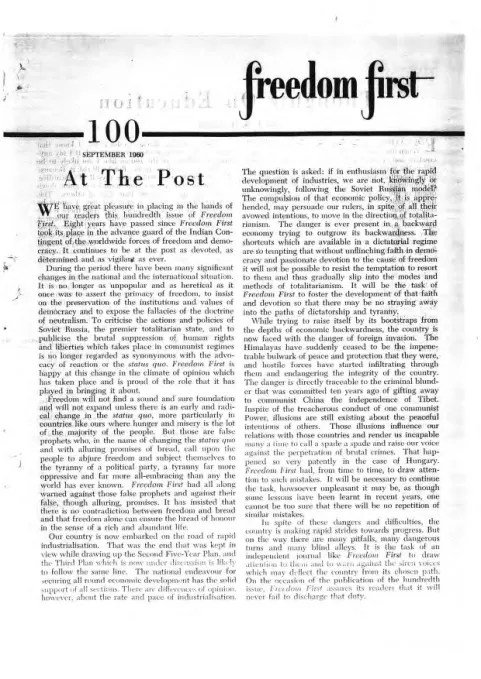
The unsigned editorial ‘At The Post’ marks Freedom First’s hundredth issue, reviewing eight years of the journal’s advocacy for freedom, democracy, and free enterprise against totalitarianism and neutralism. It warns that the pace of industrialisation under the Second and (forthcoming) Third Five-Year Plans risks pushing India, even unwittingly, toward the Soviet model, and it links this danger to the psychological temptation of totalitarian shortcuts in a poor economy. The piece also raises alarm over the loss of Tibet’s independence to China as a strategic blunder that has left the Himalayan frontier vulnerable to infiltration, and it pledges the magazine’s continued vigilance against dictatorship and foreign threat alike.
- Marks the journal’s hundredth issue and reviews eight years of advocacy for freedom and democracy
- Warns that rapid industrialisation risks unwittingly following the Soviet model
- Frames dictatorship’s ‘shortcuts’ as tempting in a backward economy, requiring vigilance
- Blames the ‘criminal blunder’ of ceding Tibet’s independence to China for the new danger of frontier infiltration
- Criticises illusions about peaceful communist intentions, citing Hungary as a precedent
- Reaffirms Freedom First’s founding role and its pledge to continue its watchdog function
Thoughts On Education
By J. B. H. Wadia
J. B. H. Wadia’s ‘Thoughts On Education’ opens with a broad reflection on education as a lifelong evolutionary and philosophical process rooted in the classical Indian tradition of catholicity across schools of thought, then pivots to a defence of the Indian film industry against blanket accusations that it corrupts the young. Wadia argues that critics such as Vinoba Bhave apply a double standard, blaming cinema for social ills while ignoring the many devotional, moralising, and artistic films it also produces, and he calls for informed rather than reflexive criticism of the medium.
- Defines education broadly, citing Funk & Vizetelly’s definition and the Latin root ‘educere’
- Praises ancient India’s catholicity toward diverse philosophical schools (Nyaya, Vaiseshika, Sankhya, Yoga, Vedanta, Purva Mimamsa) as a model of open inquiry
- Criticises modern Indian education for losing this spirit of inquiry through mass communication and misinterpreted democratisation
- Defends the Indian film industry against charges that it corrupts youth, citing Vinoba Bhave’s remarks as an example of the criticism
- Invokes Thomas Huxley’s and Francis Bacon’s maxims to argue for objective, informed criticism rather than reflexive condemnation
- Argues the industry also produces devotional, moralising, and artistic films that critics ignore
World Communism Today
By Philip Spratt
Philip Spratt’s ‘World Communism Today’ surveys the state of the global communist movement as of 1960, arguing that while communism has scored recent tactical gains, its long-run claim to have solved humanity’s problems is ‘fairly definitely disproved’ by forty years of Soviet experience. Spratt contrasts Soviet and Chinese approaches — Russia favouring ‘peaceful’ expansion through diplomacy and aid, China favouring direct revolutionary action — and discusses how this split plays out in Sino-Soviet relations and in the tactics open to the Communist Party of India, which he says has cannily avoided having to choose between a respectable parliamentary line and a revolutionary one.
- Argues industrialism and population growth push all societies toward regimentation, of which communism claims falsely to be the sole beneficiary
- Contends non-communist societies show better, freer, more egalitarian outcomes than communist ones after forty years
- Distinguishes Russian tactics (diplomacy, aid, propaganda) from Chinese tactics (revolutionary action, threats) in the world communist campaign
- Analyses the diplomatic and psychological differences between Khrushchev’s and Mao’s postures
- Describes the Communist Party of India’s dual strategy of respectability and covert alignment with revolutionary tactics, aided by the China/Russia split
- Notes declining returns on communist propaganda as populations become politically sophisticated
India: Traditional Past & Western Future
By Edward Shils
In ‘India: Traditional Past & Western Future,’ sociologist Edward Shils examines the modern Indian intellectual class as uniquely large and accomplished among new states, yet marked by a persistent malaise rooted in the tension between deep-seated Indian traditions of charismatic authority and the imported Western culture of scientism, rationalism, and socialism. Shils argues the Indian intellectual is neither as rootless nor as Westernised as critics suggest, but suffers real disappointment with post-independence politics, viewing party government and bureaucracy as a betrayal of the charismatic, transcendent hopes invested in the independence struggle, and remains without a settled political or social programme.
- Notes the exceptional scale, professional diversity, and quality of India’s modern intellectual class relative to other underdeveloped countries
- Argues Indian intellectuals are frequently accused of ‘rootlessness’ but retain a fundamentally Indian sensibility despite Western training
- Traces intellectuals’ political alienation to Indian traditions valuing the charismatic ‘saint’ figure over impersonal legal-rational authority, epitomised by Gandhi
- Describes disappointment with independence, which produced ordinary party politics rather than the transcendent renewal intellectuals hoped for
- Identifies most Indian intellectuals as instinctively socialist but distrustful of the administrative machinery any real socialism requires
- Portrays the Indian intellectual today as ‘not a happy man,’ demoralised, underpaid, and nostalgic for the Civil Disobedience era
Conflict Of Principles
By M. R. Pai
M. R. Masani’s ‘Conflict Of Principles’ (condensed from a Parliament speech) analyses the 1960 Central Government employees’ strike as a genuine clash between two valid principles: the fundamental right of association and to strike versus the principle that essential government functions must continue uninterrupted. Masani traces the wage grievance to inflationary planning policy warned against by economists like B. R. Shenoy, criticises bureaucratic overstaffing and rising establishment costs, but ultimately concludes the strike itself was ill-advised once concessions on price-linked wages and arbitration had been offered, arguing for compulsory arbitration along Australian lines rather than an outright strike ban for essential services and civil servants proper.
- Frames the strike crisis as a conflict between the constitutional right to strike/associate and the principle that essential government functions must continue
- Attributes the underlying wage grievance to inflation caused by deficit-financed Five-Year Plan spending
- Cites Professor Shenoy’s early dissenting warning about inflationary risk in the Second Plan
- Criticises bureaucratic overstaffing (underpaid, underworked clerks) as a self-inflicted government cost
- Argues Government must act as an ordinary employer, not a sovereign, once it enters industry and employment
- Judges the strike leadership failed by not calling off action after price-linked wage and arbitration concessions were made
- Recommends compulsory arbitration (citing Jayaprakash Narayan’s approach and the Australian model) over a blanket strike ban for civil servants and essential services
Crisis In Trade Union Movement
By S. R. Mohan Das
S. R. Mohan Das’s ‘Crisis In Trade Union Movement’ dissects the 1960 all-India Central Government employees’ strike as a case study in the confused identity of Indian trade unionism, arguing that both government and union leadership blurred the line between the strike as an economic (trade union) action and as a political/revolutionary challenge. He concludes that the strike leadership overestimated rank-and-file mobilisation capacity, failed to plan for sustaining a prolonged struggle, and that its rapid collapse exposed the movement’s organisational weakness, urging unions to take deliberate control of their own processes instead of feeling helpless.
- Frames the strike’s contested character: government treated it as a political/revolutionary challenge, while union leaders (S. M. Joshi, Nath Pai, Peter Alwares) insisted it was purely a trade union action
- Notes railway and Postal & Telegraph employees had recently and controversially aligned themselves with the ministerial-employee strike after prior reluctance
- Argues the strike leadership wrongly assumed nationwide rank-and-file mobilisation would match Maharashtra-based prior experience
- Contends leaders failed to plan for the strike’s sustaining power under conditions of government suppression
- Observes the strike collapsed within five days, leaving employees demoralised and facing government reprisals
- Calls on employees and unions to take conscious control of trade-union processes rather than feel desperate or helpless
End Of A Dogma
By Devadas Kini
Devadas Kini’s ‘End Of A Dogma’ argues that socialism has foundered on the dogma that private property is the sole villain and nationalisation the sole cure, contending that trade unions, mass production, and social legislation have already ‘civilised’ capitalism into a welfare-oriented People’s Capitalism without requiring abolition of private property. Kini marshals quotations from Douglas Jay, G. D. H. Cole, and the authors of The Twentieth Century Socialism to show even socialist thinkers now favour taxation and social legislation over root-and-branch nationalisation, and he criticises trusteeship-based nationalised property as equally prone to abuse as private property, invoking Harold Laski on the danger of state control over media and public opinion.
- Diagnoses socialism’s error as treating private property as sole cause and nationalisation as sole cure of inequality
- Credits trade unions, mass production, and social legislation with already reducing capitalism’s rough edges into a ‘People’s Capitalism’
- Cites national minimum wages, unemployment insurance, and old-age pensions as achieved without abolishing private property
- Quotes The Twentieth Century Socialism’s authors conceding workers may fare worse under state monopoly employer than private capitalists
- Argues modern state taxation and budgeting are as effective as nationalisation for redistribution, quoting Douglas Jay and G. D. H. Cole
- Warns that state control of media and public opinion sources is itself a threat to democracy, citing Harold Laski’s caveat about impartial news
Effects Of Socialism
By Aristide
Writing under the byline ‘Aristide,’ ‘Effects Of Socialism’ argues that socialism in India has had a twofold economic effect: it has turned politics into an ‘industry’ by fostering a ‘Perquisitive Society’ of politicians and bureaucrats who accumulate free housing, travel, and other perks at public expense, and it has attacked free enterprise through restricted entry, excessive taxation, and frustrating controls. The essay cites the Comptroller and Auditor-General’s report on ministerial perquisite abuse (including Defence Minister V. K. Krishna Menon’s Calicut visit), documents the squeeze on private handloom units versus subsidised cooperatives, and closes by asking whether India can retain free enterprise within a democratic framework.
- Identifies two effects of socialism on the Indian economy: growth of a ‘Perquisitive Society’ and a three-fold attack on free enterprise
- Cites the Comptroller and Auditor-General’s report on lavish ministerial travel, including a Cabinet Minister’s use of three aircraft for a single Calicut visit
- Notes Defence Minister V. K. Krishna Menon’s Calicut airstrip repair costing Rs. 55,000 for a holiday visit as an example of socialist double standards
- Lists specific M.P. perquisites: free first-class rail travel, priority bookings, Rs.400/month salary, Rs.21/day session allowance, 1,800 free calls, subsidised housing/furnishings, medical scheme, flying club concession
- Describes discriminatory treatment of private handloom units versus state-favoured cooperatives in Kerala, disadvantaging small entrepreneurs
- Criticises the Industrial Policy Resolution and expanding State Trading Corporation as displacing established private industry and trade
- Closes by asking whether free enterprise can be retained within a democratic framework given these twin pressures
Prospect For Party Government In India
By Anand Mohan
Anand Mohan’s ‘Prospect For Party Government In India’ surveys the attitudes of India’s major political parties — Congress, PSP, CPI, and the new Swatantra Party — toward the parliamentary party system, arguing that Congress’s dominance is rooted in its charismatic inheritance from the independence struggle rather than genuine ideological commitment to multi-party competition. He contends the CPI’s ostensible embrace of the party system is purely tactical (per its Amritsar thesis), while Swatantra is the first party genuinely devoted to unseating Congress through the party system itself. The essay diagnoses structural defects undermining party government in India: an intellectually passive electorate unable to hold the majority accountable, near-unanimity among major parties on core policy issues masking real debate, and a bureaucratic-legislative tendency to treat parliamentary majority as license to overreach.
- Argues Congress identifies itself with the party system out of historic conviction of entitlement rather than principled pluralism
- Notes the CPI’s Amritsar thesis commits it nominally to the party system, but only as a tactic to capture power
- Frames the Swatantra Party as the first serious challenger genuinely wedded to displacing Congress through party competition
- Diagnoses the absence of an informed, sturdy citizenry as the chief structural weakness undermining Indian party democracy
- Observes near-unanimity among Congress, PSP, and CPI on foreign policy and planned-economy socialism despite loud rhetorical disagreement
- Criticises Congress’s tendency to treat its parliamentary majority as a permanent fixture licensing constitutional overreach
- References Jayaprakash Narayan’s critique that the party system is unsuited to India and his ‘communitarian theory of the State’ as an alternative
Linguistic Frenzy Or Bharatiyata?
By K. K. Sinha
K. K. Sinha’s ‘Linguistic Frenzy Or Bharatiyata?’ responds to the 1960 Assam disturbances by warning that linguistic consciousness is corroding India’s national unity from within, with all major political parties complicit through their local units even as their national leadership condemns the violence. Sinha argues that Bharatiyata (Indian-ness) must be cultivated as a deliberate, individualistic, catholic attitude of mind that absorbs regional diversity without erasing it, and he proposes concrete principles — merit-based employment and trade access, freedom of movement and residence for all citizens across India — to counter the drift toward exclusionary, casteist, and linguistic parochialism.
- Frames the Assam disturbances as a warning sign of deeper linguistic-consciousness threats to Indian national unity
- Criticises all major parties (Congress, PSP, CPI) for allowing local units to inflame linguistic antagonism even as national leaders condemn violence
- Defines Bharatiyata as a deliberate, catholic, individualistic attitude of mind rather than a chauvinistic sentiment
- Warns that linguistic reorganisation of states, while accepted as settled, has reduced the emotional value of the entity ‘India’ relative to sub-national identities
- Proposes four principles: merit-based employment access, open trade/industry entry, merit-based private-sector recruitment, and freedom of movement/residence for all Indian citizens
- Argues these principles would foster an all-India elite operating on merit across parochial state and linguistic barriers
Soviet Union And Islam
By Adam Adil
Adam Adil’s ‘Soviet Union And Islam’ documents the history and current state of Soviet policy toward the Muslim populations of Central Asia and the Middle East, drawing heavily on Ivar Spector’s The Soviet Union and the Muslim World, 1917-1958. Adil traces Lenin’s 1917 appeal promising religious and cultural freedom to Russia’s Muslims, contrasts it with the subsequent suppression of Islamic institutions, declining Muslim political representation in the Duma and Supreme Soviet, and Russification of language and script in Central Asia, and closes by citing testimony from Pakistani scholar Raghib Ehsan and Soviet publications (Bakinsky Rabochy, Qizil Uzbekistan) that reveal both the persistence of anti-Islamic propaganda and Islam’s continued resilience as a cultural force in the region.
- Cites Ivar Spector’s periodisation of Soviet policy toward the Muslim world in three drives: 1917-1921, 1941-1947, and 1955-onward
- Quotes Lenin and Stalin’s November 1917 appeal to Muslims of Russia promising free national and cultural institutions
- Documents declining Muslim representation in the Duma (25 to 6 deputies across four Dumas) and negligible representation in the Supreme Soviet
- Cites Professor Raghib Ehsan’s findings on the absence of religious education, publishing, and income rights for mosques under Soviet rule
- Describes Russification of Central Asian Muslim regions, including replacement of Arabic script and decline of pilgrimage numbers to Mecca (from 50,000-60,000 before 1917 to about 22 pilgrims recently)
- Notes government-installed, subservient Muftis and Imams used to project a facade of religious freedom
- Concludes Islam nonetheless remains a resilient cultural force in Central Asia, prompting renewed Soviet anti-religious propaganda efforts
With Many Voices
‘With Many Voices’ is a closing miscellany of quoted press excerpts on Cold War and Indian political themes, ranging from the Dalai Lama’s critique of empty peace rhetoric to M. R. Masani’s, D. R. Mankekar’s, and Acharya Vinoba Bhave’s comments on Indian politics and welfare, alongside American and British commentary (Henry Cabot Lodge, Malcolm Muggeridge, Mark Bonham Carter, John Wain) on the Cold War and Sino-Soviet relations.
- Opens with a Dalai Lama quotation (Manchester Guardian Weekly) warning against empty promises of peace and goodwill
- Includes D. R. Mankekar’s Indian Express prediction that Congress will lose in several states by the 1962 elections
- Quotes Acharya Vinoba Bhave’s remark that India is having an ‘ill-fare State’ rather than a welfare state
- Includes M. R. Masani’s Indian Express quote that Soviet economy cannot coexist with parliamentary democracy
- Cites Henry Cabot Lodge on the asymmetry between US and Soviet responses to reconnaissance overflights
- Includes Malcolm Muggeridge’s characterisation of the Sino-Soviet alliance as a ‘marriage of convenience’
Generated by the v1.5 extraction pipeline. Awaiting editorial review.
Metadata and summary are AI-extracted from the source PDF and reviewed for editorial accuracy. The original work is available via the Read PDF tab above (where present); paragraph-level citation inside the PDF is deferred to a future engagement.