periodical issue
Freedom First
By V. B. Karnik, S. R. Mohan Das, M. A. Venkata Rao, (Contributed), SAADI
published for the Democratic Research Service by B. K. Desai at 127 Mahatma Gandhi Road, Bombay 1 · Bombay · 1961
12 pages
Freedom First
Summary
This is the 105th issue of Freedom First (February 1961), the classical-liberal monthly published in Bombay by the Democratic Research Service and edited by V. B. Karnik. The issue opens with Karnik’s own lead essay, “A Lesson For Us,” arguing that China’s 1959-1960 famine exposes the structural failure of communist planning—its overemphasis on heavy industry at the expense of agriculture and consumer goods—and that both China and the USSR are now being forced to concede this failure. S. R. Mohan Das reports on the Indian National Congress’s 66th session at Bhavnagar, dissecting Nehru’s dominance over party resolutions, the national-integration debate, and the ginger group’s defeat at the convention. A “Notes” section carries short items on Soviet espionage in India, the Algerian referendum, the arrest of Olga Ivinskaya, Milovan Djilas’s release from prison, and rival African power blocs (Brazzaville vs. Casablanca groups). M. A. Venkata Rao’s “Towards Party-less Democracy” expounds Jayaprakash Narayan’s and the late M. N. Roy’s proposal for a partyless parliamentary system built on polling-booth voters’ associations. An unsigned contributed piece, “Soviet Economic Growth & the West,” compares Soviet and Western growth rates, housing, women’s labour, personal transport, and agricultural output using 1913/1959 census data. “The Moscow Soap Opera,” reproduced from the Public Relations Journal (New York, December 1960), is a media-criticism piece skewering Western press coverage of Khrushchev’s theatrics at the UN. The “Review” section covers a symposium on Sino-Soviet relations published by National Review (reviewed by B. K. Desai) and S. R. Patel’s book on India’s foreign policy (reviewed by “Saadi”). The issue closes with “With Many Voices,” a compilation of quotations from Indian and international commentators on Sino-Soviet relations, Tibet, strikes, and India’s Cold War position, followed by the continuation of Karnik’s opening essay and the masthead crediting V. B. Karnik as editor and B. K. Desai as publisher.
Key points
-
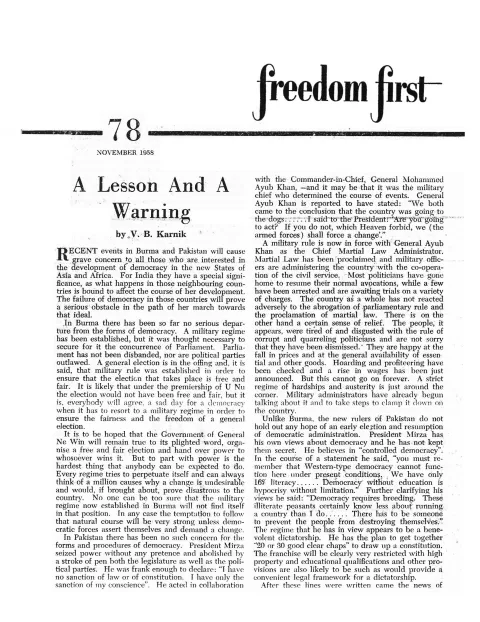
V. B. Karnik’s “A Lesson For Us” argues China’s 1959-60 famine exposes the structural failure of communist planning’s overemphasis on heavy industry, and warns India’s Third Plan risks the same mistake.
-
S. R. Mohan Das’s “Bhavnagar Congress Convention” dissects Nehru’s dominance over the 66th Congress session’s resolutions and the “ginger group’s” defeat in party elections.
-
Notes cover uncovered Soviet espionage rings in India, the French referendum strengthening de Gaulle’s hand on Algeria, the arrest of Olga Ivinskaya, Milovan Djilas’s conditional release, and rival Brazzaville/Casablanca blocs in Africa.
-
M. A. Venkata Rao’s “Towards Party-less Democracy” expounds M. N. Roy’s and Jayaprakash Narayan’s proposal for a partyless parliamentary system built on polling-booth voters’ associations.
-
An unsigned contributed piece, “Soviet Economic Growth & the West,” compares Soviet and Western growth rates, housing, and living standards, concluding Soviet GNP will remain roughly half that of the U.S. even by 1975.
-
“The Moscow Soap Opera,” reprinted from the Public Relations Journal, argues Khrushchev’s folksy theatrics are calculated propaganda technique rather than genuine emotion.
-
B. K. Desai reviews a National Review symposium concluding Sino-Soviet differences are tactical rather than a fundamental rift, with China remaining a Russian satellite for the near term.
-
“Saadi” reviews S. R. Patel’s “Foreign Policy of India”, which argues Indian foreign policy is “a one-man show” under Nehru driven by a dangerous “obsession with peace.”
Essays
A Lesson For Us
By V. B. Karnik
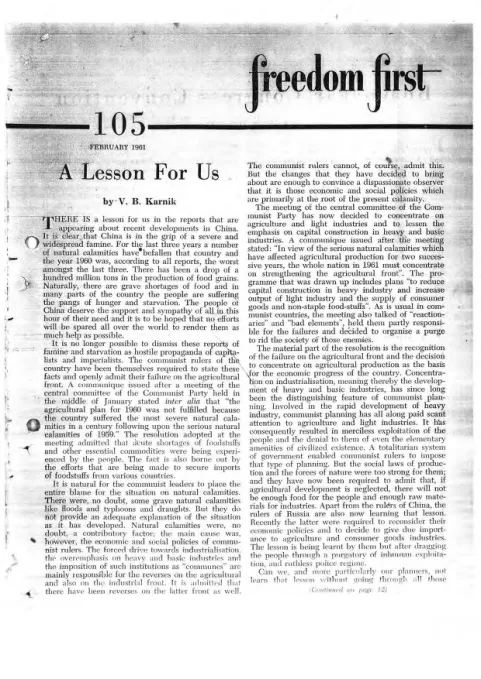
Karnik argues that China’s severe 1959-1960 famine, openly admitted by the Communist Party’s own central committee communiqué, discredits the claim that natural calamities alone are responsible; the deeper cause is the regime’s forced-industrialisation drive, its neglect of agriculture and light industry, and coercive institutions like the communes. He notes the Party’s own January 1961 resolution conceded these failures and pivoted the 1961 plan toward agriculture and consumer goods, while purging “reactionaries” and “bad elements” for the shortfall. Karnik extends the lesson to the Soviet Union, which is also now redirecting priorities toward agriculture, and closes (in the continuation on page 12) by urging Indian planners to learn this lesson without India having to pass through the same suffering, warning that India’s own Third Plan risks repeating the mistake of overweighting heavy industry (e.g. a fourth steel plant at Bokaro) over food and essential goods.
- China’s food-grain output fell by 100 million tons over three years, per the government’s own admission.
- The Communist Party’s central committee resolution (mid-January 1961) blamed natural calamities but simultaneously redirected the 1961 plan toward agriculture and light industry.
- Karnik attributes the crisis primarily to economic and social policy — forced industrialisation, communes, neglect of agriculture — not just weather.
- The USSR is undergoing a similar course correction under Khrushchev, giving more attention to agriculture and consumer goods.
- Karnik warns Indian planners against repeating the same overemphasis on heavy/basic industry (citing the proposed fourth steel plant at Bokaro) at the expense of food security.
Bhavnagar Congress Convention
By S. R. Mohan Das
Mohan Das analyses the 66th Congress session at Bhavnagar, arguing that despite ample press coverage, little real political analysis has been offered. He examines Nehru’s outsized role in shaping party resolutions — illustrated by Chief Minister Harekrishna Mahtab’s admiring (and embarrassing) revelation that every Congress manifesto since 1936 was Nehru’s handiwork, and Mahavir Tyagi’s remark that Nehru’s hand “should be kissed.” The second major theme is national integration, provoked by the 1960 unrest (Assam riots, Punjabi Suba agitation, Berubari transfer dispute), with Nehru dramatically threatening to “throw away everything, even the Five Year Plans” if unity were not achieved. The essay closes by describing the ginger group’s failed attempt to capture the party organisation by appealing to Nehru’s personality cult, and its defeat in Election and Working Committee polls (continued on page 11, where Das notes Ram Subhag Singh’s election to the Working Committee as a quiet revolt against Nehru and Krishna Menon, and Indira Gandhi’s strong showing as interim Congress President).
- Little independent political analysis has accompanied the heavy press coverage of the Bhavnagar Congress session.
- Nehru’s dominance over party resolutions is illustrated by Mahtab’s claim that every Congress manifesto since 1936 was Nehru’s own drafting.
- National integration was the session’s second major issue, driven by the Assam riots, Punjabi Suba agitation, and Berubari transfer dispute.
- Nehru threatened to abandon the Five Year Plans if national unity were not secured.
- The ‘ginger group’ misjudged that riding Nehru’s personality cult would suffice, and was defeated in the Election and Working Committees; Ram Subhag Singh’s win is read as a quiet revolt against Nehru and Krishna Menon.
Notes (Spying For Friendship; Last Chance In Algeria; Reversal Of A Trend?; Djilas Freed; Power Blocs In Africa)
A set of five short unsigned notes. “Spying For Friendship” argues that the uncovering of two long-running Soviet espionage rings in India (probing Indian arms, atomic energy progress, and border-area roads) exposes the hollowness of Soviet claims of friendship and neutrality on the Sino-Indian border dispute, and criticises the Indian government’s muted response, quoting Krishna Menon’s dismissal of the affair. “Last Chance In Algeria” reads the French referendum result as strengthening de Gaulle’s position and sees cautious grounds for a negotiated Algerian settlement given signals from the FLN’s provisional government in Tunis. Further notes cover the arrest and imprisonment of Olga Ivinskaya (Pasternak’s collaborator) in Russia, condemned by Jayaprakash Narayan; the conditional release of Milovan Djilas from a Yugoslav prison; and the emergence of two rival African blocs (the moderate, pro-West Brazzaville group led by Ivory Coast and Senegal, versus the more militant Casablanca group led by Ghana and the UAR) competing for leadership of a not-yet-decolonised Africa.
- Two Soviet espionage rings operating in India for years (one dating to 1951) sought information on Indian arms, atomic energy, and border-road construction.
- The Indian government’s muted reaction to the spy revelations is criticised, alongside Krishna Menon’s dismissal that the secrets sought ‘were of no importance’.
- The French referendum is read as strengthening de Gaulle’s hand on Algeria, with cautious optimism about a negotiated FLN settlement.
- Olga Ivinskaya and her daughter were arrested and imprisoned in Russia; Jayaprakash Narayan is noted as the only Indian public figure to issue a public statement of concern.
- Milovan Djilas was conditionally released from Yugoslav imprisonment after his 1956 arrest for criticising the Hungarian-uprising repression.
- Two rival African groupings, Brazzaville (moderate, pro-West) and Casablanca (militant, anti-West-leaning), are competing for leadership of the continent even before full decolonisation.
Towards Party-less Democracy
By M. A. Venkata Rao
Venkata Rao lays out the case for a partyless parliamentary democracy, an idea first worked out by the late M. N. Roy and now being promoted by Jayaprakash Narayan through seminars and circulated proposals. He argues the party system corrupts moral and intellectual conscience by demanding loyalty over conscience, cites the example of American farm subsidies bought by the farm vote, and lists Indian instances of policy corrupted by fear of losing popularity (unchecked police firings, unexamined provincial jealousy in Assam, campaign-fund collection from industrialists, and casteist vote-bargaining). His proposed alternative: polling-booth-level voters’ associations that discuss issues year-round and, at election time, nominate three candidates each for an electoral college; roughly 200 elected legislators would then choose ministers from among themselves without party affiliation, insulating administration from party financing and pressure-group capture. He points to Switzerland as an existing (if imperfect) example of merit-based, non-exclusive party functioning, attributing its success partly to a Swiss ethic of public service.
- The partyless-democracy idea originates with the late M. N. Roy and is being actively promoted by Jayaprakash Narayan via seminars and proposals.
- The party whip is said to corrupt individual moral and intellectual conscience by demanding loyalty over principle.
- Examples of policy corrupted by fear of losing popularity include unchecked police firings, the Assam riots, and industrialist-funded campaign finance.
- Proposed mechanism: polling-booth voters’ associations meet year-round, nominate three candidates each at election time to an electoral college, which elects roughly 200 legislators who then choose ministers among themselves without party structure.
- Switzerland is cited as a working, if partial, example of a system where parties exist but are not exclusive or sacrosanct, aided by a strong ethic of public service.
Soviet Economic Growth & the West
By (Contributed)
An unsigned contributed article compares Soviet and Western economic growth. It attributes the USSR’s faster post-war growth rate (six to seven percent versus about three percent in the US) to central direction geared toward outstripping the US in economic and military power, at the cost of consumer welfare, versus Western economies guided by dispersed political and economic power and consumer choice. It presents comparative data on housing (Britain’s 4 sq. m per capita vs. USSR’s 2.5 sq. m), women’s participation in heavy labour (over 30% of Soviet building workers are women, with minimal consumer-facing industry to support them), and personal transport (virtually non-existent in the USSR versus Britain’s spending on private motoring). A 1913/1959 census table shows the USSR’s urban population rising from 28 to 100 million against a rural decline from 131 to 108.8 million. The piece concludes that Soviet GNP remains roughly half that of the US and unlikely to overtake it by 1975, with Soviet growth achieved by deliberately suppressing the population’s welfare, urban real wages remaining at about half British and a third of American levels.
- Soviet GNP growth since WWII has run six to seven percent per annum versus about three percent in the US, attributed to centrally directed pursuit of world economic/military parity.
- British housing investment provides about 4 sq. m of living space per capita versus roughly 2.5 sq. m in the USSR despite comparable capital outlay.
- Over 30% of Soviet building-industry workers are women, reflecting heavy labour demands alongside minimal consumer-facing industry (creches, appliances) to support them.
- Personal transport is virtually non-existent in the USSR (output of just over 124,000 cars in 1959) compared to Britain’s roughly £500 million annual private-motoring spend.
- 1913-1959 census data shows Soviet urbanisation nearly quadrupling (28m to 100m) while rural population declined (131m to 108.8m).
- The article projects Soviet GNP will remain roughly half that of the US even by 1975, with growth achieved at the cost of population welfare and agriculture chronically lagging industry.
The Moscow Soap Opera
By Reproduced from Public Relations Journal, New York, December 1960
This piece, reproduced from the Public Relations Journal (New York, December 1960), is a media-criticism essay dissecting Western press coverage of Khrushchev’s theatrics during his UN visit and elsewhere. The author argues that Khrushchev’s folksy, impulsive public persona (kissing babies, pinching ears) is a calculated communications technique rather than genuine character, and warns that treating his ‘anger’ and ‘fury’ as spontaneous emotion — rather than as a deliberate zig in party line, following Communist International directives on using parliamentary bodies to undermine them from within — misleads democratic publics. It contrasts breathless coverage of Khrushchev’s UN outburst with a similar staged episode by a Russian ambassador in Bonn, and closes urging editors to maintain sceptical distance from communist theatrics rather than reporting them as genuine political passion.
- Khrushchev’s folksy public gestures (kissing an Iowa baby, pinching an ear of corn) are read as calculated public-relations technique rather than authentic character.
- The article treats Khrushchev’s ‘fury’ at the UN as a deliberate zig in party line rather than spontaneous emotion, quoting George V. Allen on Communist International directives to use parliamentary bodies to destroy them from within.
- A parallel incident is cited: a Russian ambassador staged a similarly ‘angry’ outburst at a meeting in Bonn shortly after the UN episode.
- The piece calls on editors and journalists to develop sceptical distance from communist theatrics rather than covering them as authentic statesmanship.
Review: National Review - What is the relation between Moscow and Peking?
By B. K. Desai
B. K. Desai reviews ‘What is the relation between Moscow and Peking?’ (National Review, New York, November 5, 1960), a symposium of eight essays by scholars examining Sino-Soviet relations from historical, strategic, demographic, and semantic perspectives. Desai summarises the collection’s central thesis: that despite surface-level differences in style and rhetorical emphasis, the Sino-Soviet relationship rests on shared origins (the Chinese Communist Party was founded with direct Soviet assistance and dependent on Moscow into the 1949 revolution) and identical long-term goals, and that talk of an imminent ‘rift’ or ‘rupture’ is wishful thinking encouraged, per Natalie Grant’s contribution, by a deliberate communist campaign of ‘inspiration’ and ‘misinformation.’ He cites Stefan Possony’s assessment that China’s military power is ‘declining relatively’ and that China remains ‘nothing but a Russian satellite’ for the next ten to twenty years, differing from Moscow only on methods, not on the Marxist-Leninist end goal. Desai praises James Burnham’s editorial work in assembling the volume.
- The symposium argues Sino-Soviet differences are tactical/methodological, not a fundamental rift, given shared origins and goals.
- The Chinese Communist Party was founded in 1921 with direct Soviet Party assistance and had no roots in indigenous Marxism or Western socialism.
- Natalie Grant’s essay attributes perceived Sino-Soviet tension to a deliberate communist campaign of ‘inspiration’ and ‘misinformation’ aimed at misleading the non-communist world.
- Stefan Possony is quoted assessing China’s military power as ‘declining relatively’ to the Soviet Union and the US, and China as remaining a ‘Russian satellite’ for ten to twenty years.
- Desai commends James Burnham, editor of National Review, for the volume.
Review: Foreign Policy of India by S. R. Patel
By SAADI
A reviewer using the byline ‘Saadi’ reviews S. R. Patel’s ‘Foreign Policy of India’ (N. M. Tripathi Private Ltd., Bombay, Rs. 15/-), noting the scarcity of good books on Indian foreign policy and welcoming this as a valuable addition. The review credits Patel’s discerning analysis and factual grounding, highlighting his central conclusion that India’s foreign policy is ‘a one-man show’ whose limitations flow from that concentration of authority in Nehru. The reviewer notes Patel’s criticism of India’s ‘obsession with peace,’ which Patel calls a ‘direct result of wrong Gandhian vein’ and dangerous to human freedom given the polarisation between democratic and communist forces, and Patel’s charge that Nehru’s advocacy of Panchsheel amounts to India being made ‘a propaganda tool of Khrushchev and Chou.’ The reviewer notes the book was written in haste and could have benefited from simpler prose given its erudite subject matter.
- Patel’s book argues India’s foreign policy is effectively a one-man show under Nehru, with the country’s limitations flowing from that concentration.
- Patel criticises India’s ‘obsession with peace’ as a direct result of ‘wrong Gandhian vein’, calling it dangerous to human freedom given communist-democratic polarisation.
- Patel charges that Indian advocacy of Panchsheel toward communist countries has made Nehru ‘a propaganda tool of Khrushchev and Chou’.
- The reviewer finds the analysis discerning and well-substantiated but faults the book’s rushed prose style.
With Many Voices
A compilation of short quotations from Indian and international commentators and newspapers, under the Tennyson-derived title ‘With Many Voices,’ touching on co-existence and morality, Soviet-Indian relations, the Nehru government’s reliance on Russia against China, Khrushchev’s stated aims for world communism, the arrest of three spy rings in India, Krishna Menon’s UN theatrics, Nehru’s remarks on Tibet and on the right to strike, and India’s position in the Cold War. The page closes with a subscription coupon for Freedom First and the masthead crediting V. B. Karnik as editor, printed at Inland Printers, Bombay, and published for the Democratic Research Service by B. K. Desai.
- Compiles quotations from N. D. Mazumdar, the Hindustan Times, Mysindia, the Washington Post, Nehru, the Manchester Guardian Weekly, Alistair Cooke, and the Indian Express.
- Quotations span co-existence and morality, reliance on Russia against China, Khrushchev’s stated communist aims, uncovering of spy rings in India, and Krishna Menon’s conduct at the UN.
- Nehru is quoted agreeing that the Tibetan rebellion ‘must be crushed’ though calling repression ‘another matter’, and stating he does not advocate workers give up the right to strike but believes striking would presently harm the country.
- The Indian Express is quoted characterising India, in its eleventh year as a Republic, as ‘a heavy liability in the cold war’ rather than an asset to world peace.
- The masthead identifies V. B. Karnik as editor and B. K. Desai as publisher for the Democratic Research Service, printed at Inland Printers, Bombay.
Generated by the v1.5 extraction pipeline. Awaiting editorial review.
Metadata and summary are AI-extracted from the source PDF and reviewed for editorial accuracy. The original work is available via the Read PDF tab above (where present); paragraph-level citation inside the PDF is deferred to a future engagement.