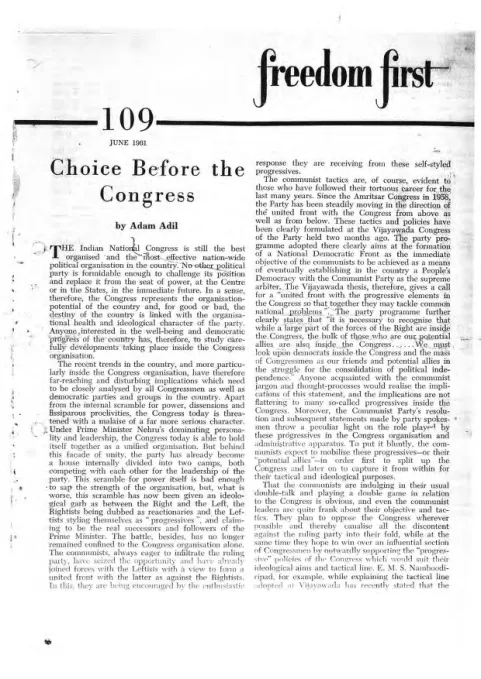
periodical issue
Freedom First
By S. Sharangpani, Oskar Helmer, K. K. Sinha, James Burnham, Nissim Ezekiel
published for the Democratic Research Service by B. K. Desai at 127 Mahatma Gandhi Road, Bombay 1 · Bombay · 1961
12 pages
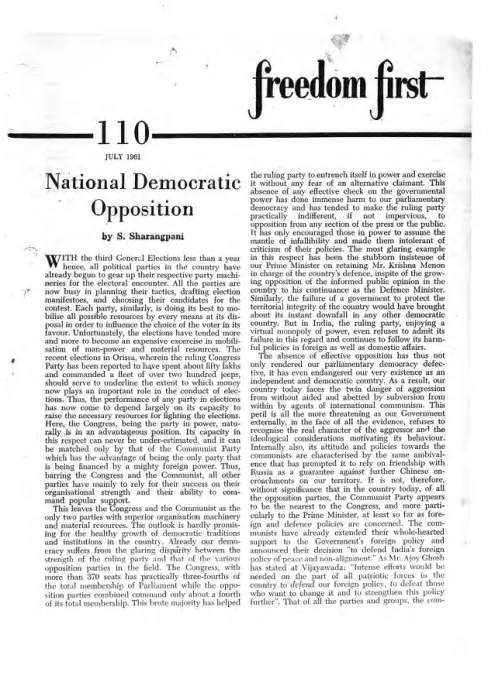
Freedom First
Summary
This is the July 1961 issue (No. 110) of Freedom First, the Bombay-based monthly of the Democratic Research Service, edited by V. B. Karnik. The lead editorial article by S. Sharangpani argues that India’s fragmented opposition parties must unite into a common ‘National Democratic Opposition’ bloc to counter what it portrays as a creeping Congress-Communist alliance, warning that the ruling Congress’s parliamentary dominance rests on a divided opposition vote rather than genuine majority support. The issue’s other contributions are a mix of translated foreign commentary and domestic reporting: Austrian Socialist elder statesman Oskar Helmer’s essay on the costs of Austria’s compelled Cold War neutrality; American conservative James Burnham’s National Review piece arguing that the Western policy of ‘containment’ has structurally failed in Laos and beyond; K. K. Sinha’s report on a Delhi convention of ‘nationalist Muslims’ and its resolutions on minority grievances; and poet Nissim Ezekiel’s critique of a Bombay magistrate’s judgment banning Lady Chatterley’s Lover. A running ‘Notes’ section comments on a British-launched ‘Prisoners of Conscience’ movement, G. D. Birla’s advocacy of expanded Indo-Soviet trade, the Punjab government’s arrests of Akali leaders, and the death of journalist Khasa Subba Rau. A ‘Without Comment’ press digest reprints wire reports on the Soviet-UAR rift over the treatment of Arab communists, and a closing ‘With Many Voices’ page collects topical quotations from Kennedy, Khrushchev, A. D. Gorwala, and others.
Key points
-
S. Sharangpani’s lead article calls for India’s fragmented opposition parties to unite into a “National Democratic Opposition” bloc against a creeping Congress-Communist alliance.
-
Oskar Helmer’s essay argues Austria’s 1955 declaration of neutrality was in substance an enforced neutralisation extracted under Soviet pressure, warning against its drift into “ideological neutralism.”
-
Notes report a British “Prisoners of Conscience” campaign, G. D. Birla’s advocacy of expanded Indo-Soviet trade, the Punjab government’s arrests of Akali leaders, and the death of journalist Khasa Subba Rau.
-
K. K. Sinha’s report on a Delhi “nationalist Muslim” convention argues real remedies for minority grievances lie in fair administrative practice rather than conferences.
-
James Burnham’s “Laos And Containment” argues Western containment doctrine is structurally bankrupt because it cannot combine halting communist advance with renouncing offensive operations.
-
Nissim Ezekiel’s essay dissects a Bombay magistrate’s judgment banning “Lady Chatterley’s Lover” as a failure of commonsense rather than merely a threat to free expression.
-
A “Without Comment” digest tracks the widening Soviet-UAR rift over the treatment of Arab communists.
-
“With Many Voices” closes with Cold War quotations from Kennedy and Khrushchev, and A. D. Gorwala’s satire on the elastic Indian use of “leftist.”
Essays
National Democratic Opposition
By S. Sharangpani
S. Sharangpani’s lead article argues that with the third General Elections less than a year away, India’s opposition parties are hopelessly outmatched by the Congress and the Communist Party, the only two parties with superior organisational machinery and material resources, and calls for the Praja-Socialist, Swatantra, Jan Sangh, and Socialist parties to unite on a common national democratic platform. The piece contends that Congress’s parliamentary ‘brute majority’ rests on a divided opposition vote, not on real popular support, since the Congress share of votes was only 43% in 1952 and 47% in 1957. It devotes substantial attention to what it calls a growing Congress-Communist alliance, citing the Communist Party’s Vijayawada resolutions on ‘infiltrating the ruling party,’ the Orissa elections where communists openly backed Congress, and the government’s ambivalent posture toward China and Russia amid continuing border encroachments. The author frames the danger as twofold: external aggression and internal subversion abetted by an opposition vacuum, and closes by urging the non-Communist opposition parties to pool their strength to ‘save the country from sliding into the communist camp.’
- Congress and the Communist Party alone command superior organisation and resources; other opposition parties must rely on organisational strength and popular support instead
- Congress’s parliamentary majority (over 370 seats) conceals a minority vote share: only 43% in 1952 and 47% in 1957
- The article alleges a deepening Congress-Communist alliance, citing Communist Party tactics of ‘infiltrating’ Congress and forming a ‘shift to the Left’ faction within it
- Cites the Orissa elections as an example where communists gave ‘fraternal assistance’ to the ruling Congress Party
- Criticizes the government’s continued backing of Krishna Menon as Defence Minister despite public opposition, and its reliance on friendship with Russia against Chinese encroachments
- Calls for the Praja-Socialist, Swatantra, Jan Sangh, and Socialist parties to combine into a single national democratic opposition bloc
- Warns the country has already lost roughly 12,000 square miles of territory (equal to the state of Kerala) due to what the author calls the government’s misplaced trust in the Congress leadership’s foreign policy judgment
Neutrality And Its Consequences
By Oskar Helmer
No summary was extracted for this article. Listed for completeness.
The Muslim Convention
By K. K. Sinha
No summary was extracted for this article. Listed for completeness.
Laos And Containment
By James Burnham
No summary was extracted for this article. Listed for completeness.
How Not To Ban A Book
By Nissim Ezekiel
No summary was extracted for this article. Listed for completeness.
Notes: Prisoners Of Conscience
No summary was extracted for this article. Listed for completeness.
Notes: Trading With The Devil
The ‘Notes’ section of this issue covers four brief items. ‘Prisoners Of Conscience’ reports on a newly launched British-based movement (backed by three lawyer-MPs) campaigning for the release of political prisoners worldwide under an ‘Appeal for Amnesty, 1961,’ timed to the centenary of Lincoln’s inauguration and the emancipation of Russian serfs. ‘Trading With The Devil’ discusses G. D. Birla’s advocacy, following his visit to Russia, for expanded Indo-Soviet trade, while cautioning that a communist country treats foreign trade as a political instrument and that Indian businessmen should not be under illusions about the Soviet Union’s intentions despite Birla’s optimism. ‘Arrests In The Punjab’ criticizes the Punjab government’s arrest of numerous Akali leaders in early June as panicky, arbitrary, and likely to strengthen rather than weaken the Akali movement’s public support, noting Master Tara Singh’s threatened fast unto death was not set to begin before August 15. A short obituary mourns the death of journalist Khasa Subba Rau, editor of the weekly Swarajya, praised for his independence, courage, and willingness to fight lone battles for his principles.
- A British movement for ‘Prisoners of Conscience’ has launched an ‘Appeal for Amnesty, 1961’ campaign, timed to the centenary of Lincoln’s inauguration and Russian serf emancipation
- G. D. Birla, after a visit to Russia, urges expanded India-Russia trade; the piece welcomes this cautiously but warns communist states use trade as a political instrument
- The Punjab government’s arrest of many Akali leaders in early June is criticized as panicky, arbitrary, and a violation of civil liberties likely to strengthen the Akali movement
- An obituary honours journalist Khasa Subba Rau, editor of Swarajya, for his independent and courageous journalism
Notes: Arrests In The Punjab
Oskar Helmer, an Austrian Socialist elder statesman and former Interior Minister, analyzes the origins and consequences of Austria’s 1955 declaration of permanent neutrality, arguing that what is legally presented as ‘voluntary’ neutrality was in substance an enforced neutralization extracted under Soviet pressure as the price of the State Treaty and the withdrawal of occupying forces. He traces the diplomatic history from the 1955 National Council resolution through Molotov’s 1954 Berlin statements and the Austrian delegation’s 1955 Moscow negotiations, arguing that Austria had no real choice but to pledge itself to neutrality to secure sovereignty. Helmer further contends that this externally-imposed neutrality carries a risk of sliding into ‘ideological neutralism,’ citing Chancellor Raab’s since-abandoned 1955 attempt to extend neutrality into a muzzling of press freedom and public opinion, which Helmer says was successfully resisted. He concludes that Austria must observe its neutrality pledge strictly in military matters while guarding against any further erosion of sovereignty five years on.
- Austria’s 1955 declaration of neutrality is framed as legally ‘voluntary’ but was in practical terms an enforced neutralization imposed under Soviet pressure as a precondition of the State Treaty
- Traces the diplomatic sequence: the 1953 Federal Government inquiry, Molotov’s February 1954 Berlin Conference remarks, and the Austrian delegation’s April 1955 Moscow negotiations
- Notes the Soviet Union viewed Austrian neutrality as a template it hoped Germany would also adopt, per Molotov’s 1955 Presidium address
- Warns of a slide from military neutrality into ‘ideological neutralism,’ citing Chancellor Raab’s October 1955 broadcast that risked implying restrictions on press freedom
- Records that Helmer and public opinion successfully pushed back against Raab’s expansive interpretation, preserving press and individual freedoms
- Concludes that Austria should observe neutrality strictly in the military sphere without further voluntarily restricting its sovereign rights
nationalist Muslim
K. K. Sinha reports on a two-day ‘nationalist Muslim’ convention recently held in Delhi, arguing that while restricted in composition (delegates were handpicked by convention organizers), it authentically surfaced the Muslim community’s sense of discrimination in India despite the liberal Constitution and government under Nehru. Sinha notes the convention notably avoided discussing Pakistan while passing resolutions on Goa and Algeria, seeing this as a sign of calculated caution. Two resolutions emerged: a request for a commission to enquire into minority grievances, and a call for an all-party conference (restricted to those believing in socialism and secularism) to promote national integration. Sinha is skeptical that such conferences will produce concrete results, arguing the real remedy lies in day-to-day administrative practice free of discrimination, and criticizes the Congress for a ‘basic hypocrisy’ between its professed secularism and its actual governance. The piece (continued on page 11) closes by noting the participation of Dr. Z. A. Ahmed, a communist leader whose presence Sinha calls a misfit given the contradiction between his advocacy for minority rights in India and his support for the suppression of liberties in Communist states.
- The Delhi Muslim Convention was sponsored by ‘nationalist Muslims’ with handpicked delegates, and deliberately avoided discussing Pakistan while addressing Goa and Algeria
- The convention passed two resolutions: for a commission to enquire into minority grievances, and for an all-party conference restricted to socialists and secularists on national integration
- Sinha argues real remedies lie in day-to-day administrative fair-play rather than conferences or commissions, accusing Congress of ‘basic hypocrisy’ between its secular professions and practice
- Identifies a latent contradiction in the convention’s stance between seeking ordinary constitutional citizenship rights and seeking special minority protections
- Criticizes the participation of communist leader Dr. Z. A. Ahmed as inconsistent, given his support for suppressing liberties within Communist states while demanding rights protections in India
Essay 5
James Burnham, in a piece reproduced from the American magazine National Review, argues that the crisis in Laos demonstrates the structural impossibility, not merely the undesirability, of a Western policy of pure ‘containment.’ He contends containment demands the contradictory combination of halting Communist advance while renouncing any offensive operations inside the enemy’s own sphere, a combination he says cannot be sustained in practice, and traces its repeated failures from Truman through Eisenhower to Kennedy, including the loss of Eastern Europe, mainland China, North Korea, Tibet, and now Laos. He argues that Laos cannot be defended from within Laos alone and that only a policy incorporating offensive elements against the Communist camp itself, such as exploiting Nationalist China’s potential against the mainland, could provide real containment. Burnham warns that the fall of Laos threatens the rest of Southeast Asia, citing Vietnam under heavy attack and Burma’s drift toward Peiping-Moscow, and lays blame for future defeats on President Kennedy if he fails to recognize that containment as a doctrine is bankrupt.
- Burnham argues pure containment is structurally impossible because it requires halting Communist advance while simultaneously renouncing offensive operations inside enemy territory
- Traces containment’s failure across Truman (Eastern Europe, China), Eisenhower (North Korea, North Vietnam, Tibet, Middle East, Africa, the Caribbean), and Kennedy (Laos, Congo, Brazil)
- Contends Laos cannot be defended purely defensively from within Laos; effective defense requires operations or credible threats against the enemy’s own territory
- Cites the potential of Nationalist China (Taiwan) as an unexploited offensive asset against mainland China that containment doctrine forecloses
- Warns that the loss of Laos threatens the defense of the whole of Southeast Asia, including Vietnam and Burma
- Concludes that containment as a US foreign policy doctrine is ‘bankrupt’ and places responsibility for future defeats on President Kennedy if he fails to learn this lesson
Essay 6
Poet and critic Nissim Ezekiel dissects the judgment of Mr. M. Nasrullah, Additional Chief Presidency Magistrate of Bombay, who fined a bookseller and partners for selling and possessing D. H. Lawrence’s Lady Chatterley’s Lover. Ezekiel argues the magistrate’s judgment reflects not just a threat to freedom of expression but a failure of commonsense and intelligence, pointing out factual errors (Lawrence was not, contrary to the judgment, a ‘sick and dying man’ throughout 1926-28, a period of prolific output) and a muddled ‘triple division’ of society into intellectuals, libertines, and the ‘average man,’ which Ezekiel finds analytically incoherent since these categories overlap and shift. He contends the novel has never been widely read and that only a small minority would actually seek its suppression, while defending the book’s literary seriousness. Ezekiel concludes that the Bombay judgment is an ‘ignominious’ episode in the international history of the Lady Chatterley case, lacking serious intellectual content and likely to expose India to ridicule.
- Ezekiel argues the Nasrullah judgment banning Lady Chatterley’s Lover in Bombay reflects a failure of commonsense and intelligence, not just a threat to free expression
- Points out factual errors in the judgment, including the claim Lawrence was a ‘sick and dying man’ between 1926 and 1928, a period during which he was in fact highly productive
- Criticizes the magistrate’s ‘triple division’ of society into university intellectuals, libertines, and the ‘average man’ as a farcical and overlapping categorization
- Argues that only a small minority actually wish to see the novel eliminated from circulation, most critics preferring ‘silent censure’ over banning
- Frames the case as an ‘ignominious’ episode in the international history of the Lady Chatterley ban, lacking serious intellectual content
Communism vs. Arab Nationalism,
The ‘Without Comment’ column, subtitled ‘Communism vs. Arab Nationalism,’ reprints a sequence of wire-service and newspaper reports from late May through June 1961 on the deteriorating relationship between the Soviet Union and the United Arab Republic. Items track Pravda’s attacks on Cairo journals Al Ahram and Al Mussawar Jad for criticizing Soviet policy, a Soviet Central Council of Trade Unions protest over the arrest and torture of Arab communist leaders (naming the death of Lebanese communist Faradzhalla Khel in a Syrian prison), Khrushchev’s warning to a visiting UAR parliamentary delegation that anti-communism risks the ‘imperialist trap,’ Egyptian Vice-President Anwar el Sadate’s reply defending the UAR’s anti-communist stance as a matter of national sovereignty, a warning from Arab defence ministers meeting in Cairo, and a report of the communist-aligned All-India Peace Council in New Delhi joining the campaign against the UAR’s suppression of communists. The compiled reports illustrate the widening ideological rift between Nasser’s Arab nationalism and Soviet-aligned communism during mid-1961.
- Pravda (May 31) attacked Cairo publications Al Ahram and Al Mussawar Jad for anti-Soviet commentary, comparing Arab socialism critically to the Soviet order
- The Soviet Central Council of Trade Unions protested (June 3) the arrest and torture of Arab communist leaders, citing the death of Lebanese communist leader Faradzhalla Khel in a Syrian prison
- Khrushchev warned a visiting UAR parliamentary delegation that anti-communism risks falling into ‘the imperialist trap,’ while Anwar el Sadate defended the UAR’s stance as confined to national boundaries
- Arab defence ministers meeting in Cairo, including Saudi Arabia’s Defence Minister, affirmed support for the UAR’s anti-communist campaign as directed against communists generally, not the UAR specifically
- The communist-aligned All-India Peace Council in New Delhi sent a protest letter to President Nasser over the death of Jafrullah Helou, a Lebanese communist, in a UAR prison
- Western observers cited in the reports believe the Soviet-UAR rift ‘goes much deeper’ than prior disputes and reflects tougher underlying attitudes
With Many Voices
The closing ‘With Many Voices’ page compiles topical quotations drawn from newspapers and magazines of May and June 1961, framed by an epigraph from Tennyson. The selections span Cold War and domestic Indian politics: President Kennedy on believing in world revolution and on Canada-US relations; Khrushchev’s warning to the UAR against anti-communism; commentary on Berlin, Cuba, Congo, and Kenya; A. D. Gorwala’s satirical note on the elastic use of the word ‘leftist’ in Indian political discourse; and a Mankind magazine quip on the number of ‘rajas, maharajas, capitalists, pandits, and maulvis’ within the Congress party exceeding the combined communist parties plus the Swatantra Party. The page also carries a subscription coupon for Freedom First and an advertisement for the magazine Encounter.
- Compiles quotations from Kennedy, Khrushchev, Lyndon Johnson, Martin Luther King, William Henry Chamberlain, J. P. Roche, and others on Cold War themes from May-June 1961
- A. D. Gorwala’s quote satirizes the elastic Indian political use of ‘leftist’ as an umbrella term covering communists, sympathizers, and journals alike
- A Mankind magazine quotation asserts the Congress contains more ‘rajas, maharajas, capitalists, pandits, and maulvis’ than all communist parties combined plus the Swatantra Party
- Includes practical magazine material: a Freedom First subscription coupon and a full advertisement for Encounter magazine
Generated by the v1.5 extraction pipeline. Awaiting editorial review.
Metadata and summary are AI-extracted from the source PDF and reviewed for editorial accuracy. The original work is available via the Read PDF tab above (where present); paragraph-level citation inside the PDF is deferred to a future engagement.