periodical issue
Freedom First
Edited by V. B. Karnik and printed at Inland Printers, 55 Gamdevi Road, Bombay 7 and published for the Democratic Research Service by B. K. Desai at 127 Mahatma Gandhi Road, Bombay 1. · Bombay · 1961
12 pages
Freedom First
Summary
Freedom First No. 113 (October 1961) is a monthly issue of the Bombay-based liberal periodical opening with an unsigned-masthead lead essay by Adam Adil assessing the Belgrade Conference of non-aligned nations, arguing that most “neutralist” delegations were in practice anti-Western. M. A. Venkata Rao follows with a reflective piece on the cynicism and isolation he found among Bangalore City voters while himself standing for the Lok Sabha, arguing for civic education toward a democratic “public mind.” A short unsigned obituary mourns UN Secretary-General Dag Hammarskjoeld’s death in the Congo crisis. Thomas J. Dodd contributes a lengthy retrospective, “Hungary — The Missed Opportunity,” faulting Western unpreparedness during the 1956 Hungarian Revolution and drawing lessons for future captive-nation uprisings. A report on the Afro-Asian Council’s New Delhi executive committee meeting (26-28 August, chaired by Jayaprakash Narayan) summarizes resolutions on Algeria, Berlin, and Tibet. A multi-signatory open letter, “A Reply To Mayor Willy Brandt,” addresses the Berlin Wall crisis in the language of universal human rights, signed by an international roster including Raymond Aron, Jorge Luis Borges, Sidney Hook, J. Robert Oppenheimer, Michael Polanyi, Stephen Spender, Jayaprakash Narayan, and Minoo Masani. A “Review” section covers Germaine Tillion’s Algeria, the Realities and C. Rajagopalachari’s Satyam Eva Jayate. “Without Comment” compiles quoted press clippings contrasting Walter Ulbricht’s East Germany with Hitler-era practices, Khrushchev statements on nuclear tests, and reports on Soviet cosmonaut deaths and a cancelled Soviet ambassadorial cinema visit in London. The issue closes with the continuation of the Hungary essay and the Afro-Asian Council report.
Key points
-
Adam Adil’s “The Belgrade Conference” argues most delegates at the non-aligned summit were in practice anti-Western, condemning Western colonialism while staying silent on Soviet and Chinese abuses.
-
M. A. Venkata Rao’s “The Mind Of The Electorate” reflects on voter cynicism and caste-based bloc voting drawn from his own Lok Sabha candidacy in Bangalore City, calling for civic education.
-
An unsigned obituary eulogises UN Secretary-General Dag Hammarskjoeld as a martyr to Congolese unity, killed amid the Congo crisis.
-
Thomas J. Dodd’s “Hungary — The Missed Opportunity” argues the West’s failure to act during the 1956 Hungarian Revolution was one of the gravest post-war policy failures, and calls for a “Freedom Academy” to train Free World counteraction.
-
A report on the Afro-Asian Council’s New Delhi meeting, chaired by Jayaprakash Narayan, summarises resolutions on Algeria, Berlin, Tibet, and the Sino-Indian border dispute.
-
An open letter, “A Reply To Mayor Willy Brandt,” signed by intellectuals including Raymond Aron, Jorge Luis Borges, and Sidney Hook, frames the Berlin Wall as a violation of the human right to leave one’s country.
-
Reviews cover Germaine Tillion’s “Algeria, the Realities” and C. Rajagopalachari’s “Satyam Eva Jayate,” the latter framed as building the intellectual case for the Swatantra Party.
-
A “Without Comment” digest likens Walter Ulbricht’s East Germany to Hitler’s regime and recounts a farcical cancelled Soviet embassy film screening in London.
Essays
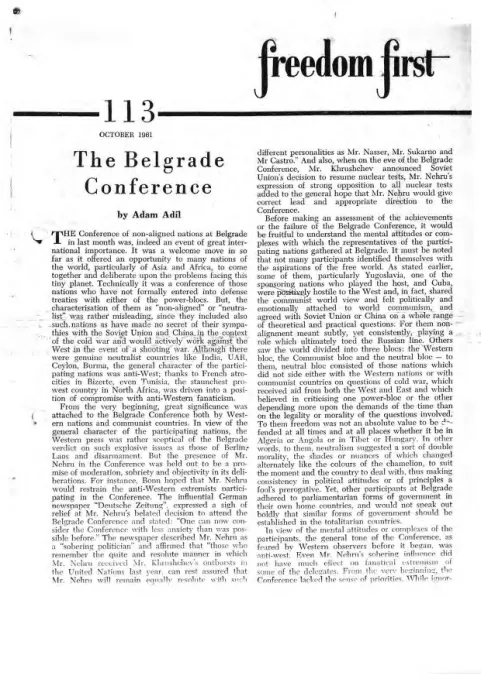
The Belgrade Conference
By Adam Adil
Adam Adil surveys the Belgrade Conference of non-aligned nations (September 1961), arguing that despite offering a genuine forum for African and Asian nations, the “non-aligned” or “neutralist” label was largely misleading: many participants, notably Yugoslavia and Cuba, were openly sympathetic to Soviet and Chinese communism and the Conference’s general tenor was anti-Western. The essay contrasts the delegates’ vocal condemnation of Western colonialism with their near-total silence on Soviet and Chinese “colonialism” in Eastern Europe and Tibet, and criticizes the Conference’s failure to take a firm stand on Berlin or to offer any constructive resolution to the Cold War standoff. It closes by crediting the Conference with a few negative achievements, such as blocking the Soviet-backed “troika” proposal for the UN Secretariat, thanks partly to Nehru’s opposition.
- The Belgrade Conference brought together non-aligned African and Asian nations but the label was misleading since many members openly sympathized with Soviet/Chinese communism.
- Yugoslavia (as host) and Cuba are singled out as positively hostile to the West and aligned with world communism.
- Delegates divided the world into Western, Communist, and neutral blocs, with neutralism functioning as a shifting, opportunistic position rather than a principled one.
- Khrushchev’s announcement resuming nuclear tests on the conference’s eve drew only muted criticism from delegates despite Nehru’s own opposition to all nuclear testing.
- The Conference exhibited complete silence on Soviet/Chinese colonialism in Eastern Europe and Tibet while loudly condemning Western colonialism in Algeria, Angola, and South Africa.
- On Berlin, most delegates were unwilling to uphold the legal and moral position of the West or the rights of West Berliners, in effect conceding ground to communist dictatorship.
- The Conference’s chief accomplishments were negative: defeating the Soviet-backed ‘troika’ reorganization of the UN Secretariat, partly due to Nehru’s opposition.
The Mind Of The Electorate
By MA Venkata Rao
M. A. Venkata Rao reflects on the absence of a coherent “public mind” among Indian voters, drawing on his own experience as a Lok Sabha candidate for Bangalore City in the recent general elections. He describes widespread cynicism among both educated and uneducated voters, who felt their individual votes could not influence outcomes dominated by party bosses and charismatic leaders like Nehru, and recounts anecdotes of voter indifference, caste-based bloc voting, and candidates buying influence through community leaders. He calls for long-term civic education so that voting becomes a “sacred obligation,” for public discussion of principles over personalities, and for intellectuals to expose the shallowness of Marxism and articulate deeper social ideals.
- There is no single ‘Mind of the electorate’ in India — no shared public mind of ideas and attitudes on major issues comparable to what democracy requires.
- The author’s Lok Sabha candidacy in Bangalore City revealed widespread cynicism, especially the sense that individual votes did not matter against big-party bosses and charismatic leadership.
- Voter isolation and futility were reinforced by low turnout and indifference, with polling-day holidays often used for leisure rather than voting.
- Some educated voters expressed cynical pride in seeing through party hypocrisy, believing all parties are equally unreliable and corrupt.
- Caste-based bloc voting persisted though it could sometimes be overcome when trusted candidates crossed caste lines; money was also used to induce anti-caste voting.
- The author invokes Julius Benda’s Treason of the Clerks (The Great Betrayal) to condemn intellectuals’ complicity, and calls for civic education to make voting a ‘sacred obligation.’
- He urges educated candidates and thinkers to expose the shallowness of Marxism and cultivate deeper social ideals through press, platform, and study circles.
Dag Hammerskjoeld
A brief unsigned obituary honors UN Secretary-General Dag Hammarskjoeld, who died amid the Congo crisis, describing him as a martyr to the cause of Congolese unity and freedom and to the principle of international intervention against civil war and exploitation by outside powers. It praises his fearlessness and impartiality under criticism from both sides of the Cold War and expresses hope that the UN will continue his line of policy in the Congo and resist Soviet efforts (the ‘troika’ proposal) to weaken the organization.
- Dag Hammarskjoeld is eulogized as a martyr to the cause of Congolese unity and freedom and to international intervention against civil war.
- His fearlessness, impartiality, and integrity in performing an unpopular task under criticism from both Cold War blocs are emphasized.
- The piece expresses hope the UN will continue his policies in the Congo despite his death.
- It calls for resisting Russian efforts to weaken the UN via the ‘troika’ proposal for the Secretariat.
- Mystery surrounding the circumstances of his death (crash) is noted, with hope that investigations will clarify whether it was sabotage or accident.
Hungary — The Missed Opportunity
By Thomas J. Dodd
Thomas J. Dodd argues that the West’s failure to act decisively during the 1956 Hungarian Revolution was one of the gravest policy failures of the postwar period, representing a lost opportunity to roll back communist control in Eastern Europe. He contends the revolution, even in defeat, was a significant victory for the cause of freedom because it exposed the illegitimacy of Soviet rule and shattered the myth of popular support for communism, comparing it to Napoleon’s pyrrhic ‘victory’ at Borodino. The essay narrates the timeline of the revolution — the Poznan revolt, Imre Nagy’s government, Hungary’s withdrawal from the Warsaw Pact, and the UN’s slow, ultimately ineffective response — and Dodd lists specific missed opportunities: failing to recognize Nagy’s government promptly, failing to prepare a UN resolution before the Soviet crackdown, and the Security Council convening at Cuban rather than American insistence. He closes (in the continuation on page 12) urging that future ‘Hungaries’ are inevitable given communist repression, and calls for strengthened NATO ground forces, a ‘Freedom Academy’ to train Free World representatives in counteraction, and sustained propaganda on Soviet imperialism.
- Dodd calls the West’s failure to act during the 1956 Hungarian Revolution one of the gravest post-war policy failures, arguing a favorable conjuncture of Soviet weakness made liberation achievable.
- He argues the Revolution, though defeated, was a ‘many-sided victory’ for freedom, exposing the lie of Communist popular support, akin to Napoleon’s Pyrrhic victory at Borodino as recounted by Tolstoy.
- The essay narrates the timeline: the Poznan revolt, formation of Imre Nagy’s government, Hungary’s declared neutrality and withdrawal from the Warsaw Pact, and Nagy’s urgent UN appeal on November 1, 1956.
- Dodd faults the UN and US for slow response: Nagy’s appeal was buried among mimeographed documents and not read by many delegates before the Soviet crackdown, and John Foster Dulles’s medical collapse hampered US diplomacy at the critical juncture.
- The Security Council met on Hungary only at Cuban insistence, not American, and the Yugoslav delegate argued for adjournment rather than intervention — a proposal supported by US Ambassador Lodge, which Dodd says he cannot understand.
- Dodd lists six concrete steps that should have been taken: prompt recognition of the Nagy government, lining up UN support in advance, dispatching UN observers immediately, marking Nagy’s communications ‘urgent’, warning the USSR of sanctions for reinvasion, and placing US/NATO forces on alert.
- He predicts more ‘Hungaries’ are inevitable given communist regimes’ inherent tendency toward crisis, and calls for strengthened NATO ground forces and a ‘Freedom Academy’ to train Free World representatives in the ‘science of liberation.‘
Afro—Asian Council
An unsigned report on the Executive Committee meeting of the Afro-Asian Council, held in New Delhi from 26-28 August under the chairmanship of Jayaprakash Narayan, records the constitution and objectives adopted (promoting cooperation among member nations, eradicating colonialism, and upholding human rights and self-determination) and summarizes resolutions on the Association of South-East Asia (ASA), Algeria, Berlin, and the question of Tibet at the UN, plus a resolution on the Sino-Indian border dispute expressing concern over Chinese incursions into Indian territory.
- The Afro-Asian Council’s Executive Committee met in New Delhi (26-28 August) under Jayaprakash Narayan’s chairmanship, with delegates from Ceylon, Turkisland, Japan, Jordan, Lebanon, Malaya, Philippines, Congo (Brazzaville), South Vietnam, Thailand, and Tibet.
- The Council adopted a constitution with objectives of promoting social, economic, cultural, and political cooperation, eradicating colonialism and discrimination, and upholding human rights and self-determination.
- Jayaprakash Narayan was reelected President; Yoji Hirola, Nusseibeh, and Senator Tan were elected Vice-Presidents; Leela P. Trikamdas was elected Honorary Secretary General.
- A resolution welcomed the formation of ASA (Malaya, Thailand, Philippines) as a step toward regional cooperation.
- On Algeria, the Committee criticized French partition attempts and supported the Algerian Provisional Government’s independence struggle.
- On Berlin, the Committee called the sealing off of East Berlin a violation of basic human rights and urged negotiated resolution to avert a threat to world peace.
- A resolution on the Sino-Indian border dispute condemned Communist Chinese incursions into Indian territory as reflecting expansionist and aggressive designs, and upheld India’s position.
- The Committee resolved to send Purshottam Trikamdas to the UN’s 16th Session to assist on Tibet and Algeria questions, and sent a cable to Marshal Tito urging the Neutral Nations Summit to take up Tibetan self-determination.
A Reply To Mayor Willy Brandt
An open letter addressed to Mayor Willy Brandt of Berlin, signed by a large international roster of intellectuals and public figures, responds to the Berlin Wall crisis by framing the right to leave one’s country (citing Article 12 of the Universal Declaration of Human Rights) as a fundamental human right transcending politics or ideology. The signatories argue that both rebellion and flight are understandable human responses to denial of self-determination, invoke Pushkin’s Boris Godunov to condemn the ‘reactionary and unnatural command’ of sealing borders, and declare they will not cease to insist that all governments be measured against the right of all human beings to freedom and dignity.
- The letter frames the Berlin Wall and the shooting of escapees as a violation not of politics but of an elementary human right to leave one’s own country, citing Article 12(2) of the Universal Declaration of Human Rights.
- It argues self-determination is a human right transcending narrow political or economic considerations, applicable equally to rebels and refugees.
- It invokes Pushkin’s Boris Godunov, quoting the Czar’s order to fence the frontiers, as an analogy for the ‘reactionary and unnatural command’ being re-enacted at the Berlin Wall.
- The letter closes with a pledge that barbed wire and bayonets will not be accepted as the ‘decor’ of any new freedom, and that all governments’ claims must be measured against the right to life and dignity.
- Signatories include Raymond Aron, Jorge Luis Borges, A. K. Brohi, Victor Raul Haya de la Torre, Sidney Hook, J. Robert Oppenheimer, Michael Polanyi, Stephen Spender, Minoo Masani, and Jayaprakash Narayan, among many others from Europe, Asia, Africa, and the Americas.
Review: Algeria, the Realities (Germaine Tillion)
The Review section carries two short book notices. The first, on Germaine Tillion’s Algeria, the Realities, praises her sociological analysis of the impoverishment and cultural decay caused by the French-Algerian contact, though the reviewer disputes her view that colonialism is a mere scapegoat, arguing instead that colonialism itself blocks the natural adaptation of an ‘archaic’ society to industrial civilization. The second, on C. Rajagopalachari’s Satyam Eva Jayate (a compilation of his 1956-61 articles from Swarajya), commends Rajagopalachari’s courage of conviction and wide-ranging commentary, framing the volume as part of the intellectual case for the Swatantra Party’s opposition politics, signed ‘V.B.K.’
- Germaine Tillion’s Algeria, the Realities is reviewed as a germinal sociological study of Algeria’s impoverishment and cultural decay from contact with industrial France.
- The reviewer disputes Tillion’s view that colonialism is a mere scapegoat, arguing colonialism itself prevents natural adaptation between archaic and industrial societies.
- C. Rajagopalachari’s Satyam Eva Jayate collects his 1956-61 articles (mostly from Swarajya) and is praised for solid common sense and the author’s courage of conviction.
- The review frames Rajagopalachari’s articles as building the intellectual case for the Swatantra Party’s opposition to Congress policies.
- The review is signed with the initials V.B.K.
Review: Satyam Eva Jayate (C. Rajagopalachari)
By V.B.K.
The ‘Without Comment’ feature compiles quoted press clippings without editorial commentary. The first item, from an Austrian Socialist daily, likens Walter Ulbricht’s East Germany to Hitler’s regime, citing the reintroduction of forced labour and detention camps for those attempting to flee. A second item strings together Khrushchev’s public statements calling for disarmament and an end to nuclear testing, ironic given the Soviet resumption of tests. A third item, ‘Not All Russians Are Heroes,’ recounts an anti-communist Glasgow group’s leaflet naming Soviet cosmonauts who allegedly died in earlier space attempts, and a farcical episode in which the Soviet ambassador’s public screening of a Gagarin film in London was cancelled after the leaflet campaign, forcing a small private cinema screening instead.
- An Austrian Socialist daily (Arbeiter Zeitung) compares Walter Ulbricht’s East Germany to Hitler’s regime, citing reintroduced forced labour and detention camps for would-be escapees.
- A compilation of Khrushchev’s own quoted statements calling for disarmament and cessation of nuclear tests is juxtaposed, ironically, against the Soviet Union’s actual resumption of testing.
- The ‘Not All Russians Are Heroes’ item describes a Glasgow-based anti-communist group, ‘Friends of Free Russia,’ distributing a leaflet naming Soviet cosmonauts allegedly killed in earlier space missions before Gagarin.
- The same item recounts how a planned public screening of the Soviet film ‘With Gagarin to the Stars’ for the Soviet London Embassy was abruptly cancelled and replaced with a small private cinema screening after the leaflet campaign became known.
Generated by the v1.5 extraction pipeline. Awaiting editorial review.
Metadata and summary are AI-extracted from the source PDF and reviewed for editorial accuracy. The original work is available via the Read PDF tab above (where present); paragraph-level citation inside the PDF is deferred to a future engagement.