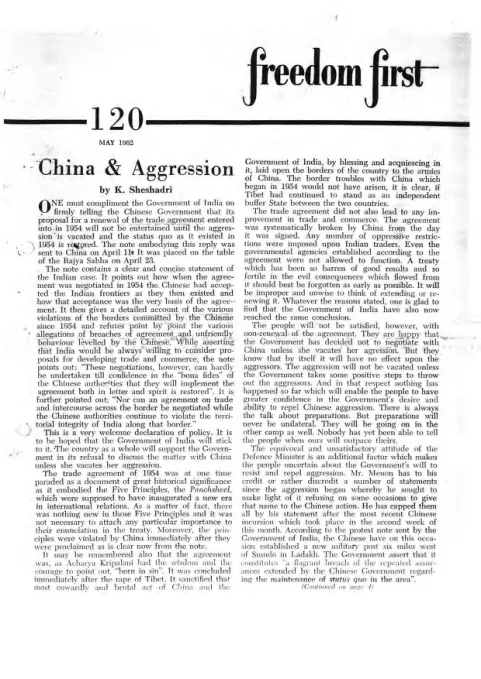
periodical issue
Freedom First
Publisher's Name: B. K. Desai, 127, Mahatma Gandhi Road, Bombay 1; Printer's Name: B. K. Desai, The Inland Printers, Bombay 7; issued for the Democratic Research Service · Bombay · 1962
12 pages
Freedom First
Summary
Freedom First No. 119 (April 1962) is dominated by analysis of the Third General Election, held earlier that year, and its implications for Indian democracy. B. K. Desai’s lead editorial-style essay reads the results as a Congress victory that masks organisational decline and a widening space for opposition parties, especially the Swatantra Party and Jan Sangh. Two companion pieces examine flashpoints within that election: V. B. Karnik dissects the North Bombay parliamentary contest in which Krishna Menon defeated Acharya Kripalani, and M. A. Venkata Rao warns that Menon’s win strengthens covert Communist Party influence inside the Congress government (the ‘elephant, mahout and raja’ allegory). S. R. Mohan Das traces the ideological and organisational history of the DMK’s rise in Madras. The issue also carries international reporting — a contributed piece on the deepening Sino-Soviet ideological rift, and E. P. Whittemore’s account of how Castro’s Cuba absorbed and purged its labour movement — plus the magazine’s regular ‘Without Comment’ page of press clippings on Eastern Bloc dissidents and ‘With Many Voices’ page of Indian political quotations, alongside the mandated ownership-and-circulation statement.
Key points
-
B. K. Desai’s lead essay reads the Third General Election as a Congress victory masking organisational decline and a widening space for the Swatantra Party and Jan Sangh.
-
V. B. Karnik’s “North Bombay Election” dissects Krishna Menon’s defeat of Kripalani, attributing it to Congress organisational muscle, Nehru’s intervention, and Communist mobilisation.
-
S. R. Mohan Das’s “The Resurgence Of The D.M.K.” traces the party’s lineage from the anti-Brahmin Justice Party to Annadurai’s culturally organised DMK, arguing its separatism is tactical rather than core ideology.
-
M. A. Venkata Rao’s “The Elephant, The Mahout And Raja” warns Menon’s win signals a CPI strategy of infiltrating Congress from within toward a future “National Unity” coalition.
-
A contributed piece reports the deepening Sino-Soviet rift, with Peking’s support for Albania read as an indirect attack on Khrushchev’s “revisionism.”
-
E. P. Whittemore’s “Cuba’s Unions Come Full Circle” chronicles the Confederation of Cuban Workers’ return to complete Communist control, purging genuine anti-Batista labour leader David Salvador.
-
A “Without Comment” digest reports the arrest of Soviet writer Mikhail Naritza and the suicide of Polish journalist Henryk Holland amid a crackdown on liberal journalists.
-
“With Many Voices” closes with Krishna Menon denying he needs to prove his patriotism and Nehru affirming that private enterprise is good for India.
Essays
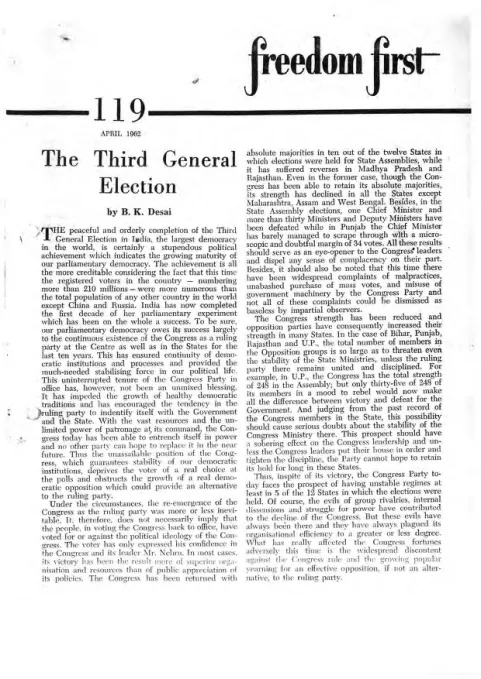
The Third General Election
By B. K. Desai
B. K. Desai surveys the Third General Election of 1962, arguing that the Congress Party’s continued dominance is less a popular endorsement of its ideology than a product of its entrenched organisational advantages and resources. He notes Congress’s declining vote share and legislative strength in several states, widespread complaints of electoral malpractice, and the emergence of the Swatantra Party and Jan Sangh as serious opposition forces, while cautioning that Congress instability looms in states like Bihar, Punjab, Rajasthan and U.P. where its majorities are thin.
- Congress retained power nationally but its vote share and assembly strength declined in most states except Maharashtra, Assam and West Bengal.
- Widespread complaints of malpractice, vote-buying, and misuse of government machinery marked the election.
- The Swatantra Party and Jan Sangh made significant gains and are read as the vanguard of an emerging non-Communist opposition.
- Congress’s continuous tenure has entrenched it in power and stunted the growth of a genuine democratic alternative.
- In several states (Bihar, Punjab, Rajasthan, U.P.) Congress majorities are narrow enough that internal indiscipline could destabilise ministries.
North Bombay Election
By V. B. Karnik
V. B. Karnik gives a detailed account of the North Bombay parliamentary contest between Acharya Kripalani and Defence Minister V. K. Krishna Menon, framing it as a struggle over India’s democratic versus communist future. He argues Menon’s decisive win owed less to popular endorsement of communism than to the alliance of Congress organisational muscle, Nehru’s personal intervention, and Communist Party support mobilised on Menon’s behalf, while slum-dweller vote blocs controlled by local ‘dadas’ further tilted the result against Kripalani’s narrower, more educated base of support.
- Kripalani’s campaign drew enthusiastic backing from intellectuals, film personalities, and figures like Jayaprakash Narayan, but lacked a mass organisational base.
- Menon’s victory margin exceeded the combined vote total of Congress’s own Assembly candidates in the constituency, indicating Communist mobilisation on his behalf.
- Slum-dwelling voters, dependent on local ‘dadas’ for direction, were a decisive and manipulable bloc that broke for Menon.
- Karnik warns against reading the result as a mandate for communism, but also against complacency, since it strengthens Menon’s and the Communist-influenced wing’s position within government.
- The propaganda battle over ‘crypto-communism’ left a lasting impression on public opinion regardless of the vote’s outcome.
The Resurgence Of The D.M.K.
By S. R. Mohan Das
S. R. Mohan Das traces the DMK’s growth into Tamilnad’s dominant opposition force, tracing its lineage from the anti-Brahmin Justice Party of the 1930s through Periyar Ramaswamy Naicker’s Dravida Kazhagam to Annadurai’s more disciplined, culturally-organised DMK. He argues that the DMK’s separatist rhetoric is a tactical device rather than its ideological core, that its real strength lies in cultural, cinematic and organisational infrastructure, and that the party’s relationship to its parent DK and to caste politics in Tamilnad is more complex than alarmist national commentary suggests.
- The DMK won 50 Assembly seats and 7 Lok Sabha seats in 1962, polling 27.1% of the vote in Madras State.
- Its lineage runs from the anti-Brahmin Justice Party through Ramaswamy Naicker’s DK to Annadurai’s breakaway DMK.
- The party built a strong base through the Tamil film industry, newspapers, and cultural organising rather than relying solely on ideology.
- Its demand for an independent Dravidian state is characterised as more a rhetorical device than a realistic goal.
- The DK, the DMK’s parent body, has ironically become associated with Brahmin and high-caste interests via its alliance with Congress, while the DMK represents a more liberal, less extremist offshoot.
The Elephant, The Mahout And Raja
By MA Venkata Rao
M. A. Venkata Rao warns that Krishna Menon’s electoral triumph, read alongside the Communist Party of India’s own stated hope that ‘the elephant needs a mahout,’ signals a deliberate CPI strategy of infiltrating the Congress from within rather than contesting it directly. He surveys CPI tactics since the failure of its Kerala government experiment, predicts a coming push for a ‘National Unity’ coalition government as a vehicle for expanding Communist influence, and cautions that engineered crises — labour unrest, communal tension, border pressure from China — could be used to justify such a coalition, concluding with an appeal for public vigilance against this creeping infiltration.
- The CPI’s own journal, The New Age, described the Congress as an ‘elephant’ needing a communist ‘mahout’ — i.e., Krishna Menon — to steer it toward Moscow-aligned policy.
- Venkata Rao sees Menon’s rising stature, buoyed by Nehru’s patronage, as enabling him to succeed Nehru and further embed Communist influence in government.
- He predicts the CPI will manufacture crises — labour agitation, communal clashes, price unrest — to force a ‘National Unity’ coalition that would give it a share of power.
- He warns of possible admission of Communist Party members into the cabinet, facilitated by China-Soviet diplomatic overtures.
- The piece closes with a call for public opinion (cast as the ‘Raja’ in the elephant-mahout allegory) to stay alert and prevent the mahout from usurping the elephant’s sovereignty.
Sino-Soviet Rift Deepens
By (Contributed)
This contributed piece reports on the widening ideological rift between the Chinese and Soviet Communist parties, documenting how Peking’s rhetorical support for Albania functions as an indirect attack on Khrushchev’s ‘revisionism,’ and situating the split within a longer history of Comintern factionalism dating to Lenin. It surveys likely alignments (Albania, North Vietnam, North Korea, Indonesia, Japan, Algeria, Malaya with China; the mainstream CPSU bloc with Moscow) and closes with Peking’s defiant public statements against anti-Chinese pressure.
- Peking’s economic planners are revising China’s 1962 plans in anticipation of a full halt of Soviet aid.
- Chinese support for Albania is read as an indirect rebuke of Soviet ‘Stalinist’ criticism and cult-of-personality charges.
- A Hong Kong Communist-front paper called Khrushchev ‘much more stupid than’ Chiang Kai-shek, an unusually sharp public jab.
- The article predicts a coalescing ‘Stalinist Menshevik group’ among China, Albania, and several Asian Communist parties.
- Peking’s People’s Daily New Year message warned of an ‘anti-Chinese, anti-Communist and anti-people surge’ and vowed to resist further Soviet sanctions.
Cuba’s Unions Come Full Circle
By E. P. Whittemore
E. P. Whittemore chronicles how the Confederation of Cuban Workers (CTC), founded under a Batista-Communist coalition in the 1930s, has come ‘full circle’ back under complete Communist control following the Cuban Revolution. He contrasts the career of Lázaro Peña, the CTC’s original Communist-aligned founder, with that of David Salvador, a genuine anti-Batista labour organiser who was later purged, imprisoned, and silenced under Castro, and details the 11th CTC Congress of November 1961 at which independent unionism was effectively liquidated in favour of state-directed ‘sections.’
- The CTC was originally established in 1939 under a Batista-Communist Party coalition, with Lázaro Peña as Secretary General.
- David Salvador, a working-class anti-Batista labour leader, rose through the 26th of July Movement’s labour section but was purged after the Revolution and imprisoned for 15 months.
- In August 1961 Cuban trade unions were legally abolished and replaced by Ministry-controlled union ‘sections’ under a new Union Organization Law.
- At the CTC’s 11th Congress (November 1961), Castro personally intervened to force a ‘unity’ slate favoring Communist-aligned ‘melons’ over independent 26th of July labour leaders.
- Workers were made to surrender accumulated benefits (profit-sharing, bonuses, sick leave) and accept increased salary withholding for state industrialization.
Without Comment
This is the magazine’s recurring ‘Without Comment’ feature, reprinting without editorial gloss two press items on repression in the Communist bloc: the arrest of Soviet writer Mikhail Naritza for smuggling his novel ‘Unfinished Song’ abroad for Western publication, and the suicide of Polish journalist Henryk Holland after arrest and police searches amid a crackdown on liberal-leaning journalists in Warsaw.
- Soviet novelist Mikhail Naritza was arrested after his manuscript ‘Unfinished Song’ was smuggled to the West and published pseudonymously in the Frankfurt Russian-language review Grany.
- Naritza had unsuccessfully tried several channels (a French tourist, a West German tourist, Dr. Klaus Mehnert) before his manuscript reached the West.
- Polish journalist Henryk Holland, a former party member and liberal-line figure since 1956, jumped to his death during a police search of his apartment following his arrest.
- Holland’s ex-wife Irena Rybczynska and her husband Stanislaw Brodzki, editor of the illustrated magazine Swiat, were also arrested and later released.
Right, Left & Communism
The ‘With Many Voices’ page compiles short quotations from Indian public figures and international commentators on the political mood following the election, ranging from Krishna Menon’s denial of needing to prove his patriotism to Nehru’s endorsement of private enterprise, alongside sharply differing readings of Congress’s shift toward the political Right from Link and New Age (pro-Communist publications) versus mainstream papers. The same page carries Freedom First’s statutory ownership-and-circulation declaration, naming B. K. Desai as printer/publisher and V. B. Karnik as editor.
- Krishna Menon denies needing to ‘carry a card of patriotism’ in his sleeve, quoted from the Indian Express.
- Nehru is quoted affirming that private enterprise is good for India and that its suppression would be very bad.
- Communist-aligned publications (Link, New Age) frame the Congress as drifting dangerously toward the ‘Right’ and warn against alliance with Swatantra.
- B. C. Patnaik, Chief Minister of Orissa, is quoted calling mixed economy ‘unmixed evil.’
- The statutory notice confirms Freedom First is published monthly from Bombay by B. K. Desai for the Democratic Research Service, with V. B. Karnik as editor and an annual subscription of Rs. 3.
Generated by the v1.5 extraction pipeline. Awaiting editorial review.
Metadata and summary are AI-extracted from the source PDF and reviewed for editorial accuracy. The original work is available via the Read PDF tab above (where present); paragraph-level citation inside the PDF is deferred to a future engagement.