periodical issue
Freedom First
By K. Sheshadri, Ernest Halperin, (Contributed), Adam Adil, John B. Wood
printed at Inland Printers, 55 Gamdevi Road, Bombay 7 and published for the Democratic Research Service by B. K. Desai at 127 Mahatma Gandhi Road, Bombay 1 · Bombay · 1962
12 pages
Freedom First
Summary
Freedom First No. 120 (May 1962) is dominated by the Sino-Indian border standoff and the broader Cold War contest inside the Communist bloc. The unsigned lead editorial, “China & Aggression” by K. Sheshadri, welcomes the Government of India’s refusal to renew the 1954 Panchsheel trade agreement with China until the border aggression is vacated, reviews the history of Chinese treaty violations since 1954, and criticises Defence Minister Krishna Menon’s equivocal public statements on the Ladakh incursions. Several pieces examine fractures and manoeuvring within world communism: Ernest Halperin’s “The New Djilas Affair” covers Milovan Djilas’s renewed persecution in Yugoslavia over his manuscript “Conversations with Stalin”; an unsigned “Notes” section discusses the Chinese National People’s Congress and a British Radcliffe Report on Civil Service security infiltration by communists; a contributed piece, “Asian Reds Between Moscow & Peking,” surveys how Asian Communist parties (Indonesia’s PKI, Japan’s JCP, North Vietnam, North Korea, Outer Mongolia) are positioning themselves in the Sino-Soviet split; and John B. Wood’s “Albania’s Moves Under Scrutiny” examines Albania’s economic dependence on China amid its quarrel with Moscow. Adam Adil’s “Ghana - A One-Party State” turns to Africa, indicting Kwame Nkrumah’s use of preventive detention and one-party consolidation as a betrayal of Ghana’s democratic promise. The issue closes with the recurring “Without Comment” press-digest column (on Czechoslovak and Polish agriculture, Sino-Soviet aid and trade, Pasternak’s rehabilitation, and a study branding the USSR a “master colonial power”) and the “With Many Voices” quotations page, plus a subscription form and masthead identifying the editor as V. B. Karnik, published by the Democratic Research Service, Bombay.
Key points
-
K. Sheshadri’s “China & Aggression” welcomes the government’s refusal to renew the 1954 Panchsheel trade agreement with China until border aggression is vacated, while criticising Krishna Menon’s equivocal statements.
-
Ernest Halperin’s “The New Djilas Affair” covers Milovan Djilas’s renewed persecution in Yugoslavia over his manuscript “Conversations with Stalin.”
-
Notes discuss China’s secretive National People’s Congress amid economic hardship and Britain’s Radcliffe Report on communist infiltration of Civil Service unions.
-
A contributed piece, “Asian Reds Between Moscow & Peking,” surveys how Asian communist parties are positioning themselves in the Sino-Soviet split, noting the Indian Communist Party’s own division following Ajoy Ghosh’s death.
-
Adam Adil’s “Ghana - A One-Party State” indicts Nkrumah’s use of preventive detention and one-party consolidation as a betrayal of Ghana’s democratic promise.
-
John B. Wood’s “Albania’s Moves Under Scrutiny” concludes Albania remains too economically dependent on China to turn West despite its quarrel with Moscow.
-
A “Without Comment” digest covers Czechoslovak and Polish agriculture, halted Russian aid to China, and preparations reportedly underway to rehabilitate Boris Pasternak.
-
“With Many Voices” includes de Gaulle on the Soviet “totalitarian empire” and a jab that Nehru is “the world’s greatest self-contradictor.”
Essays
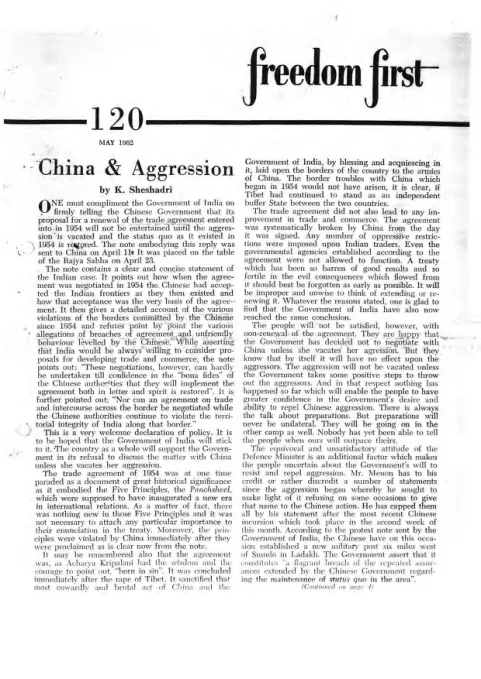
China & Aggression
By K. Sheshadri
This lead editorial praises the Indian Government’s note of April 11, 1962 refusing to renew the 1954 Sino-Indian trade agreement until China vacates its border aggression and restores the pre-1954 status quo. It argues the 1954 agreement (embodying the Panchsheel principles) was “born in sin,” concluded immediately after China’s annexation of Tibet, and was systematically violated by China from the outset. The piece welcomes the government’s firm stance but criticises Defence Minister Krishna Menon for equivocal statements that downplay the seriousness of continuing Chinese incursions, including a new military post established six miles west of Sumdo in Ladakh, and calls for firmer, more energetic government action.
- Government of India refused on April 11, 1962 to renew the 1954 trade agreement with China until aggression is vacated and status quo restored.
- The note was tabled in the Rajya Sabha on April 23 and details China’s border violations since 1954.
- The 1954 agreement, embodying the Panchsheel (Five Principles), is described as having been ‘born in sin’ per Acharya Kripalani, concluded right after the ‘rape of Tibet.’
- China is accused of systematically breaking the trade agreement and imposing oppressive restrictions on Indian traders.
- Defence Minister Krishna Menon is criticised for inconsistent and complacent statements, including denying that a new Chinese incursion near Sumdo in Ladakh ‘created any new situation.’
- The piece calls the aggression a continuing seven-year phenomenon likely to intensify in coming months and urges firmer government action.
The New Djilas Affair
By Ernest Halperin
Ernest Halperin’s piece examines the renewed persecution of former Yugoslav Politburo member Milovan Djilas, arrested again despite his forthcoming book, “Conversations with Stalin,” containing no attack on the Yugoslav regime or communism itself. Halperin argues the Yugoslav leadership’s hostility toward Djilas is driven by emotion rather than reason, treating his dissent as a communist “betrayal of conspirator’s secrets,” and notes that Djilas has already served over four years in prison, been denied a promised amnesty and pension, and struggled to publish his non-political writing, including a biography of the Montenegrin poet Prince-Bishop Peter Petrovitch Njegosh.
- Djilas was sentenced in 1957 for publishing ‘The New Class’ and has now been arrested again over his forthcoming, non-political book ‘Conversations with Stalin.’
- Halperin argues there are no rational grounds for the new arrest; Yugoslav leaders react to Djilas with emotion, viewing him as a traitor to a communist ‘conspiracy.’
- Djilas has served over four years, partly in solitary confinement, and the promised amnesty, pension, and ability to publish have not materialised.
- His biography of national poet Njegosh cannot be published in Yugoslavia, and Ignazio Silone’s magazine carrying a Djilas story was also banned there.
- Halperin argues the persecution damages Yugoslavia’s international standing more than Djilas’s dissent ever could.
Notes (New Chinese Line; Radcliffe Report — Its Lesson)
The unsigned ‘Notes’ section covers two items. ‘New Chinese Line’ analyses the secretive Chinese National People’s Congress of March 27, arguing China’s severe economic hardship is forcing a temporary retreat from militant policies and closer alignment with Soviet pressure, with implications for Sino-Indian relations given a Tass report that China’s trade-agreement renewal proposal was rejected by India. ‘Radcliffe Report — Its Lesson’ discusses a British government committee’s findings on communist infiltration of Civil Service unions and recommended ‘purge procedures,’ arguing India faces a comparable, arguably more urgent problem given communist penetration of unions and the active Chinese threat on its northern border.
- China’s National People’s Congress met in strict secrecy on March 27 amid severe internal economic hardship from failed planning and natural calamities.
- The Chinese Communists appear to be retreating temporarily from militant policies, partly under Soviet economic pressure.
- Soviet press coverage of India’s rejection of a Chinese trade proposal, reported one-sidedly via Tass, may signal a shift in Soviet ‘neutrality’ on the Sino-Indian dispute.
- Britain’s Radcliffe Report found communists had achieved significant penetration of Civil Service trade unions and recommended purge procedures for named officials.
- The piece argues India faces a comparable or greater risk from communist infiltration of unions, compounded by direct Chinese aggression on India’s borders.
Asian Reds Between Moscow & Peking
By (Contributed)
This contributed piece surveys the Sino-Soviet dispute’s effect on Asian communist parties, describing how China’s doctrine of ‘principled coexistence’ differs from the Soviet version and tracing party-by-party alignment: Outer Mongolia fully endorses the Soviet position; North Vietnam and North Korea straddle both sides; Indonesia’s PKI has adopted a generally pro-Chinese line while claiming to stress unity; and Japan’s JCP has moved leftward, expelling dissident member Kasuga amid Chinese approval. The piece situates these divisions within the broader Albania-centred rift and notes the Indian Communist Party is similarly split between pro-Soviet and pro-Chinese factions following the death of General Secretary Ajoy Ghosh.
- China promotes ‘principled coexistence’ based on the Five Principles, applied selectively and excluding relations with the US; the USSR pushes ‘unconditional’ coexistence.
- Outer Mongolia’s First Party Secretary Tsedenbal is the only Asian bloc party leader to fully endorse the Soviet position, attacking Albania directly.
- Indonesia’s PKI leader D. N. Aidit has taken a generally pro-Chinese line while stressing world communist unity and avoiding open commitment.
- Japan’s JCP has moved leftward since 1960, prioritising anti-‘US imperialism’ over transition to socialism, and expelled veteran member Kasuga and others as ‘revisionist.’
- The Indian Communist Party is divided geographically and factionally between pro-Soviet and pro-Chinese leaders following Ajoy Ghosh’s death.
Ghana - A One-Party State
By Adam Adil
Adam Adil’s piece indicts Ghana’s slide toward a one-party dictatorship under President Kwame Nkrumah, arguing that unlike other post-colonial states destabilised by militarist coups, Ghana’s democracy is being dismantled by its own elected leadership. It details the imprisonment of opposition leaders under the Preventive Detention Act (with the prospect of extending detention to twenty years without trial), the proposal to merge Convention People’s Party structures with local government councils, and the suppression of independent trade unions, concluding that Western nations providing aid to Ghana should attach moral conditions rather than allow it to strengthen Nkrumah’s anti-democratic consolidation of power.
- Unlike other post-colonial states destabilised by military coups, Ghana’s democracy is being destroyed by its own civilian political leadership under Nkrumah.
- President Nkrumah has called the opposition United Party ‘defunct’ after imprisoning its leaders under the Preventive Detention Act.
- Nkrumah has proposed extending preventive detention from five years up to twenty years without trial.
- The article acknowledges Nkrumah initially faced genuine separatist and tribal threats to unity but argues the Preventive Detention Act has since been repurposed to destroy all opposition.
- The piece calls on Western countries to impose moral conditions on economic aid to Ghana rather than let it entrench Nkrumah’s anti-democratic rule.
Albania’s Moves Under Scrutiny
By John B. Wood
John B. Wood’s article assesses whether Albania might eventually turn West given its quarrel with Moscow, concluding this is unlikely in the near term because Albania remains economically dependent on China (which is supplying large amounts of machinery and goods under a 1961 credit agreement) even as some Eastern Bloc satellites quietly increase trade with Tirana. The piece surveys Albania’s limited and cautious openings to non-communist countries (mainly Italy, plus France and Turkey), the diplomatic friction with Rome, and tentative signs of reconciliation with Greece, concluding that Albania is ‘by no means ripe for a pro-Western course’ but may gain more confidence to look outward now that it has freed itself from direct Soviet control.
- Albania’s split from Moscow parallels but differs from Tito’s 1948 break with Stalin; only Albania’s economic plight could push it toward the West.
- China is supplying Albania roughly $125 million in machinery and goods under a February 1961 credit agreement, making Tirana dependent on Peking.
- Some Soviet satellites (Czechoslovakia, Poland, Bulgaria, Hungary, East Germany) have quietly increased trade with Albania despite the Soviet-Albanian rift.
- Italy is the only Western country with significant dealings with Albania; recent diplomatic friction followed the expulsion of an Albanian diplomat from Rome accused of spying.
- There are tentative, so-far unsuccessful signs of reconciliation between Albania and Greece, including the return of Greek hostages.
Without Comment (Agriculture in Czechoslovakia; And in Poland; Pasternak to be Rehabilitated?; Cash Prizes for Workers; Russian Aid to China; Russia: A Master Colonial Power)
The ‘Without Comment’ section reprints without editorial commentary a set of short press items: on Czechoslovakia’s extension of social security benefits to collective farmers amid poor agricultural results; on Poland’s contrasting success with private farming and Warsaw’s concern that peasants may be ‘enriching himself’ relative to other sectors; on the reported halt in Russian aid to China and the history and scale of Sino-Soviet trade and credit; on a U.S. News & World Report study branding the USSR a ‘master colonial power’ for underpaying and overcharging its European satellites in trade; on Chinese moves toward capitalist-style private plots and country fairs to address grain shortages; and on preparations reportedly underway to rehabilitate Boris Pasternak and his works in the USSR.
- Czechoslovakia is extending social security benefits to collective farmers on a sliding scale tied to plan fulfilment, amid an acknowledged poor agricultural year.
- Poland’s Politburo is reportedly concerned that private farmers are benefiting disproportionately even as the country posts the bloc’s best crop yields.
- Russian aid to China has reportedly been stopped; Soviet technicians have been withdrawn, reflecting deep ideological differences.
- A study by economist Aleksander Kutt for the Assembly of Captive European Nations concludes Russia is a ‘master colonial power’ that systematically over-charges and under-pays its satellites in trade.
- China is reportedly reviving ‘capitalist-style’ practices such as private plots and country fairs to address grain shortages.
- Reports suggest preparations for the rehabilitation of Boris Pasternak’s reputation and works in the USSR, with ‘Dr. Zhivago’ already circulating with minor changes.
With Many Voices
The closing ‘With Many Voices’ page reprints a selection of pointed quotations from the contemporary press and public figures on politics, communism, and manners, drawn from sources such as The Economist, National Review, the Spectator, U.S. News & World Report, and the Indian Libertarian, framed by an epigraph from Tennyson. The page is followed by a subscription form for Freedom First, the masthead giving its publication details (Rs. 3 annual subscription, 25 nP per copy, published monthly from Maneckji Wadia Building, Mahatma Gandhi Road, Bombay), and the printer’s imprint naming V. B. Karnik as editor and B. K. Desai as publisher for the Democratic Research Service.
- The page compiles short quotations under the Tennyson epigraph ‘The deep / Moans round with many voices. Come, my friends, / ‘Tis not too late to seek a newer world.’
- Quotations include General de Gaulle on a ‘totalitarian empire’ that ‘muzzles fourteen nations,’ Russell Kirk on healthy versus morbid political reaction, and Katharine Whitehorn on manners.
- An item from Opinion criticises Krishna Menon’s rhetoric about ‘traitors’ in Congress, calling for his own resignation and that of pro-Communist fellow-travellers.
- An item from the Indian Libertarian remarks that ‘Mr. Nehru is emerging as the world’s greatest self-contradictor.’
- The issue’s masthead identifies V. B. Karnik as editor and the Democratic Research Service, 127 Mahatma Gandhi Road, Bombay, as publisher, with an annual subscription of Rs. 3.
Generated by the v1.5 extraction pipeline. Awaiting editorial review.
Metadata and summary are AI-extracted from the source PDF and reviewed for editorial accuracy. The original work is available via the Read PDF tab above (where present); paragraph-level citation inside the PDF is deferred to a future engagement.