periodical issue
Freedom First
Published for the Democratic Research Service by K. R. Desai, 127 Mahatma Gandhi Road, Bombay 1; printed at Inland Printers, 53 Gamdevi Road, Bombay 7. Editorial/subscription address: Maneckji Wadia Building, 4th Floor, 127 Mahatma Gandhi Road, Bombay 1. · Bombay · 1962
12 pages
Freedom First
Summary
This is Issue No. 124 (September 1962) of Freedom First, the Bombay-based monthly published by the Democratic Research Service on behalf of the Forum of Free Enterprise. In the rendered pages, the issue leads with V. B. Karnik’s editorial “The First Step,” a sharp critique of Nehru government policy toward Chinese aggression in Ladakh, arguing that the government’s shifting negotiating position and reluctance to break diplomatic ties with China reflect weakness rather than realism. Other contributions in the rendered pages include N. C. Zamindar’s report on factional Congress politics in Madhya Pradesh; Margaret Roberts’s report on malnutrition and starvation conditions among non-white populations in South Africa; two economic-policy essays — M. R. Pai on the political distortions undermining the efficiency of Indian state enterprises, and M. A. Venkata Rao on the ideological “dogma” of the Third Five Year Plan’s expanded public sector at the expense of private enterprise; an unsigned/contributed piece on communist opposition to the proposed Malaysian Federation; Wolfgang Leonhard’s report judging the 1962 World Youth Festival in Helsinki a failure due to one-sided Communist stage-management; two book reviews (Patrick van Rensberg’s “Guilty Land” and Thomas Hodgkin’s “African Political Parties”); a “Without Comment” digest of press clippings on Cold War and Sino-Indian topics; and the “With Many Voices” page of quoted political commentary, along with subscription information and a house advertisement for a book on M. N. Roy and Radical Humanism.
Key points
-
V. B. Karnik’s “The First Step” criticises the government’s retreating negotiating position on Chinese aggression in Ladakh and calls for breaking off diplomatic relations with China.
-
N. C. Zamindar’s “Madhya Pradesh Scene” surveys factional Congress infighting and warns the state risks becoming “another Kerala” as communists exploit the disunity.
-
Margaret Roberts’s “Hunger In South Africa” documents severe malnutrition and rising infant mortality among non-white South Africans amid destroyed agricultural surpluses.
-
M. R. Pai’s “Predominance Of The Economic Factor” cites a 0.3 per cent return on state enterprise investment and a Mysore bicycle factory producing 18 bicycles in two and a half years as evidence of political override of economic rationality.
-
M. A. Venkata Rao’s “Dogma Versus Development In Our Plans” attacks the Third Plan’s ideological commitment to state monopoly over “commanding heights” industries.
-
A contributed piece analyses communist opposition, from Moscow, Peking, and local parties, to the proposed Federation of Malaysia.
-
Wolfgang Leonhard judges the 1962 Helsinki World Youth Festival a failure, citing attendance shortfalls masked by substitute Soviet “delegates” and the absence of free discussion.
-
Reviews cover Patrick van Rensberg’s “Guilty Land” on apartheid and Thomas Hodgkin’s “African Political Parties.”
Essays
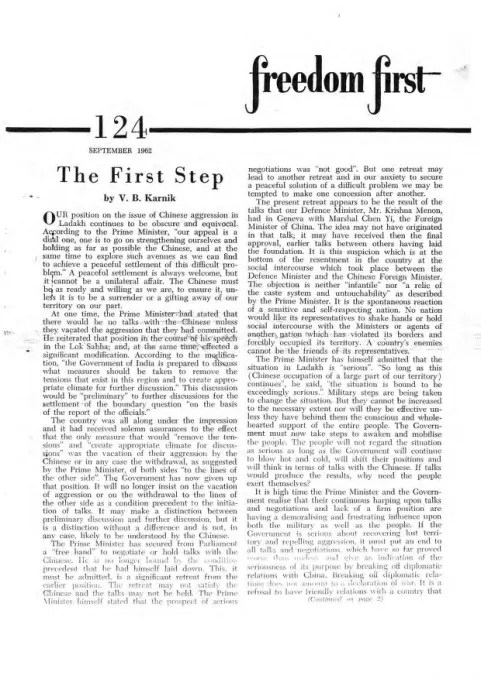
The First Step
By V. B. Karnik
V. B. Karnik’s lead editorial excoriates the Government of India’s China policy following the Ladakh border crisis, arguing that Nehru’s repeated softening of preconditions for talks with China — from insisting on Chinese vacation of aggression to merely discussing ‘appropriate climate’ for further discussion — amounts to a serious retreat that will neither satisfy the Chinese nor rally the Indian public. Karnik links this retreat to the controversial Geneva meeting between Defence Minister Krishna Menon and Chinese Foreign Minister Chen Yi, framing public resentment of that meeting as a legitimate response to diplomatic contact with an aggressor rather than casteist prejudice, as the Prime Minister had suggested. The piece calls on the government to break off diplomatic relations with China as a first step toward mobilising the country and demonstrating seriousness about repelling aggression.
- Nehru’s stated ‘dual’ policy of strengthening India while exploring peaceful settlement is criticised as obscure and equivocal.
- The government has retreated from its earlier precondition that China vacate its aggression before talks could begin.
- The article attributes the shift in position to the Krishna Menon-Chen Yi meeting in Geneva.
- Public unease about that meeting is defended as principled objection to fraternising with an aggressor nation, not casteism.
- The editorial calls for breaking off diplomatic relations with China as a necessary ‘first step’ to mobilise public and military resolve.
Madhya Pradesh Scene
By N. C. Zamindar
N. C. Zamindar’s ‘Madhya Pradesh Scene’ surveys factional infighting within the state Congress party, describing allegations of corruption and discrimination in the administration alongside a Byzantine internal power struggle involving Congress leader Shri Deshlehra, former strongman D. P. Mishra, and Dr. Katju, whose bye-election contest in Narsinggarh drew support from a young Maharaja backed by communists and the Jan Sangh against the official Congress candidate. Zamindar warns that the ruling party is ‘a house divided against itself,’ creating openings that the Communist Party is actively exploiting in both the state assembly and Indore’s municipal politics, and closes by warning that Madhya Pradesh risks becoming ‘another Kerala.’
- Administrative corruption and discrimination are described as endemic in Madhya Pradesh’s Revenue Department and City Improvement Boards.
- A factional struggle inside the state Congress pits Shri Deshlehra’s group against a revived faction around Dr. Katju and D. P. Mishra.
- A Narsinggarh bye-election saw a young Maharaja, backed by communists and Jan Sanghis, campaign for Dr. Katju against the official Congress candidate.
- The Communist Party is described as exploiting Congress disunity in both state and Indore municipal politics.
- The piece warns Madhya Pradesh could become ‘another Kerala’ if Congress disorganisation continues.
Hunger In South Africa
By Margaret Roberts
Margaret Roberts documents severe malnutrition and starvation among non-white South Africans, citing infant mortality data from Port Elizabeth (48 per cent of babies born in 1961 died before age one), kwashiorkor and malnutrition rates among Cape Town hospital patients, and Red Cross reports of near-starvation conditions in the Potgietersrust Reserve. She contrasts this with South Africa’s vast agricultural surpluses — including destroyed skim milk and rotting fruit — and situates the crisis within the broader argument that apartheid economic policy, not national poverty, produces these conditions, concluding that African prosperity claims must be ‘drastically revised’ given the impoverishment of the reserves and exclusion of Africans from remunerative work.
- Citing Dr. J. A. Richter, infant mortality in Port Elizabeth’s non-white population rose from 244.4 to 481.9 per thousand between 1960 and 1961.
- Cape Town hospitals report large daily volumes of infants suffering severe malnutrition and kwashiorkor.
- Red Cross reports found ‘near-starvation’ conditions affecting 200,000 people in the Potgietersrust Reserve.
- South Africa simultaneously destroys huge agricultural surpluses (e.g., 370,000 gallons of skim milk in the Transvaal) while non-white populations starve.
- The article argues the crisis stems from apartheid economic structuring rather than genuine national scarcity, given South Africa’s wealth relative to the rest of Africa.
Predominance Of The Economic Factor
By M. R. Pai
M. R. Pai examines how political considerations have overridden economic rationality in Indian planning, focusing on the poor performance of state enterprises. He cites a 0.3 per cent return on Rs. 709 crores invested across 73 state enterprises in 1961-62, and the notorious example of a Mysore Government bicycle factory that produced only 18 bicycles in two and a half years against an installed capacity of 72,000 a year. Pai also criticises the monopoly status of enterprises like LIC and Indian Airlines Corporation, the absence of accountability for mismanagement, and the practice of appointing political loyalists to chairmanships of state enterprises regardless of competence.
- State enterprises returned only 0.3 per cent on an investment of Rs. 709 crores in 1961-62.
- A Mysore Government bicycle factory produced 18 bicycles in about two and a half years versus an installed capacity of 72,000 per year.
- Monopoly enterprises such as LIC and Indian Airlines Corporation are criticised for lacking competitive accountability, illustrated by the 1961 air-ticket shortage.
- The 42nd Report of the Public Accounts Committee is cited as evidence that disciplinary action for mismanagement in state enterprises is rarely taken.
- Political appointments to enterprise chairmanships are criticised as prioritising patronage over competence.
Dogma Versus Development In Our Plans
By MA Venkata Rao
M. A. Venkata Rao attacks what he calls the ‘dogma’ underlying India’s Five Year Plans — the socialist commitment to state monopoly over ‘commanding heights’ industries — arguing that this ideological commitment, rather than sound economics, drives the Third Plan’s decision to raise the state sector’s share of investment to two-thirds of the total, despite the private sector’s comparatively better track record in the first two plans. He surveys instances across insurance nationalisation, road and automobile transport, and coal and power where private enterprise has been excluded on doctrinal rather than performance grounds, and closes by warning that dogma is ‘sacrificing the present generation to a problematic future.’
- The Third Five Year Plan raises the state sector’s share of investment to two-thirds, up from one-third in the Second Plan, without economic justification according to the author.
- Life insurance nationalisation is presented as a case of ‘needless dogma’ unsupported by any economic case, per a claimed admission by Finance Minister C. D. Deshmukh.
- Road/automobile transport and coal/power expansion are cited as sectors where private enterprise could deliver faster growth but is blocked by reservation policy.
- The article credits economist Imre Nagy’s reforms (a correlation between heavy and consumer industry) as vindicating attention to consumer-industry balance.
- The piece calls for private enterprise, including foreign equity investment, to be given a larger role for a transitional period of about twenty years.
Malaysian Federation And Communists
By (Contributed)
This unsigned/contributed piece analyses communist opposition — from the USSR, China, and local Southeast Asian communist parties — to the proposed Federation of Malaysia, which would unite the Malayan Federation, Singapore, Sarawak, Brunei, and North Borneo. It describes negotiations culminating in a July 31, 1962 London agreement, and details how the illegal Malayan Communist Party, the Sarawak-based Clandestine Communist Organisation, and the Indonesian PKI have campaigned against the federation as a form of ‘neo-colonialism,’ with Peking’s and Moscow’s propaganda organs (including Tass and Moscow Radio) amplifying these objections while pursuing rival influence in Southeast Asia.
- A London agreement of July 31, 1962 finalised plans for a Federation of Malaysia joining Malaya, Singapore, Sarawak, Brunei, and North Borneo.
- The illegal Malayan Communist Party (MCP) opposes the federation via the front Malayan People’s Socialist Front.
- In Sarawak, the Clandestine Communist Organisation (CCO) cooperates with the Sarawak United People’s Party (SUPP) to resist the federation.
- The Indonesian PKI, under chairman D. N. Aidit, publicly condemned the federation as ‘colonialist intrigue’ and neo-colonialism.
- Soviet and Chinese propaganda organs (Moscow Radio, Tass) both criticised the federation, with China notably extending its influence via Burma.
World Youth Festival—A Failure
By Wolfgang Leonhard
Wolfgang Leonhard reports from the 1962 World Youth Festival in Helsinki, judging it a failure because of its one-sided communist stage-management: attendance fell far short of the expected 18,000 (only 13,000 arrived), several national delegations (Ghana, Turkey, Ceylon) withdrew or shrank, and the Festival Committee papered over the shortfall by drafting in students from Moscow’s Lumumba University as substitute ‘delegates.’ Leonhard describes widespread frustration among non-aligned participants at the impossibility of free discussion in the official seminars, protests by delegations including Ceylon, Indonesia, Dahomey, Nigeria, and Uganda, and debate among participants over whether Western and non-aligned youth organisations should seek greater representation in future festivals.
- Only 13,000 of an expected 18,000 attendees arrived; Ghana’s delegation cancelled, and Turkey’s and Ceylon’s delegations were much smaller than expected.
- The Festival Committee substituted Lumumba University (Moscow) students as ‘delegates’ to mask attendance shortfalls, provoking indignation.
- Political seminars offered no genuine free discussion, prompting protests from Ceylon, Indonesia, Dahomey, Nigeria, and Uganda delegations.
- Some non-aligned delegates, such as the U.A.R. delegation, publicly asserted independence from prescribed communist slogans.
- Participants debated a ‘constructive alternative’: a genuinely all-embracing festival under UN/UNESCO or non-aligned patronage.
Review: Guilty Land (Patrick van Rensberg) and African Political Parties (T. Hodgkin)
By R.S.
Two unsigned book reviews (initialled ‘R.S.’) appear under the ‘Review’ heading. The first covers Patrick van Rensberg’s ‘Guilty Land’ (Penguin Special), an Afrikaner author’s account of his disillusionment with apartheid, its historical genesis, and the fractured resistance of the Liberal Party and others against it; the review recommends the book to ‘all friends of the non-whites in South Africa.’ The second reviews Thomas Hodgkin’s ‘African Political Parties’ (Penguin Books, 1961), praising its analysis of post-war African party systems — their mix of tribal and modern educated-class leadership, Marxist and Gandhian influences, and general preference for constitutionalism over violence — as a valuable and much-needed reference work on Afro-Asian politics.
- ‘Guilty Land’ by Patrick van Rensberg is a memoir-and-history hybrid describing an Afrikaner’s disillusionment with apartheid and his subsequent activism.
- The reviewer notes the internal divisions within South Africa’s Liberal Party opposition to apartheid.
- ‘African Political Parties’ by Thomas Hodgkin is praised for adapting Western political-science frameworks to fit Afro-Asian party systems.
- Hodgkin’s book is said to find Gandhian and Marxist influence coexisting within African political parties, most of which favour constitutionalism over violence.
- Both reviews recommend the books as valuable references for readers interested in South African and African politics respectively.
Without Comment (news miscellany: Czech Police Poisoned Food, Russia the Bigger Loser, Moscow Turns “Yes” to “No”, Cuba Rations Shoes and Clothing, India-Tibet Road, Chinese Breakthrough, Moscow’s Rising Price Index)
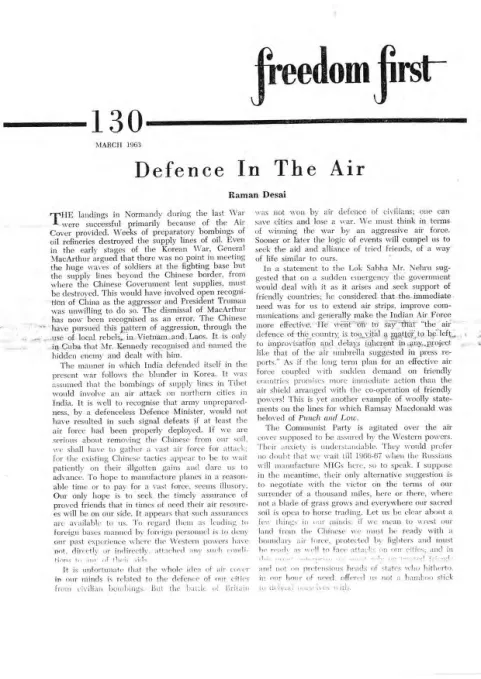
The ‘Without Comment’ page collects short unsigned press items and clippings, largely reprinted from other sources: an allegation by a Nigerian medical student that Czech police attempted to poison him; a U.S. News & World Report analysis arguing ‘Russia, the Bigger Loser’ in any nuclear exchange and detailing the U.S. missile/bomber buildup; a wry note on Khrushchev’s press conference answer being altered from ‘Yes’ to ‘No’ in the official transcript; a report on rationing in Cuba; an item on progress and fatalities in constructing the Hindustan-Tibet road; and a ‘Chinese Breakthrough’ item from Thought magazine condemning the Chinese advance in the Galwan Valley as a failure of Indian defence.
- A Nigerian medical student in Prague alleged Czech security police attempted to poison him after he refused to act as an informer.
- A U.S. News & World Report piece argues that in a nuclear war ‘Russia is the bigger loser’ given the scale of the U.S. missile, bomber, and Polaris submarine buildup.
- An anecdote reports that Khrushchev’s spoken ‘Yes’ to a question about press restrictions in the USSR was altered to ‘No’ in the official Soviet transcript.
- Cuba is reported to be rationing shoes and clothing in addition to food under Castro’s government.
- A ‘Thought’ magazine excerpt criticises the Chinese army’s unopposed advance in the Galwan Valley as exposing weaknesses in India’s defence and the government’s position.
With Many Voices (quotations column)
The ‘With Many Voices’ page assembles brief quoted excerpts from newspapers and public figures on Cold War, China, and Indian politics, including remarks from Roscoe Drummond, Phil Newsom, S. N. Dwivedy, Kingsley Martin, Sudhakar Dixit, Tunku Abdul Rahman, T. T. Krishnamachari, and Melvin Jones. The page also contains a reader subscription coupon for Freedom First and a house advertisement for a book on M. N. Roy and Radical Humanism by G. P. Bhattacharya, available at Strand Book Shop, Bombay.
- Excerpted commentary from multiple sources addresses neutrality, China’s incursions into Indian territory, and the Sino-Soviet relationship.
- Malayan Prime Minister Tunku Abdul Rahman is quoted rejecting neutrality on the grounds that his government will not ally with communist countries.
- Union Minister T. T. Krishnamachari is quoted suggesting a different form of communism could be an alternative to Congress rule, though not the Swatantra Party or DMK.
- Melvin Jones’s Forum Service commentary criticises the World Youth Festival as a platform for vilifying ‘imperialism, colonialism and capitalism.’
- The page includes a subscription coupon (annual subscription Rs. 3) and an advertisement for a book on M. N. Roy and Radical Humanism.
Generated by the v1.5 extraction pipeline. Awaiting editorial review.
Metadata and summary are AI-extracted from the source PDF and reviewed for editorial accuracy. The original work is available via the Read PDF tab above (where present); paragraph-level citation inside the PDF is deferred to a future engagement.