periodical issue
Freedom First
By V. B. Karnik, Richard Moore, S. Natarajan
Edited [by name illegible] and printed at Inland Printers, 53 Gamdevi Road, Bombay 7, and published for the Democratic Research Service by B. K. Desai at 127 Mahatma Gandhi Road, Bombay 1. · Bombay · 1962
12 pages
Freedom First
Summary
Freedom First No. 126 (November 1962) appeared amid the outbreak of full-scale war with China in Ladakh and NEFA, and the issue is dominated by that crisis and by the wider Cold War. V. B. Karnik’s lead article, ‘Preconditions To Victory,’ argues that China’s border war is part of a larger communist bid for world domination and calls for a broadened, more resolute Indian government, foreign military aid despite non-alignment, and the removal of the Defence Minister. The issue’s centrepiece is a long essay, ‘Winning The Cold War,’ by Richard Moore, Secretary-General of Liberal International, which lays out in fourteen numbered sections a liberal strategy for the Cold War — rejecting both neutralism and indiscriminate anti-communism, arguing that ideological attack rather than passive containment is the best defence, and surveying topics from the myth of neo-colonialism to Vietnam, Saigon, and NATO. A book review by S. Natarajan assesses Gyula Paloczi-Horvath’s biography of Khrushchev. The issue closes with two recurring miscellany features: ‘Without Comment,’ reprinting a declaration on Eastern European rights and news items on anti-Castro and anti-communist manoeuvring in Latin America and Southeast Asia, and ‘With Many Voices,’ a page of pointed quotations from contemporary politicians and press on communism, non-alignment, and Krishna Menon’s political fall.
Key points
-
V. B. Karnik’s “Preconditions To Victory” frames the Chinese offensive in Ladakh and NEFA as part of a global communist bid for domination alongside Vietnam, Berlin, and Cuba, and calls for foreign military aid, a broadened government, and the Defence Minister’s removal.
-
Richard Moore’s “Winning The Cold War” argues liberals cannot be neutral in the Cold War since totalitarian claims to total authority are inherently in conflict with liberty, and that ideological attack is the best form of defence.
-
Moore’s essay debunks the communist-promoted “myth of neo-colonialism,” arguing nationalism in newly independent states works against, not for, communism.
-
Moore proposes a pragmatic, differentiated liberal stance toward anti-communist but illiberal regimes such as Diem’s Vietnam, and calls for a “Great Debate” using open scientific and intellectual exchange as ideological attack.
-
S. Natarajan reviews Gyula Paloczi-Horvath’s biography of Khrushchev, crediting its account of his rise to power through mastery of the party machine and the collectively authored de-Stalinisation speech.
-
Natarajan’s review questions the book’s claim of deep popular Soviet disgust with party bureaucracy as overstated, and notes its account of persistent Sino-Soviet tension beneath a maintained “appearance of monolithic unity.”
Essays
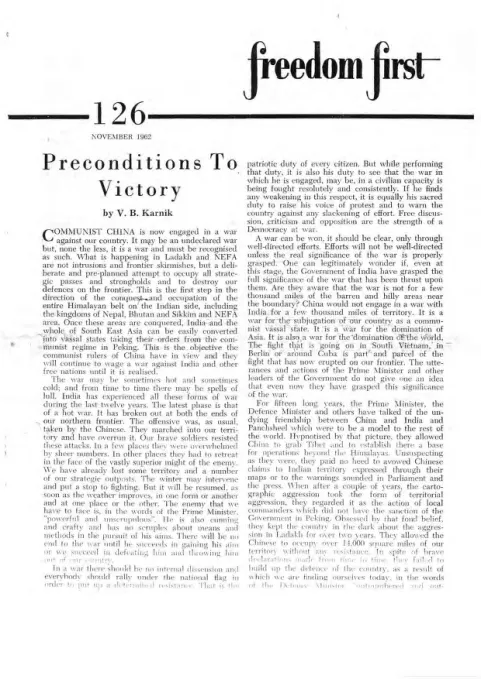
Preconditions To Victory
By V. B. Karnik
V. B. Karnik argues that the Chinese offensive in Ladakh and NEFA is not a mere border skirmish but a deliberate, pre-planned war aimed at conquering the whole Himalayan belt and reducing India and Southeast Asia to vassal states of Peking, part of a larger communist bid for world domination that also encompasses Vietnam, Berlin, and Cuba. He contends that India has fought with ‘hands tied,’ hampered by continued diplomatic relations with China, unbroken non-alignment, and a government slow to grasp the war’s real significance despite fifteen years of naively trusting Chinese friendship (Panchsheel). Karnik calls for accepting foreign military aid from Britain and the US regardless of non-alignment doctrine, encouraging revolt in Tibet and Sinkiang, ending all talk of negotiations until China vacates all aggression, broadening the government to include other democratic parties (noting the Congress won only 45 percent of the vote), and replacing the Defence Minister, whom he accuses of pro-communist sympathies, incompetence, and negligence.
- Frames the China war as a deliberate, pre-planned attempt to conquer the Himalayan belt and reduce India and Southeast Asia to communist vassal states.
- Situates the Ladakh/NEFA fighting as part of a single global communist offensive alongside Vietnam, Berlin, and Cuba.
- Criticizes the government for having been ‘hypnotised’ by the idea of Sino-Indian friendship and Panchsheel, ignoring warnings for years.
- Calls for accepting military aid from Britain and the USA even though this cuts against non-alignment.
- Demands a broadened government including other democratic parties, since Congress won only 45 percent of the vote.
- Calls for the Defence Minister’s replacement, alleging communist sympathies, incompetence, and negligence.
- Urges no negotiations with China until all post-September 8 aggression is vacated.
Winning The Cold War
By Richard Moore
Richard Moore, Secretary-General of Liberal International, presents a fourteen-section strategic essay arguing that liberals cannot be neutral in the Cold War because the conflict is inherent in liberalism’s commitment to liberty against totalitarian claims of total authority. He rejects both neutralist retreat and a purely negative anti-communism as self-defeating, arguing instead that ideological attack is ‘not only the best means of ideological defence’ but also the best way to prevent the Cold War turning hot, since communist confidence in ultimate victory makes communists reluctant to risk decisive war. Moore surveys the nature of communism’s fear of nuclear extinction and Sino-Soviet strains, the value of self-criticism as a Western weapon, the exploitation of the ‘element of time’ by communist propaganda, the debunking of the ‘neo-colonialism’ myth given nationalism’s success in the newly independent world, the empirical disproof of Marx’s predictions in the West’s mixed economies versus communism’s own retreat into private enterprise, aid and trade policy toward developing countries, the ‘inglorious reality’ of life under communism as opposed to Western cultural decline, a proposed liberal strategy exploiting the political cost the Iron Curtain imposes on the Kremlin, a call for open intellectual debate (a ‘Great Debate’) especially through science, missed communist propaganda opportunities such as China’s famine, the case for treating Vietnam (‘Saigon — outpost of freedom’) and other anti-communist dictatorships pragmatically while still pressing for liberal reform, and a final call for liberals to take the initiative regionally and for the Liberal International to coordinate strategy among liberal parties worldwide.
- Argues liberals cannot be neutral in the Cold War because Liberalism’s core value of liberty is itself in conflict with any movement asserting total authority.
- Rejects both neutralism/pacifism and indiscriminate, allies-of-convenience anti-communism as self-defeating for liberal values.
- Claims ideological attack is the best form of ideological defence and the best safeguard against the Cold War turning into a hot, nuclear war.
- Explains communist reluctance toward all-out nuclear war via fear of destroying the Soviet state and Sino-Soviet demographic/strategic tensions.
- Debunks the communist-promoted ‘myth of neo-colonialism,’ arguing nationalism in newly independent states is working against, not for, communism.
- Argues the survival of mixed economies in the West and forced tolerance of private enterprise inside communist states disprove Marx’s predictions.
- Proposes a pragmatic, differentiated liberal stance toward anti-communist but illiberal regimes (Diem’s Vietnam, Franco’s Spain, apartheid South Africa).
- Calls for a ‘Great Debate’ using science and open intellectual exchange as the most promising line of ideological attack.
- Closes by urging liberals worldwide, coordinated through Liberal International, to take the initiative rather than remain reactive.
Without Comment
S. Natarajan reviews Gyula Paloczi-Horvath’s biography-study of Khrushchev’s rise to power, praising its detailed account of how Khrushchev, an uneducated man educated through the party machine, rose from fifth-ranked Soviet leader at Stalin’s death to undisputed dictator by mastering the party apparatus, eliminating rivals, and delivering the influential (though collectively authored) de-Stalinization speech to the Twentieth Party Congress. Natarajan credits Paloczi-Horvath’s account of Khrushchev’s political skill but faults his premises: the author’s claim that ordinary Soviet people were fundamentally disgusted with party rule is, in Natarajan’s view, insufficiently supported and derived mainly from writings during the post-Stalin ‘thaw,’ understating four decades of successful Soviet indoctrination and expansion of communist sympathy among neutral countries. The review closes by summarizing the book’s discussion of Sino-Soviet relations, noting Paloczi-Horvath’s view that Russia and China preserve only the ‘appearance of monolithic unity’ while genuine tension persists, and drawing a parallel to India’s own dilemma in balancing Soviet support against the Chinese threat.
- Summarizes Paloczi-Horvath’s central thesis that Khrushchev rose to power through mastery of the party machine rather than intellectual or ideological conviction.
- Highlights the book’s account of the de-Stalinization speech as a ‘cooperative effort’ among warring party factions rather than Khrushchev’s sole authorship.
- Criticizes the author for overstating popular Soviet disgust with party bureaucracy, based mainly on ‘thaw’-era writings.
- Notes the book’s discussion of Sino-Soviet tension beneath a maintained ‘appearance of monolithic unity.’
- Draws an explicit parallel between the Sino-Soviet dilemma and India’s own need to balance Soviet backing against the Chinese threat.
Generated by the v1.5 extraction pipeline. Awaiting editorial review.
Metadata and summary are AI-extracted from the source PDF and reviewed for editorial accuracy. The original work is available via the Read PDF tab above (where present); paragraph-level citation inside the PDF is deferred to a future engagement.