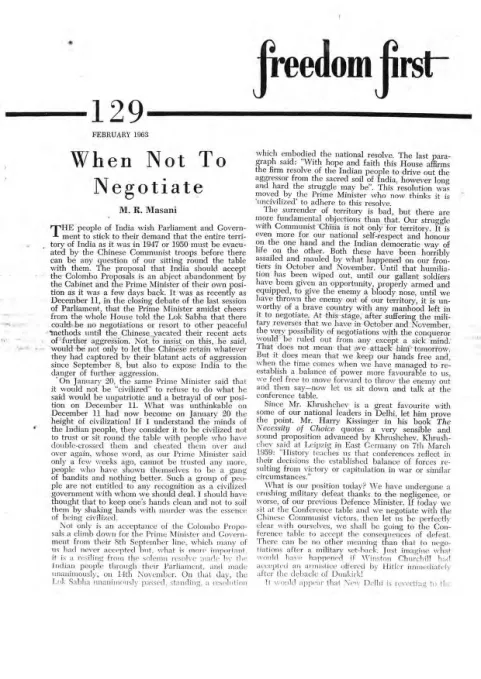
periodical issue
Freedom First
Freedom First — Registered No. B-6354. Published on the first of each month. Annual Subscription: Rs. 3, Single Copy: 25 nP. Manekji Wadia Building, 4th Floor, 127 Mahatma Gandhi Road, Bombay 1. Printed at [illegible] ... Gamdevi Road, Bombay ... and published for the Democratic Research Service by [illegible] at 127 Mahatma Gandhi Road, Bombay 1. · Bombay · 1963
12 pages
Freedom First
Summary
Freedom First issue 128 (January 1963) appears in the immediate aftermath of the 1962 Sino-Indian War and the Chinese cease-fire, and its contributors are almost uniformly preoccupied with two linked crises: the war’s exposure of India’s non-alignment policy as bankrupt, and a domestic crackdown on critics of Nehru that the magazine reads as a dangerous slide toward one-party, one-leader authoritarianism. S. N. Aiyer’s opening piece protests the arrest of three anti-communist public workers under the Defence of India Rules even as it endorses banning the Communist Party itself, and links this to V. K. Krishna Menon’s public call for a Hitlerite ‘one nation, one policy, one leader’ cult. An open letter from Dharampal, Roop Narain, and N. N. Datta (the arrested men) presses the case for the right to criticise the Prime Minister even in wartime. Several essays — by S. R. Mohan Das, M. A. Venkata Rao, and Devadas Kini — dissect non-alignment as a failed premise, arguing India in fact leans on the Soviet bloc’s goodwill while pretending neutrality, and that the war has proven the Western democracies to be India’s natural allies. Raman Desai’s economic piece considers how to finance the war through savings, taxation, and borrowing. The issue closes with a reprinted Uruguayan commentary on Indian neutrality, a joint statement by Calcutta intellectuals on Indo-Pakistan talks and joint defence, and the regular ‘With Many Voices’ quotations column.
Key points
-
S. N. Aiyer’s “Disturbing Trends” protests the arrest of three anti-communist workers under the Defence of India Rules even as it endorses banning the Communist Party outright, and warns that V. K. Krishna Menon’s call for a “one nation, one policy, one leader” cult and the AICC’s branding of criticism of Nehru as treason mark a slide toward authoritarianism.
-
Raman Desai’s “Financing The War” argues India’s roughly Rs. 1000-crore annual defence bill can only be met through mass savings from ordinary peasants and workers rather than a narrow income-tax base, and calls for a more equalitarian, US-style economy and an independent Planning Commission.
-
The reprinted “Open Letter To Members Of Parliament” by Dharampal, Roop Narain and N. N. Datta, the three men arrested for criticising Nehru, insists that criticism of the Prime Minister is a democratic right and no less patriotic than support for the government.
-
S. R. Mohan Das’s “Cease Fire Or War By ‘Other Means’?” argues, citing M. N. Roy’s 1951 warnings on Tibet and Lenin’s writings on deceiving the West, that the Chinese cease-fire is not peace but a shift to diplomatic and psychological pressure on India.
-
M. A. Venkata Rao’s “Non-Alignment Plus” and Devadas Kini’s “God That Failed” both argue non-alignment was undermined by illusory trust in Communist China and Soviet neutrality, with Kini calling it a failed ‘religion’ and urging India to recognise its natural bonds with the democratic West.
-
A translated reprint from the Uruguayan journal El Plata, “An Instructive Reality,” cites India’s post-invasion predicament as proof that neutralism sympathetic to Communism is self-defeating and warns Uruguayan politicians against romanticising it.
-
A joint statement by Calcutta intellectuals welcomes Indo-Pakistan talks and urges both governments to compromise on Kashmir so as to present a united front against Chinese domination of the subcontinent.
-
The issue’s “With Many Voices” column of quotations includes Indira Gandhi asserting Congress unity exists only ‘behind my father’ and N. G. Ranga declaring in Parliament that Nehru ‘should have been dismissed long ago.‘
Essays
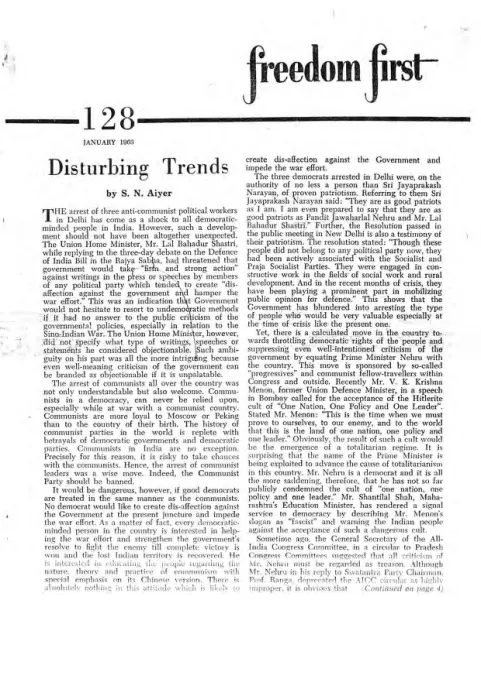
Disturbing Trends
By S. N. Aiyer
S. N. Aiyer’s ‘Disturbing Trends’ condemns the arrest under the Defence of India Rules of three anti-communist political workers in Delhi, whom Jayaprakash Narayan vouched for as patriots, while simultaneously endorsing the arrest of actual Communists and calling for the Communist Party to be banned outright. The essay’s central alarm is a ‘calculated move’ to equate criticism of Nehru with treason: it cites V. K. Krishna Menon’s call for India to accept a Hitlerite cult of ‘One Nation, One Policy and One Leader,’ the AICC circular branding criticism of Nehru as treason, and Home Minister Lal Bahadur Shastri’s threat of ‘firm and strong action’ against critical writings. The piece credits Maharashtra’s Education Minister Shantilal Shah for publicly denouncing Menon’s slogan as ‘fascist’ and calls on democratic-minded Indians, inside and outside Congress, to resist the trend toward totalitarianism.
- Three anti-communist workers were arrested in Delhi under the Defence of India Rules despite Jayaprakash Narayan’s testimony to their patriotism.
- The author supports banning the Communist Party and arresting actual Communists, but objects to good democrats being treated the same way.
- Home Minister Lal Bahadur Shastri warned of ‘firm and strong action’ against press criticism during the Defence of India Bill debate.
- V. K. Krishna Menon publicly advocated a ‘one nation, one policy, one leader’ cult, which the author calls Hitlerite/totalitarian.
- The AICC circularised Pradesh Congress Committees that criticism of Nehru should be treated as treason.
- Maharashtra Education Minister Shantilal Shah is praised for calling Menon’s slogan ‘fascist.‘
Financing The War
By Raman Desai
Raman Desai’s ‘Financing The War’ addresses how India should fund a projected annual defence budget of roughly Rs. 1000 crores through borrowing, savings, and taxation. He argues mass savings can only come from the roughly six crore families of ordinary peasants and workers, since income-tax data show 90% of assessees fall below the super-tax limit and yield only 9% of the total tax. He presents grim poverty statistics — over 56% of urban households below the poverty line, four crore agricultural labourers earning Rs. 104 a year against a national per-capita figure of Rs. 265 — and argues that only a more equalitarian economy, on the U.S. model, can generate the mass savings the war requires. The piece closes by calling for reconstitution of the Planning Commission as an independent advisory body and redirection of the Plans’ social aims toward defence-linked industrial priorities.
- India needs roughly Rs. 1000 crores a year in defence spending for the next several years.
- 90% of income-tax assessees are below the super-tax limit and yield only 9% of total tax collected, showing the narrow base of direct taxation.
- Over 56% of urban households have monthly income below the national average and the poverty line (Rs. 100/month).
- Four crore agricultural labourer families have a per-capita income of Rs. 104/year versus a national figure of Rs. 265/year, and rural indebtedness has doubled in an inflationary era.
- The U.S. is cited as a comparatively equalitarian economy (71% of families in the middle-income bracket) capable of generating mass savings.
- Calls for reconstituting the Planning Commission as an independent advisory body of public men and technicians rather than a Cabinet committee.
Open Letter To Members Of Parliament
By Dharampal, Roop Narain and N. N. Datta (introduced/edited by Freedom First)
This piece reprints extracts from an open letter to Members of Parliament by Dharampal, Roop Narain, and N. N. Datta — three young public workers arrested under the Defence of India Rules for criticising Nehru. The editor’s preface stresses that even in an emergency citizens must be free to criticise without hampering the war effort. The letter itself excoriates the AICC’s circular branding criticism of Nehru as treason, catalogues fifteen years of unfulfilled rhetoric about resolve against invaders, and questions whether Nehru can rise above personal glory to lead the country through the crisis, while insisting the government’s critics are no less patriotic than its defenders. A sidebar, ‘Mr. Menon’s Future?’, reports that Nehru told William Randolph Hearst Jr. that former Defence Minister V. K. Krishna Menon was absolved of blame for the army’s reverses in NEFA and Ladakh, with a hint of a possible return to the Cabinet.
- The letter’s authors — Dharampal, Roop Narain, and N. N. Datta — were arrested under the Defence of India Rules for criticising Nehru.
- An AICC circular to Congress committees stated that criticism of the Prime Minister ‘must be regarded as treason.’
- The letter argues the public has heard fifteen years of similar exhortation and resolve from Nehru with no substantive change.
- The letter urges that criticism of the Prime Minister is a democratic right and does not indicate lesser patriotism.
- The sidebar reports Nehru told Hearst Jr. that Krishna Menon was absolved of blame for the NEFA and Ladakh reverses, with a hint of return to the Cabinet.
Cease Fire Or War By “Other Means”?
By S. R. Mohan Das
S. R. Mohan Das’s ‘Cease Fire Or War By “Other Means”?’ opens with a lengthy Reuter-sourced quotation of Khrushchev addressing the Supreme Soviet on the Sino-Indian conflict, then argues that Indian policymakers for years mistook Chinese Communism for a benign ‘Asian variety,’ citing M. N. Roy’s 1951 Radical Humanist warning that China’s ‘liberation’ of Tibet would rebuff Nehru’s Asian diplomacy. The essay recounts how China converted Tibet into a military arsenal within three years of occupation and quotes Lenin’s writings on treating the West as ‘deaf-mutes’ to be placated with fictional separations between party and government while communist subversion proceeds. It concludes that the Chinese cease-fire is not the end of hostilities but ‘war by other means,’ waged now through diplomacy and psychological pressure on India’s non-aligned posture, and notes Nehru’s continuing illusions about the ‘peculiar’ and less dangerous nature of Chinese Communism.
- Opens with Khrushchev’s Reuter-quoted Supreme Soviet speech professing sympathy for China while urging cease-fire.
- M. N. Roy’s 1951 Radical Humanist article predicted China’s Tibet ‘liberation’ would rebuff Nehru’s Asian diplomacy.
- China built up Tibet as a military arsenal within three years of occupation despite claims of peaceful reconstruction.
- Lenin’s notes on treating capitalist countries as ‘deaf-mutes’ are quoted as a template for current Sino-Soviet diplomatic tactics toward India.
- The cease-fire is framed as ‘war by other means’ — a shift to diplomatic and psychological pressure rather than a genuine end to hostilities.
- Nehru is criticised for continuing to describe Chinese Communism in Parliament as ‘peculiar,’ ‘dangerous and harmful’ but distinct from Soviet Communism.
Non-Alignment Plus
By M. A. Venkata Rao
M. A. Venkata Rao’s ‘Non-Alignment Plus’ argues that Indian non-alignment was not wrong in principle but was undermined by the accessory illusion that it required trusting Communist China and relying on Soviet neutrality, leaving India militarily unprepared for the Chinese invasion. Distinguishing the passive ‘Swiss way’ of neutrality from an active non-alignment that still builds armed strength, the essay argues India failed to heed ample warning signs from Tibet, Ladakh’s 1954 territorial claims, and China’s 1956 border settlement with Burma. It criticises India’s inconsistent moral judgments — condemning the Anglo-French-Israeli Suez action while staying silent on Hungary and Tibet — and argues true non-alignment should mean confining intervention to UN action while building sufficient armed deterrence, rather than romantic reliance on Russia’s goodwill.
- Non-alignment as a foreign-policy principle is distinguished from the flawed practice of trusting Communist China and relying on Russian neutrality.
- China’s 1954 territorial claims in Ladakh, its 1956 border settlement with Burma, and its actions in Tibet, Vietnam, and Laos were ample warning of expansionist intent that India ignored.
- The ‘Swiss way’ of armed but disengaged neutrality is contrasted with India’s more active, UN-engaged non-alignment.
- India is accused of a double standard: strident condemnation of the Anglo-French-Israeli Suez attack alongside silence on Soviet suppression of Hungary (1956) and the occupation of Tibet.
- The essay recommends confining Indian intervention in world affairs strictly to UN action while maintaining sufficient armed deterrence at home.
God That Failed
By Devadas Kini
Devadas Kini’s ‘God That Failed’ declares non-alignment a failed ‘religion’ that must be abandoned in favour of enlightened self-interest, arguing the premise of two roughly equal warring blocs is false since only the Soviet bloc (with China as a tactically divergent partner) actively seeks to dominate through force, while the West’s colonial empires have already been liquidated. Kini contends non-aligned nations remain neutral toward the Soviet bloc chiefly out of residual anti-colonial memory rather than clear-eyed assessment, and that the Colombo powers’ refusal to condemn Chinese aggression as aggression betrays the non-aligned policy itself. He concludes India shares democratic, open-society bonds with the West and should recognise this alignment plainly rather than continue a policy ‘out of touch with reality.’
- Non-alignment is described as having become ‘a creed, a dogma, nay — a religion’ rather than a flexible policy responsive to national interest.
- The essay argues there is only one expansionist bloc (Soviet, with China in a tactical rather than real rift) since Western empires have already been liquidated.
- Non-aligned nations’ neutrality toward the Soviet bloc is attributed to lingering colonial-era resentment rather than present clear-sightedness.
- The Colombo Conference of non-aligned powers is criticised for treating Chinese aggression as a mere ‘dispute’ rather than condemning it outright.
- Kini calls for recognising India’s ‘invisible but strong bonds’ with the democratic West given shared open-society values.
An Instructive Reality
By [translated from El Plata, Montevideo, Uruguay; unsigned]
This translated reprint from the Uruguayan journal El Plata of Montevideo argues that neutralist movements sympathetic to Communism are inherently one-sided and self-defeating, using India’s post-invasion predicament as the clearest proof. It portrays India as the world’s principal champion of neutrality now paying dearly for a doctrinaire middle course that left it defenceless against Chinese aggression, and warns Uruguayan politicians against exploiting young voters’ inexperience by romanticising neutrality as the stance of the weaker, more virtuous side.
- The article is a translated reprint from El Plata of Montevideo, one of Uruguay’s most prominent journals.
- It argues neutralism that only criticises one side (the West) while excusing the other (the Communist bloc) is a ‘suicidal neutrality.’
- India is cited as the principal example: its long-championed non-alignment left it ‘almost completely defenceless’ against Chinese invasion.
- The essay warns Uruguayan politicians against exploiting young, inexperienced voters with a romantic, one-sided notion of neutrality.
- It calls India’s experience a concrete lesson for other nations considering doctrinaire neutrality.
A Statement On Indo-Pakistan Talks
By Issued by a number of prominent intellectuals of Calcutta: Srikumar Banerjee, Kazi Abdul Wadud, Ajit Kumar Dutta, Prof. Amlan Dutta, K. K. Sinha, Dr. Bhupal Bose, Prof. Dilip Chakravarty, Gobinda Lal Banerjee, Captain Bhag Singh, K. M. Yusuf, H. Ghoshal, D. Basu Roy Chowdhury, Charles Newton, Kshitindra Nath Chowdhury
A joint statement issued by a number of prominent Calcutta intellectuals welcomes the decision of India and Pakistan to hold direct talks, framing the Chinese aggression as a threat to the stability of both countries and urging joint defence arrangements. The signatories argue the Kashmir dispute has become secondary to the larger threat of Chinese domination of the subcontinent and call on both governments to compromise on Kashmir honourably in order to present a united front against China, warning that failure to do so risks both nations being ‘devoured by the Communist dragon.’
- Signed by a group of prominent Calcutta intellectuals including Srikumar Banerjee, Kazi Abdul Wadud, Prof. Amlan Dutta, and others.
- The statement frames Chinese aggression as an existential threat to both India and Pakistan, not India alone.
- It urges both governments to organise joint defence and to compromise on the Kashmir dispute rather than let prestige block progress.
- It expresses hope that President Ayub Khan will maintain balance against domestic anti-India political pressures in Pakistan.
- It closes with a warning that failure to unite risks both nations being ‘devoured by the Communist dragon.‘
Mr. Menon’s Future? (continued from page 3)
The regular ‘With Many Voices’ column compiles topical quotations from newspapers and magazines of the period, ranging from George E. Floris on Nehru’s ‘peremptory idealism’ and V. K. Krishna Menon’s ‘Back Nehru to survive’ remark, to Indira Gandhi’s assertion that unity in India can only exist ‘behind the Congress Party, and in the Congress Party only behind my father,’ and Robert Frost’s quip that Khrushchev feared modern liberals were ‘too liberal to fight.’ The page closes with the magazine’s standard subscription notice and masthead details.
- Compiles short quotations on the India-China war and non-alignment from sources including Time, the Manchester Guardian Weekly, Encounter, and Indian newspapers.
- Indira Gandhi is quoted asserting Congress Party unity exists only ‘behind my father’ (Nehru).
- Robert Frost is quoted recounting Khrushchev’s remark that modern liberals are ‘too liberal to fight.’
- N. G. Ranga is quoted in Parliament saying Nehru ‘should have been dismissed long ago.’
- The page carries the magazine’s standard subscription form and publication details (Rs. 3 annual, 25 nP single copy, published by Democratic Research Service, Bombay).
Generated by the v1.5 extraction pipeline. Awaiting editorial review.
Metadata and summary are AI-extracted from the source PDF and reviewed for editorial accuracy. The original work is available via the Read PDF tab above (where present); paragraph-level citation inside the PDF is deferred to a future engagement.