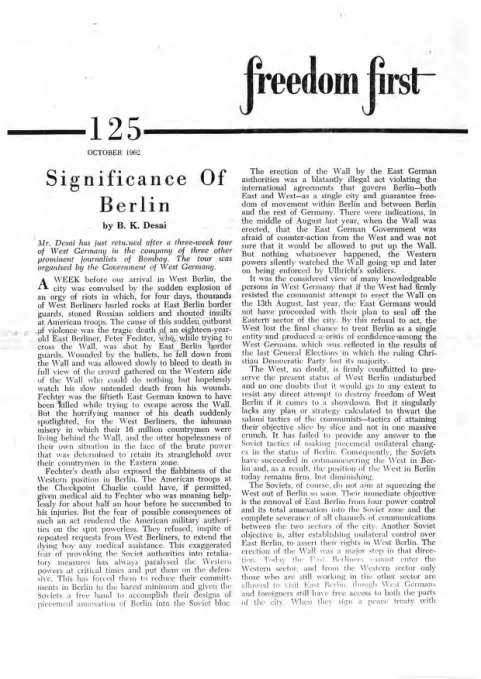
periodical issue
Freedom First
By Raman Desai, Raman Desai, M. R. Masani, V. B. Karnik, S. R. Mohan Das, M. D. Kini
Edited by RAMAN DESAI and printed at Inland Printers, 55 Gamdevi Road, Bombay 7 and published for the Democratic Research Service by Adam Adil at 127 Mahatma Gandhi Road, Bombay 1. · Bombay · 1963
12 pages
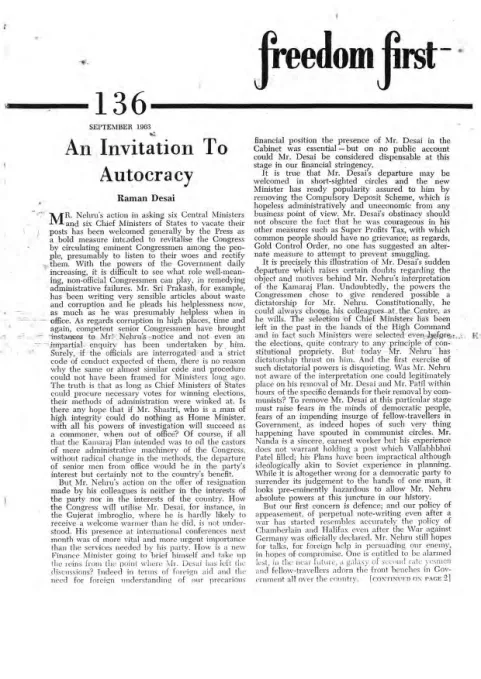
Freedom First
Summary
Freedom First No. 136 (September 1963) is dominated by the political crisis inside the Congress Party following Nehru’s acceptance of resignations from senior ministers and chief ministers under the Kamaraj Plan. The lead editorial, “An Invitation To Autocracy” by Raman Desai, warns that stripping Nehru’s cabinet of figures like Morarji Desai concentrates dictatorial power in the Prime Minister’s hands at a dangerous moment. S. R. Mohan Das’s companion piece, “The Kamaraj Plan,” traces the scheme’s origins to the Amroha-Farukhabad-Rajkot by-election defeats and dissects the factional manoeuvring it triggered, concluding that N. V. Gadgil was right to call it an inadvertent mechanism for making the Prime Minister a dictator. M. R. Masani contributes extracts from his No-Confidence Motion speech in the Lok Sabha, indicting fifteen years of Nehruvian socialism as disguised state capitalism that has enriched a new class of politicians, officials and cronies while failing labour, peasants and industry alike. V. B. Karnik reviews the recent Bombay municipal workers’ strike as a failed, politically-tinged confrontation with the state. Raman Desai also contributes a second piece marking the second anniversary of the Berlin Wall, cataloguing its human costs, and M. D. Kini surveys the widening Sino-Soviet ideological rupture. The issue closes with the recurring “With Many Voices” column of press quotations and a subscription notice.
Key points
-
Raman Desai’s “An Invitation To Autocracy” condemns Nehru’s removal of six Central Ministers and six Chief Ministers under the Kamaraj Plan, especially Finance Minister Morarji Desai, warning it concentrates unchecked, dictatorial power in Nehru’s hands and comparing his foreign policy of appeasement to Chamberlain’s toward Nazi Germany.
-
Raman Desai’s second piece, “The Berlin Wall,” marks the wall’s second anniversary with statistics on its scale and toll — 27 miles, 129 watch towers, 65 people killed attempting to cross — and the mass exodus of nearly 4 million East Germans before its construction.
-
M. R. Masani’s “Socialism Or State Capitalism?”, extracted from his No-Confidence Motion speech, argues fifteen years of professed socialism have produced a “New Class” of politicians, officials and cronies while real wages for labour and peasants stagnated, citing a 370-step bureaucratic land-allotment process and the perverse Gold Control Order.
-
V. B. Karnik’s “Bombay Civic Strike - An Evaluation” reviews the collapse of the Municipal Mazdoor Union’s dearness-allowance strike, faulting the union for escalating without exhausting conciliation machinery and the Government for treating the dispute as a political rather than industrial confrontation.
-
S. R. Mohan Das’s “The Kamaraj Plan” traces the plan’s origin to the Amroha-Farukhabad-Rajkot by-election defeats and endorses N. V. Gadgil’s verdict that the scheme has made the Prime Minister a dictator, however unintentionally.
-
M. D. Kini’s “Split In The Communist Church” surveys the widening Sino-Soviet rupture from Khrushchev’s 1956 denunciation of Stalin through the Cuban missile crisis and the Sino-Indian war, asking whether the schism will prove as momentous as the Christian schism five centuries earlier.
-
The issue’s “With Many Voices” column quotes Karl Popper warning that centralised planning inevitably leads to a closed society, and N. V. Gadgil predicting Nehru would be automatically vested with dictatorial powers once his Finance Minister was removed.
Essays
An Invitation To Autocracy
By Raman Desai
Raman Desai’s lead editorial condemns Nehru’s move to have six Central Ministers and six Chief Ministers resign under the Kamaraj Plan, arguing it does nothing to address the real causes of Congress administrative failure and instead concentrates unchecked power in Nehru’s hands. The piece singles out the removal of Finance Minister Morarji Desai as reckless given the country’s financial stringency, and worries that the vacated Cabinet seats may be filled by fellow-travellers and “second rate yesmen,” while Nehru’s foreign and defence policy is faulted as a policy of appeasement resembling Chamberlain’s toward Germany.
- Nehru asked six Central Ministers and six Chief Ministers to resign under the Kamaraj Plan, ostensibly to revitalise Congress party organisation.
- The author doubts non-official Congressmen can remedy administrative failures once out of office, citing Sri Prakash and Lal Bahadur Shastri as examples of impotence against corruption.
- Morarji Desai’s removal as Finance Minister is called financially reckless despite his unpopular Compulsory Deposit Scheme and Gold Control Order.
- The Kamaraj Plan is read as having handed Nehru an unconstitutional, dictatorial power to handpick his colleagues.
- The author fears the vacated cabinet posts may go to fellow-travellers, given prior support for such moves from communist circles.
- Nehru’s foreign policy of appeasement and continual note-writing is compared to Chamberlain and Halifax’s policy toward Nazi Germany.
The Berlin Wall
By Raman Desai
Raman Desai’s second contribution marks the second anniversary of the Berlin Wall’s construction on 13 August 1961. He surveys the postwar division of Germany and Berlin, faults Roosevelt’s wartime decisions for enabling Soviet encroachment, and documents the Wall’s scale and toll: 27 miles across Berlin, seven feet high, six feet wide, 129 watch towers, 231 fortified bunkers, 11,000 armed guards, 65 people killed and 589 wounded attempting to cross, and roughly 1,500 arrested at the border in two years. He contrasts East and West German population trends, notes the mass exodus of 3.7 to 4 million people from East to West Germany before 1961, and closes by citing an International Commission of Jurists report, “The Berlin Wall, a defence of Human Rights.”
- The essay marks the second anniversary (13 August 1961) of the Berlin Wall’s construction.
- Roosevelt’s wartime decisions are blamed for allowing Soviet forces to occupy eastern Germany and Berlin.
- The Wall stretches 27 miles across Berlin (border between the two Germanys is 859 miles total), with 129 watch towers, 231 bunkers, and 11,000 armed guards.
- In two years, 65 people were killed, 589 wounded, and roughly 1,500 arrested attempting to cross.
- Between 1950-59 East Germany’s population fell from 18.4 to 17.3 million as 3.7-4 million people fled west before the Wall’s construction.
- The essay closes citing an International Commission of Jurists report defending human rights against the Wall.
Socialism Or State Capitalism?
By M. R. Masani
This piece reproduces extracts from M. R. Masani’s speech in the Lok Sabha on 19 August 1963, delivered during debate on a No-Confidence Motion in the Union Government. Masani argues that fifteen years of professed socialism have not made Indians freer or more equal but have instead created a “New Class” of politicians, officials and favoured businessmen who alone have benefited, while landless labourers, small peasants and industrial workers have seen little real improvement. He contends the government’s actual practice has been “State Capitalism” masquerading as socialism, marked by inflationary finance, crippling taxation, proliferating controls, and bureaucratic paralysis (citing a land-allotment process requiring 370 steps), and he uses the Gold Control Order as an example of a well-intentioned but perverse and economically illiterate measure that has thrown lakhs of people out of work.
- Masani argues Indian government policy amounts to State Capitalism, not genuine socialism, benefiting a ‘New Class’ of politicians, officials and cronies.
- He cites stagnant real wages for industrial labour and no improvement for landless labourers or small peasants despite fifteen years of planning.
- Agricultural productivity growth is put at a mere 1.5 per cent a year due to misallocated investment favouring heavy, top-heavy industrial projects over irrigation, seed and fertiliser.
- State-sector investment share has risen from 46% in the First Plan to a planned 65-68% by 1975-76, which Masani opposes as removing consumer choice from the people.
- Bureaucratic controls are illustrated by a land-allotment case in the Land and Development Office requiring 370 procedural steps.
- The Gold Control Order is criticised as a meaningless, perverse measure that has caused mass unemployment without addressing currency debasement, the real cause of gold hoarding.
Bombay Civic Strike - An Evaluation
By V. B. Karnik
V. B. Karnik reviews the recently concluded Bombay municipal workers’ strike over dearness allowance, calling it unusual in its organisation, the way it was combated, and the publicity it drew. He questions whether the Municipal Mazdoor Union was wise to place the burden of a citywide grievance about the cost-of-living index onto a strike by municipal workers alone, and criticises both the union’s tactics (escalating to a sympathetic strike by bus, tram, taxi and dock workers, and a one-day general token strike on 20 August) and its failure to exhaust conciliation or arbitration machinery before striking. Karnik also criticises the Government and Corporation for treating the dispute as a political confrontation, using the Defence of India Rules, Home Guards and mass arrests to break it, calling the strike’s collapse a ‘collossal failure’ but urging the state not to use the defeat to victimise the union or its members, since the underlying grievance over prices remains legitimate.
- The Bombay Municipal Mazdoor Union struck for a 25% dearness allowance increase, launched on the night of 11 August after the demand had been pending since June.
- Karnik questions whether municipal workers should have borne the burden of a demand relevant to the whole working class, and whether union leaders sought a political rather than genuinely industrial settlement.
- The union escalated with sympathetic strikes by bus, tram, taxi and dock workers and a one-day general token strike on 20 August, but the action collapsed in the early hours of 21 August.
- The Government and Corporation used the Defence of India Rules, Home Guards, strikebreakers, mass arrests, and bans on meetings to defeat the strike, treating it as a political rather than industrial dispute.
- Karnik faults the union for never using conciliation machinery or accepting arbitration, and concludes the strike failed as a ‘collossal failure’ but the underlying demand for compensation against price rises remains just and will recur.
The Kamaraj Plan
By S. R. Mohan Das
S. R. Mohan Das examines the Kamaraj Plan, under which K. Kamaraj Nadar, Chief Minister of Madras, proposed that senior Congress ministers resign their government posts to revitalise party organisation. Mohan Das traces the plan’s antecedents to earlier, unsuccessful ‘ten-year rule’ proposals by Dhebar and Morarji Desai, and argues its real cause was the Congress’s by-election debacles at Amroha, Farukhabad and Rajkot, which set off internal factional warfare, especially targeting ‘Progressive’ figures like Krishna Menon, K. D. Malaviya and Hafiz Ibrahim. He analyses how the Congress, lacking its own organisational apparatus, has come to rely on the civil service and government machinery, breeding corruption, and states plainly that N. V. Gadgil was right that the plan has resulted, however unintentionally, in making a dictator of the Prime Minister. The piece closes by listing the ministers and chief ministers actually relieved of their posts, including Lal Bahadur Shastri, Morarji Desai, S. K. Patil, Jagjivan Ram, Gopala Reddy and Dr. Shrimali at the Centre.
- K. Kamaraj Nadar proposed senior Congress ministers at the States and Centre resign and devote themselves to party organisational work.
- The plan’s real trigger was the Congress’s Amroha-Farukhabad-Rajkot by-election defeats, which unleashed internal factional battles against ‘Progressives’ such as Krishna Menon, K. D. Malaviya and Hafiz Ibrahim.
- Similar ‘ten-year rule’ proposals had earlier been floated unsuccessfully by Dhebar and Morarji Desai/Sanjiva Reddy.
- The Congress Party, lacking its own organisational apparatus, has relied on the civil service and Defence Service, breeding corruption as a byproduct.
- Mohan Das endorses N. V. Gadgil’s view that the Kamaraj Plan has resulted in making the Prime Minister a dictator, however unintentionally.
- Ministers relieved of their posts included Lal Bahadur Shastri, Morarji Desai, S. K. Patil, Jagjivan Ram, Gopala Reddy and Dr. Shrimali at the Centre, and several state chief ministers.
Split In The Communist Church
By M. D. Kini
M. D. Kini surveys the deepening rift between the Soviet Union and China within the international communist movement, tracing it from Khrushchev’s 1956 denunciation of Stalin at the 20th Congress, which Mao and the Chinese Communist Party rejected, through the Cuban missile crisis (which China called Soviet ‘adventurism’ followed by ‘capitulation’), the Sino-Indian border war, and a series of international conferences where the two parties publicly clashed. Kini quotes extensively from both sides’ polemics on peaceful coexistence, war and atomic weapons, and closes by asking whether the coming split will be as momentous as the Christian schism 500 years earlier, invoking predictions from Charles de Gaulle and Arnold Toynbee about the possible realignments and eventual convergence of communist and democratic states.
- The Sino-Soviet split is traced to Khrushchev’s 1956 denunciation of Stalin’s ‘cult of personality’ at the 20th Congress, rejected by Mao and the Chinese Communist Party.
- The Cuban missile crisis deepened the rift, with China accusing the USSR of ‘adventurism’ in placing missiles and then ‘capitulation’ in withdrawing them.
- The two parties clashed publicly at the Moshi Conference in Africa, the Djakarta Journalists’ Meet, and a 1962 European communist congress, and China voted against a Soviet resolution on peaceful coexistence at a Moscow Women’s Conference.
- Ideologically, Moscow argues nuclear war would destroy both camps and favours peaceful coexistence and transition to communism; China argues capitalist states are ‘paper tigers,’ rejects any precedent for peaceful change, and is willing to countenance the loss of hundreds of millions of lives in a Third World War.
- Sino-Soviet trade has fallen roughly 50% since 1959 amid withdrawal of Soviet experts and disputed claims about who initiated the rupture in economic cooperation.
- Kini closes by asking whether the schism heralds a Franco-Soviet alignment against China (per de Gaulle) or an eventual convergence of communist and democratic states (per Toynbee).
With Many Voices
The issue’s recurring back-page feature “With Many Voices” compiles short, pointed press quotations from the preceding month (August 1963) on themes of socialism, planning, non-alignment, freedom, and the Kamaraj Plan/cabinet crisis, drawn from figures including Khrushchev, Krishna Menon, Rajaji, Averell Harriman, Ben Bella, Kripalani, Charles de Gaulle, M. R. Masani, A. P. Jain, Cardinal Wyszynski of Poland, Karl Popper, and N. V. Gadgil. The page also carries a subscriber enrolment form for Freedom First and the masthead crediting Raman Desai as editor and Adam Adil as publisher for the Democratic Research Service, Bombay.
- A compilation of brief August 1963 press quotations from Indian and international figures on socialism, planning, non-alignment and the Kamaraj Plan crisis.
- Rajaji is quoted arguing freedom should be the rule and control the exception, with the position now reversed in India.
- Karl Popper is quoted warning that all centralised planning and administration inevitably lead to a closed society.
- N. V. Gadgil is quoted predicting that with the top Finance Minister gone, Nehru would be automatically vested with dictatorial powers.
- The page includes the Freedom First subscription form (annual subscription Rs. 3.00) and masthead: edited by Raman Desai, published for the Democratic Research Service by Adam Adil, Bombay.
Generated by the v1.5 extraction pipeline. Awaiting editorial review.
Metadata and summary are AI-extracted from the source PDF and reviewed for editorial accuracy. The original work is available via the Read PDF tab above (where present); paragraph-level citation inside the PDF is deferred to a future engagement.