periodical issue
Freedom First
By K. K. Sinha, A. G. Mulgaonkar, A. B. Shah, Raman Desai, B. K. D.
Edited by RAMAN DESAI and printed at Inland Printers, 55 Gamdevi Road, Bombay 7 and published for the Democratic Research Service by Adam Adil at 127 Mahatma Gandhi Road, Bombay 1. · Bombay · 1963
12 pages
Freedom First
Summary
This is issue No. 139 of Freedom First (December 1963), the Bombay-based classical-liberal monthly. The issue is dominated by a critique of the Congress Party’s Jaipur Thesis on “Democracy and Socialism” by K. K. Sinha, who argues that the plan’s push toward centralized planning, public-sector dominance, and forced cooperativization is incompatible with democratic freedoms and will produce economic dislocation without meeting its own development goals. A. G. Mulgaonkar examines the Denning Report on British ministerial corruption in parallel with the ongoing Kairon Enquiry into corruption charges against the Punjab Chief Minister, criticizing Nehru’s reluctance to act against Pratap Singh Kairon. A. B. Shah offers an admiring account of the Radhakrishnan (University Education) Commission’s 1949 report, lamenting how little of its vision for university reform has been implemented. Shorter pieces cover government suppression of books critical of Nehru’s China policy (Raman Desai), an editorial rebuttal to Krishna Menon equating Chinese and Pakistani “aggression,” book/journal reviews of a seminar volume on communism and of a special Formosa survey by The China Quarterly, and a closing page of quoted opinions (“With Many Voices”) from public figures of the day.
Key points
-
K. K. Sinha’s “The Jaipur Thesis” critiques the Congress Party’s “Democracy and Socialism” thesis, arguing its chain from planning to state ownership and forced cooperativisation will crush the entrepreneurial and middle classes and curtail free elections as the ruling party brands critics “anti-people.”
-
A. G. Mulgaonkar’s “The Kairon Enquiry” contrasts Lord Denning’s candid Profumo report with Nehru’s evasive defence of Punjab Chief Minister Pratap Singh Kairon despite adverse Supreme Court findings against him.
-
A. B. Shah’s “The Radhakrishnan Report” offers an admiring retrospective on the 1949 University Education Commission’s recommendations — capped university size, objective testing, opposition to caste-based reservation — lamenting that implementation remains partial and distorted.
-
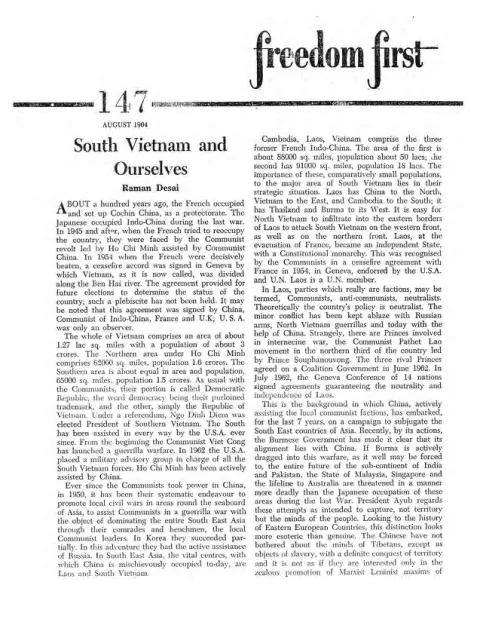
Raman Desai’s “Suppression of Opinion” reports the government’s banning of George N. Patterson’s “Peking Vs. Delhi” under the Defence of India Rules while Bertrand Russell’s similarly critical “Unarmed Victory” went unbanned, accusing Nehru and Nanda of suppressing embarrassing criticism.
-
The “Without Comment” column rejects Krishna Menon’s equating of Chinese and Pakistani “aggression,” arguing Pakistan had an arguable claim via the promised Kashmir plebiscite while China’s seizure of Tibet had no comparable basis.
-
Raman Desai reviews the seminar volume “A New Look at Communism” (ed. A. B. Shah and Nissim Ezekiel), praising its argument that resisting communist expansion requires contesting its underlying ideas, not just its territory.
-
A second review (signed B.K.D.) of The China Quarterly’s Formosa survey criticises its anti-Nationalist bias while crediting its articles on Formosa’s economic growth and the alienation of Formosan intellectuals toward liberal-democratic ideals.
-
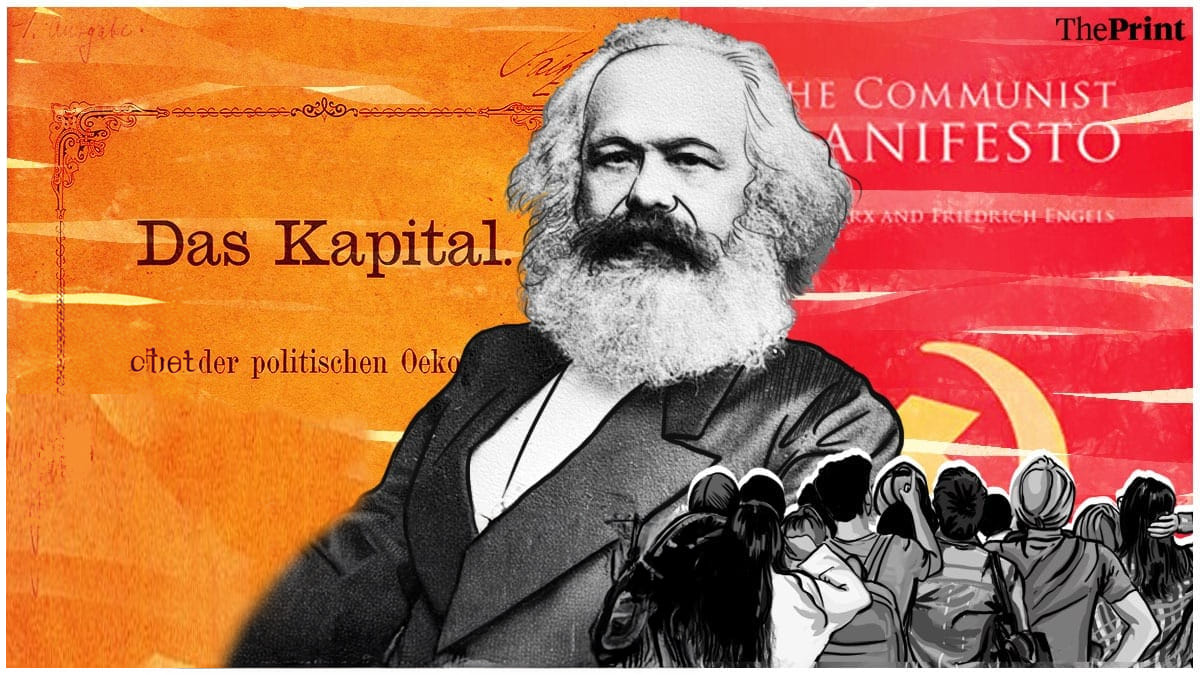
The closing “With Many Voices” column quotes C. Rajagopalachari arguing it is effectively impossible to prove the corruption of a leader who holds absolute power over witnesses, and Nehru’s own remark on having an “emotional rapport” with Marx and Lenin without having read them.
Essays
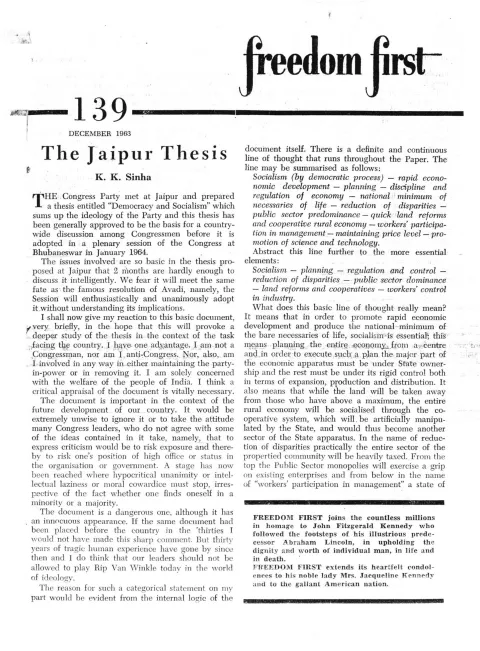
The Jaipur Thesis
By K. K. Sinha
K. K. Sinha critiques the Congress Party’s “Democracy and Socialism” thesis adopted at its Jaipur session, to be placed before the Bhubaneswar plenary in January 1964. He traces its logical chain from socialism through central planning to state ownership, price control, and forced land/cooperative reorganization, arguing this will create a state “octopus,” crush the entrepreneurial and middle classes, and curtail political liberty and free elections, since a ruling party wedded to an economic dogma will need to suppress dissent to sustain it. He contrasts India’s stagnant development goals with the West’s demonstrably faster and more humane postwar growth without doctrinaire socialism, and warns the thesis risks setting India on a path toward one-party authoritarianism, comparing Nehru’s position to that of Stalin’s Soviet Union despite differing intentions.
- The Jaipur Thesis proposes a chain running from democratic socialism to planning, discipline/regulation of the economy, public-sector predominance, land reform and cooperativization, and workers’ participation in management.
- Sinha argues the practical effect will be a state ‘octopus’ controlling the economy, mobilization of ‘masses’ against entrepreneurs, and the throttling of the independent middle class.
- He contends political liberty, free criticism, and free elections will be curtailed as the ruling party brands critics ‘anti-people’ and ‘reactionary’.
- He compares the thesis’s professed commitment to ‘democratic methods and values’ unfavorably with the Soviet Constitution under Stalin, warning ideological momentum can outrun the intentions of well-meaning leaders like Nehru.
- Sinha notes that non-communist countries (USA, Britain, Japan, France, West Germany) achieved comparable postwar development and higher living standards without adopting the socialist/planned model.
- He predicts the thesis, if adopted at Bhubaneswar, will generate economic and political instability rather than the promised ‘sense of urgency’ toward development.
The Kairon Enquiry
By A. G. Mulgaonkar
A. G. Mulgaonkar discusses Lord Denning’s forthcoming visit to India and his report on the Profumo affair, drawing a parallel to the ongoing enquiry into corruption charges against Punjab Chief Minister Pratap Singh Kairon. He criticizes Nehru’s note to the President for evasively defending his decision not to remove Kairon during the inquiry, contrasting Denning’s candid acknowledgment of his inquiry’s procedural limits with Nehru’s dismissal of the Supreme Court’s adverse findings of fact in the Dr. S. P. Singh case as binding only on the parties. Mulgaonkar closes by noting that ministerial corruption has historically been dealt with even in exalted political careers (Marlborough, Walpole) and even under Akbar’s rule in India, implying Nehru’s reluctance to act is a departure from this precedent.
- Denning’s visit and report on the Profumo affair are used as a lens for examining Nehru’s handling of corruption charges against Punjab CM Pratap Singh Kairon.
- Nehru’s note to the President recommends an inquiry under the Commissions of Inquiries Act, 1952, distinct from Denning’s tribunal model, but Mulgaonkar sees this as evasive of the substantive corruption charges.
- The Supreme Court’s findings in Dr. S. P. Singh’s case (that his suspension and disciplinary proceedings were ordered mala fide by the Chief Minister) are cited as prior evidence bearing on Kairon’s fitness for office, which Nehru’s inquiry terms of reference exclude from consideration.
- Denning’s own report acknowledges the procedural weaknesses of a one-man inquiry (no cross-examination, in secret, not a suitable body to determine guilt).
- Mulgaonkar surveys historical precedent — Marlborough, Walpole, and Akbar’s execution of corrupt ministers — to argue ministerial corruption has always demanded a reckoning.
The Radhakrishnan Report
By A. B. Shah
A. B. Shah offers an appreciative retrospective on the Radhakrishnan Commission’s 1949 Report of the University Education Commission, praising it as a synthesis of Eastern and Western thought and a foundational document for democratic higher education in India. He outlines the Commission’s formation under Maulana Abul Kalam Azad in 1948, its membership including Zakir Hussain and other scholars, and its key findings on India’s low spending on education, poor library provisioning, high teacher-student ratios, and high failure rates. He summarizes major recommendations: a three-year degree course preceded by twelve years of schooling, caps on university size (3,000 students unitary, no more than 40-50 affiliated colleges), a shift from rote-based essay examinations to objective tests, opposition to caste-based reservation of seats, and support for the regional language as medium of instruction while retaining English. Shah closes by lamenting that, more than a decade on, implementation has been partial and distorted, calling this a form of vulgarization of a document he ranks second only to the Constitution in post-Independence significance.
- The Radhakrishnan (University Education) Commission was appointed in November 1948 and completed its two-volume report by August 1949.
- The report found India spent only 5% of its budget on education versus 11-12% in postwar Britain and France, and detailed poor library funding and high teacher-student ratios (1:40 vs 1:10 in good universities).
- The Commission frames its central question as what a university is for in a free, democratic society, versus a totalitarian one — training individuals, not merely citizens.
- Key recommendations: a 3-year degree course after 12 years of schooling, caps on university/college size, replacing essay exams with objective tests, opposing caste-based reservation, and separate arrangements for working students.
- Shah recommends the regional language eventually replace English as medium of instruction, while the Commission insisted on maintaining a ‘living contact’ with English.
- Shah judges implementation of the Commission’s recommendations as only partial, haphazard, and distorted more than a decade after publication.
Suppression of Opinion
By Raman Desai
Raman Desai reports on the Government of India’s ban on the sale of George N. Patterson’s book Peking Vs. Delhi under the Defence of India Rules, suspecting it was banned for criticizing Nehru’s pre-war China policy rather than for genuine security concerns. He contrasts this with the non-banning of Bertrand Russell’s similarly critical ‘Unarmed Victory,’ though its import has reportedly been informally discouraged, and accuses Nehru and Nanda of suppressing informed criticism that might embarrass the government’s self-image. This is followed by the unsigned ‘Without Comment’ column, which rebuts Krishna Menon’s equating of Chinese and Pakistani ‘aggression’ in Kashmir and Ladakh, arguing the two cases are historically and morally distinct — Pakistan had an arguable claim via the plebiscite question, whereas China’s occupation of Tibet and incursion were unprovoked seizures with no comparable claim.
- The Government of India banned George N. Patterson’s Peking Vs. Delhi (Faber & Faber) under the Defence of India Rules; Desai suspects political rather than security motives.
- Bertrand Russell’s ‘Unarmed Victory,’ also critical of government policy, was not formally banned but its import was reportedly discouraged informally.
- Desai accuses Nehru and Nanda of suppressing informed criticism under the guise of national security.
- The ‘Without Comment’ column rejects Krishna Menon’s AICC Jaipur remarks treating Chinese and Pakistani actions as equally ‘aggression,’ arguing Pakistan had some arguable claim to Kashmir via the promised plebiscite while China’s seizure of Tibet and incursions had no such basis.
- The column argues China represents a larger, more dangerous threat than Pakistan and criticizes bracketing the two as equal evils.
Without Comment (Aggressions and Aggressions)
This is the ‘Review’ section, containing two book/journal notices. Raman Desai reviews ‘A New Look at Communism’ (ed. A. B. Shah & Nissim Ezekiel, Indian Committee for Cultural Freedom), a collection of seminar papers on the myths of communism, the communist movement in India and South-East Asia, the Sino-Soviet schism, and consumer economics under communism, praising its clear analysis and its argument that resistance to communist expansion must include contesting the ideas, not just the territory, behind it. A second, unsigned notice (initialed B.K.D. at the essay’s end) reviews The China Quarterly’s special survey of the Formosan situation, criticizing it for failing to give a balanced assessment of the Nationalist case, noting an anti-Nationalist bias in contributions such as John Israel’s ‘Politics of Formosa,’ while acknowledging useful articles on Formosa’s economic growth, its armed forces, and its intellectuals’ alienation and attraction to liberal-democratic ideals.
- Raman Desai reviews ‘A New Look at Communism,’ a seminar volume from the Indian Committee for Cultural Freedom (August 30-Sept 1, 1963), covering myths of communism, its appeal to intellectuals, the Sino-Soviet schism, and consumer economics under communism.
- The volume argues resistance to communist expansion must engage the underlying ideas, not merely counter territorial expansion militarily.
- Desai cites Laxmanshastri Joshi’s inaugural address call for education fostering ‘habits of empirical analysis and libertarian values.’
- A second review of The China Quarterly’s special Formosa survey criticizes its lack of balance and its anti-Nationalist bias, particularly in John Israel’s contribution, which dubs the Nationalist regime a ‘Police State’.
- The reviewer credits useful articles on Formosa’s economic growth (Sheppard Glass), armed forces (Joyce Kallgren), and the alienation of Formosan intellectuals drawn to liberal-democratic ideals (Mei Wen-li).
Review: A New Look at Communism (ed. A. B. Shah & Nissim Ezekiel)
By Raman Desai
The closing page, ‘With Many Voices,’ is a compilation of short quotations from public figures and publications of November 1963, headed by a Tennyson epigraph. It juxtaposes remarks from John F. Kennedy on American leadership, an editorial on the deaths of Lincoln and Kennedy, V. K. Krishna Menon on bank nationalization, Arjun Arora on socialism within the ruling party, Mahavir Tyagi and K. D. Malaviya on Congress and socialism, C. Rajagopalachari on the impossibility of proving political corruption, and Nehru’s own comment on Marx and Lenin, among others, without editorial commentary.
- The page collects short, sourced quotations from November 1963 without commentary, framed by a Tennyson epigraph on seeking ‘a newer world’.
- Quotes include J. F. Kennedy on American leadership and missiles, Krishna Menon on bank nationalization, Arjun Arora and Mahavir Tyagi on socialism within Congress, and Nehru’s remark on having an ‘emotional rapport’ with Marx and Lenin without having read them.
- C. Rajagopalachari is quoted arguing that proving the ‘defects and crimes of political leaders’ is effectively impossible when the accused holds absolute power over witnesses.
- The page also completes the Formosan Situation review (continued from page 11), arguing it is misleading to judge the Nationalist regime by pure liberal-democratic standards given the ongoing state of emergency.
Generated by the v1.5 extraction pipeline. Awaiting editorial review.
Metadata and summary are AI-extracted from the source PDF and reviewed for editorial accuracy. The original work is available via the Read PDF tab above (where present); paragraph-level citation inside the PDF is deferred to a future engagement.