periodical issue
Freedom First
By Smt. Gayatri Devi, M. R. Masani, K. K. Sinha, Raman Desai
Edited by RAMAN DESAI and printed at Inland Printers, 55 Gamdevi Road, Bombay 7 and published for the Democratic Research Service by Adam Adil at 127 Mahatma Gandhi Road, Bombay 1 · Bombay · 1964
12 pages
Freedom First
Summary
Freedom First No. 144 (May 1964) is a 12-page issue of the Bombay classical-liberal periodical, edited by Raman Desai and published for the Democratic Research Service. In the rendered pages it carries four signed pieces and one unsigned quotations column. Two of the pieces are transcribed Lok Sabha speeches, Gayatri Devi’s on the Santhanam Committee’s corruption report and M. R. Masani’s on the disputed Dange letters, both making the case that the Nehru government is shielding ministers and a Communist Party leader from scrutiny. K. K. Sinha reports on the deteriorating communal and refugee situation in eastern India following the Khulna and Calcutta riots, and Raman Desai gives a long historical brief on the Kashmir dispute, its accession, wars and plebiscite question, arguing against any concession on Kashmir’s status. The issue closes with ‘With Many Voices,’ a page of topical quotations drawn from Indian and international press in March-April 1964. The recurring thread across the issue is the classical-liberal critique of the ruling Congress establishment on grounds of corruption, appeasement of the Communist Party, and weakness on national-security and border questions.
Key points
-
Gayatri Devi’s Lok Sabha speech on the “Santhanam Committee Report on Corruption” argues the Committee’s recommendations do not go far enough, calling for a broad statutory definition of corruption covering influence-peddling, disclosure of ministers’ assets to an independent tribunal, and confiscation of unaccounted wealth as the penalty.
-
M. R. Masani’s Lok Sabha speech on the “Dange Letters” presses the government to authenticate the disputed 1924 letters in which CPI leader S. A. Dange purportedly offered to serve as an intelligence agent for the colonial Governor-General, accusing the Home Minister of evading the question to avoid embarrassing Nanda or antagonising the Soviet Union.
-
An unsigned compilation, “When Thieves Fall Out…,” assembles press reports of internal CPI accusations against chairman S. A. Dange, alleging he held undisclosed property through a nominee and received substantial funds from the Soviet-aligned World Federation of Trade Unions.
-
K. K. Sinha’s “Crisis In Eastern India” describes an accelerating refugee exodus of non-Muslims from East Pakistan following the Khulna riots, reporting 4,000-5,000 crossings a day by mid-April 1964 and the inadequacy of the Dandakaranya rehabilitation scheme.
-
Raman Desai’s “Kashmir—Past And Future” gives a long historical account of the 1947 accession, the UN plebiscite resolution, and Sheikh Abdullah’s later advocacy for independence, concluding India must resist further Pakistani pressure even at the risk of war.
-
The closing “With Many Voices” column quotes C. Rajagopalachari calling “Congress socialism” a “South Sea Bubble” and Jayaprakash Narayan observing that “the freedom fighters of yesterday began so early to imitate the language of the imperialists.”
Essays
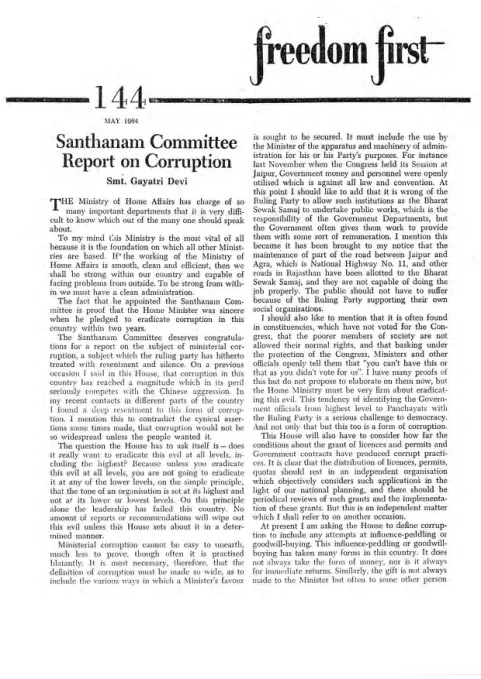
Santhanam Committee Report on Corruption
By Smt. Gayatri Devi
Gayatri Devi’s Lok Sabha speech (delivered April 13, during the Demands for Grants of the Home Ministry) welcomes the Santhanam Committee’s report on ministerial corruption but argues its recommendations do not go far enough. She calls for a wide statutory definition of corruption that covers influence-peddling and ‘goodwill-buying’ even when no money changes hands, for the disclosure of ministers’ income-tax returns and property to an independent tribunal, for confiscation of unaccounted wealth as the penalty for proven corruption, and for the tribunal to include a sitting judge. She criticises the Congress for using government resources for party purposes, for letting bodies like the Bharat Sewak Samaj do public works meant for government departments, and for local Congress officials threatening voters in constituencies that fail to support the party. She closes by arguing the failure of integrity among ministers reflects on the image of every Indian, not just the Congress.
- Argues the Home Ministry is the most vital government department because a clean administration underpins all others.
- Credits the Home Minister with sincerity for appointing the Santhanam Committee but says its recommendations do not go far enough.
- Calls for corruption to be defined broadly enough to include influence-peddling and goodwill-buying, not just direct bribery.
- Proposes that ministers’ income-tax returns and property be disclosed to an independent tribunal on the same terms as civil servants.
- Wants confiscation of unaccounted-for wealth as the penalty for proven ministerial corruption, not merely loss of office.
- Criticises the Bharat Sewak Samaj being given government works as political patronage by the ruling party.
- Alleges Congress officials in some constituencies tell poorer voters they will lose government benefits if they don’t vote Congress.
Dange Letters
By M. R. Masani
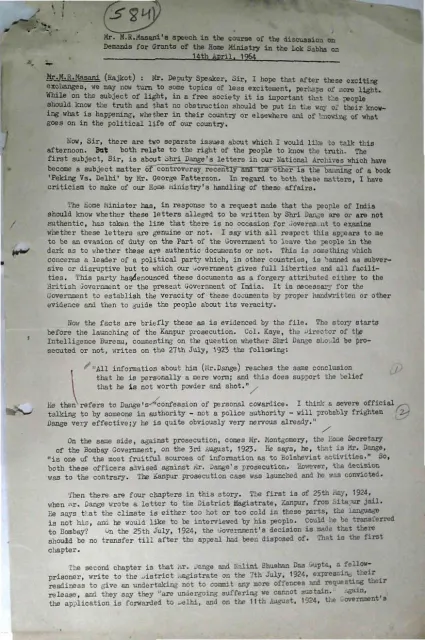
M. R. Masani’s Lok Sabha speech (delivered April 14, during Demands for Grants of the Home Ministry) presses the government to establish, through handwriting and other expert evidence, whether the controversial ‘Dange letters’ held in the National Archives are genuine. He recounts the sequence of correspondence from 1923-24 between S. A. Dange (imprisoned after the Kanpur conspiracy case), fellow prisoner Nalini Bhushan Das Gupta, and colonial officials, culminating in a disputed 1924 letter in which Dange purportedly offers to serve as an intelligence agent for the Governor-General in exchange for release. Masani argues the Home Minister’s refusal to authenticate the letters amounts to an evasion of duty, given that the government has since tolerated the Communist Party’s full political participation. He suggests political motives, including a wish not to embarrass Mr. Nanda or to appease Khrushchev, may be behind the government’s reluctance to settle the question, and calls on the Home Ministry to resolve the matter through proper evidence rather than leaving the public to guess.
- Argues the government evades its duty by refusing to formally authenticate or debunk the disputed Dange letters held in the National Archives.
- Lays out four chapters of 1924 correspondence: Dange’s request for transfer from Sitapur jail; a joint plea with Nalini Bhushan Das Gupta for release; the controversial petition offering intelligence services to the Governor-General; and a final clemency plea, all rejected.
- Notes Dange disputes the authenticity of the two most damaging letters on the grounds of a signature spelling discrepancy (‘T’ versus ‘D’).
- Cites colonial-era officials’ notes (Col. Kaye, Mr. Montgomery) characterising Dange as personally fearful and a valuable informant on Bolshevist activities.
- Calls for handwriting and expert evidence to settle whether the letters are genuine, since circumstantial evidence (jail stamps, notes) suggests authenticity.
- Suggests the Home Minister’s silence may reflect a wish to protect Mr. Nanda’s association with Dange or to avoid antagonising the Soviet Union.
When Thieves Fall Out…
An unsigned compilation, ‘When Thieves Fall Out…,’ assembles press clippings from March-April 1964 (Current, Thought, Indian Express, Times of India, Statesman) detailing internal accusations of corruption within the Communist Party of India, chiefly directed at CPI chairman S. A. Dange. The clippings allege Dange held undisclosed shares and property through a nominee (‘S. Amrit’), received substantial funds from the Soviet-aligned World Federation of Trade Unions and AITUC for personal and party use, profited from paper imports from the USSR resold to the CPI, and that other party figures similarly diverted funds; a cartoon captioned by ‘Ranga’ about a no-confidence motion accompanies the piece.
- Compiles press reports alleging S. A. Dange used the name ‘S. Amrit’ to hold shares and property while publicly disclaiming wealth.
- Reports a rumoured Rs. 60,000 that disappeared under former CPI general secretary Ajoy Ghosh, allegedly encashed after Dange became chairman.
- Reports Dange’s reported admission at an April 12 meeting to receiving £5,000 annually from the WFTU plus £12,000 in expenses via AITUC.
- Alleges Dange admitted receiving money from the Soviet Union along with two Andhra Communist leaders, and profited from reselling USSR paper imports to the CPI.
Crisis In Eastern India
By K. K. Sinha
K. K. Sinha’s report, ‘Crisis in Eastern India,’ surveys the aftermath of the January 1964 communal riots in Calcutta and West Bengal, which he traces to provocations following the Khulna riots in East Pakistan. He describes a large and accelerating refugee exodus of non-Muslims from East Pakistan (averaging 4,000-5,000 a day by mid-April 1964, out of roughly 9 million non-Muslims remaining there), the inadequacy of rehabilitation efforts such as the Dandakaranya project, and retaliatory attacks on Muslims by tribal populations in Bihar and Orissa. He notes rising communal tension, Pakistani espionage networks, and increasing public support in India for population exchange or an economic boycott of Pakistan, and warns that the eastern crisis is fundamentally a political problem in Indo-Pakistani relations, not merely an administrative one of refugee transit.
- Traces the January 1964 Calcutta-area riots to provocations from the Khulna riots in East Pakistan and describes Bengali reaction as swift but short-lived.
- Reports a refugee exodus from East Pakistan accelerating to 4,000-5,000 people a day by mid-April 1964, with over 260,000 having crossed by that point.
- Estimates 9 million non-Muslims remain in East Pakistan and predicts 5-6 million may eventually leave over the next two years.
- Criticises the slow pace of the Dandakaranya rehabilitation scheme, noting only about 8,000 of 35,000 proposed refugee families settled and reports of at least 15 deaths a day in camps.
- Describes retaliatory attacks on Muslims by tribal populations in Jamshedpur, Rourkela, and other parts of Bihar and Orissa.
- Notes rising public support for two slogans: a full population exchange between India and Pakistan, and an economic boycott/satyagraha against goods trains to Pakistan.
- Argues Pakistan’s strategy of raising the ‘eviction’ issue in the east, in collusion with China, is meant to pressure India diplomatically over Kashmir-style disputes.
Kashmir—Past And Future
By Raman Desai
Raman Desai’s ‘Kashmir - Past and Future’ gives a lengthy historical account of the Kashmir dispute from Pakistan’s 1947 invasion through the 1964 political situation. He reviews the state’s demography and geography, the 1947 accession under Maharaja Hari Singh following Pakistani tribal raids and the Baramula atrocities, the 1947-48 war, the UN Commission’s ceasefire and resolutions, and subsequent constitutional developments including the 1951 Constituent Assembly and later elections. He discusses Sheikh Abdullah’s later advocacy of an independent Kashmir (guaranteed by India, Pakistan, Britain and the USSR) and his 1953 dismissal, and closes by rejecting any plebiscite formula or territorial concession, arguing India must resist further Pakistani pressure over Kashmir with courage even at the risk of war with Pakistan or China.
- Reviews 1951 and 1961 census figures for Jammu and Kashmir’s religious composition on the Indian side of the ceasefire line.
- Describes the geographic and strategic importance of Ladakh (a Buddhist-majority district) and the Kashmir Valley to India’s northern defence.
- Recounts the 1947 Pakistani-backed tribal invasion, the Maharaja’s accession to India, and Mountbatten’s letter promising an eventual reference to the people once order was restored.
- Summarises the 1947-49 fighting, the UN Commission’s findings that Pakistani army units participated in the invasion, and the January 1949 ceasefire.
- Explains the three-part 1948 UN resolution (ceasefire, Pakistani withdrawal, plebiscite) and argues the plebiscite condition never became binding because Pakistan never withdrew its forces.
- Notes Sheikh Abdullah’s 1953 dismissal and later advocacy for an independent Kashmir guaranteed by multiple powers, contrasted with his earlier imprisonment of Jammu leaders without trial.
- Argues against any plebiscite or partition formula on grounds that non-Muslim minorities in Jammu and Ladakh would be forced into Pakistan against their will.
- Concludes India must not withdraw its forces from Kashmir and should be prepared to face war with Pakistan or China rather than make further concessions.
With Many Voices
‘With Many Voices’ is the issue’s closing page, an unsigned column of topical quotations culled from Indian and international press and public figures in March-April 1964, epigraphed with lines from Tennyson’s ‘Ulysses.’ The quotations range across Congress socialism, the Dange/Communist controversy, Nehru’s succession, Algerian emigration under Ben Bella, and remarks from figures including Senator McCarthy, Khrushchev, Rajagopalachari, Morarji Desai, and Jayaprakash Narayan, generally selected to needle Congress and the political left.
- Epigraph from Tennyson’s ‘Ulysses’ (‘Tis not too late to seek a newer world’) frames the column.
- Quotes C. Rajagopalachari calling ‘Congress socialism… a South Sea Bubble’ (Swarajya, April 11).
- Quotes Jayaprakash Narayan observing that ‘the freedom fighters of yesterday began so early to imitate the language of the imperialists’ (Hindustan Times, April 20).
- Quotes Morarji Desai arguing only a party believing in ‘freedom and democracy’ should replace the Congress (Link, April 5).
- Includes a quotation from Khrushchev defending rising Soviet living standards against charges of bourgeois conception of life (Statesman, April 7).
Generated by the v1.5 extraction pipeline. Awaiting editorial review.
Metadata and summary are AI-extracted from the source PDF and reviewed for editorial accuracy. The original work is available via the Read PDF tab above (where present); paragraph-level citation inside the PDF is deferred to a future engagement.