periodical issue
Freedom First
By M. R. Masani, M.P., A. G. Mulgaonkar, N. S. Ranganath Rao, Alexander Frater
Edited by Raman Desai and printed at Inland Printers, 55 Gamdevi Road, Bombay 7 and published for the Democratic Research Service by Raman Desai at 127 Mahatma Gandhi Road, Bombay 1. · Bombay · 1964
12 pages
Freedom First
Summary
Freedom First No. 148 (September 1964) opens with M. R. Masani’s polemic ‘The Food Crisis,’ which blames stagnant foodgrain output and rising prices on the Second Plan’s priority given to heavy industry over agriculture, attacks state trading and zonal restrictions as scapegoating of peasants and traders, and calls for releasing buffer stocks, ending zonal controls, and halting food exports. A. G. Mulgaonkar’s ‘Choosing The Leader’ uses a historical survey of how British prime ministers have been chosen (Walpole through Douglas-Home) to frame the puzzle of Lal Bahadur Shastri’s unexpected rise to India’s premiership after Nehru’s death, and to ask what precedent this offers for how the Congress party will select future leaders. N. S. Ranganath Rao begins a two-part historical essay, ‘Obscenity: Literature And Law,’ tracing the shifting, culturally relative concept of obscenity in English law and letters from ancient Greece through the 1868 Hicklin test, and laying out the opposing arguments of literary-freedom advocates and moral-restraint advocates that the second instalment will continue. The issue closes with two lighter features: Alexander Frater’s satirical dialogue ‘Goulash And Ballet,’ imagining a backstage conversation between Khrushchev and Mao that lampoons Cold War posturing and Sino-Soviet rivalry, and ‘With Many Voices,’ a page of topical newspaper quotations on world and Indian affairs from figures including President Johnson, Dean Rusk, G. L. Nanda, and Asoka Mehta.
Key points
-
M. R. Masani’s “The Food Crisis” blames stagnant foodgrain output and rising prices on the Second Plan’s priority for heavy industry over agriculture, criticises the government for scapegoating peasants and traders as hoarders, and calls for releasing buffer stocks, ending zonal restrictions and halting food exports.
-
A. G. Mulgaonkar’s “Choosing The Leader” surveys three centuries of British prime-ministerial selection, from Walpole through the criticised 1963 “soundings” that produced Sir Alec Douglas-Home, to ask what precedent Lal Bahadur Shastri’s unexpected rise offers for how Congress will choose future leaders.
-
N. S. Ranganath Rao opens a two-part essay, “Obscenity: Literature And Law,” tracing the culturally relative history of obscenity regulation in English law from antiquity through the 1868 Hicklin test that Indian courts adopted, setting out the opposing arguments of free-expression and moral-restraint advocates.
-
Alexander Frater’s satirical dialogue “Goulash And Ballet,” reprinted from Punch, imagines Khrushchev and Mao privately coordinating a feigned Sino-Soviet rivalry for propaganda purposes while secretly planning a staged nuclear provocation.
-
The issue closes with “With Many Voices,” a page of topical quotations from figures including President Johnson, Dean Rusk, G. L. Nanda and Asoka Mehta on world and Indian affairs.
Essays
The Food Crisis
By M. R. Masani, M.P.
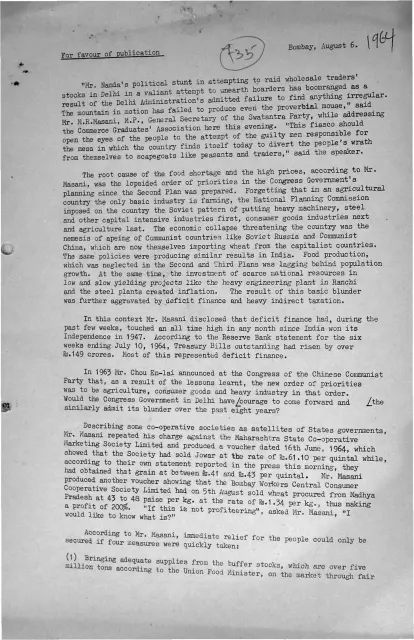
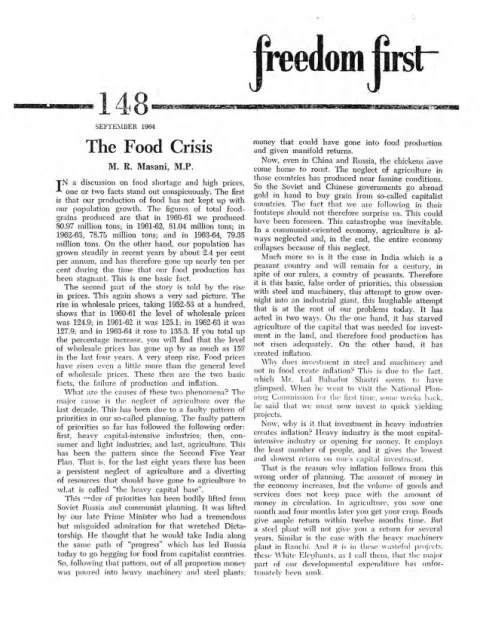
M. R. Masani’s ‘The Food Crisis’ argues that India’s food shortage and price inflation stem from a deliberate, Soviet-derived planning priority that starved agriculture of capital in favour of heavy industry, and that this same misallocation is the structural cause of inflation. He criticizes the government’s response of blaming peasants and grain traders as ‘scapegoats’ and recounts a botched Delhi anti-hoarding police drive that found almost no wrongdoing. Masani closes with concrete short-term demands: release government buffer stocks onto the market, abolish zonal foodgrain restrictions, decontrol trade as Rafi Ahmed Kidwai once did, and stop food exports, warning that continued ‘Marxist’ planning will lead to economic collapse.
- Foodgrain output stagnated (80.97 to 79.35 million tons, 1960-64) while population grew ~2.4% a year and wholesale prices rose about 15% over the same period.
- Masani attributes the crisis to a planning order that prioritized heavy capital-intensive industry, then consumer/light industry, with agriculture last, a pattern he says was copied from Soviet Russia under Nehru’s influence.
- He argues investment in steel and heavy machinery (slow-return, capital-intensive, low-employment) rather than agriculture (fast-return) is the direct cause of inflation, compounded by excise duties and deficit finance exceeding Third Plan limits by Rs. 600 crores.
- He criticizes the government’s scapegoating of peasants and traders for hoarding, citing a Delhi police raid drive that collapsed after finding almost no violations among grain dealers.
- Proposed remedies: bring government buffer stocks (over 5 million tons) onto the open market, abolish zonal restrictions on grain movement, decontrol trade, and halt exports of edible commodities.
- He invokes Chou En-lai’s 1963 admission that China wrongly prioritized steel over agriculture as evidence that even Communist China had reversed the very policy India was still following.
Choosing The Leader
By A. G. Mulgaonkar
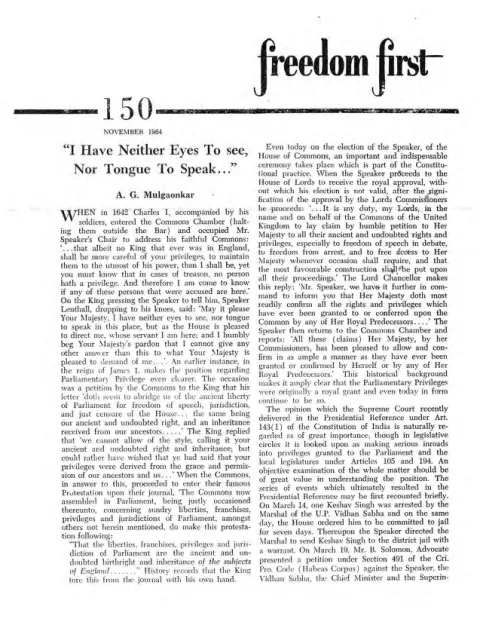
A. G. Mulgaonkar’s ‘Choosing The Leader’ opens by noting that Lal Bahadur Shastri’s rise to the premiership after Nehru’s death puzzled observers given his lack of family background or powerful backing, and argues this reflects how parliamentary democracy channels public opinion even through seemingly unremarkable figures. The bulk of the essay is a historical survey of how British prime ministers have been selected across three centuries and three parties (Conservative, Liberal, Labour), from Walpole’s consolidation of the office through Baldwin, Attlee, and the recent, sharply criticized selection of Sir Alec Douglas-Home under Macmillan. Mulgaonkar closes by asking what precedent this offers India, concluding that the Congress party’s own organisational structure will likely keep leadership selection tightly controlled by its central executive rather than by a genuine backbench vote.
- Shastri’s ascent to PM despite modest stature and no powerful backing is presented as evidence that parliamentary democracy can elevate a common man whose ‘hopes and limitations’ resemble the public’s own.
- Walpole is credited with three achievements: making the PM office substantial, maturing the cabinet system, and centering political business in the Commons.
- The essay surveys the differing selection customs of Conservatives (family/school ties), Liberals (democratic vote), and Labour (parliamentary party vote), noting exceptions like Attlee’s 1945 confirmation despite an ‘alternative leadership’ challenge.
- The 1963 selection of Sir Alec Douglas-Home under Macmillan is cited as a sharply criticized instance of the ‘soundings’ method.
- Mulgaonkar argues the Congress party’s organisational structure (Working Committee, Parliamentary Board) more closely resembles the Conservative pattern, implying leadership choice will stay tightly controlled by the central executive rather than open to backbenchers.
Obscenity: Literature And Law (1)
By N. S. Ranganath Rao
N. S. Ranganath Rao opens a two-part essay, ‘Obscenity: Literature And Law,’ arguing that obscenity is not a fixed but a relative and culturally contingent concept, illustrated by works once condemned (Zola’s La Terre, Fanny Hill, Lady Chatterley’s Lover) that were later celebrated or vice versa. He traces the legal history of obscenity regulation in England from classical antiquity, through medieval ecclesiastical courts concerned chiefly with heresy rather than obscenity, the licencing regime opposed by Milton, the Restoration’s freer mores, Victorian puritanism spurred by evangelicalism and mass literacy, and the 1857 Obscene Publications Act, culminating in the 1868 Hicklin test formulated by Sir Alexander Cockburn, which India’s own courts have followed. The instalment then sets out, without resolving, the central legal-philosophical debate between champions of free expression (who favour education and cure over censorship) and champions of moral restraint (who argue the law must protect the susceptible), promising continuation in the next issue.
- Obscenity is described as inherently relative and subjective, varying by individual, community, and era, illustrated by the reversal of reputation of works like Zola’s La Terre and Lady Chatterley’s Lover.
- Ancient Greek and Roman societies, and even Anglo-Saxon literature, tolerated erotic content because literature was largely an elite, male preserve.
- Medieval ecclesiastical courts policed heresy, not obscenity; the shift to Common Law jurisdiction over ‘obscene libel’ only occurred at the end of the eighteenth century.
- The 1857 Obscene Publications Act (Lord Campbell’s Act) empowered magistrates to order destruction of obscene books and authorized police search warrants.
- The 1868 ‘Hicklin case’ (regarding the pamphlet ‘The Confessional Unmasked’) produced Sir Alexander Cockburn’s test of obscenity, which Indian courts have also adopted.
- The essay lays out, without adjudicating, the opposing camps: those favouring freedom of expression with education/cure of susceptible readers versus those favouring legal restraint to protect the vulnerable, especially the young.
- Explicitly promises a second instalment (‘To be continued’) that will discuss the defects of the Hicklin test.
Goulash And Ballet
By Alexander Frater
Alexander Frater’s ‘Goulash And Ballet,’ reprinted by permission of Punch, is a satirical fictional dialogue imagining a secret backstage meeting between Nikita Khrushchev and Mao Zedong (in disguise as a Chinese minstrel) in which the two leaders trade cynical confidences about their public rivalry, racist asides about Africans and Jews, and plans to feign a Sino-Soviet split for propaganda purposes while secretly coordinating strategy against the West, including a staged nuclear provocation and a plan to woo the West with cultural diplomacy (‘goulash and ballet’) before eventually resuming pressure.
- The piece is a work of political satire lampooning Cold War diplomacy and the publicized Sino-Soviet ideological rift.
- Khrushchev and Mao are portrayed privately coordinating a strategy of feigned rivalry (‘You push Stalinism and steel, you push goulash and ballet’) to strengthen both regimes’ positions.
- The satire mocks both leaders’ courting of newly independent African and Asian nations for Cold War advantage.
- Mao plans a staged nuclear detonation near Washington timed to his birthday as a propaganda stunt, which Khrushchev refuses to assist with directly.
- The dialogue closes with the two leaders departing arm-in-arm for vodka, undercutting their public antagonism.
- Piece explicitly credited as reprinted by permission of Punch magazine.
Generated by the v1.5 extraction pipeline. Awaiting editorial review.
Metadata and summary are AI-extracted from the source PDF and reviewed for editorial accuracy. The original work is available via the Read PDF tab above (where present); paragraph-level citation inside the PDF is deferred to a future engagement.