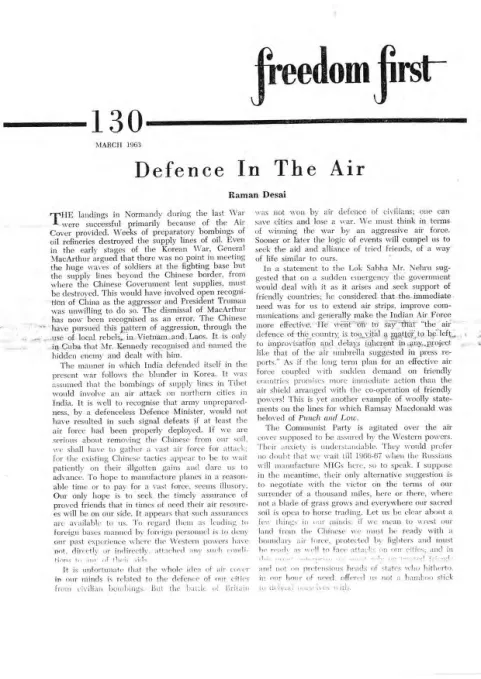
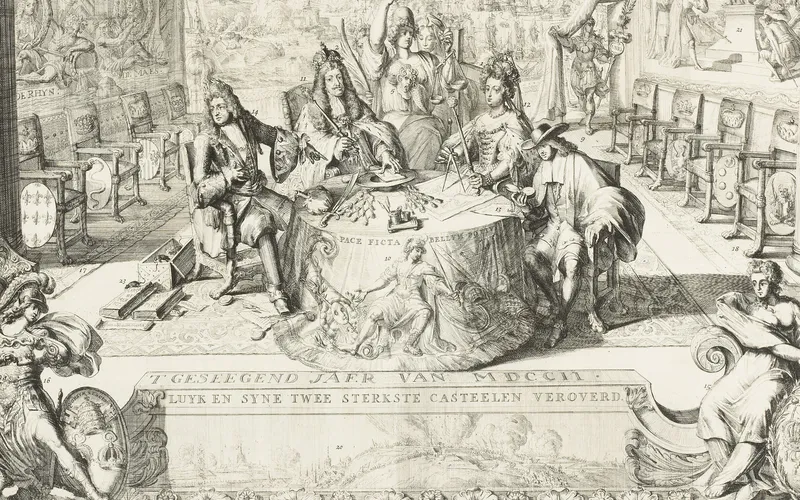
periodical issue
Freedom First
By Philip Spratt, Rohit Dave, B. K. Desai
Freedom First / Democratic Research Service, Maneckji Wadia Building, 4th Floor, 127 Mahatma Gandhi Road, Bombay 1 · Bombay · 1964
12 pages
Freedom First
Summary
Freedom First No. 149 (October 1964) opens with Philip Spratt’s “The Hindu Personality,” a Freudian analysis originally delivered at the Indian Committee for Cultural Freedom’s Poona seminar on “Indian Tradition and its Significance for Freedom,” which argues that the traditional Hindu psyche is narcissistic rather than punitive and traces the political consequences of that structure for caste, authority, and the prospects of liberty. The rest of the issue is dominated by the Sino-Soviet and Sino-Indian confrontation: Rohit Dave’s “South East Asia And Ourselves” surveys the regional crisis (Laos, Vietnam, Malaysia, the Tonkin Gulf incident) and calls for a firmer Indian defence and foreign policy; “Russian Aid” and “Without Comment” reprint, without editorial commentary, excerpts from the Chinese Communist Party’s February 1964 letter to the CPSU and a Pravda critique of internal Communist Party of China practices; and “China’s Territorial Claims” documents Chinese expansionist doctrine and reproduces a 1954 Chinese textbook map showing claims on Indian and neighbouring territory. B. K. Desai reviews Peter Lyons’s book Neutralism, and the issue closes with the regular press-quotes column “With Many Voices.” The magazine was edited by Raman Desai and published by the Democratic Research Service, Bombay.
Key points
-
Philip Spratt’s “The Hindu Personality,” delivered at the Indian Committee for Cultural Freedom’s Poona seminar, argues from a Freudian perspective that the Hindu psyche is narcissistic rather than punitive, tracing this to Advaita Vedanta and indulgent child-rearing, and asks whether liberty can be made part of the ruling elite’s ego-ideal.
-
Rohit Dave’s “South East Asia And Ourselves” surveys the regional crisis in Laos, Vietnam and Malaysia after the Tonkin Gulf incident, rejecting both an all-out Indian military buildup and abandoning non-alignment for Western alliances, and calls for India to lead a regional response to Chinese expansionism.
-
“Russian Aid” reprints excerpts from the Chinese Communist Party’s February 1964 letter to the CPSU rebutting Soviet claims of one-sided aid, detailing Chinese exports of grain and strategic minerals to the USSR and accusing Moscow of abruptly withdrawing 1,390 experts in 1960.
-
The “Without Comment” column reprints a Pravda article criticising the Communist Party of China for failing to hold regular Party Congresses and for the leadership deciding matters by “the directives of Mao Tse-tung” rather than its own Rules.
-
B. K. Desai’s review of Peter Lyons’s “Neutralism” argues non-alignment degenerated from a sound policy of avoiding military pacts into a dogma that blinded India to the communist threat, citing the Colombo powers’ refusal to condemn Chinese aggression in 1962.
-
An unsigned piece, “China’s Territorial Claims,” documents Chinese expansionist doctrine and reproduces a 1954 Chinese textbook map showing claims on Ladakh, Nepal, Sikkim, Bhutan, NEFA/Assam and other neighbouring territories.
-
The closing “With Many Voices” column quotes C. Rajagopalachari denouncing the Fourth Plan’s Rs. 22,000-crore outlay as “the nation’s biggest enemy” and Sukarno describing himself as “a Communist, religious and nationalist as well.”
Essays
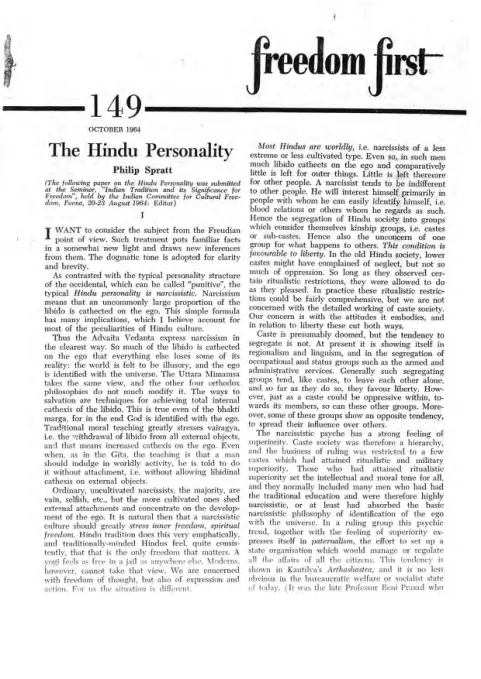
The Hindu Personality
By Philip Spratt
Philip Spratt argues, from a Freudian perspective, that the Hindu personality is fundamentally narcissistic rather than punitive like its Western counterpart, with libido heavily cathected on the ego rather than directed outward in guilt-driven discipline. He traces this to Advaita Vedanta’s philosophy of the illusory world and the ego identified with the universe, and to indulgent early child-rearing that leaves the positive Oedipus conflict undeveloped while a submissive, propitiating attitude to father-figures persists into adulthood. He extends the analysis to caste (an extended narcissistic family that promotes mutual indifference between groups but is “favourable to liberty”), to Hindu mythology (where father-figures typically triumph over sons, unlike Western punitive myths), and to the psychology of Hindu rulers, whom he describes as paternalistic and conformist but afflicted with a “high ego-ideal” that could, in principle, be redirected from socialism toward liberalism. He closes by questioning whether intellectual liberty can be made a genuinely operative part of the ruling elite’s ego-ideal, expressing skepticism about both a revived Charvaka rationalism and M. N. Roy’s call for a Hindu Renaissance.
- Contrasts the narcissistic Hindu personality structure with the punitive Western/occidental type
- Traces narcissism to Advaita Vedanta and other orthodox philosophies that identify the ego with the universe
- Argues indulgent Hindu child-rearing prevents the punitive personality from forming and leaves the negative Oedipus phase (submission to the father) dominant
- Links narcissism to caste segregation, arguing indifference between castes is paradoxically favourable to liberty while oppression within groups is not
- Analyzes Hindu myths (Rama, Krishna, Shukra-Kacha-Yayati, Prajapati-Rudra) as father-figure-victorious narratives, contrasting with Western punitive myth patterns
- Describes the Hindu ruler/bureaucrat as paternalistic, egalitarian, and stifling, but constrained by a high, potentially liberalizing ego-ideal
- Questions whether liberty can be made a more effective part of the elite’s ego-ideal than equality/socialism currently is
- Expresses doubt that reviving Charvaka rationalism or M. N. Roy’s ‘Indian Renaissance’ can succeed, since Hindus are narcissistic rather than repressed
South East Asia And Ourselves
By Rohit Dave
Rohit Dave surveys the deteriorating situation in South East Asia — Laos, South Vietnam, Malaysia, and the Sino-Indonesian-Malaysian confrontation — arguing that Communist China’s strategic goal is a ‘powerful greater China’ that reduces India and Indonesia to obedient neutralist satellites, and that the Tonkin Gulf incident functioned as a loud American ultimatum to Hanoi. He rejects both extremes in India’s domestic debate (all-out military buildup regardless of cost versus abandoning non-alignment for Western military alliances), calling instead for a reformulated, more outward-looking defence strategy and greater Indian leadership in helping the region resist Chinese expansionism, while warning that China’s likely acquisition of nuclear weapons could make the regional balance resemble the pre-WWI Balkans.
- Frames Chinese strategic goals in South East Asia (via Juergen Domes) as establishing a totalitarian greater China with India and Indonesia as obedient neutralist buffers
- Cites the Tonkin Gulf incident as a decisive US ultimatum to North Vietnam
- Criticizes both the ‘defence at any economic cost’ school and the ‘abandon non-alignment for Western alliances’ school in India as extremes out of touch with the region’s realities
- Warns that Chinese acquisition of atomic weapons would make the South East Asian balance resemble the pre-World War I Balkans
- Calls for India to take the lead in an Asian solution to Chinese expansionism and to build up regional defence potential with friendly-nation help
- Notes the U.S. has not taken a clear position on the Indonesia-Malaysia confrontation despite deep UK involvement
Russian Aid
Presented under the heading ‘Russian Aid’ without attribution to a Freedom First author, this piece reprints excerpts from a Chinese Communist Party letter of February 29, 1964 to the CPSU, rebutting Soviet claims of one-sided ‘disinterested assistance’ to China. The excerpts detail the scale of Chinese exports of raw materials, grain, and metals to the USSR (including tonnages of soya beans, rice, edible oils, meat, lithium, beryllium, borax, wolfram, mercury, and other strategic minerals), accuse Moscow of unilaterally withdrawing 1,390 Soviet experts and voiding hundreds of technical contracts in 1960, and charge the Soviet Union with using aid and trade as instruments of political pressure, bullying less-developed fraternal countries, and effectively replicating the ‘jungle law’ of the capitalist Common Market.
- Reprints excerpts from the CPC’s February 29, 1964 letter to the CPSU as a documentary source, without editorial comment
- Rebuts Soviet claims of one-way ‘disinterested assistance,’ detailing Chinese exports of grain, edible oils, meat, and strategic minerals to the USSR
- States China repaid Soviet loans mainly used for war material during the Korean War, which is called China’s ‘bounden internationalist duty’
- Accuses the USSR of abruptly withdrawing 1,390 experts and voiding 343 contracts and 257 projects within a month in 1960
- Charges the Soviet Union with using aid/trade as political leverage and likens its conduct to the capitalist Common Market’s ‘jungle law’
- Includes a British Political cartoon (courtesy B.P.A.) depicting Mao alongside Viet Cong and Catholic/Buddhist figures
Without Comment
‘Without Comment’ reprints, verbatim and without editorializing, a Pravda article titled ‘Certain aspects of Party Life in the Communist Party of China,’ which criticizes the CPC for failing to convene Party Congresses on schedule (only two in 35 years, with the Eighth Congress’s mandated five-year delegate term expiring in 1961 with no new Congress convened by the time of writing), for the Central Committee’s expired term of office, and for the Party leadership deciding such matters not by its own Rules but by ‘the directives of Mao Tse-tung,’ which Pravda likens to the Stalin-era Soviet practice.
- Reprints Pravda’s critique of the Communist Party of China’s failure to hold regular Congresses per its own Party Rules
- Notes the CPC held only two Congresses (1945, 1956) in the 35 years to 1963, far short of the five-year cycle mandated by its Rules
- Highlights that delegates elected to the 1956 Congress (10.7 million members) still hold power though CPC membership has grown to 18 million, disenfranchising over 7 million newer members
- States the Central Committee’s term of office has also expired without a new Congress being convened
- Concludes such matters are decided in China ‘not by the Rules, but by the directives of Mao Tse-tung,’ comparing this to Soviet practice under Stalin
Review: Neutralism by Peter Lyons
By B. K. Desai
B. K. Desai reviews Peter Lyons’s book Neutralism (Oxford University Press, Rs. 15), summarizing Lyons’s identification of five assumptions underlying the neutralist stand and then largely rejecting the neutralist claim to moral superiority. Desai argues non-alignment began as a sound policy of avoiding military pacts but degenerated into a dogma that blinded countries like India to the communist threat, cites the 1962 Sino-Indian war and the Colombo powers’ refusal to condemn Chinese aggression as proof of its failure, and concludes neutralism is now a manifestation of an anti-Western, authoritarian-leaning Afro-Asian nationalism that communists exploit for their own ends, leaving regimes like Sukarno’s a ‘prisoner’ of local communists while Nasser and Tito retained more genuine independence.
- Summarizes Lyons’s five assumptions of neutralism: refusal to take Cold War sides, claimed moral superiority, independent foreign policy, opposition to colonialism, and demand for aid without strings
- Desai argues the claim to moral superiority is ‘not only arrogant, but also blatantly absurd’
- Argues the Cold War is ideological as well as geopolitical, making strict neutrality on the ideological plane untenable given communist ‘fifth column’ activity
- Cites India’s failure to recognize Chinese expansionism as imperialism until 1958, and the Colombo powers’ refusal to condemn Chinese aggression in 1962, as evidence of non-alignment’s practical failure
- Argues only Sukarno’s Indonesia and Nasser’s Egypt genuinely benefited from non-alignment, and that Sukarno has since become a prisoner of Indonesian communists while Nasser and Tito preserved independence
- Concludes neutralism is now a vehicle for anti-Western, authoritarian Afro-Asian nationalism that communists exploit for their own purposes
China’s Territorial Claims
This unsigned piece documents Communist China’s territorial claims and expansionist doctrine, opening with Mao Tse-tung’s 1931 Kiangsi Soviet constitutional promise of self-determination for national minorities (which did not prevent the ‘liberation’ of Tibet), and citing Mao’s 1939 writings and a 1963 People’s Daily editorial cataloguing ‘unequal treaties’ China wishes to revise, including Nanking (1842), Aigun (1858), Tientsin (1858), Peking (1860), Ili (1881), and others. It reproduces a map from a 1954 Chinese history textbook published in Peking showing nineteen numbered territories claimed or eyed by China, including Ladakh, Nepal, Sikkim, Bhutan, NEFA/Assam, Burma, Malaya/Singapore, Indochina, the Andamans, and parts of the Soviet Far East, framing this as evidence of a long-standing, methodically pursued expansionist ambition.
- Cites Mao’s 1931 Kiangsi Soviet constitution promising self-determination to minorities, contrasted with the subsequent ‘liberation’ of Tibet
- Quotes Mao’s 1939 ‘Chinese Revolution and the Chinese Communist Party’ listing territories taken from China by Japan, Britain, France, and Portugal
- Cites a 1963 People’s Daily statement listing ‘unequal treaties’ (Nanking 1842, Aigun 1858, Tientsin 1858, Peking 1860, Ili 1881, Lisbon protocol 1887, 1898 Hong Kong extension, 1901) China considers open to revision
- Reproduces a map from a 1954 Peking-published Chinese history textbook showing 19 numbered territories including Ladakh, Nepal, Sikkim, Bhutan, NEFA/Assam Plain, Burma, the Andamans, Malaya/Singapore, Indochina, Formosa, and parts of Soviet Central Asia and the Amur region
- Frames the ‘five fingers of Tibet’ doctrine (Ladakh, Nepal, Sikkim, NEFA, Bhutan) as explaining Chinese pressure on these regions
- Continues onto page 12 discussing outstanding Sino-Soviet border issues and repeats the 1954 map reference
With Many Voices
‘With Many Voices’ is the issue’s regular closing column of press quotations (dated September 6-23, 1964) from figures including T. T. Krishnamachari, Pothan Joseph, C. Rajagopalachari, J. B. Kripalani, S. A. Dange, Frank Moraes, and Sukarno, on topics ranging from Indian foreign policy and the Fourth Plan to Sino-Soviet polemics and party politics; it closes with the continuation of the China’s Territorial Claims piece and the masthead crediting editor Raman Desai and the Democratic Research Service, Bombay, as publisher.
- Regular press-quotes column drawing from Times of India, Swarajya, Janata, Indian Express, New Age, The Sunday Standard, and The Hindustan Times, September 6-23, 1964
- Includes C. Rajagopalachari’s quotes criticizing the Fourth Plan’s Rs. 22,000 crore outlay as ‘the nation’s biggest enemy’ and denouncing Chinese chauvinism
- Includes Sukarno’s self-description as ‘a Communist, religious and nationalist as well’
- Includes domestic political sparring among Kripalani, Dange, and others over Congress/Opposition roles
- Masthead identifies Raman Desai as editor and the Democratic Research Service, Bombay, as printer/publisher, with Registered No. B-6354
Generated by the v1.5 extraction pipeline. Awaiting editorial review.
Metadata and summary are AI-extracted from the source PDF and reviewed for editorial accuracy. The original work is available via the Read PDF tab above (where present); paragraph-level citation inside the PDF is deferred to a future engagement.