periodical issue
Freedom First
By M. R. Masani, M.P., A. G. Mulgaonkar, N. S. Ranganath Rao
published for the Democratic Research Service by Raman Desai at 127 Mahatma Gandhi Road, Bombay 1 · Bombay · 1964
12 pages
Freedom First
Summary
Freedom First No. 151 (December 1964) is a 12-page issue of the Bombay-based liberal monthly, published for the Democratic Research Service and edited by Raman Desai. The issue opens with M. R. Masani’s editorial “The Bomb,” written weeks after China’s first nuclear test, weighing India’s strategic options and arguing that India should seek a mutual-security understanding with the United States rather than pursue an independent deterrent or rely on Soviet protection. It is followed by an unsigned constitutional commentary (bylined earlier in the piece to A. G. Mulgaonkar) analysing the Supreme Court’s advisory opinion in the U.P. Vidhan Sabha privileges case (the Keshav Singh affair), which had pitted the U.P. legislature against the Allahabad High Court judges at Lucknow. N. S. Ranganath Rao contributes the third installment of a series, “Obscenity: Literature & Law,” proposing specific amendments to Sections 292-293 of the Indian Penal Code and to Customs and postal enforcement practice. A report titled “Press Council” summarises a seminar held by the Indian Committee for Cultural Freedom on the proposed Press Council Bill, chaired by Professor Ranganath Rao, including a set of clause-by-clause amendments and a dissenting letter from S. Natarajan questioning whether any Press Council can safeguard press freedom. The issue closes with a reader’s letter defending A. G. Noorani’s book on the Kashmir question and criticising the journal’s earlier review of it, and the recurring “With Many Voices” column of press quotations, closing with a short note from Masani.
Key points
-
M. R. Masani’s editorial “The Bomb” argues China’s atomic test is chiefly a political and psychological weapon, rejects an independent Indian nuclear deterrent as unaffordable, and urges India to seek a formal mutual-security understanding with the United States.
-
A. G. Mulgaonkar’s essay, headed with Charles I’s trial quotation, analyses the Supreme Court’s advisory opinion in the Keshav Singh privilege dispute, which held that Indian legislative sovereignty, unlike Britain’s, is subordinate to the Constitution and that High Courts’ Article 226 jurisdiction cannot be ousted by a claim of privilege.
-
N. S. Ranganath Rao’s third installment on “Obscenity: Literature & Law” proposes rewriting IPC Section 292 with a “taken as a whole” test, exceptions for bona fide literary and scientific work, and statutory Regional Boards with binding authority replacing the ad hoc Customs advisory panel.
-
A report on “Press Council” summarises an Indian Committee for Cultural Freedom seminar on the proposed Press Council Bill, including S. Natarajan’s dissenting letter arguing press freedom is an internal professional responsibility that no external Council can secure.
-
A reader’s letter to the editor defends A. G. Noorani’s book “The Kashmir Question” against the journal’s earlier unfavourable review, citing a favourable Observer editorial and objecting to the review’s characterisation of Jayaprakash Narayan as “eccentric” for favouring a negotiated Kashmir settlement.
-
The closing “With Many Voices” column quotes Marshal Chen Yi on China’s bomb and Fidel Castro on capitalism versus socialism, and closes with a signed note from M. R. Masani defending the journal’s stance on Kashmiri self-determination even at the risk of “temporary unpopularity.”
Essays
The Bomb
By M. R. Masani, M.P.
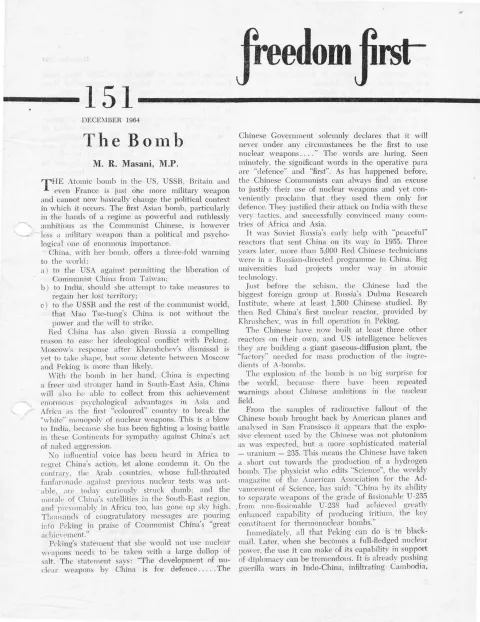
M. R. Masani’s editorial argues that China’s atomic bomb is chiefly a political and psychological weapon rather than an immediate military one, intended to warn the US, India, and the USSR of Chinese power. He surveys India’s three options — doing nothing, building its own bomb, or seeking mutual security with the United States — and rejects an independent Indian deterrent as prohibitively expensive and strategically inadequate against China’s geographic and numerical advantages. Masani concludes that only the American nuclear umbrella offers India a credible and affordable deterrent, and urges India to formalise an understanding with the U.S. for mutual security.
- China’s bomb is framed as primarily political and psychological rather than a game-changing military weapon.
- China’s test is read as a three-fold warning: to the US against Taiwan’s liberation, to India against reclaiming lost territory, and to the USSR about China’s independent power.
- India is said to have three alternatives: do nothing, build its own bomb, or seek mutual security with the US.
- An independent Indian nuclear programme is judged unaffordable and strategically insufficient, requiring roughly ten-to-one superiority to deter China.
- Reliance on Soviet protection is dismissed as folly given Russo-Chinese common cause against the West.
- The US nuclear umbrella is presented as the only credible and already-proven deterrent protecting weak nations, and India is urged to seek a formal mutual-security understanding with Washington.
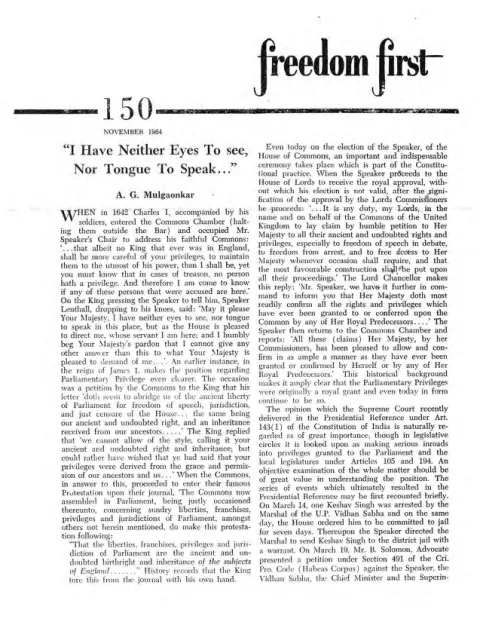
”If Power Without Law May Make Laws What Subject Can Be Sure Of His Life…” Charles I At His Trial
By A. G. Mulgaonkar
This piece analyses the Supreme Court of India’s advisory opinion (with Justice Sarkar dissenting), read out by Chief Justice Gajendragadkar, on the privilege dispute between the U.P. Vidhan Sabha and the Allahabad High Court judges at Lucknow (the Keshav Singh case). The Court held that legislative sovereignty in India, unlike in Britain, is subordinate to the written Constitution, that fundamental rights under Part III bind the legislature, and that the High Courts’ jurisdiction under Articles 226 and 32 cannot be ousted by a claim of parliamentary privilege. The author, invoking Charles I’s remark at his trial, argues that superior courts must retain jurisdiction over legislative privilege disputes to prevent constitutional deadlock, criticises the U.P. Vidhan Sabha’s failure to follow proper habeas corpus procedure against the Lucknow Bench judges, and calls for Article 194(3) to be amended so that legislative powers and privileges are clearly and precisely defined rather than left to analogy with the House of Commons.
- The Supreme Court’s advisory opinion held Indian legislatures’ sovereignty is subject to the Constitution, unlike the British Parliament’s.
- Fundamental rights under Part III of the Constitution bind legislative action, and courts can strike down legislative acts that violate them.
- The High Courts’ power under Article 226 and citizens’ guaranteed right under Article 32 cannot be excluded even against action by a legislature.
- The U.P. Vidhan Sabha’s issuing of warrants against Lucknow Bench judges is criticised for not following the established procedure the House of Commons itself observes before acting in matters of privilege.
- Historical English precedents (Shaftsbury’s case, 1676-80; Sherley v. Fagg) are cited to show that even the British Parliament’s claims to unchecked privilege have been contested and reversed.
- The author calls for legislative powers and privileges under Article 194(3) to be defined precisely by law rather than left vague by reference to House of Commons practice, to prevent future constitutional deadlock.
Obscenity: Literature & Law (III)
By N. S. Ranganath Rao
In the third installment of his series on obscenity law, N. S. Ranganath Rao proposes a detailed rewrite of Section 292 of the Indian Penal Code, including a new definition of obscenity based on whether an object’s effect, taken as a whole, tends to deprave and corrupt, exceptions for religious and bona fide literary/scientific/artistic material, and admission of expert evidence on literary merit. He then turns to enforcement, criticising the current ad hoc, non-binding advisory panel system used by Customs and arguing that quite a lot of genuinely obscene material circulates commercially while serious literature is wrongly targeted. He recommends replacing the informal panel with statutory Regional Boards of experts in law, literature, medicine, and psychology, whose opinion would be binding, covering both Customs import controls and the Indian Post Offices Act’s provisions on obscene mail, and suggests introducing an in rem civil proceeding against a suspect book/work (modelled on a proposal by University of Minnesota Law School professors, adopted in parts of the U.S.) as an alternative to criminal prosecution.
- Proposes a new statutory definition of obscenity in Section 292 IPC based on whether the material, taken as a whole, tends to deprave and corrupt likely readers/viewers.
- Recommends exceptions for religious use and for bona fide scientific, literary, or artistic material, with admissible expert evidence on literary merit.
- Criticises the existing informal, non-binding advisory panel used by Customs to vet suspect imported books as inconsistent and lacking real consultation.
- Proposes replacing the panel with statutory Regional Boards (in centres like Bombay, Madras, Calcutta) with binding authority over both Customs and postal (Indian Post Offices Act) enforcement.
- Recommends introducing civil in rem proceedings against a suspect book or work, citing a proposal by University of Minnesota Law School professors adopted in some U.S. states, as an alternative to criminal prosecution of authors/publishers.
- Notes the paradox that serious literature is often prosecuted for notoriety while indigenous and imported pornographic material circulates with little enforcement.
Press Council
This report summarises a seminar on the proposed Press Council Bill held by the Indian Committee for Cultural Freedom on October 19-20, 1964, chaired by Professor N. S. Ranganath Rao. Participants compared the statutory Indian bill unfavourably with Britain’s voluntary Press Council, debated whether non-journalists should sit on the Council, and worried the bill could be used to curb press freedom rather than protect it against government encroachment; a detailed set of clause-by-clause amendments to the 1963 Press Council Bill is reproduced. The report also carries a dissenting letter from S. Natarajan, who argues that no Press Council or external machinery can safeguard press freedom because that responsibility is internal to the profession and rests with individual editors, and who criticises the proposed Council’s emphasis on ‘propriety, decency and decorum’ as an unworkable and paternalistic standard.
- Seminar organised by the Indian Committee for Cultural Freedom, chaired by Professor N. S. Ranganath Rao, on the Press Council Bill.
- Comparisons drawn with the voluntary British Press Council versus the statutory character of the Indian bill.
- Detailed clause-by-clause amendments proposed to the Press Council Bill, 1963, covering composition, term of office, objects, functions, and powers of the Council.
- Some participants favoured a Press Advisory Council with limited, non-judicial powers rather than a body with quasi-judicial or penal authority.
- S. Natarajan’s dissenting letter argues press freedom is an internal professional responsibility of editors, not something external machinery like a Press Council can secure.
- Natarajan criticises reliance on vague standards like ‘propriety, decency and decorum’ as unworkable and warns that non-journalist members risk being co-opted as ‘safe men’ who strengthen political and commercial pressure on the press.
Letter to the Editor
By M. R. Masani
A reader’s letter to the editor defends A. G. Noorani’s book “The Kashmir Question” against what the writer considers an ungenerous review in Freedom First’s November issue, citing a favourable Observer (London) editorial on the book’s argument that Kashmir’s accession to India, while legally valid, was not necessarily final and irrevocable, and that a settlement might involve making the Kashmir Valley and Azad Kashmir a neutral, autonomous zone. The writer also objects to the earlier review’s description of Jayaprakash Narayan as ‘eccentric’ for holding similar views on Kashmir, comparing such labelling unfavourably to how anti-imperialists and independence advocates elsewhere have historically been dismissed, and notes that V. B. Karnik’s introduction to the book went unmentioned in the review despite Karnik’s long editorial association with the journal.
- Reader disputes Freedom First’s November review of A. G. Noorani’s “The Kashmir Question” as insufficiently appreciative.
- Cites a favourable Observer (London) editorial (27 September) summarising Noorani’s argument that Kashmir’s accession, though legally valid, was not final, and proposing a neutral autonomous status for the Valley and Azad Kashmir.
- Objects to the prior review’s characterisation of Jayaprakash Narayan as ‘eccentric’ for favouring a negotiated Kashmir settlement.
- Draws a comparison to how anti-imperialists (opponents of British rule in India, Algerian independence advocates, opponents of Portuguese rule in Goa) have historically been dismissed as eccentrics.
- Notes that V. B. Karnik’s 12-page introduction to the book was not mentioned in the journal’s review, despite Karnik’s long association as an editor of the journal.
With Many Voices
“With Many Voices” is the issue’s recurring column of press quotations, epigraphed with Tennyson’s Ulysses, gathering short quoted remarks from world leaders and commentators (Marshal Chen Yi, Kosygin/Brezhnev coverage, a US State Department official, Fidel Castro, Lal Bahadur Shastri, D. N. Aidit, Elspeth Huxley, and others) on topics including China’s bomb, Soviet politics, socialism, Kashmir, and development planning. The column includes two quotations from M. R. Masani himself (on the Fourth Plan and, in a closing signed note, defending Freedom First’s willingness to risk ‘temporary unpopularity’ in advocating Kashmiri self-determination and expressing regret that V. B. Karnik’s introduction to the Noorani book went unremarked in the journal he long edited).
- Recurring quotations column epigraphed with lines from Tennyson’s ‘Ulysses.’
- Includes remarks from Marshal Chen Yi on China’s bomb, a US State Department official, Fidel Castro on capitalism versus socialism, and Lal Bahadur Shastri on socialism and uniformity.
- Quotes M. R. Masani (from Free Press Journal, 3 November) warning the Fourth Plan risks being as great a danger to India as the Chinese atomic explosion.
- Closing signed note from Masani defends the journal’s stance on Kashmiri self-determination even at the cost of ‘temporary unpopularity’ and regrets that V. B. Karnik’s introduction to the Noorani book was not mentioned in the review.
Generated by the v1.5 extraction pipeline. Awaiting editorial review.
Metadata and summary are AI-extracted from the source PDF and reviewed for editorial accuracy. The original work is available via the Read PDF tab above (where present); paragraph-level citation inside the PDF is deferred to a future engagement.