periodical issue
Freedom First
By Adam Adil, M. D. Kini, R. Srinivasan, V. B. Karnik, V. B. Karnik, V.B.K., V.B.K., N.S.
Printed ... Bombay ... Edited and published for the Democratic Research Service, 127, Mahatma Gandhi Road, Bombay 1 · Bombay · 1968
12 pages
Freedom First
Summary
Freedom First No. 189 (February 1968) is a monthly issue of the Bombay-based liberal periodical, opening with a survey of the recent national conventions of the PSP, SSP, Bharatiya Jan Sangh, and Indian National Congress, and continuing with reports on a Poona seminar on liberalism, an essay on the Russian Revolution’s descent into totalitarianism, a review-essay on the American trade union movement, a report on the persecution of Soviet and Czechoslovak writers, a books-review section, and a closing column of quoted press excerpts under the title ‘With Many Voices.’ Contributors in this issue include Adam Adil, M. D. Kini, R. Srinivasan, and V. B. Karnik (who also reviews for the Reviews section), with the unsigned report on writers under communism and short reviews signed only with initials (V.B.K., N.S.). Its argumentative center is a defence of political and economic liberty against both communist totalitarianism and the drift toward statist planning in India, paired with running coverage of party politics and civil-liberties abuses abroad.
Key points
-
Adam Adil’s “Recent National Conventions” surveys the PSP, SSP, Jan Sangh and Congress party conventions, criticising the SSP’s withdrawal from the UP coalition cabinet as lawless and portraying the Congress Hyderabad plenary as a win for the party’s right wing that avoided self-criticism over corruption.
-
M. D. Kini’s “A Seminar On Liberalism” reports on a Poona seminar co-sponsored by the Indian Group of Liberal International, summarising talks by B. R. Shenoy, F. A. Mehta and others on planning’s failures, and closing with M. R. Masani’s argument that free economies like Taiwan and Israel grew faster than planned economies like India.
-
R. Srinivasan’s “Liberty And Russian Revolution” traces how the Revolution’s promise of freedom gave way under Lenin to Cheka terror and under Stalin to the 1937 purge that killed or exiled 70% of the Central Committee, arguing even Khrushchev’s “welfare totalitarianism” left the underlying lack of freedom unaddressed.
-
V. B. Karnik reviews Gus Tyler’s “The Labour Revolution,” crediting its analysis of the American trade union movement’s challenges from automation and Black workers’ entry into the labour force, and its argument that unions are inherently political.
-
An unsigned report on the “Persecution Of Writers Under Communism” details the Soviet ‘literary underground’ trial sentencing Yury Galanskov to seven years’ hard labour, alongside continuing concern over Sinyavsky and Daniel and Czechoslovak novelist Ladislav Mnacko’s protest resignation from the Party.
-
The Reviews section covers A. G. Noorani’s biography of President Zakir Husain, K. P. S. Menon’s uncritically pro-Soviet Moscow ambassadorial diary, a U.S. Information Service booklet on the Peace Corps in India, and H. R. Pardiwala’s balanced pamphlet on the Shiv Sena controversy.
-
The closing “With Many Voices” column quotes Frank Moraes and other commentators from January 1968 on Communist doctrine, the Naxalbari uprising, and the Soviet writers’ trials.
Essays
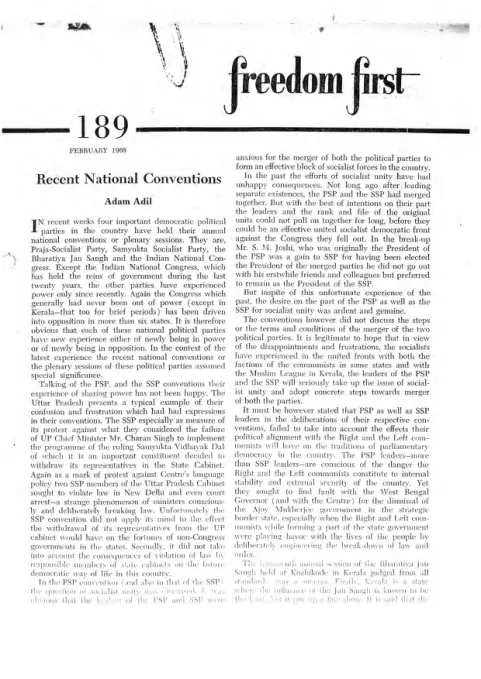
Recent National Conventions
By Adam Adil
Adam Adil surveys the annual conventions of the PSP, SSP, Bharatiya Jan Sangh, and Indian National Congress held in recent weeks, arguing each party faces a new experience of either holding or losing power for the first time in years. He criticizes the SSP’s withdrawal from the UP coalition cabinet over language policy as reckless disregard for the rule of law, notes the PSP and SSP’s shared but unresolved desire for socialist unity, credits the Jan Sangh’s Kozhikode session with a clear-cut (if debatable) foreign and economic policy platform, and portrays the Congress plenary at Hyderabad as a victory for the party’s right wing that nonetheless avoided serious self-criticism over corruption, inefficiency, and confused ‘democratic socialism’ rhetoric, while failing to address the nuclear threat posed by Communist China.
- Four major parties (PSP, SSP, Jan Sangh, Congress) held conventions in early 1968, each grappling with a new experience of power or opposition.
- The SSP’s withdrawal from the UP Samyukta Vidhayak Dal cabinet over Centre language policy is criticized as ministers ‘consciously and deliberately breaking law.’
- PSP and SSP both want socialist unity but past merger attempts (e.g., under S. M. Joshi) collapsed, and neither convention set concrete merger terms.
- The Bharatiya Jan Sangh’s Kozhikode session produced clear foreign policy (recognition of Taiwan, support for Tibet/Sinkiang/Mongolia/Pakhtoonistan independence) and economic policy (private-sector encouragement, rejection of bank nationalisation) resolutions.
- The Jan Sangh’s alliance with communists in UP and MP to keep Congress out of power is called self-contradictory given its anti-communist stance in Kerala.
- The Congress Hyderabad plenary was a win for the party’s right wing over the ‘Young Turks’ and leftists, with PM Indira Gandhi isolated from the majority of delegates.
- Congress devoted little time to eradicating corruption and inefficiency in non-Congress-turned-Congress governments, focusing instead on criticizing rival state governments.
- The Congress session is faulted for ignoring China’s growing nuclear and missile capability despite the Defence Minister’s own warnings.
A Seminar On Liberalism
By M. D. Kini
M. D. Kini reports on a seminar on ‘The role of competitive free enterprise in economic development’ held in Poona, jointly sponsored by the Indian Group of Liberal International and the Friedrich-Naumann-Stiftung Foundation. He opens with his own definition of liberalism as centring on the individual and favouring maximum freedom and free enterprise, then summarizes talks by a roster of speakers including R. Bhaskaran, B. R. Shenoy, V. K. Narasimhan, S. H. Deshpande, F. A. Mehta, Y. D. Phadke, V. B. Karnik, and Raj Krishna, on themes from planning’s failures to trade unions, food policy, and comparative Asian development. The report closes with M. R. Masani’s summation that development and democracy, or food and freedom, are not in conflict, and his tracing of Indian liberalism’s roots from Naoroji, Pherozeshah Mehta, and Ranade through Gandhiji to the 1950 Constitution, urging liberals to root their appeal in Indian tradition.
- The seminar was jointly sponsored by the Indian Group of Liberal International and the Friedrich-Naumann-Stiftung Foundation of Germany, organized by R. Bhaskaran and S. P. Aiyar.
- Prof. Bhaskaran defined liberalism as a philosophy of freedom that believes in neither total individuality nor total collectivity.
- B. R. Shenoy argued India’s planning apparatus (exchange control, import restrictions, foreign aid) crowded out public enterprise and deficit financing, and that basic industry priorities must differ by country (India’s being agriculture).
- F. A. Mehta criticized the mis-direction of India’s limited planning resources, noting only 30 of 178 Third Plan projects had proper project reports, and that 1960-65 productivity rose 26% against 55% wage growth.
- Y. D. Phadke’s comparative lecture on Thailand, Taiwan, and Malaysia’s development was criticized by the author as understating their real progress.
- V. B. Karnik traced trade unionism’s development alongside democracy, arguing free trade unions cannot exist without a free society, citing USSR and Nazi Germany as counterexamples.
- Raj Krishna presented data on India’s food production growth (54 to 89 million tons, 1951-65) and criticized use of US PL-480 grain imports for buffer stocks rather than direct consumption.
- M. R. Masani summed up that rapid economic development in Taiwan, Israel, Thailand, Malaysia, South Korea, Japan, and Pakistan versus slow growth in India, Ceylon, Egypt, Indonesia, Burma, and Communist China proves free economies grow faster, and called for liberalism to root itself in Indian tradition.
Liberty And Russian Revolution
By R. Srinivasan
R. Srinivasan, in extracts from a paper prepared for Indian Committee for Cultural Freedom seminars on the Russian Revolution, traces how the revolution’s founding promise of extending freedom to the peasantry and urban masses gave way, under Lenin, to terror, forced grain requisition, and the creation of a disciplined one-party dictatorship (the Cheka), and then under Stalin to forced collectivization, deportations, and the Great Purge of 1937 that consumed 70% of the Party Congress’s Central Committee and half the army’s elite. The piece (continued from page 6 onto page 11) closes by arguing that even post-Stalin ‘welfare totalitarianism’ under Khrushchev retains pervasive curbs on individual liberty, situates the USSR’s totalitarian trajectory against Huxley’s Brave New World and Orwell’s Nineteen Eighty-Four, and notes the enduring appeal of the Russian model to intellectuals in underdeveloped, newly independent nations including India.
- The Russian Revolution’s distinguishing feature from earlier revolutions (Roman, English 1688, French, American) was its elaborate philosophy holding that liberty is meaningless without economic opportunity.
- Lenin’s dictatorship of the proletariat depended on a disciplined, ruthless party core; the Cheka’s police apparatus (established 1917, abolished 1922, succeeded by the GPU) enforced terror against ‘enemies of the people.’
- War communism and forced grain confiscation caused a near-famine by 1920, forcing Lenin to retreat via the New Economic Policy.
- Stalin’s forced collectivization deported thousands of peasants to Siberia and built a compulsory labour force from the bourgeoisie, intellectuals, and uncooperative peasants.
- The 1937 purge killed or exiled 70% of the Central Committee members elected at the Party Congress, half the army elite, and many economist-administrators and intellectuals; industrial production growth crashed from 20% (1935) to 2% (1939).
- Khrushchev’s post-Stalin Russia is characterized as ‘welfare totalitarianism’: reduced work hours and increased consumer goods and social security, but without addressing the underlying lack of freedom.
- The author situates Soviet totalitarianism against Huxley’s Brave New World Revisited (which the USSR’s current form resembles more than Orwell’s Nineteen Eighty-Four) as still ‘not a free society.’
- Underdeveloped and newly independent nations’ intellectuals (including in India) were drawn to the Russian model as a blueprint for rapid development.
American Trade Union Movement
By V. B. Karnik
V. B. Karnik reviews Gus Tyler’s book ‘The Labour Revolution’ (subtitled ‘Trade Unions in a New America’, The Viking Press, New York, $6.50), which traces the American trade union movement’s origins and then focuses on the challenges it faces amid automation, the entry of Black workers into the labour force, industry’s shift to the South, and the growing politicization of American society. Karnik highlights Tyler’s argument that American unions are not apolitical but engage in political struggle to secure legal status, employment, and protections, and praises the book as a distinct contribution given Tyler’s dual academic and practical grounding as an official of the International Ladies Garment Workers’ Union.
- Gus Tyler’s book outlines the American trade union movement’s history before devoting its larger part to the challenges of the ‘new America.’
- Key present-day problems identified: automation, entry of Negroes into the labour force, industry’s shift to the South, and growing politicization of American society.
- Tyler argues unions are a distinct expression of the broader ‘labour movement’ that turns to politics for legal status, employment, protection against workplace hazards, and political voice.
- Tyler projects the 1975 American labour force will be bigger, younger, more feminine, better schooled, white-collar, and service-oriented.
- Tyler predicts an era of ‘political unionism’ emerging piecemeal and silently as a genuine revolution in workers’ political attitudes.
- Karnik credits Tyler’s dual qualification: academic knowledge combined with practical experience as Director of Politics and Education for the International Ladies Garment Workers’ Union.
Persecution Of Writers Under Communism
An unsigned report (continued from page 8 to page 11) details the trial and sentencing of Soviet writers Yury Galanskov, Alexander Ginsburg, Alexei Dobrovolsky, and Vera Lashkova in Moscow’s ‘literary underground’ trial, alongside continuing international concern over the earlier imprisonment of Andrei Sinyavsky and Yuli Daniel, and a parallel account of Czechoslovak novelist Ladislav Mnacko’s protest resignation of Communist Party membership and citizenship after a trip to Israel. The piece surveys the international campaign for the writers’ release led by PEN and prominent signatories including A. J. Ayer, Doris Lessing, and Graham Greene, and situates the persecution within a broader account of Soviet totalitarianism’s persistence.
- A Soviet court sentenced Yury Galanskov to seven years’ hard labour and Alexander Ginsburg to five years in the ‘literary underground’ trial; Alexei Dobrovolsky and Vera Lashkova received two years and one year respectively.
- A separate case saw four writers of the ‘Berdyayev Circle,’ arrested with 17 Leningrad students, sentenced to up to fifteen years for an alleged illegal political grouping working for foreign intelligence.
- International concern continues over Andrei Sinyavsky and Yuli Daniel, sentenced in February 1966 to seven and five years respectively; PEN and the Belgian League for the Defence of Human Rights organised a campaign for their release.
- Signatories demanding Sinyavsky and Daniel’s release include A. J. Ayer, C. V. Wedgwood, Iris Murdoch, Doris Lessing, J. B. Priestley, Rebecca West, Margharita Laski, Graham Greene, Arthur Miller, Ignazio Silone, Francois Mauriac, and Gunther Grass.
- Pavel Litvinov, grandson of former Soviet Foreign Minister Maxim Litvinov, publicised the trial of writer Vadimir Bukovsky, embarrassing the Soviet government.
- Czechoslovak novelist Ladislav Mnacko, author of the acclaimed novel ‘The Taste of Power,’ protested Czechoslovak policy on Israel and the Arab-Israel war by travelling to Israel, and was stripped of his honours, Party membership, and citizenship in punishment.
Reviews: President Zakir Husain (A. G. Noorani, Popular Prakashan)
By V. B. Karnik
The Reviews section (pages 9-10) carries four short book/pamphlet reviews. V. B. Karnik reviews A. G. Noorani’s biography ‘President Zakir Husain’ (Popular Prakashan), praising its portrait of Zakir Husain’s life and integrity while faulting its silence on the Muslim League’s rise and on Jamia Milia’s educational work, and noting a foreword by Jayaprakash Narayan. An unsigned review of K. P. S. Menon’s ‘The Lamp and the Lampstand’ (Oxford University Press) criticizes Menon’s uncritically pro-Soviet ambassadorial diary from Moscow (1952-1961) as offering nothing new, though praising its travel descriptions of Soviet Asian republics. V.B.K. reviews a U.S. Information Service booklet on the Peace Corps’ work in India since 1961, noting Communist criticism of the programme as an expansion of American influence. N.S. reviews H. R. Pardiwala’s pamphlet ‘The Shiv Sena, Why? and Why not?’ (Popular Prakashan) as a balanced, commendable statement of the pros and cons of the Shiv Sena controversy.
- V. B. Karnik’s review of A. G. Noorani’s ‘President Zakir Husain’ praises its lucid portrait of Zakir Husain but notes it omits discussion of the Muslim League’s rise and Zakirsaheb’s educational work at Jamia Milia; foreword by Jayaprakash Narayan.
- The review of K. P. S. Menon’s ‘The Lamp and the Lampstand’ (a combination of two earlier books, ‘The Flying Troika’ and ‘Russian Panorama’) criticizes Menon’s diary from his 1952-1961 Moscow ambassadorship as uncritically pro-Soviet and revealing nothing new, though his travel descriptions of Soviet Asian republics are praised.
- The Peace Corps review notes over 16,000 American volunteers working in 53 countries by end-1966, doing agricultural, social-service, and small-industry work in India including Bihar famine relief, and reports Communist criticism of the programme.
- N.S.’s review of H. R. Pardiwala’s pamphlet on the Shiv Sena calls it a needed, balanced statement of the controversy’s pros and cons.
The Lamp and the Lampstand (K. P. S. Menon, Oxford University Press)
By V.B.K.
The closing column ‘With Many Voices’ (page 12) reprints a series of short quotations from the Indian press in January 1968 on topics including Communist Party doctrine, the Naxalbari uprising, ministerial inefficiency, the SSP/Congress conflict in West Bengal, and the Soviet writers’ trials, framed by an epigraph from Tennyson. The page also carries the periodical’s subscription coupon and printing/publishing imprint identifying it as printed and edited for the Democratic Research Service, 127 Mahatma Gandhi Road, Bombay 1, registered as MH 272.
- The column collects short excerpts from Indian newspapers and public figures dated January 8-27, 1968, including March of the Nation, Indian Express, Economic Times, Manchester Guardian Weekly, Opinion, Thought, Current, and Swarajya.
- Quoted figures include Frank Moraes, Acharya Kripalani, Jo Grimond M.P., Dr. P. B. Gajendragadkar, Congress General Secretary Sadiq Ali, and MP Tarkeshwari Sinha.
- One excerpt (Observer, January 14) frames the Soviet writers’ protest (Yury Galanskov, Pavel Litvinoff) as reinforcing rather than weakening the case for East-West coexistence.
- The page carries Freedom First’s subscription form (annual subscription Rs. 3.00) addressed to the Democratic Research Service, 127 Mahatma Gandhi Road, Bombay 1.
- The imprint states the periodical is printed at Bombay and edited/published for the Democratic Research Service, Registered No. MH 272.
Generated by the v1.5 extraction pipeline. Awaiting editorial review.
Metadata and summary are AI-extracted from the source PDF and reviewed for editorial accuracy. The original work is available via the Read PDF tab above (where present); paragraph-level citation inside the PDF is deferred to a future engagement.