periodical issue
Freedom First
By M. R. Pai
Printed at Inland Printers, 55 Gandevi Road, Bombay 7 and edited and published for the Democratic Research Service by V. B. Karnik at 127 Mahatma Gandhi Road, Bombay 1. · Bombay · 1968
12 pages
Freedom First
Summary
Freedom First No. 194 (July 1968) is a monthly issue of the Bombay-based liberal journal edited and published by V. B. Karnik for the Democratic Research Service. The issue is dominated by foreign and security affairs: Kashmir’s unresolved political status following Sheikh Abdullah’s release, the risks of “dovetailing” India’s Five-Year Plans with Soviet planning, an extended report on the May 1968 French student and worker uprising against President de Gaulle, a review of President Ayub Khan’s autobiography and Pakistan’s political system, and a report on Prime Minister Indira Gandhi’s tour of Singapore, Australia, New Zealand and Malaysia. The issue closes with “With Many Voices,” a column of short quoted opinions culled from the Indian and international press on democracy, communism, and current affairs. Contributors include V. B. Karnik (writing on both Kashmir and Pakistan), M. R. Pai on Indo-Soviet economic ties, S. Narasimhan on the French crisis, and a writer using the pen name “Atreya” on Indira Gandhi’s South-East Asia tour. The volume’s throughline is a classical-liberal, anti-communist skepticism of centralized planning and of political drift toward authoritarianism, whether Soviet, Gaullist-technocratic, or homegrown.
Key points
-
V. B. Karnik’s “Sheikh Abdulla and Kashmir Problem” argues Abdullah has offered no concrete solution to Kashmir since his release, dismisses plebiscite or independence as impractical, and proposes free and fair elections under the Election Commission as a substitute.
-
M. R. Pai’s “Indo-Soviet Plan Tie-Up” warns against “dovetailing” India’s Five-Year Plans with Soviet planning, citing the loss-making Ranchi Heavy Engineering Corporation, mounting Bokaro Steel Plant costs, and Soviet pressure to buy uneconomical Tu-134 aircraft as cautionary examples.
-
S. Narasimhan’s “France In Turmoil” recounts the May 1968 Sorbonne student revolt and general strike of over ninety lakh workers, describing how de Gaulle’s dissolution of the National Assembly produced a Gaullist landslide framed as a choice against “totalitarian Communism.”
-
V. B. Karnik reviews Mohammad Ayub Khan’s autobiography “Friends Not Masters,” correcting Indian misconceptions that Ayub Khan is a military dictator or Pakistan a theocratic state, while sharply criticising his claim that Indian leaders harbour “a deep hatred for the Muslims.”
-
Writing as “Atreya,” a report on Indira Gandhi’s May 1968 tour of Singapore, Australia, New Zealand and Malaysia describes her cautious avoidance of filling the vacuum left by British defence withdrawal, and Peking Radio’s denunciation of the tour as an anti-China plot.
-
The closing “With Many Voices” column quotes M. R. Masani stating there is “too much politics in India and too little citizenship” and Nirlep Kaur’s six-step prescription for transforming India into a foodgrain exporter.
Essays
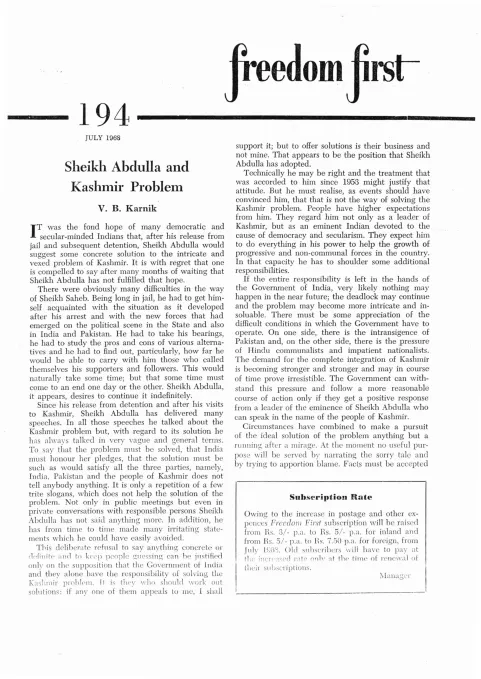
Sheikh Abdulla and Kashmir Problem
By V. B. Karnik
V. B. Karnik argues that Sheikh Abdullah, since his release from detention, has repeatedly refused to offer any concrete solution to the Kashmir problem, hiding behind vague appeals to Indian pledges while making avoidable inflammatory statements. Karnik holds that Abdullah, as a leader trusted by Kashmiris, bears a share of responsibility for breaking the deadlock and should place specific proposals before his followers and then the Government of India, rather than leaving the entire burden on New Delhi. The essay rejects a plebiscite or independence as unrealistic (achievable only through war or revolution), and instead urges free and fair elections, held under the Election Commission, as a practical substitute — while noting Abdullah’s own qualification that such elections must be seen as fair by all parties, a demand Karnik expects India and Indian public opinion to resist.
- Sheikh Abdullah has not proposed any concrete solution to Kashmir despite months of speeches since his release.
- Karnik attributes this partly to Abdullah needing time to reacquaint himself with post-arrest political realities, but says that excuse has run its course.
- A plebiscite or independence is dismissed as achievable only via war or violent revolution, and thus impractical.
- Karnik proposes Abdullah formulate concrete proposals, test them with followers, then place them before the Government of India.
- Free and fair elections (under Election Commission supervision) are floated as a possible substitute for a plebiscite, though Abdullah’s own qualifying language is expected to make the proposal unacceptable to nationalist opinion.
Indo-Soviet Plan Tie-Up
By M. R. Pai
M. R. Pai warns against the proposed “dovetailing” of India’s Five-Year Plans with Soviet economic planning, calling the move a threat to India’s national interests announced, tellingly, while Parliament was in recess. Pai contrasts the USSR’s centralized command economy with India’s professed democratic, decentralized model, and argues that tying Indian planning to Soviet planning would import distortions — citing the Bhilai over-stocking problem, the loss-making Ranchi Heavy Engineering Corporation, the Bokaro Steel Plant’s mounting costs, and Soviet pressure to buy uneconomical Tu-134 aircraft for Indian Airlines as cautionary examples. He also invokes Czechoslovakia’s economic troubles, quoting a London Times report on Czechoslovak industry being distorted for two decades by Soviet demand, as a warning of what over-reliance on Soviet economic ties can do to a national economy. Pai closes by urging that any India-Russia trade be conducted strictly on commercial terms, without ideological sentiment, and appeals to Indira Gandhi not to let India drift into economic dependency on Communist Russia as her father allegedly tried and failed to introduce communism to India “on instalment plan.”
- The Indo-Soviet plan “dovetailing” proposal was announced while Parliament was in recess, which Pai frames as evasive.
- Soviet and Indian economies are structurally incompatible: Soviet planning is centralized command, India’s is (nominally) decentralized and democratic.
- Cites Bhilai over-stocking, the loss-making Ranchi Heavy Engineering Corporation (chaired by K. D. Malaviya at Soviet insistence), and escalating Bokaro Steel Plant costs as evidence of Soviet-linked distortions.
- Reports Soviet pressure to force India’s Indian Airlines Corporation to buy the Tu-134 aircraft despite a technical committee ruling it uneconomical.
- Quotes Dana Adams Schmidt’s London Times report on Czechoslovakia to argue Soviet economic entanglement stunts and distorts partner economies over decades.
- Concludes India should trade with Russia on strict commercial terms only, without ideological sentiment, and warns against India becoming an economic satellite of Communist Russia.
France In Turmoil
By S. Narasimhan
S. Narasimhan recounts the May 1968 upheaval in France — the student revolt centered on the Sorbonne against antiquated teaching methods and administration, which escalated into a nationwide general strike by over ninety lakh workers demanding higher wages, shorter hours, and a voice in management. The essay describes President de Gaulle’s initial disorientation, his decision (after securing army backing) to dissolve the National Assembly and call fresh elections rather than hold a referendum, and his framing of the crisis as a choice between himself and “totalitarian Communism.” Narasimhan credits de Gaulle’s decisive turn for the Gaullist landslide in the first round of the June 23 elections (148 of 160 seats decided outright), while quoting Time and U.S. News and World Report analyses that portray France as economically fragile beneath de Gaulle’s decade of stability — high unemployment, an unfavourable trade balance, low wages, and bureaucratic inefficiency. The piece stresses that neither the student revolt (anarchist in temperament, inspired by Che Guevara, Mao and Reginald Debray rather than Marx or Lenin) nor the workers’ strikes were instigated or controlled by the Communist Party, which arrived late and sought only a negotiated settlement.
- The May 1968 crisis began as a Sorbonne student protest over teaching methods and administration, escalating into pitched battles with police.
- The revolt spread into a general strike of over 90 lakh workers demanding higher wages, a 40-hour week without loss of pay, and greater voice in management.
- De Gaulle, initially shaken and reportedly considering resignation, secured army support, dissolved the National Assembly, and called elections for June 23 and 30 rather than holding the referendum he had floated.
- Gaullists won 148 of 160 seats decided in the first round (June 23), which Narasimhan attributes to French voters choosing stability over ‘totalitarian Communism’ as framed by the Gaullist campaign.
- The Communist Party (CGT) is described as arriving after the strikes began and pushing for settlement, not revolution; workers rejected a negotiated agreement and continued striking regardless of union leadership.
- Student leaders and ideology are described as anarchist in dominant trend, inspired by Che Guevara, Mao Zedong and Reginald Debray rather than Marx or Lenin.
- Quoted U.S. News and World Report analysis describes France as economically fragile under the surface: high unemployment, wage stagnation, inflation, and bureaucratic inefficiency in industry, education and agriculture.
India’s New Look At South-East Asia
By “Atreya”
V. B. Karnik reviews Mohammad Ayub Khan’s autobiography, Friends Not Masters, to correct what he calls Indian misconceptions about the Pakistani President — namely, that Ayub Khan is a military dictator and that Pakistan is a theocratic state. Karnik notes Ayub Khan was elected President in 1960 and re-elected in 1965 against Fatima Jinnah in a contest widely agreed to have been free and fair, and describes Pakistan’s system of “basic democracy” (80,000 local councils electing upward to the National Assembly and Presidency) as Ayub Khan’s alternative to parliamentary democracy, which he argues is unsuited to a country with powerful landlords, religious pirs and faqirs, fragmented parties, and low literacy. Karnik also highlights Ayub Khan’s clash with Ulema religious leaders who regarded Pakistan as insufficiently Islamic, and his self-presentation as a moderate reformer who avoided force and terror during the 1958 revolution. The essay then turns sharply critical of Ayub Khan’s views on India, quoting his charge that Indian leaders harbor a “deep hatred for the Muslims” and seek to dominate or absorb Pakistan — a portrayal Karnik calls false and distorted, while acknowledging that equally distorted Indian views of Pakistan present a comparable psychological barrier to improved relations.
- Corrects the common Indian belief that Ayub Khan is Pakistan’s military dictator, noting his 1960 election and 1965 re-election (63.31% vs Fatima Jinnah’s 36.36%) were free and fair.
- Describes Pakistan’s ‘basic democracy’ system of 80,000 local councils electing upward to the National Assembly and Presidency, as Ayub Khan’s substitute for parliamentary democracy.
- Ayub Khan’s stated reasons for abandoning parliamentary democracy: powerful landlords, religious pirs/faqirs who influence votes, fragmented parties without programmes, and low literacy.
- Corrects the misconception that Pakistan is a theocratic state; Ulema religious leaders in fact opposed Ayub Khan as insufficiently Islamic.
- Quotes Ayub Khan’s autobiography describing his approach to the 1958 revolution as deliberately avoiding force and political vendetta.
- Sharply criticizes Ayub Khan’s views on India as false and distorted — his claim that Indian leaders have ‘a deep hatred for the Muslims’ and seek to dominate Pakistan — while noting Indian views of Pakistan are equally distorted, creating a psychological barrier to better relations.
President Ayub And Pakistan
By V. B. Karnik
Writing under the pen name “Atreya,” the author reports on Prime Minister Indira Gandhi’s May 1968 tour of Singapore, Australia, New Zealand and Malaysia, undertaken after the Budget session as Britain’s defence withdrawal from South-East Asia loomed. In Singapore, Lee Kuan Yew sought Indian support while carefully avoiding open alignment against Communist China given Singapore’s demographics and improving US ties. Gandhi was consistently cautious in public statements, avoiding any impression that India sought to fill the vacuum left by British withdrawal, and argued that South-East Asian security rested on internal strength, economic development and ‘true’ nationalism rather than collective security arrangements — though she conceded India might help a country like Malaysia if asked. Indian diplomats in the region separately pressed for a more dynamic Indian policy, citing roughly 2 million Indians resident in Burma, Malaysia and Singapore. The essay characterizes the tour as India’s first serious, pragmatic engagement with South-East Asia and a step toward a genuinely independent foreign policy beyond ‘big power chauvinism,’ while noting Peking Radio’s hostile reaction accusing Gandhi of assembling an anti-China bloc under US and Soviet direction.
- Indira Gandhi’s May 1968 tour covered Singapore, Australia, New Zealand and Malaysia following the Budget session, amid British withdrawal from South-East Asian defence commitments.
- Lee Kuan Yew sought Indian support but avoided direct opposition to Communist China given Singapore’s Chinese population and his own ethnicity; Singapore had also improved ties with the US and allowed Bank of China operations.
- Gandhi was notably cautious in all four countries, avoiding any suggestion India sought to expand influence into the vacuum from British withdrawal, and stressed internal strength and economic development over collective security.
- India’s diplomats posted in the region pressed Gandhi for a more dynamic policy toward South-East Asia, citing roughly 2 million resident Indians in Burma, Malaysia and Singapore.
- Gandhi’s post-tour statement in New Delhi emphasized countries in the region ‘standing together’ economically rather than forming military blocs.
- Peking Radio denounced the tour as an attempt to build an anti-China clique at the bidding of ‘US Imperialists and Soviet revisionists,’ calling Gandhi’s ambition ‘just a day dream.’
- The essay frames the tour as India’s first pragmatic, semi-independent foreign-policy initiative in the region, marking greater maturity beyond non-alignment shibboleths.
With Many Voices
“With Many Voices” is the issue’s closing miscellany column, gathering brief quoted opinions from Indian and international newspapers and public figures in June 1968 on topics ranging from Kerala’s Communist ministry and caste pressure groups to US political violence and Naxalite defections from the Communist Party in West Bengal. The column includes M. R. Masani’s remark (Times of India) that there is ‘too much politics in India and too little citizenship,’ Nirlep Kaur’s six-step prescription for transforming India from food importer to exporter, and C. Rajagopalachari’s ironic comment on privy purses. It is framed by an epigraph from Tennyson.
- A compilation of short quotations from named commentators (Kingsley Martin, C. Achuta Menon, M. R. Masani, Sham Lal, C. Rajagopalachari, P. Spratt, Karan Singh, Nirlep Kaur, and others) drawn from June 1968 press sources.
- Topics include the record of Kerala’s EMS Communist ministry, caste pressure groups, US gun culture after Dallas/Memphis/Los Angeles, privy purses for former ruling princes, and Naxalite defections from the CPI in West Bengal.
- M. R. Masani is quoted from the Times of India (June 22) stating there is ‘too much politics in India and too little citizenship.’
- Nirlep Kaur, M.P., outlines six steps (water, electricity, seeds, fertilizers, pesticides, incentive prices) to transform India into a foodgrain exporter.
- The column is prefaced with an epigraph from Tennyson (‘The deep / Moans round with many voices…’).
Generated by the v1.5 extraction pipeline. Awaiting editorial review.
Metadata and summary are AI-extracted from the source PDF and reviewed for editorial accuracy. The original work is available via the Read PDF tab above (where present); paragraph-level citation inside the PDF is deferred to a future engagement.